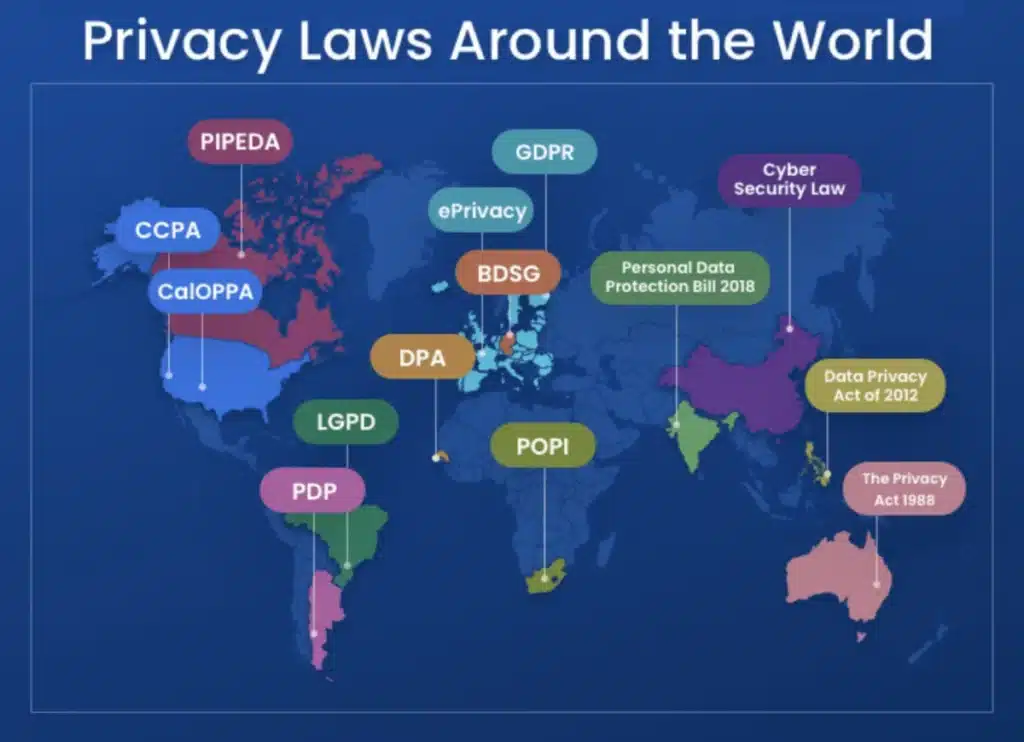
Privacy and data protection have become central concerns for governments, businesses, and individuals worldwide. As digital transformation accelerates and data-driven technologies evolve, regulators are responding with stricter and more complex legal frameworks. In 2025, organizations must navigate a growing web of global privacy and data protectionlaws that govern how personal data is collected, processed, stored, and shared.
This definitive guide provides a clear, up-to-date overview of key regulations, compliance obligations, and emerging trends across the globe, from GDPR in Europe to CCPA in California, DPDP Act in India, and beyond, helping you understand your rights and compliance responsibilities.
Why Data Privacy Matters More Than Ever
Data has become the most valuable asset in the digital economy. Every time you browse a website, make a purchase, use social media, or interact with online services, you generate personal data. This information includes your name, address, browsing habits, financial details, health records, and even your location history.
The problem is that this data has become a target. Matomo reports that:
“With over 400 million internet users in Europe and 331 million in the US (11% of which reside in California alone), understanding the nuances of privacylaws like GDPR and CCPA is crucial for compliant and ethical consumer data collection.”
Companies collect massive amounts of personal data because it helps them understand customers, improve services, and increase profits. However, when this data falls into the wrong hands through breaches or misuse, the consequences can be devastating, including identity theft, financial fraud, reputational damage, and loss of personal privacy.
Privacylaws have emerged as the legal framework protecting individuals’ rights to control their personal information. These laws establish clear rules about what data companies can collect, how they must protect it, and what rights individuals have regarding their information.
“seven years of GDPR have reshaped how we think about privacy, not just in Europe, but around the world… GDPR sparked a global movement towards privacy-preserving data practices.”
Today, more than 170 countries have enacted data privacy regulations, creating a complex global landscape businesses must navigate.
Understanding the major privacy frameworks across different regions helps you know which laws apply to your situation.
European Union: GDPR – The Global Standard
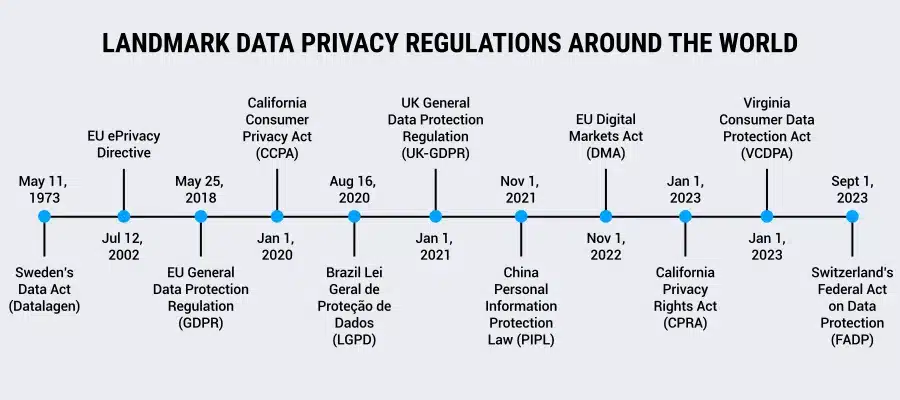
The General Data Protection Regulation (GDPR) is the world’s most comprehensive and influential privacy law. Enforced since May 2018, it applies to any organization processing personal data of EU residents, regardless of where that organization is located.
Lawful Basis: Organizations must have a valid legal reason to process personal data, such as consent, contractual necessity, legal obligation, vital interests, public task, or legitimate interests.
“organizations should collect only the data necessary for their stated purposes and retain it no longer than needed.”
Transparency: Companies must clearly inform individuals about what data is collected, why it’s collected, and how it will be used.
Security: Appropriate technical and organizational measures must protect personal data from unauthorized access, loss, or destruction.
Individual Rights: GDPR grants extensive rights including access, rectification, erasure (“right to be forgotten”), data portability, restriction of processing, and objection to processing.
Penalties: Non-compliance can result in fines up to €20 million or 4% of global annual revenue, whichever is higher. Matomo reports that:
“The GDPR has resulted in 2,248 fines totaling almost €6.6 billion since 2018, with Meta receiving a €1.2 billion fine in May 2023—the largest ever.”
ePrivacy Regulation: The proposed ePrivacy Regulation will complement GDPR by specifically addressing electronic communications, cookies, and tracking technologies. While still under development, it will strengthen consent requirements for cookies and online tracking.
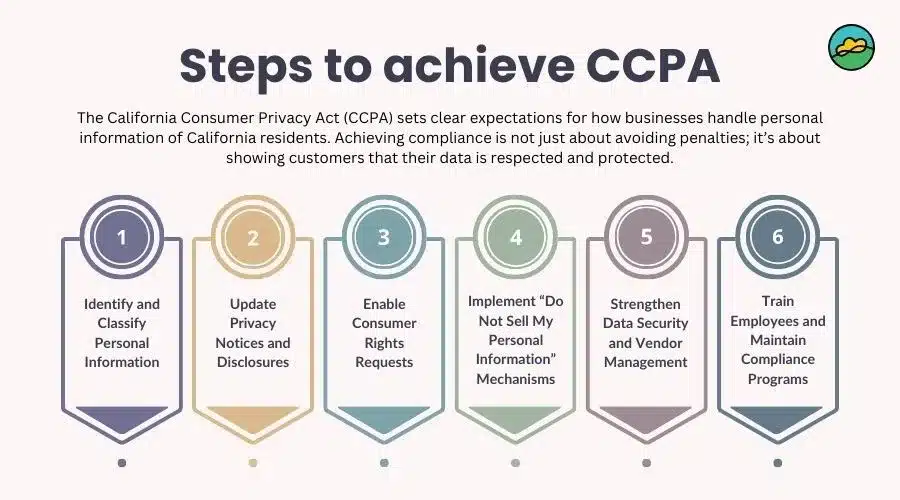
California leads US privacy protection. The CCPA, effective January 2020, and its enhancement the CPRA, effective January 2023, apply to for-profit businesses doing business in California that meet specific thresholds.
The Health Insurance Portability and Accountability (HIPAA) Act protect patient health information. Healthcare providers, health plans, and their business associates must implement privacy and security safeguards for Protected Health Information (PHI).
The Children’s Online Privacy Protection (COPPA) Act requires websites and online services directed at children under 13 to obtain verifiable parental consent before collecting personal information from children.
“eight new state privacylaws will take effect in 2025, bringing the total to 21 states with comprehensive privacylegislation.”
States including Virginia, Colorado, Connecticut, Utah, and others have enacted privacylaws with similar consumer rights but subtle variations in scope and enforcement.
Following Brexit, the UK implemented UK-GDPR, which mirrors the EUGDPR with minor modifications. Usercentrics explainsthat:
“the UK-GDPR took effect on January 1, 2021 following Brexit to ensure there was no gap in data protection after the EUGDPR ceased to apply in the UK.”
UK-GDPR works alongside the Data Protection Act 2018 and Privacy and Electronic Communications Regulations to form the UK’s comprehensive data protectionframework. The Information Commissioner’s Office (ICO) enforces these regulations with penalties similar to GDPR—up to £17.5 million or 4% of global annual turnover.
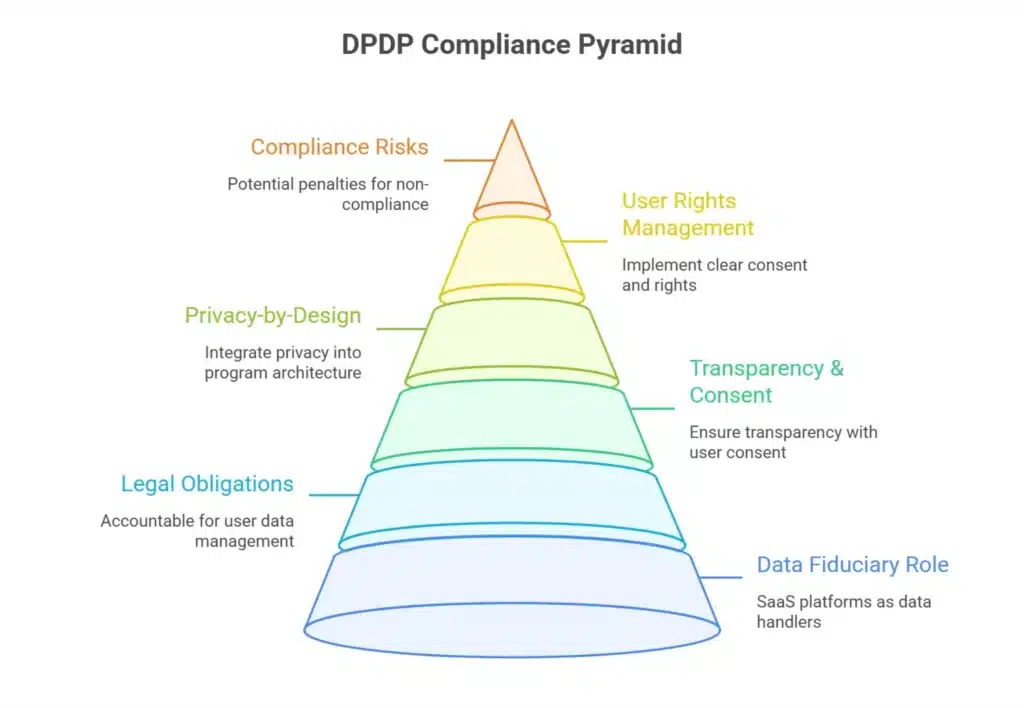
India: Digital Personal Data Protection Act (DPDP Act) 2023
“while the law outlines the rights of data principals, obligations of data fiduciaries, and penalties for data breaches, implementation will occur in phases throughout 2025.”
“unlike GDPR, DPDPA-2023 does not distinguish between personal and sensitive personal data but requires clear, affirmative consent for most processing.”
Data Principal Rights: Individuals have rights to access their data, correct inaccuracies, erase data, and file grievances. However, unlike GDPR, the DPDP Act does not include a data portability requirement.
Data Fiduciary Obligations: Organizations must provide clear notice before collecting data, implement security measures, and enable easy consent withdrawal.
Significant Data Fiduciaries (SDFs): Large-scale data processors face enhanced requirements including appointing a Data Protection Officer in India, conducting annual Data Protection Impact Assessments, and undergoing independent audits.
Cross-Border Transfers: The act allows personal data transfers to any country unless specifically restricted by the government, providing more flexibility than GDPR’s transfer restrictions.
Brazil: Lei Geral de Proteção de Dados (LGPD)
Brazil’s LGPD, effective since 2020, closely mirrors GDPR in structure and requirements. ComplianceHub explains that:
LGPD applies to organizations processing data in Brazil or targeting Brazilian residents through localized services with no minimum revenue threshold.”
The Brazilian National Data Protection Authority (ANPD) oversees enforcement. In Q1 2025, the ANPD issued $12 million in fines for improper biometric data handling, demonstrating active enforcement.
South Africa: Protection of Personal Information Act (POPIA)
POPIA governs personal information processing in South Africa, requiring organizations to implement appropriate security safeguards and respect individual rights including access, correction, and deletion. The Information Regulator enforces POPIA with substantial penalties for violations.
United Arab Emirates: Personal Data Protection Law (PDPL)
The UAE’s federal PDPL establishes comprehensive data protection requirements for the private sector, including consent requirements, individual rights, and cross-border transfer restrictions. The law aligns broadly with international standards while addressing regional priorities.
Data Subject Rights: Your Power Over Personal Information
Privacylaws grant individuals significant rights over their personal data. Understanding these rights helps you control your information.
Right to Access
You have the right to know what personal data organizations hold about you. Companies must provide copies of your data in a clear, understandable format, usually within 30 days of your request.
Right to Rectification
If your personal information is inaccurate or incomplete, you can request corrections. Organizations must update your data promptly to ensure accuracy.
Right to Erasure (“Right to be Forgotten”)
In certain circumstances, you can request deletion of your personal data. This applies when data is no longer necessary for its original purpose, you withdraw consent, you object to processing, or data was unlawfully processed.
Right to Data Portability
GDPR grants you the right to receive your personal data in a structured, commonly used, machine-readable format and transfer it to another organization. This promotes competition and prevents vendor lock-in.
Right to Restrict Processing
You can request that organizations limit how they use your data, such as when you contest data accuracy or when processing is unlawful but you don’t want deletion.
Right to Object
You can object to processing based on legitimate interests, direct marketing, or research purposes. Organizations must stop unless they demonstrate compelling legitimate grounds.
Right to Opt-Out
US privacylaws emphasize opt-out rights, particularly for sale of personal information. California’s “Do Not Sell My Personal Information” requirement exemplifies this approach.
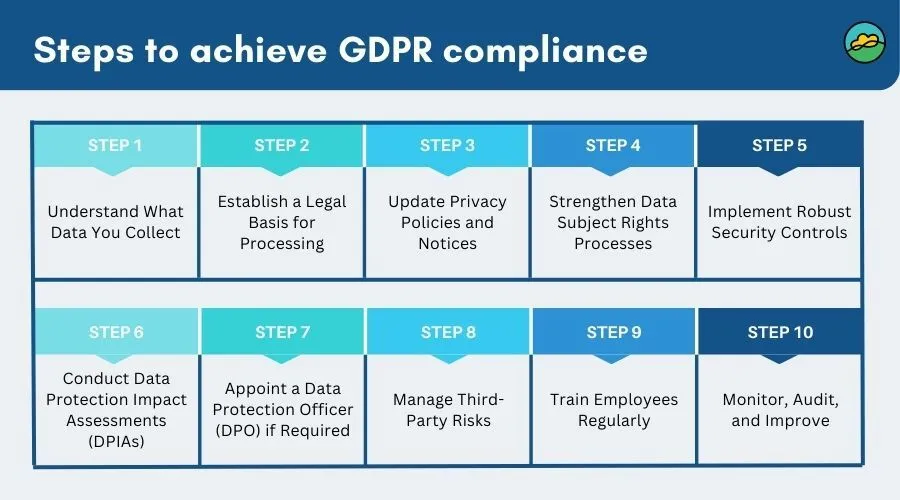
Corporate Responsibilities & Compliance Steps
Organizations handling personal data face extensive compliance obligations under privacylaws.
“businesses must understand the type of personal data being collected and how it is processed. Data mapping should be the first step to identify what kind of data may be subject to potential regulatory oversight.”
Identify:
Data types collected (personal, sensitive, payment)
Establish processes to handle individual rights requests within legal timeframes, typically 30 days under GDPR, 45 days under CCPA. ComplianceHub recommends deploying:
“consent management platforms supporting all three frameworks and automating DSAR responses to meet tightening deadlines.”
“CCPA requires opt-outs for AI profiling affecting credit/employment decisions.”
Biometric Data Protections
Biometric data including facial recognition, fingerprints, and voice patterns receives heightened protection. The ANPD’s $12 million in fines for improper biometric handling in Q1 2025 demonstrates enforcement priorities.
Cross-Border Data Transfers
International data transfers face increasing scrutiny. GDPR’s transfer mechanisms (adequacy decisions, standard contractual clauses, binding corporate rules) set the standard, with other jurisdictions implementing similar frameworks.
Children’s Privacy
Enhanced protections for children’s data continue expanding. India’s DPDP Act requires parental consent for processing data of children under 16, while COPPA protects US children under 13.
Privacy by Design
Organizations increasingly adopt “privacy by design” approaches, integrating privacy considerations into product development from the outset rather than retrofitting compliance later. PDTN explains that:
“This proactive strategy helps ensure compliance with multiple frameworks and reduces the need for costly retrofitting.”
Unified Global Standards
While complete harmonization seems unlikely, core principles around consent, transparency, individual rights, and security are converging globally. Organizations benefiting from unified approaches that address multiple regulations simultaneously.
Conclusion
Privacy and data protectionlaws have transformed from niche concerns into fundamental business requirements affecting every organization handling personal information. With over 170 countries enacting privacy regulations and enforcement intensifying globally, compliance is no longer optional.
The key to success is treating privacy not as a compliance burden but as a competitive advantage. Didomi’s CEO Romain Gauthier notes that seven years of GDPR have reshaped how we think about privacy, not just in Europe, but around the world. Organizations embracing privacy build customer trust, avoid costly penalties, and position themselves for long-term success.
Start by understanding which laws apply to your organization, implement robust data governance practices, respect individual rights, and maintain ongoing compliance programs. Privacy is a journey, not a destination—stay informed, adapt to changes, and commit to responsible data stewardship.
Glossary
Consent: Freely given, specific, informed agreement to process personal data
Data Controller: Entity determining purposes and means of processing personal data
Data Processor: Entity processing data on behalf of a controller
Data Subject: Individual to whom personal data relates
Personal Data: Any information relating to an identified or identifiable person
Processing: Any operation performed on personal data (collection, storage, use, deletion)
Pseudonymization: Processing data so it can’t be attributed to a person without additional information
Sensitive Data: Special categories requiring extra protection (health, biometric, racial/ethnic data)
GDPR is more comprehensive, applying to all EU residents’ data regardless of where processing occurs. CCPA is California-specific, focusing on transparency and consumer rights like opt-out rather than consent-first approaches. GDPR penalties are significantly higher—up to €20 million vs. CCPA’s $7,988 per violation.
Yes, most privacylaws apply regardless of company size if you handle personal data. However, some laws have thresholds—CCPA requires $25 million revenue, 100,000+ consumers, or 50%+ revenue from data sales. Always verify specific law requirements.
PDTN advises implementing a unified privacyframework addressing the strictest requirements across all applicable laws. This “highest common denominator” approach ensures compliance everywhere you operate.
Penalties vary significantly: GDPR up to €20 million or 4% global revenue; CCPA/CPRA up to $7,988 per violation; India’s DPDP Act up to ₹250 crore; LGPD significant administrative sanctions. Beyond fines, expect reputational damage and customer loss.
Do I need to comply with GDPR if I’m not in Europe?
Yes, if you process EU residents’ data.PDTN reports that a hospital in Mumbai faces €200,000 in GDPR fines despite being located outside EU borders—a stark reminder that today’s data protectionlaws transcend geographical boundaries.
What were once treated as separate legal domains are now deeply interconnected. IP protection increasingly depends on cybersecuritycompliance, while cybersecurity failures often result in intellectual property loss, regulatory scrutiny, and legal liability. This article provides a clear, global analysis of how IP and cybersecurity laws are evolving, where regulatory approaches diverge, and what these shifts mean for businesses, policymakers, and the future of the digital economy
Intellectual property in the digital realm encompasses creative works, inventions, brands, and proprietary information stored, transmitted, or distributed through digital channels. The fundamental challenge is that digital IP can be copied perfectly and distributed globally in seconds a reality that traditional IP laws written for physical goods never anticipated.
“Criminalizes production and dissemination of technology, devices, or services intended to circumvent measures that control access to copyrighted works (commonly known as digital rights management or DRM).”
This anti-circumvention provision represents a significant evolution in IP protection for the digital age. The digital transformation has created new IP challenges:
Easy Replication: Digital files can be copied infinitely without quality loss
Global Distribution: Content shared online reaches worldwide audiences instantly
Anonymity: Online infringers can hide identities and locations
Speed: Piracy occurs at unprecedented velocity
Scale: Single actors can infringe millions of copyrights simultaneously
These challenges require legal frameworks that balance rightsholder protection with technological innovation and public access to information.
Core IP Categories and Online Challenges
Copyright and Digital Content
Copyright protects original creative works fixed in tangible form books, music, movies, software, and digital art.
“Under the TRIPS Agreement, copyright terms must extend at least 50 years, establishing minimum global protection standards.”
Online challenges include streaming piracy, unauthorized downloads, content aggregation sites, and deepfaketechnology creating derivative works. Social media platforms face constant battles with users uploading copyrighted content without permission.
Trademarks and Brand Protection
Trademarks identify goods and services sources, building brand recognition and consumer trust. Online trademark challenges include:
Cybersquatting (registering domain names with trademarked terms)
Counterfeit goods sold through e-commerce platforms
Search engine advertising using competitor trademarks
Typosquatting (similar domains exploiting typos)
Patents and Trade Secrets
Patents protect inventions, granting exclusive rights for typically 20 years. Trade secrets encompass confidential business information like formulas, processes, and strategies.
“Trade secrets as a form of intellectual property… obliging members to protect confidential business information from unauthorized disclosure or acquisition.”
Industrial designs protect ornamental or aesthetic aspects of products. In the digital realm, this includes user interfaces, website layouts, and digital product appearances. Cybersecurity concerns involve design theft, unauthorized reproduction, and reverse engineering of protected designs.
Economic dependence on digital assets has made IP protection and cybersecurity matters of national policy.
As a result, lawmakers are strengthening enforcement mechanisms and expanding compliance obligations across sectors.
How Intellectual Property Laws Are Evolving Globally
Expansion of Digital IP Protections
In 2025, IP laws have been increasingly focused on digital-first assets. Governments are clarifying protections for software, databases, AI-assisted creations, and proprietary algorithms. Trade secret laws are also being reinforced to address data exfiltration and insider threats, which often occur through cyber intrusions rather than traditional corporate espionage. Online copyrightenforcement has also expanded, with greater scrutiny on digital platforms that host or distribute protected content.
Enforcement Challenges in the Digital Economy
Despite stronger laws, enforcement remains complex. Cross-border infringement, anonymous actors, and jurisdictional limits make IP violations difficult to prosecute. Policymakers are increasingly debating platform liability, notice-and-takedown standards, and the balance between innovation and rights enforcement.
Mandatory Security and Breach Reporting
Many jurisdictions now require organizations to adopt minimum security standards and report cyber incidents within defined timeframes. These obligations are designed to improve transparency, reduce systemic risk, and protect users whose data or digital assets may be compromised. Failure to comply can result in significant fines, operational restrictions, or legal exposure.
Protection of Critical Digital Infrastructure
Cybersecurity regulation increasingly prioritizes sectors considered essential to national stability, including finance, healthcare, telecommunications, and energy. Supply-chain security requirements are also expanding, placing responsibility on organizations to assess and manage third-party risks.
Key International IP Frameworks
World Intellectual Property Organization (WIPO)
WIPO, established in 1967, administers international IP treaties and promotes IP protection globally.WIPO, a specialized United Nations agency with 193 member states, administers international IP treaties and promotes IP protection globally. WIPO provides services including international patent and trademark filing systems, dispute resolution for domain names, and technical assistance to developing countries.
“Promoting effective and balanced IP enforcement that respects due process and fundamental freedoms.”
Key WIPO treaties include:
Paris Convention for the Protection of Industrial Property(1883) covers patents, trademarks, and industrial designs across 177 countries. It establishes national treatment requiring countries to grant foreign nationals the same IP protection as their own citizens.
Berne Convention for the Protection of Literary and Artistic Works(1886) protect copyrights internationally across 181 countries. Works created in one member country receive automatic protection in all other member countries without registration requirements.
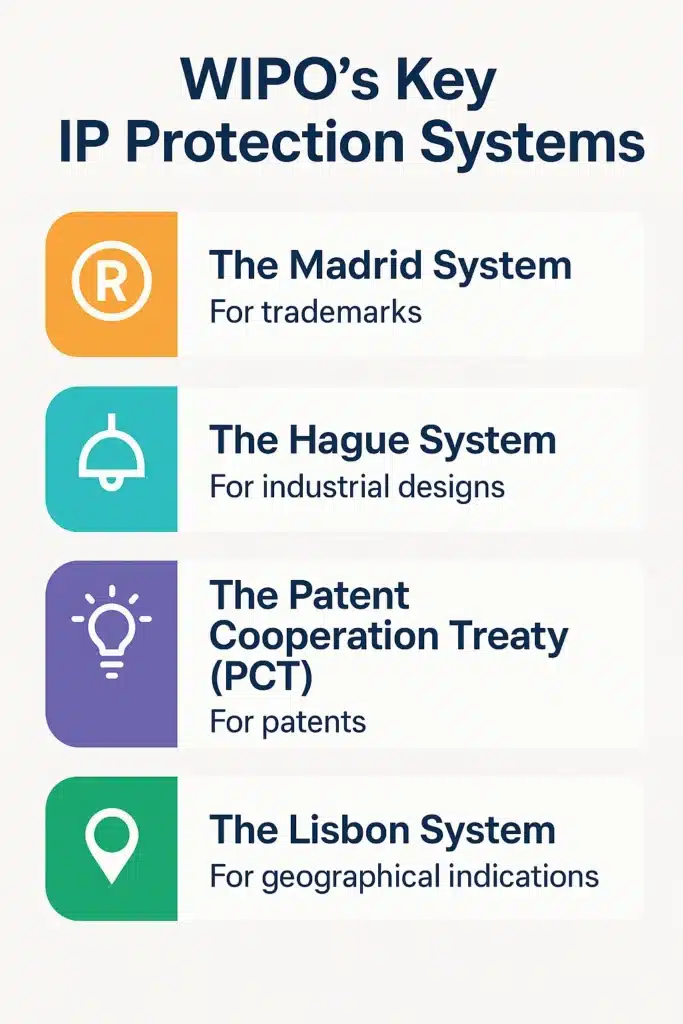
Patent Cooperation Treaty (PCT) simplifies international patent filing. A single PCT application provides a pathway to seeking patent protection in over 150 countries, though each country ultimately decides whether to grant protection.
Madrid System for international trademark registration allows trademark owners to protect marks in multiple countries through one application in one language with one set of fees.
The 1996 WIPO treaties, often called “Internet Treaties,” specifically address digital challenges by establishing rights for online transmission and requiring protection against circumvention of technological protection measures.
TRIPS Agreement – Trade-Related Aspects of IP Rights
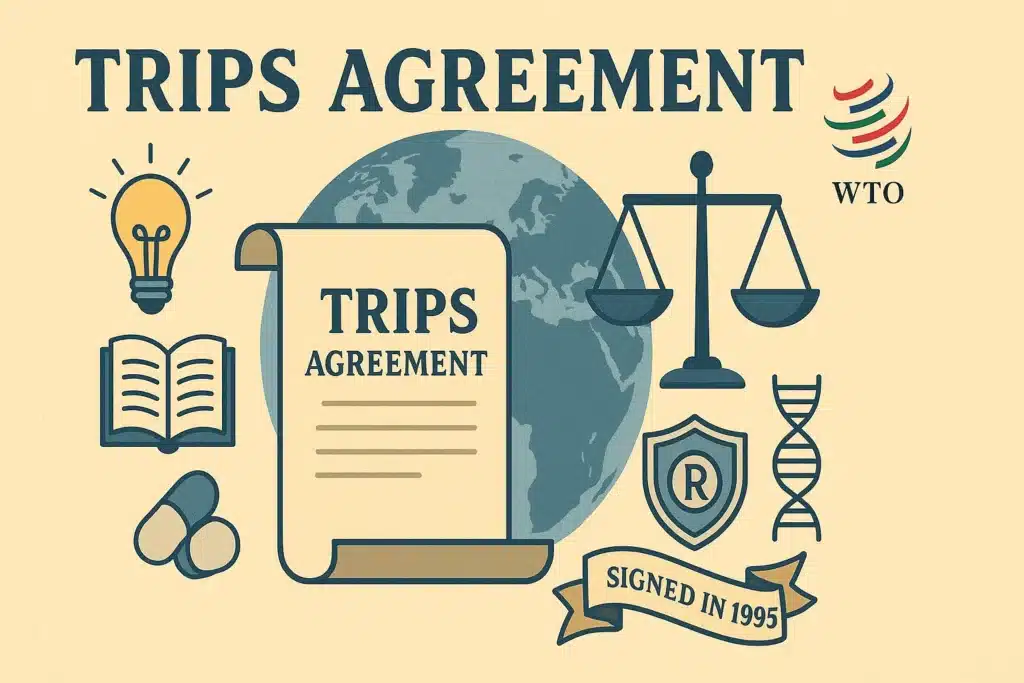
The TRIPS Agreement, entering into force in 1995 as part of the WTOframework, revolutionized international IP law. The Agreement on Trade-Related Aspects of Intellectual Property Rights (TRIPS), administered by the World Trade Organization, sets minimum IP protection standards for all WTO members (164 countries). TRIPS covers copyrights, trademarks, patents, trade secrets, and enforcement mechanisms, making IP protection a condition of international trade participation.
TRIPS requires member countries to provide both substantive protection (minimum standards for each IP type) and procedural protections (enforcement procedures including civil remedies, border measures, and criminal penalties for commercial-scale infringement).
“TRIPS marks the first time intellectual property was treated as a matter of international trade, linking economic liberalization with the enforcement of intangible rights.”
Unlike earlier WIPO treaties, TRIPS includes binding dispute resolution through the WTO Dispute Settlement Body, with non-compliance potentially leading to tradesanctions. This enforcement mechanism gives TRIPS unprecedented power in international IP protection.
“DMCA provides safe harbors from liability for online service providers when their users post or transmit copyright-infringing materials.”
To qualify, service providers must:
Lack knowledge of infringing material
Not receive direct financial benefit from infringement
Respond promptly to takedown notices
Implement repeat infringer policies
DMCA Takedown Process: Cloudwards describes the takedown process where copyright holders send notices to service providers identifying infringing content. Providers must remove material expeditiously upon receiving proper notice, notify uploaders, and restore content if counter-notices demonstrate legitimate use.
Controversies and SecurityResearch: The DMCA’s anti-circumvention provisions have sparked debate.
“Security researchers battle against the DMCA because Section 1201 prevents circumvention even for legitimate cybersecurityresearch, potentially leaving vulnerabilities unaddressed.”
Lanham Act: This act governs federal trademark law, providing trademark registration, infringement remedies, and protection against counterfeiting and cybersquatting.
Patent Act: The Act (Title 35 USC) governs patent rights with recent America Invents Act reforms transitioning to a first-to-file system and creating post-grant review procedures.
Economic Espionage Act and Defend Trade Secrets Act provide criminal and civil remedies for trade secret theft, including up to 15 years imprisonment and substantial damages.
Latin American IP Protection
Latin American countries participate in regional IP systems:
Andean Community Decision 486 creates common IP regime for Bolivia, Colombia, Ecuador, and Peru covering patents, trademarks, and industrial designs.
MERCOSUR coordinates IP protection among Argentina, Brazil, Paraguay, and Uruguay through various protocols.
Individual countries maintain national laws: Brazil’s Industrial Property Law and Copyright Law, Mexico’s Industrial Property Law and Federal Copyright Law, and Argentina’s Patent Law and Trademark Law.
European Union: EUIPO Digital Enforcement Rules
The EU has harmonized IP protection across member states through various directives and regulations:
EUTrade Secrets Directive (2016) harmonizes trade secret protection across the EU, defining trade secrets and providing remedies for misappropriation including injunctions and damages.
EUCopyright Directive (2019) updated copyright rules for the digital age, including provisions for online content sharing platforms, press publishers’ rights, and text and data mining exceptions. Article 17 requires platforms to obtain licenses or remove copyrighted content.
European Patent Convention enables patent protection across 39 European countries through a single application, though individual countries grant patents.
EU Trademark Regulation provides unitary trademark protection across all EU member states through a single registration.
InfoSoc Directive (2001/29/EC): Harmonizes copyright and related rights, including reproduction, communication to the public, and distribution rights for the digital environment.
Enforcement Directive (2004/48/EC): Establishes civil enforcement procedures including injunctions, damages, and the right of information, allowing right holders to identify infringers.
E-Commerce Directive (2000/31/EC): Provides liability limitations for internet intermediaries similar to DMCA safe harbors.
WIPO’s 2025 analysis suggests that the Court of Justice of the European Union (CJEU) decisions have clarified site-blocking orders, establishing that:
“Courts ensure site blocking is a balanced and necessary response to piracy while respecting fundamental rights.”
Asia-Pacific: Emerging Enforcement Models
Asian countries have significantly strengthened IP protection in recent decades:
China: China has reformed IP laws extensively, including Copyright Law amendments (2020) increasing damages for infringement, Patent Law revisions (2020) introducing patent term extensions and strengthening enforcement, Trademark Law updates (2019) increasing penalties and combating bad faith registrations, and Civil Code provisions (2021) establishing comprehensive IP protection.
Japan: Japan maintains strong IP protection through the Copyright Act, protecting works for the author’s life plus 70 years, Patent Act providing 20-year patent protection from filing, Trademark Act offering renewable 10-year trademark protection, and Unfair Competition Prevention Act protecting trade secrets and combating counterfeiting. Copyright law provides strong protection for digital content, with particular focus on manga, anime, and gaming industries. Japan actively enforces anti-piracy measures and participates in international IP cooperation.
Singapore: The Intellectual Property Office of Singapore (IPOS) administers comprehensive IP protection including site-blocking orders for persistent copyright infringement. Singapore has implemented strong enforcement mechanisms aligned with international standards.
India: India has modernized IP laws, including the Patents Act (amended 2005), complying with TRIPS, Copyright Act (amended 2012) addressing digital issues, Trademarks Act (1999) providing comprehensive trademark protection, and Information Technology Act addressing cyber-IP issues. The Copyright Act 1957 (as amended) addresses digital challenges, with courts issuing dynamic injunctions allowing right holders to block infringing websites. Indian law increasingly addresses streaming piracy and online trademark infringement.
South Korea: Strong copyrightenforcement supports the K-pop and entertainment industries, with active government cooperation in combating online piracy.
Saudi Arabia: The Saudi Authority for Intellectual Property (SAIP) modernizes IP protection, implementing digitalenforcement mechanisms and international cooperation protocols. Saudi Arabia has significantly strengthened IP protection as part of its Vision 2030 economic diversification program.
Both countries have signed international treaties and are enhancing enforcement capabilities to attract foreign investment and support domestic innovation.
Cyber Law Updates: Recent Developments in Online IP Protection
Recent legislative and regulatory developments reflect evolving digital challenges:
EU Digital Services Act and Digital Markets Act (2023-2024)
The Digital Services Act creates obligations for online platforms including content moderation requirements, transparency in algorithms, protection against illegal content, and user rights including appeals.
The Digital Markets Act regulates “gatekeeper” platforms to ensure fair competition and includes provisions affecting IP licensing and data portability.
US Copyright Office AI Guidance (2023-2025)
The Copyright Office has issued guidance on AI-generated works stating that works created by AI without human authorship cannot be copyrighted, human selection and arrangement of AI-generated elements may qualify for copyright, and registration applications must disclose AI-generated content.
WIPO AI and IP Policy Developments
WIPO has undertaken extensive consultations on IP and AI including inventorship and ownership of AI-generated inventions, copyright in AI-generated works, data protection and IP, and liability for AI systems infringing IP.
International Enforcement Cooperation
Countries have increased cooperation on cross-border IP enforcement through Interpol’s IP Crime Programme coordinating investigations, customs cooperation sharing intelligence and conducting joint operations, and mutual legal assistance treaties facilitating evidence gathering.
Budapest Convention: Addressing Cyber IP Crimes
The Council of Europe’s Convention on Cybercrime (Budapest Convention), effective since 2004, represents the primary international treaty addressing cybercrime including IP theft.
Coverage: The Convention covers computer-related offenses including copyright infringement, related rights infringement, and trademark infringement when committed through computer systems.
Procedural Powers: It establishes procedures for investigating cybercrimes including expedited preservation of computer data, production orders for electronic evidence, search and seizure of data, and real-time collection of traffic data.
International Cooperation: The Convention requires parties to provide mutual assistance including extradition for cybercrimes, preservation of stored data across borders, and sharing of investigative information.
Current Status: 68 countries have ratified the convention including the US, most European countries, and several others globally.
Handling Online Piracy, Counterfeiting, and Patent Theft
Detecting IP Infringement
Modern enforcement combines technological and legal approaches:
Digital Fingerprinting: Identifying copyrighted content through automated comparison
Web Scraping: Monitoring e-commerce platforms for counterfeit goods
“WTO members make available effective, balanced and fair procedures.”
Site Blocking Orders: Courts can order ISPs to block access to persistent infringement sites. This remedy has gained traction globally despite concerns about overblocking.
Criminal Prosecution: For commercial-scale infringement, many jurisdictions provide criminal penalties including imprisonment. TRIPS mandates criminal procedures for willful trademark counterfeiting and copyright piracy on commercial scale.
Border Measures: Customs authorities can seize counterfeit goods at borders.
“The importance of border measures, criminal procedures, and penalties in comprehensive enforcement strategies.”
Challenges in Cross-Border Enforcement
Global infringement creates jurisdictional challenges. Infringers operate from jurisdictions with weak IP protection, making enforcement difficult. International cooperation through TRIPS, WIPO, and bilateral agreements facilitates cross-border enforcement, but significant gaps remain.
Legal Remedies and Court Precedents
Civil Remedies
IP holders can pursue various civil remedies:
Injunctions: Court orders preventing further infringement. Preliminary injunctions stop infringement during litigation; permanent injunctions provide ongoing protection.
Damages: Monetary compensation for losses. This includes actual damages (provable economic harm) plus infringer profits, or statutory damages (predetermined amounts per infringement).
Destruction Orders: Courts can order destruction of infringing goods and tools used to create them.
Right of Information: Rightholders can compel infringers to identify suppliers, distributors, and customers involved in infringement.
Criminal Penalties
Criminal IP enforcement addresses willful, commercial-scale infringement. Penalties include fines, imprisonment, and asset forfeiture. The DMCA includes criminal penalties for willfully circumventing TPMs for commercial advantage or private financial gain.
Landmark Cases
Chamberlain Group v. Skylink Technologies: This case clarified DMCA’s anti-circumvention provisions, establishing that circumvention alone doesn’t violate DMCA without underlying copyright infringement. Courts ruled DMCA doesn’t create new property rights beyond copyright itself.
Viacom v. YouTube: This major case tested DMCA safe harbor provisions, ultimately establishing that service providers can qualify for protection even when aware of general infringement if they lack specific knowledge of particular infringing content.
CJEU Site-Blocking Decisions: European courts have developed extensive jurisprudence on site-blocking orders, balancing IP protection with fundamental rights including freedom of expression and internet access.
These precedents shape how courts interpret and apply IP laws in cybersecurity contexts, establishing balances between rightsholder protection and legitimate interests of users, researchers, and service providers.
Determining which country’s laws apply when infringement involves multiple countries creates complexity. Questions arise about where infringement occurred, which courts have jurisdiction, which country’s laws govern, and how to enforce judgments across borders.
Enforcement Limitations
Even with favorable judgments, enforcement proves difficult when infringers operate from countries with weak IP protection, use anonymous services hiding identities, constantly change domains and servers, or have no assets in jurisdictions where judgments are obtained.
Technological Evolution
New technologies create challenges faster than laws can adapt including AI-generated content raising authorship questions, blockchain and NFTs creating new distribution models, deepfakes enabling sophisticated infringement, and streaming technologies facilitating real-time piracy.
Developing Country Concerns
Developing countries often face tensions between IP protection and access to knowledge, technology transfer and local innovation, traditional knowledge protection, and balancing IP protection with public health and education needs.
Future of IP Law in Cybersecurity
The IP-cybersecurity intersection continues evolving rapidly:
Artificial Intelligence and IP
AI generates content raising novel IP questions such as:
“Section 1202 restrictions on removing copyright management information are being applied to AI training, creating new enforcement frontiers.”
Blockchain and NFTs
Non-fungible tokens (NFTs) create digital ownership records but don’t necessarily transfer IP rights. Courts are beginning to address NFT-related IP disputes, establishing that owning an NFT doesn’t automatically grant copyright ownership of the underlying work.
3D Printing and Digital Manufacturing
3D printing enables easy reproduction of patented inventions and protected designs from digital files. IP law must adapt to address distributed manufacturing where infringement occurs at endpoint rather than centralized production.
Cybersecurity Research Exemptions
Growing recognition that cybersecurity requires circumventing protection measures has led to periodic DMCA exemptions for securityresearch.
Duke Law argues for permanent solutions, suggesting:
“Combining legislative reform with best practices like bug bounty programs to support legitimate securityresearch.”
International Harmonization
While complete global harmonization seems unlikely, core principles continue converging. Future developments may include updated WIPO treaties addressing AI, strengthened enforcement cooperation, and balanced approaches protecting both innovation and IP rights.
Digital-First Legislation
New laws specifically designed for digital environments including platform liability frameworks, AI and IP-specific regulations, and digital content licensing systems.
Alternative Dispute Resolution
Growth in ADR mechanisms for IP disputes including WIPO Arbitration and Mediation Center, domain name dispute resolution (UDRP), and online dispute resolution platforms.
Where Intellectual Property and Cybersecurity Laws Intersect
The intersection of IP and cybersecurity law is now a defining feature of global digital policy. Cyberattacks frequently aim to steal trade secrets, source code, or proprietary datasets.
As a result:
IP owners are expected to implement adequate cybersecurity safeguards.
Data breaches involving protected IP may trigger both cyber and IP liability.
Courts and regulators increasingly view security failures as contributing factors in IP loss.
In practice, effective IP protection in 2025 depends heavily on robust cybersecuritycompliance.
What Policymakers and Companies Should Watch Next
Looking ahead, several trends are likely to shape digital policy beyond 2025:
Disputes over AI-generated content and IP ownership
Tighter rules governing cross-border data transfers
Ongoing tension between regulatory harmonization and national control
Organizations that align legal, technical, and governance strategies will be better positioned to adapt. For businesses operating across borders, the convergence of IP and cybersecurity laws creates new challenges:
Increased legal exposure following cyber incidents
Need for jurisdiction-specific compliance strategies
Greater emphasis on internal governance and risk management
Companies are increasingly expected to treat cybersecurity as a legal obligation tied directly to IP stewardship.
Conclusion
In 2025, intellectual property and cybersecurity laws function as a single regulatoryframework shaping global digital policy. Governments now view digitalsecurity, innovation protection, and economic resilience as inseparable legal priorities. The legal frameworks governing this space, anchored by the DMCA in the US, TRIPS internationally, and regional implementations globally, continue evolving to address emerging technologies and threats.
For businesses and digital platforms, this convergence raises the stakes. IP protection without cybersecurity safeguards is increasingly insufficient, while cybersecuritycompliance is now a prerequisite for protecting proprietary digital assets. As regulatory scrutiny intensifies worldwide, organizations that integrate legal, technical, and governance strategies will be best positioned to operate, innovate, and scale in the global digital economy.
The intersection of IP law and cybersecurity creates particular tensions. While strong IP protection incentivizes creation and innovation, overly restrictive measures can hinder legitimate cybersecurityresearch and create vulnerabilities. Finding the right balance requires ongoing dialogue between rightholders, technologists, policymakers, and the public.
Looking forward, AI, blockchain, 3D printing, and other emerging technologies will continue challenging traditional IP frameworks. Success requires adaptable legal structures that protect creators while fostering the innovation and securityresearch necessary for a thriving digitalecosystem. International cooperation through WIPO, TRIPS, and bilateral agreements remains essential for addressing global infringement in an interconnected world.
Understanding these frameworks empowers businesses to protect their IP assets, helps creators enforce their rights, and enables everyone to navigate the complex landscape where intellectual property, cybersecurity, and technology intersect in 2025 and beyond.
Why are cybersecurity laws becoming stricter globally in 2025?
Governments are tightening cybersecurity laws due to increased ransomware attacks, AI-driven cybercrime, critical infrastructure risks, and growing concerns over cross-border data security.
Which regions have the strongest IP and cybersecurity regulations?
How do global digital policies affect multinational companies?
Multinational companies must comply with overlapping IP, cybersecurity, and data protection laws, often requiring region-specific compliance strategies and stronger internal security controls.
What legal trends should businesses watch in 2025?
Key trends include tighter software IP enforcement, mandatory breach reporting, AI governance laws, expanded cybercrime penalties, and stronger cross-border data transfer rules.
Copyright protects original creative expression fixed in tangible form (software code, documentation), while patents protect inventions (novel technical solutions, algorithms). Copyright arises automatically upon creation; patents require application and approval. Both face unique cybersecurity challenges—copyright from piracy, patents from theft of designs and trade secrets.
Service providers qualify for safe harbor from user infringement liability by: lacking knowledge of infringement, not receiving direct financial benefit, responding promptly to takedown notices, and implementing repeat infringer policies. This protects platforms like YouTube from liability for user-uploaded content if they follow proper procedures.
Generally no, though the US Copyright Office grants limited three-year exemptions for specific purposes. Current exemptions allow some securityresearch, but researchers risk DMCA liability for circumventing technological protection measures even without copyright infringement intent. Advocacy continues for permanent securityresearch exceptions.
TRIPS establishes minimum IP protection standards for all WTO members and provides binding dispute resolution with potential tradesanctions for non-compliance. Unlike earlier WIPO treaties, TRIPS has enforcement mechanisms making it the most powerful international IP agreement.
How are courts handling AI-generated content IP issues?
Courts are beginning to address AI IP questions, with early cases suggesting that purely AI-generated works may lack human authorship required for copyright protection. However, using AI as a tool in creative processes may still yield copyrightable works. This remains an evolving area with significant uncertainty.
Australia tightens gun control following the Bondi Beach mass shooting, with officials announcing stricter firearm laws, enforcement measures, and public safety reforms.
Australia is moving to further reinforce its gun control regime after what officials have called the country’s worst mass shooting in nearly three decades, in which a father and son allegedly killed 15 people during a Hanukkah celebration near Sydney’s Bondi Beach. Prime Minister Anthony Albanese denounced the killings as:
“An act of pure evil”
He further confirmed that his cabinet has agreed in principle to tougher firearms restrictions and an accelerated rollout of a national gun register.
What Happened At Bondi Beach
Police say two gunmen opened fire on men, women and children gathered for a Jewish holiday event, with shots reportedly continuing for up to 20 minutes as around 1,000 people fled along the sand and into nearby streets.
The suspects are described as a 50‑year‑old father, who was shot dead at the scene, and his 24‑year‑old son, who remains in critical condition under police guard, bringing the overall death toll to 16.
The victims ranged in age from 10 to 87 and included a rabbi and father of five, a Holocaust survivor, a retired police sergeant, and a French footballer, according to officials and community organisations. New South Waleshealth authorities said 27 people were still in hospital on Monday, with several patients listed as critical or critical but stable following the attack.
Explosives, Prior Investigations And Shooter Profiles
Investigators have confirmed that two “rudimentary” but active explosive devices were found at the scene and safely neutralised, with the state police commissioner saying he was:
“very glad that those devices were not activated.”
Authorities say they have spoken with the attackers’ family but have declined to speculate publicly on motive while the investigation continues, noting that one of the suspects was previously known to security agencies.
This assessment at the time concluded he did not pose a direct threat. Officials say the father arrived in Australia on a student visa in 1998 before transitioning to a partner visa, held a licence covering six firearms, and had travelled abroad only a handful of times, while the son is Australian‑born.
Heroism, Grief And A City In Mourning
Amid the chaos, bystander Ahmed al‑Ahmed has emerged as a powerful symbol of courage after video showed him tackling and disarming one of the armed men from behind when the attacker appeared to run out of ammunition. Al‑Ahmed, a 43‑year‑old fruit shop owner and father of two, was shot multiple times in the shoulder and arm and has already undergone at least one surgery, with doctors indicating that further procedures may be required.
His parents, who recently arrived from Syria, described their son as:
They further said he acted purely out of instinct to protect strangers
“regardless of their background or faith.”
A crowdfunding campaign for his recovery has raised hundreds of thousands of dollars within hours, including a six‑figure donation from financier Bill Ackman, while New South Wales Premier Chris Minns and President DonaldTrump have both publicly praised his actions as having:
“saved countless lives.”
Bondi Beach Becomes A Place Of Vigil And Solidarity
Bondi Beach, usually synonymous with surf culture and summer crowds, has been transformed into a space of mourning, with floral tributes and handwritten messages mounting outside the Bondi Pavilion near the attack site. People have gathered throughout the day to lay bouquets, hold hands and support one another, as political leaders, including Albanese and former Prime Minister Malcolm Turnbull, visit to pay their respects and join local vigils.
Similar scenes are playing out globally as Jewish communities and their allies mark Hanukkah under heightened security. In Berlin, police have stepped up measures around the Brandenburg Gate, where a large electric menorah is being lit, while New York Mayor Eric Adams and London’s Metropolitan Police say additional protection has been deployed for synagogues and holiday events, though operational details remain limited.
Planned Changes To Australia’s Gun Laws
Australia’s strict gun laws, introduced after the 1996 Port Arthur massacre, already include bans on most automatic and semiautomatic rifles and shotguns, mandatory licensing, and a 28‑day waiting period, backed by a national buyback that removed hundreds of thousands of weapons from circulation.
Even so, the Bondi shooting has exposed weaknesses around long‑term licences and the number of firearms an individual can legally hold, particularly given that the older suspect reportedly had a licence since 2015 and six registered guns.
Following an emergency National Cabinet meeting, Albanese said leaders had agreed to pursue a new round of reforms, including restricting gun ownership to Australian citizens, expanding the use of criminal intelligence in licence decisions, capping the number and types of firearms one person can own, limiting open‑ended licences, and accelerating work on a fully integrated National Firearms Register. The Australian Federal Police Association and other policing bodies have welcomed the agenda, arguing it would give officers stronger preventative tools across state and territory lines.
International Condemnation And Debate Over Antisemitism
World leaders, including DonaldTrump, UN Secretary‑General António Guterres and Pope Leo XIV, have condemned the attack, describing it as a “heinous” and “purely anti‑Semitic” act and expressing support for Australia’s Jewish community as Hanukkah begins. Albanese has repeatedly emphasised that:
“Jews in Australia must be able to worship and live in peace and safety.”
He further framed the government’s response as both a security issue and a test of social cohesion.
Israel’s Prime Minister Benjamin Netanyahu has gone further by linking Australia’s recognition of Palestinian statehood to a supposed rise in antisemitism and to the Bondi shooting, a claim criticised by UN special rapporteur Ben Saul as inappropriate and inflammatory.
Australian officials have sought to keep the focus on unity at home, with Albanese saying:
“This is a moment for Australians to come together.”
Officials further restated that the country has taken extensive measures to combat antisemitic incidents domestically.
Rising Tensions, Islamophobia Risks And Misplaced Backlash
Security experts and academics warn that political point‑scoring and divisive rhetoric risk fuelling Islamophobia and broader communal tensions in the wake of the attack. They note that in parts of Sydney with large Muslim populations, there is concern about retaliatory violence by individuals who may falsely view local communities as collectively responsible for the actions of the two suspects.
Those fears are already being borne out in part. Police are investigating the desecration of a Muslim cemetery in Sydney’s southwest, where pig heads and animal remains were dumped at the entrance in what community members believe was a hate‑motivated response.
At the same time, a Pakistani‑Australian man who shares a name with one of the alleged attackers says he has been doxed, had his photos circulated online and now feels unable to leave his home, underscoring the collateral damage of misidentification and online vigilantism.
Australia At An Inflection Point On Guns And Social Cohesion
Mass shootings remain rare in Australia, with the Bondi attack the deadliest since Port Arthur in 1996, but the incident has reignited debate over whether existing safeguards have kept pace with changing risks and enforcement realities.
Recent analysis suggests that the number of firearms in circulation has climbed in recent years despite earlier buybacks, raising questions about monitoring, data sharing, and the consistency of licensing decisions across jurisdictions.
The National Cabinet’s decision to pursue another round of gun reforms fits a familiar national pattern of decisive action after major gun violence, typically backed by broad public support.
The more complex task will be pairing legal changes with efforts to cool polarising rhetoric, address underlying drivers of extremist violence, and protect both Jewish and Muslim communities from further harm as Australia processes an attack that has shaken one of its most recognisable public spaces
What Triggered the Legal Response
The Bondi Beach attack prompted immediate scrutiny of how the perpetrator obtained and retained access to weapons. While Australia already enforces some of the world’s strictest gun laws, officials acknowledged that administrative and oversight failures can still occur.
As with previous incidents, the focus has shifted to whether existing safeguards were applied consistently rather than whether entirely new restrictions are required.
What Is Changing in Australia’s Gun Control Framework
Authorities are examining several areas:
Licensing and Eligibility Reviews
State and federal agencies are reassessing how background checks are conducted, particularly around mental health disclosures and ongoing eligibility monitoring.
Enforcement and Compliance
Law enforcement agencies are being directed to improve coordination and data sharing to ensure firearms are removed promptly when licenses lapse or conditions are breached.
Weapon Classification Oversight
Some categories of firearms and accessories are under review to determine whether they remain appropriately classified under current regulations.
How This Fits Australia’s Historical Approach
Australia’s response mirrors earlier reforms following the Port Arthur massacre and other high-profile incidents. Rather than expanding gun ownership rights, lawmakers typically:
This incremental approach has been credited with reducing mass shooting incidents over the past two decades.
Why This Matters Beyond Australia
Australia is frequently cited in international gun policy debates as evidence that regulatoryenforcement, not broad bans alone, shapes outcomes.
For policymakers elsewhere, the Bondi Beach response reinforces a key lesson as even strong legal frameworks require constant oversight to remain effective.
Further regulatory updates are expected following internal reviews and consultations with state authorities. Any legislative amendments are likely to focus on implementation gaps, rather than a fundamental shift in gun policy.
This guide explains zero-click search and examines how it is changing SEO performance, visibility, and traffic in 2025.
Zero-click search has fundamentally transformed the digital landscape, reshaping how users interact with search engines and how businesses approach online visibility. In 2025, understanding this phenomenon is no longer optional for marketers, content creators, and business owners who want to maintain their competitive edge in the evolving search ecosystem.
Understanding Zero-Click Search in the Modern Era
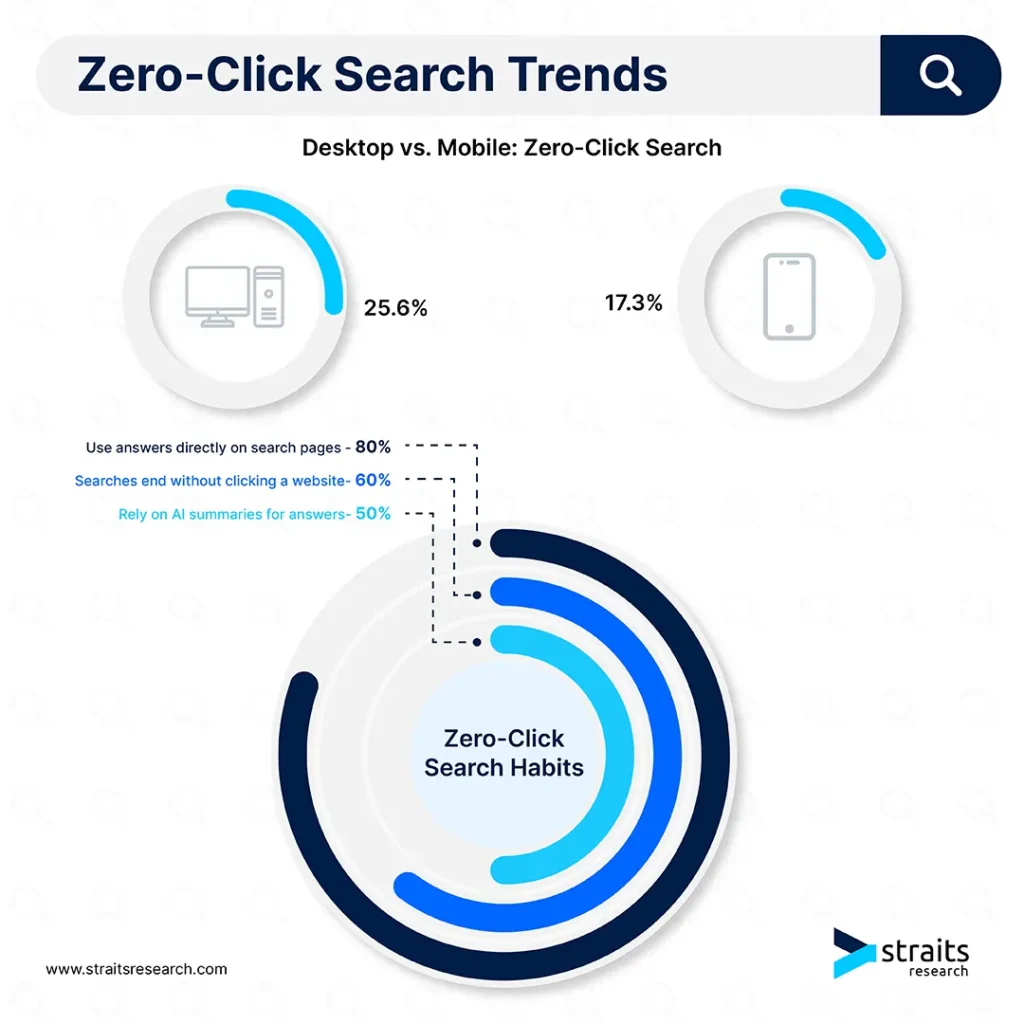
Zero-click search occurs when users find the information they need directly on a search engine results page (SERP) without clicking through to any website. This behavior has become the dominant pattern in online search, with approximately 60% of all Google searches now ending without a single click to an external website.
The rise of zero-click searches represents a fundamental shift in how search engines deliver value to users. Instead of serving as intermediaries that direct traffic to websites, search platforms have evolved into answer engines that resolve user queries directly on the results page. This transformation has been driven by advanced AI technologies, changing user expectations, and the proliferation of mobile devices.
When you search for simple questions like “what time is it in Tokyo” or “how many ounces in a cup,” Google immediately displays the answer at the top of the page. You get your information instantly without needing to visit any website. This convenience has trained users to expect immediate answers, fundamentally changing search behavior patterns.
The journey toward zero-click dominance began years ago but has accelerated dramatically in recent years. Back in 2017, approximately 54% of searches ended without clicks. According to Click Vision’s comprehensive analysis:
“By 2021, that number had climbed to 62%, and recent data from 2025 confirms that roughly 60% of all global searches now result in no external click.”
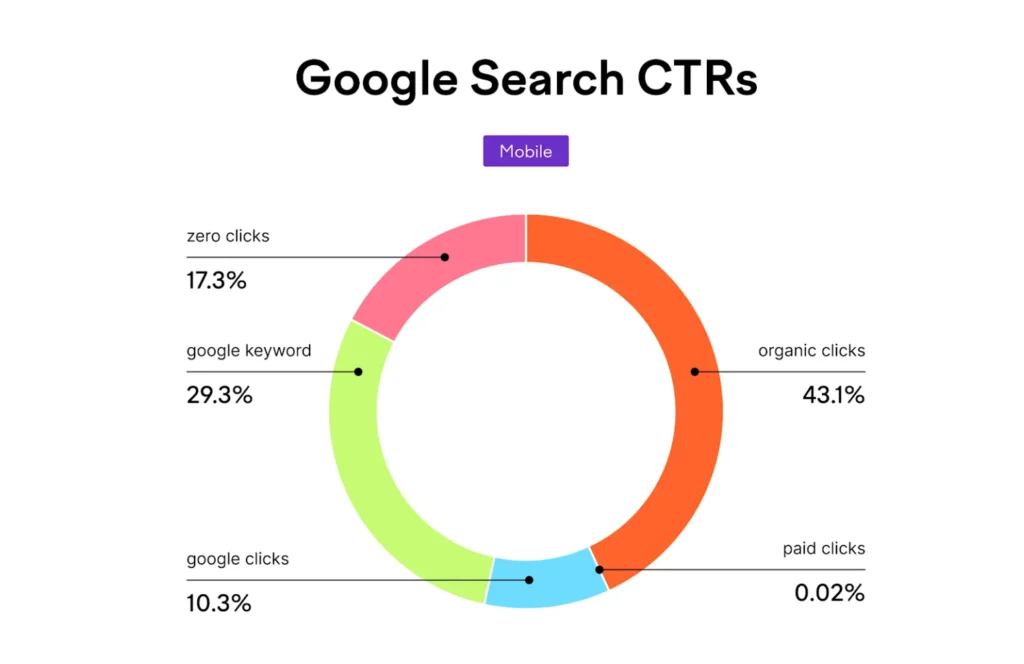
Mobile devices have become the primary driver of this trend. On smartphones and tablets, an astonishing 77% of queries end without visiting another website, compared to just 46.5% on desktop computers. This massive disparity exists because mobile users face smaller screens, slower connections, and greater time constraints, making them even more likely to rely on quick answers displayed directly in search results.
The pace of change has intensified between 2024 and 2025. According to Search Engine Land’s quarterly report:
“The United States saw its zero-click rate rise from 24.4% to 27.2% year over year, while the European Union and United Kingdom increased from 23.6% to 26.1% over the same period. Meanwhile, organic click-through rates fell to 40.3% in the United States and 43.5% in the EU/UK.”
These statistics reveal more than just numbers. They demonstrate a structural shift in how search engines handle user intent. From feature-based snippets in 2020 to AI-driven summaries in 2025, each year represents a measurable reduction in the open web’s share of traffic.
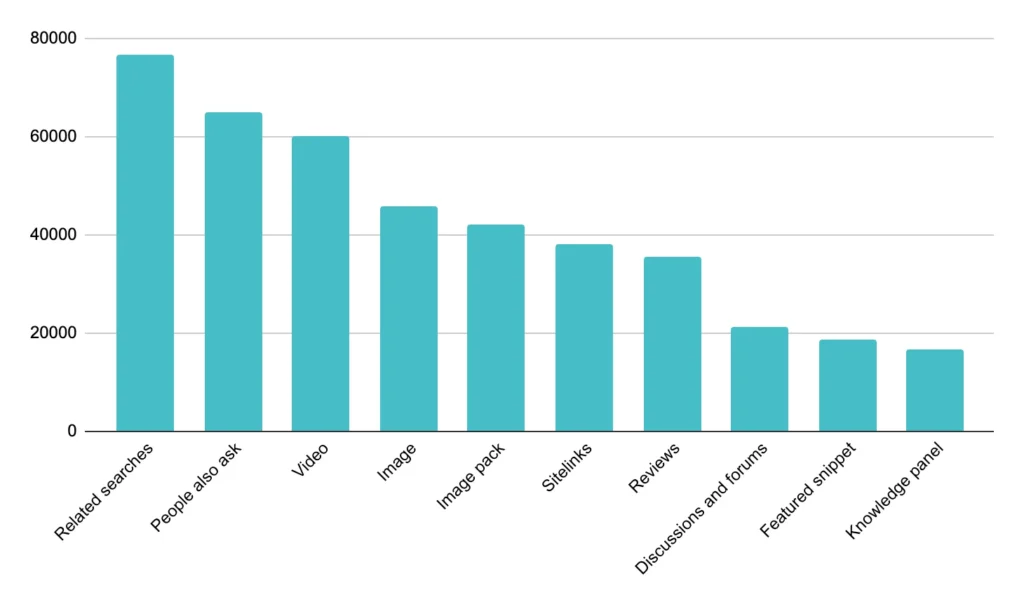
Understanding the specific features that enable zero-click searches is essential for anyone working in digital marketing or SEO. These features have evolved to become increasingly sophisticated and user-friendly.
Featured Snippets
Featured snippets appear at the very top of search results, often called “position zero.” These boxes provide direct answers to user queries, displaying information extracted from web pages along with the source’s name and link. Featured snippets can take several forms including paragraph summaries, numbered lists, bulleted lists, and tables.
For example, searching “how to tie a tie” typically triggers a featured snippet showing step-by-step instructions. Users can read the entire process without clicking through to the source website. While this reduces traffic, it also provides massive brand visibility and establishes authority.
Knowledge Panels
Knowledge panels are those information-rich boxes that appear on the right side of desktop search results or at the top on mobile. They provide comprehensive overviews of well-known entities including celebrities, companies, landmarks, and historical events. Google populates these panels using data from its Knowledge Graph, which contains billions of facts about people, places, and things.
When you search for “Eiffel Tower,” you immediately see its height, location, construction date, architect, and visitor information without clicking anywhere. These panels satisfy informational queries completely within the SERP.
AI Overviews and Search Generative Experience
The most significant development in zero-click search has been the introduction of AI-powered summaries. According to data from Semrush’s analysis.
These AI-generated responses synthesize information from multiple sources into comprehensive, conversational answers. For queries triggered by AI Overviews, the median zero-click rate reaches an astounding 80%, averaging around 83%. This dramatically exceeds the traditional zero-click rate, making AI Overviews the most significant factor in reducing website traffic.
Longer, conversational, or question-style queries with eight or more words trigger GoogleAI Overviews far more frequently than shorter queries. This makes long-tail, question-based content increasingly important for SEO strategies moving forward.
Local Packs
Local packs display map-based results for location-specific searches like “coffee shops near me” or “best dentist in Boston.” These packs show three local businesses with their ratings, addresses, phone numbers, and hours directly on the SERP. Users can call businesses, get directions, or read reviews without ever visiting the business’s website.
For local businesses, optimizing Google Business Profile and consistently gathering positive reviews has become crucial for visibility in these zero-click results.
People Also Ask Boxes
People Also Ask (PAA) boxes display related questions that expand when clicked to reveal answers pulled from various websites. These expandable sections allow users to explore related topics without leaving the search results page. Each answered question can lead to additional related questions, creating an endless rabbit hole of information.
The Impact on Businesses and Content Creators
The dominance of zero-click searches presents both challenges and opportunities for businesses, publishers, and content creators. Understanding these dynamics is critical for adapting your strategy.
The most obvious concern is the reduction in organic website traffic. When users find answers directly on Google, they have less reason to click through to your site. This directly impacts metrics that many businesses rely on, including page views, time on site, and conversion opportunities.
Publishers who depend on advertising revenue face particular challenges. Fewer clicks mean fewer ad impressions and lower revenue. Some estimates suggest this shift has cost publishers billions in potential advertising income.
Visibility and Brand Recognition
However, zero-click features are not entirely negative. Appearing in featured snippets, knowledge panels, or AI Overviews provides massive visibility. Your brand name appears prominently at the top of search results, establishing authority and credibility in your field.
Research shows that 80% of users read and use information directly from search results features, even if they eventually click through to a website. This means your content influences purchasing decisions and builds brand awareness, even without direct traffic.
Strategic Adaptation
Forward-thinking businesses are adapting by optimizing specifically for these zero-click features while also creating content that encourages clicks for deeper engagement. The key is providing quick, valuable answers in featured snippets while offering comprehensive resources that motivate users to visit your site for complete information.
Optimizing Content for Zero-Click Search in 2025
Success in the zero-click era requires a sophisticated approach that balances visibility in SERP features with driving meaningful traffic and conversions.
Structure your content to answer specific questions clearly and concisely. Use question headings (H2, H3 tags) that match common search queries. The first paragraph under each heading should provide a direct, complete answer in 40 to 60 words. This format aligns perfectly with how Google selects featured snippet content.
For example, instead of writing “The Importance of Hydration,” use “How Much Water Should You Drink Daily?” and immediately provide the recommended amount.
Implement Structured Data Markup
Structured data helps search engines understand your content better and increases the likelihood of appearing in rich results. Implement schema markup for FAQs, How-To guides, recipes, products, events, and reviews.
Use schema.org vocabulary to mark up your content properly. This structured approach makes it easier for AI systems to extract relevant information from your pages.
Create Comprehensive Content Hubs
While providing quick answers is important, you also want users to click through for deeper information. Create comprehensive content hubs that thoroughly cover topics from multiple angles. Link related articles together to demonstrate topical authority.
When users see that your snippet comes from an authoritative, comprehensive resource, they are more likely to click through for additional information.
Optimize for Long-Tail Keywords
As AI Overviews become more prevalent, long-tail, conversational keywords become increasingly valuable. These queries trigger AI responses more frequently, and appearing in those responses provides significant visibility.
Target natural language phrases like “what is the best way to” or “how can I improve” rather than just simple keywords.
Enhance Your Google Business Profile
For local businesses, a fully optimized Google Business Profile is non-negotiable. Complete every section, add high-quality photos, respond to reviews promptly, and keep your business information updated. This optimization increases your chances of appearing in local packs.
“Looking ahead, zero-click searches will likely surpass 70% by late 2025 or early 2026.”
Several factors will drive this continued growth.
Expanding AI Capabilities
Google continues to expand AI Overviews to more query types and regions. Internal testing suggests that AI Overviews could soon appear in more than 80% of informational queries. This massive expansion will dramatically increase zero-click rates.
Voice Search Growth
Voice-activated searches through smart speakers, smartphones, and other devices inherently produce zero-click results. When users ask Siri or Google Assistant a question, they receive a spoken answer without any screen interaction. As voice search continues growing, it will push zero-click rates even higher.
Mobile-First Indexing
As mobile devices continue dominating internet usage, the higher zero-click rates on mobile will further increase overall zero-click percentages. Mobile screens simply cannot accommodate the same browsing behavior as desktop computers.
New Search Platforms
Alternative search platforms and AI chatbots like ChatGPT, Perplexity AI, and Claude are creating entirely new zero-click ecosystems. These platforms do not even present traditional search results; they only provide conversational answers. As users adopt these platforms, traditional website traffic will face additional pressure.
Strategies for Success in a Zero-Click World
Thriving in this new environment requires a fundamental mindset shift from traffic-focused metrics to visibility and influence-based strategies.
Diversify Your Presence
Do not rely solely on organic search traffic. Build direct relationships with your audience through email newsletters, social media followings, and community platforms. These owned channels provide traffic sources that search engines cannot control.
Create Value Beyond Answers
Develop interactive tools, calculators, templates, and resources that cannot be replicated in search results. These unique offerings provide compelling reasons for users to visit your website.
Leverage Video Content
Video content continues growing across all platforms. Create valuable video content for YouTube, TikTok, and Instagram. Videos often appear in search results and can drive traffic through multiple channels. According to Workshop Digital’s research:
“Commercial keywords presenting videos on the SERP saw a 24% increase from October 2024 to January 2025.”
Monitor Referral Traffic
Check your GoogleAnalytics to see if traffic from YouTube, Reddit, and other platforms has increased. Users may discover your content through featured snippets or AI Overviews, then find your website through other channels. Understanding these user journeys helps you optimize the entire experience.
Embrace AI-Optimized Content
Create content specifically designed to appear in AI Overviews. This means using clear, structured formatting with headers, bullet points, and tables. Provide authoritative, well-researched information with citations and expert credentials. AI systems prioritize credible, comprehensive sources.
Traditional metrics like click-through rates and page views no longer tell the complete story. Modern marketers must track a broader range of metrics.
Brand Awareness Metrics
Monitor branded search volume to see if more people are searching specifically for your company name. Track social media mentions, backlinks, and domain authority as indicators of growing brand recognition.
Impression Data
Use Google Search Console to track impressions even when clicks are declining. High impression counts indicate strong visibility, which builds brand awareness and influences future purchasing decisions even without immediate clicks.
Conversion Quality
Analyze whether the traffic you do receive converts at higher rates. Users who click through after seeing featured snippets may be more qualified and ready to take action because they have already consumed initial information.
Multi-Touch Attribution
Implement multi-touch attribution models that credit all touchpoints in the customer journey, not just the last click. This approach reveals how zero-click features contribute to conversions even when they do not generate direct traffic.
Conclusion
Zero-click search has fundamentally transformed the digital landscape in 2025, creating both challenges and opportunities for businesses, content creators, and marketers. With approximately 60% of searches ending without clicks, and that percentage continuing to climb, adaptation is not optional but essential for survival.
The key to success lies in embracing this new reality rather than fighting against it. Focus on earning visibility in featured snippets, knowledge panels, and AI Overviews while creating compelling reasons for users to visit your website for deeper engagement. Diversify your traffic sources, build direct audience relationships, and measure success through broader metrics than just clicks.
Those who adapt their strategies to thrive in a zero-click world will find new opportunities for brand building, authority establishment, and customer connection. The future of search is here, and it requires a fundamental rethinking of how we approach online visibility and audience engagement.
Frequently Asked Questions
What percentage of Google searches are zero-click in 2025?
Approximately 60% of all Google searches globally now end without any click to an external website. On mobile devices, this number reaches 77%, while desktop searches see about 46.5% zero-click rates. These percentages continue increasing as AI Overviews and other SERP features expand.
How do zero-click searches affect website traffic?
Zero-click searches reduce direct website traffic because users find answers directly on search results pages. However, they can increase brand visibility and awareness. Websites appearing in featured snippets and AI Overviews gain authority and recognition, which can drive traffic through other channels and influence future purchasing decisions.
Can businesses still succeed with high zero-click rates?
Yes, businesses can absolutely succeed by adapting their strategies. Focus on optimizing for visibility in SERP features, creating unique value that requires website visits, diversifying traffic sources, and building direct audience relationships through email and social media. Success metrics should expand beyond just traffic to include brand awareness and conversion quality.
What types of content perform best in zero-click search features?
Question-based content with clear, concise answers performs best. Content structured with descriptive headings, bullet points, tables, and step-by-step instructions has higher chances of being featured. Implementing structured data markup and focusing on long-tail, conversational keywords also improves performance in AI Overviews and featured snippets.
Will zero-click searches continue increasing?
Yes, projections suggest zero-click searches will surpass 70% by late 2025 or early 2026. Factors driving this growth include expanding AI Overviews, increasing voice search usage, continued mobile-first behavior, and the emergence of alternative AI-powered search platforms. Businesses should prepare strategies for an increasingly zero-click future.
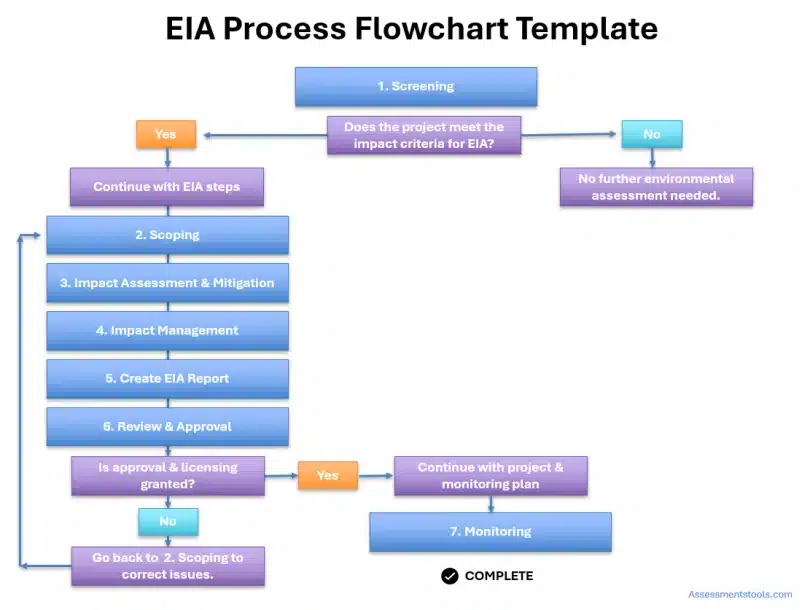
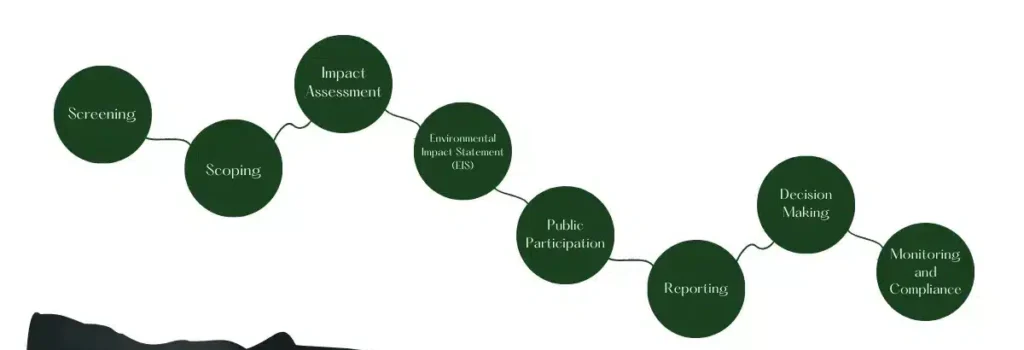
A complete beginner’s guide to Environmental Impact Assessment. Learn what an EIA is, how the process works, key steps, legal requirements, and why it matters.
Environmental Impact Assessment (EIA) has become one of the most vital tools in modern environmental management and sustainable development planning. As the world grapples with climate change, biodiversity loss, and resource depletion, understanding the potential environmental consequences of development projects before they begin has never been more critical. This comprehensive guide explores what EIA is, why it matters, and how it shapes responsible development worldwide.
Defining Environmental Impact Assessment
Environmental Impact Assessment is a systematic, formal process used to evaluate the potential environmental consequences of a proposed project, policy, program, or plan before a decision is made to proceed with implementation. According to Wikipedia’s comprehensive definition:
“EIA assesses environmental consequences before moving forward with proposed actions.”
The process examines how a project might affect various aspects of the environment, including air and water quality, soil conditions, biodiversity and ecosystems, local communities and human health, cultural and heritage sites, and natural resources. By identifying potential problems early, EIA enables decision-makers to modify projects, implement mitigation measures, or in some cases, reject proposals that would cause unacceptable environmental harm.
EIA differs from Strategic Environmental Assessment (SEA), which applies to higher-level policies, plans, and programmes. While EIA focuses on individual projects proposed by companies or individuals, SEA addresses broader governmental initiatives and planning frameworks.
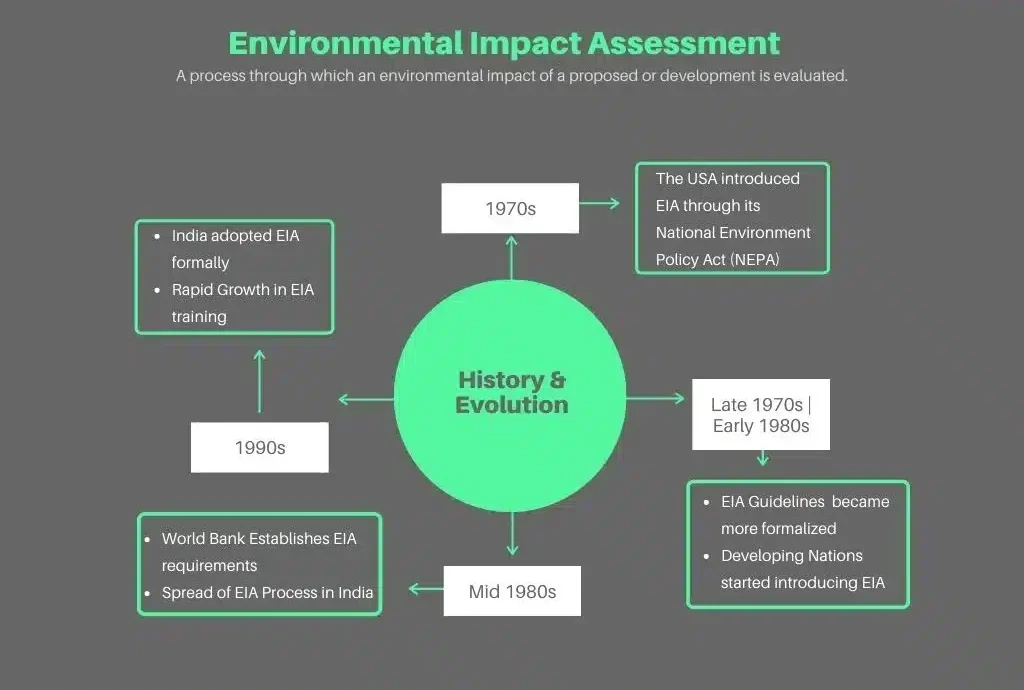
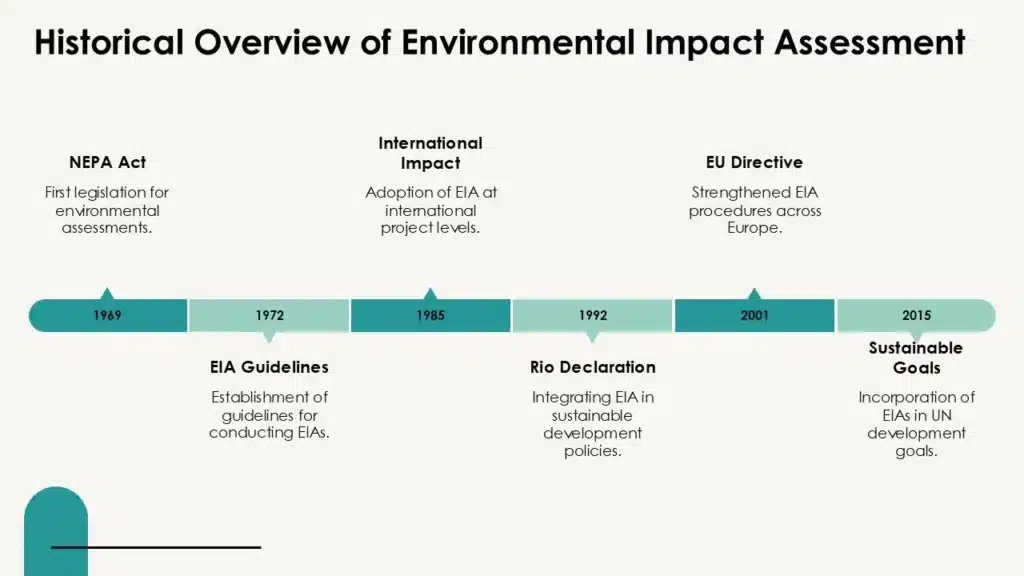
The modern EIA process originated in the United States with the passage of the National Environmental Policy Act (NEPA) in 1970. This landmark legislation established EIA as a formal requirement for federal actions significantly affecting the environment. NEPA’s introduction marked a revolutionary shift in how governments and organizations approach development planning.
Following the United States’ lead, countries worldwide began adopting EIA frameworks. Canada, Australia, and European nations implemented their own EIA systems throughout the 1970s and 1980s. The process gained international recognition as an essential tool for environmental protection and sustainable development.
In developing nations, EIA adoption accelerated during the 1980s and 1990s, often driven by international development banks and lending institutions requiring environmental assessments for funded projects.
“India introduced its first official EIA Notification in 1994, following growing environmental concerns and the wake-up call provided by the 1984 Bhopal gas tragedy.”
The 1994 Indian notification required certain projects to undergo EIA before approval. In 2006, India revised the notification, introducing project categories and improving the assessment process. This evolution demonstrates how EIA frameworks continue adapting to address emerging environmental challenges and incorporate lessons learned from implementation experience.
International agreements and conventions have further strengthened EIA requirements. The 1991 Espoo Convention on Environmental Impact Assessment in a Transboundary Context established frameworks for assessing environmental impacts that cross national boundaries, recognizing that environmental harm often does not respect political borders.
Environmental Impact Assessment serves multiple critical objectives that extend beyond simple regulatorycompliance. Understanding these objectives helps explain why EIA has become such a fundamental component of responsible development.
Protecting Environmental Quality
The primary objective is identifying and preventing environmental degradation before it occurs. By assessing potential impacts during the planning phase, projects can be designed to avoid or minimize harm to air, water, soil, and ecosystems. This proactive approach proves far more effective and economical than attempting to remediate environmental damage after the fact.
“EIA facilitates informed decision-making by providing clear, well-structured, factual analysis of the effects and consequences of proposed actions.”
Decision-makers receive comprehensive information about environmental trade-offs, enabling them to weigh development benefits against potential environmental costs.
Promoting Sustainable Development
EIA helps promote development that is sustainable and optimizes resource use and management opportunities. By incorporating environmental considerations into development planning from the outset, EIA ensures that economic progress does not come at the expense of environmental quality or future generations’ needs.
Ensuring Public Participation
Modern EIA processes emphasize stakeholder engagement and public participation. Communities affected by proposed projects have opportunities to voice concerns, share local knowledge, and influence project design. This democratic aspect of EIA builds trust, improves project outcomes, and ensures that development benefits align with community values and priorities.
Legal and Regulatory Compliance
Many jurisdictions mandate EIA for certain types or scales of projects. Conducting proper environmental assessments ensures compliance with environmentallaws and regulations, reducing legal risks and avoiding costly project delays or cancellations due to regulatory violations.
Enhancing Corporate Responsibility
For businesses, conducting thorough EIAs demonstrates commitment to environmental stewardship and corporatesocial responsibility. This transparency can enhance corporate reputation, build stakeholder confidence, and create competitive advantages in markets where environmental performance matters to customers and investors.
The requirement for conducting EIA varies by country, jurisdiction, and project characteristics. Understanding when EIA is necessary helps project proponents plan appropriately and avoid regulatory complications.
Project Size and Scale
Many jurisdictions establish size thresholds that trigger EIA requirements. Large-scale projects typically require full EIA regardless of other factors. For example, major infrastructure developments like highways, airports, and dams almost always undergo comprehensive environmental assessment.
“The requirement for EIA is often triggered by the size, scale, and complexity of the proposed activity or project.”
Smaller projects may be exempt or subject to simplified screening processes.
Project Type and Sector
Certain project categories automatically require EIA due to their inherent environmental sensitivity. These commonly include mining and extractive industries, power generation facilities (especially fossil fuel plants), industrial manufacturing plants, waste management facilities, and large agricultural or forestry operations.
“The review process requires EIA for major federal actions significantly affecting the quality of the human environment.”
This includes projects receiving federal funding, requiring federal permits, or occurring on federal lands.
Environmental Sensitivity
Project location significantly influences EIA requirements. Developments proposed in or near environmentally sensitive areas typically require assessment regardless of size. Sensitive areas include protected areas and nature reserves, wetlands and coastal zones, critical wildlife habitats, areas with endangered species, and cultural or heritage sites.
Potential Impact Severity
Projects likely to cause significant environmental impacts require EIA even if they do not meet size thresholds or fall into automatically assessed categories. Significance is determined by considering factors like magnitude of change to environmental conditions, duration and reversibility of impacts, and number of people or area affected.
Transboundary Impacts
Projects with potential impacts extending beyond national borders may require international EIA processes, as established by conventions like the Espoo Convention. This ensures that affected nations have input into environmental decision-making.
“Agencies first determine whether Categorical Exclusions apply, then prepare EAs to assess significance, and finally develop full EISs for actions with significant impacts.”
European Union Directive
The EUEnvironmental Impact Assessment Directive establishes requirements for member states. According to Capacity4dev’s EIA information:
“The Directive underwent revision in 2014 and continues evolving to address new environmental challenges.”
The system emphasizes public participation consistent with the Aarhus Convention.
Developing Country Systems
Many developing nations have established EIA systems, often with support from international development institutions. These systems face unique challenges including limited resources and expertise, weak enforcement capacity, and balancing development pressures with environmental protection. However, as demonstrated by India’s evolving framework, these systems continue strengthening over time.
International Standards
Beyond national regulations, international standards guide EIA practice. The International Association for Impact Assessment (IAIA) has developedprinciples of EIA best practice that provide widely agreed guidance for practitioners worldwide. These principles emphasize rigor, practicality, credibility, cost-effectiveness, efficiency, focus, adaptability, and participation.
Key Components of Effective EIA
While specific requirements vary, effective EIA processes share common elements that ensure comprehensive environmental assessment.
Baseline Environmental Studies
Understanding existing environmental conditions provides the foundation for impact assessment. Baseline studies document the state of the environment before project implementation, covering physical parameters (climate, air quality, water resources, soil conditions, topography), biological parameters (flora, fauna, ecosystems, biodiversity), and socioeconomic parameters (population, land use, cultural resources, economic activities).
This baseline information establishes the reference point against which predicted project impacts are measured.
Impact Identification and Prediction
The heart of EIA involves identifying which environmental components the project will affect and predicting the nature and magnitude of those impacts. This requires understanding causal relationships between project activities and environmental changes.
Predictions address questions about the type of impact (positive or negative), magnitude and intensity, spatial extent (local, regional, global), temporal dimensions (short-term or long-term, temporary or permanent), and probability of occurrence.
Alternatives Analysis
Effective EIA examines project alternatives, including different locations, technologies, designs, and operational approaches. Even the “no-action” alternative is considered to understand what would happen if the project does not proceed.
Comparing alternatives helps identify the most environmentally sound approach and may reveal options that achieve project objectives with fewer environmental costs.
Mitigation Measures
When impacts cannot be avoided entirely, EIA identifies measures to minimize, reduce, or offset environmental harm. The mitigation hierarchy prioritizes avoiding impacts first, then minimizing unavoidable impacts, and finally compensating for residual impacts through offsets or restoration.
Environmental Management Plans
The assessment culminates in an Environmental Management Plan (EMP) that details how mitigation measures will be implemented, who is responsible for implementation, what resources are required, and how compliance will be monitored. According to Capacity4dev:
“EMPs lay out implementation and monitoring procedures for recommended measures.”
Public participation has evolved from a peripheral activity to a central element of effective EIA. Meaningful stakeholder engagement improves assessment quality, builds social acceptance, and ensures that local knowledge informs environmental decision-making.
Types of Stakeholders
EIA processes involve diverse stakeholders including affected communities and landowners, indigenous peoples with traditional territories or interests, local and national government agencies, environmental organizations and advocacy groups, technical experts and scientific institutions, and project proponents and their consultants.
Participation Methods
Stakeholder engagement employs various methods depending on project scale, context, and regulatory requirements. Common approaches include public meetings and hearings, written comment periods, focused stakeholder workshops, community advisory committees, and online consultation platforms.
“Environmental impact assessments offer transparent processes for identifying impacts and encourage stakeholder participation. Stakeholders can voice opinions, concerns, and priorities, contributing to project credibility.”
Effective participation helps identify impacts that technical studies might miss, incorporates local and traditional ecological knowledge, builds trust and reduces conflict, and improves project design through diverse perspectives.
Emerging Trends in EIA Practice
As environmental challenges evolve and technology advances, EIA practice continues developing in several important directions.
Climate Change Integration
Modern EIAs increasingly address climate change from two angles: how projects contribute to greenhouse gasemissions (mitigation) and how projects and affected communities will cope with climate impacts (adaptation). This dual focus ensures that development projects align with climate action goals.
Cumulative Impact Assessment
Rather than examining projects in isolation, contemporary EIA considers cumulative impacts from multiple developments affecting the same environment. This systems-level perspective better captures real-world environmental pressures.
Strategic Environmental Assessment
Strategic Environmental Assessment (SEA) applies EIA principles to policies, plans, and programs, enabling environmental considerations to inform higher-level decision-making before individual projects are proposed. This proactive approach can prevent environmental problems more effectively than project-level assessment alone.
Technology Applications
Digital tools are transforming EIA practice. Geographic Information Systems (GIS) enable sophisticated spatial analysis, remote sensing provides comprehensive environmental monitoring data, and modeling software improves impact prediction accuracy. These technologies make EIA more rigorous and efficient.
Ecosystem Services Approach
Increasingly, EIA examines impacts on ecosystem services – the benefits that humans derive from ecosystems. This framework helps communicate environmental values in terms meaningful to decision-makers and the public.
Conclusion
Environmental Impact Assessment represents humanity’s commitment to understanding and managing the environmental consequences of development. From its origins in 1970s environmentallegislation to its current global application, EIA has evolved into a sophisticated, multi-faceted process that shapes how societies balance progress with environmental stewardship.
At its core, EIA embodies a simple but profound principle: look before you leap. By requiring systematic examination of potential environmental impacts before projects proceed, EIA enables informed decision-making that considers environmental costs alongside economic and social benefits. This foresight helps avoid environmental damage that would be difficult or impossible to reverse, protecting natural resources and ecosystem services for current and future generations.
The effectiveness of EIA depends on multiple factors including regulatory frameworks that require rigorous assessment, adequate resources and expertise, meaningful public participation, decision-makers who take EIA findings seriously, and robust monitoring and enforcement mechanisms. When these elements align, EIA succeeds in steering development toward more sustainable pathways.
As we face escalating environmental challenges including climate change, biodiversity loss, and resource scarcity, the importance of EIA will only grow. Strengthening EIA systems, improving assessment methods, and ensuring that environmental considerations genuinely influence decisions about development represent crucial tasks for the global community.
Environmental Impact Assessment is not a perfect tool, but it remains our best systematic approach to understanding and managing the environmental consequences of human activities. By continuing to refine and strengthen EIA practice worldwide, we can work toward a future where economic development and environmental protection advance together rather than in conflict.
Under systems like the United StatesNEPA, Environmental Assessment (EA) is a shorter document that determines whether a proposed action will have significant environmental impacts. If the EA concludes no significant impact, a Finding of No Significant Impact (FONSI) is issued. If significant impacts are identified, a full Environmental Impact Statement (EIS) must be prepared. The EIS is more comprehensive and detailed, with stricter procedural requirements including extended public comment periods.
EIA duration varies considerably based on project complexity, regulatory requirements, and stakeholder processes. Simple projects might complete screening and scoping within weeks, while complex projects requiring full EIS can take 6 to 18 months or longer. Large infrastructure projects with significant environmental concerns and extensive public involvement may require several years from initial screening through final approval.
Typically, the project proponent (the company or organization proposing the development) bears the cost of conducting EIA. However, regulatory agencies, not proponents, make the final decisions on project approval. This separation helps maintain objectivity. EIA costs generally range from 0.1 to 3% of total project costs, depending on project size and complexity.
Social engineering attacks are rising fast. This guide explains what social engineering is, how cybercriminals exploit human behavior, and the steps you can take to stay protected in 2025.
Cybersecurity threats have evolved dramatically, but one attack method remains devastatingly effective year after year, namely social engineering. Unlike technical exploits that target system vulnerabilities, social engineering attacks exploit the most unpredictable element in any security system, human psychology. In 2025, these attacks have become more sophisticated, widespread, and damaging than ever before.
Understanding social engineering is no longer optional for businesses, organizations, or individuals who want to protect themselves in the digital age. This comprehensive guide breaks down everything you need to know about social engineering attacks, how they work, and most importantly, how to defend against them.
Understanding Social Engineering: The Human Hack
Social engineering is a manipulation technique that exploits human psychology to gain unauthorized access to systems, data, or physical locations. Instead of hacking technology directly, attackers hack people, using deception, urgency, authority, and trust to trick individuals into divulging sensitive information or performing actions that compromise security.
“social engineering accounts for 36% of all security incidents, making it the single most effective entry point for cybercriminals.”
These attacks succeed not because of technological sophistication but because they understand and exploit fundamental human behaviors. The power of social engineering lies in its ability to bypass even the most advanced security measures. A company might invest millions in firewalls, encryption, and endpoint protection, yet a single employee falling for a convincing phishingemail can provide attackers complete access to the network.
Social engineering works because it leverages psychological principles that include:
Authority (people obey figures of power)
Urgency (rushed decisions lead to mistakes)
Fear (threats motivate immediate action)
Trust (we believe people we think we know)
Helpfulness (humans naturally want to assist others)
The Alarming Statistics of Social Engineering in 2025
The scale and impact of social engineering attacks have reached unprecedented levels in 2025, with several concerning trends emerging from recent data.
“The human element, including social engineering, user error, and privilege misuse, factors into approximately 60% of all data breaches in 2025.”
This highlights that human interaction remains the primary pathway for attackers. More specifically, 36% of all incidents in incident response caseloads began with a social engineering tactic. The CX Quest analysis shows that:
“66% of social engineering attacks target privileged accounts, while 60% lead to data exposure.”
Phishing remains the most common breach vector, accounting for roughly 16% of breaches with an average cost of $4.88 million per incident. The Anti-Phishing Working Group recorded over 1 million phishing attacks in Q1 2025 and 1.13 million in Q2 2025, representing a 13% quarter-over-quarter increase.
Financial Impact
The financial consequences of social engineering attacks are staggering. The FBI reports that Business Email Compromise (BEC) caused $2.77 billion in losses during 2024. The median loss from a single BEC incident is around $50,000, but individual cases can reach tens of millions.
The average cost of a social engineering attack reached $130,000 in 2024, with BEC attacks averaging $4.89 million. Spacelift’s research indicates that:
“89% of social engineering attacks between May 2024 and May 2025 were financially motivated.”
“91% of security professionals said their organizations faced AI-enabled email attacks in the past six months.”
Deepfake-enabled vishing (voice phishing) surged by over 1,600% in the first quarter of 2025. Voice cloning technology now requires just three seconds of audio to create convincing replicas that pass both automated systems and human verification.
Social engineering manifests in numerous forms, each exploiting different psychological vulnerabilities. Understanding these attack types is essential for recognizing and preventing them.
Phishing Attacks
Phishing represents the most prevalent social engineering technique. These attacks involve fraudulent communications, typically emails, designed to entice recipients into sharing sensitive information or clicking malicious links. Messages often depict urgency or intrigue and appear to come from legitimate senders like CEOs, banks, or trusted companies.
“94% of organizations faced phishing attacks in 2024, with 96% of successful incidents causing negative business impacts.”
The Cofense Phishing Defense Center analyzed an average of one malicious email every 42 seconds throughout 2024. Common phishing channels include email (the primary vector), fake websites designed to look like legitimate login pages, social media platforms where attackers impersonate contacts, and SMS messages (smishing).
The most imitated brands in phishing attacks include Microsoft, Google, Amazon, DHL, DocuSign, PayPal, and various financial institutions. Attackers continuously update their tactics to mimic current trends and trusted services.
Spear Phishing
Spear phishing takes traditional phishing to a more targeted, personalized level. Instead of casting a wide net, attackers research specific individuals or organizations and tailor messages based on that information.
These attacks might reference recent activities, known contacts, or current projects to build credibility. An employee might receive an email that appears to come from a colleague mentioning a real ongoing project, making the deception far more convincing than generic phishing.
Business Email Compromise (BEC)
Business Email Compromise involves attackers gaining access to corporateemail accounts and impersonating the owner to defraud the company, employees, customers, or partners. These attacks typically focus on employees with access to company finances, tricking them into conducting unauthorized wire transfers.
CEO fraud, a specific BEC variant, involves impersonating executive leadership to leverage authority and pressure employees into immediate action. A finance employee might receive what appears to be an urgent request from the CEO for an immediate wire transfer to complete a time-sensitive deal.
Vishing (Voice Phishing)
Vishing uses phone calls to manipulate victims into revealing sensitive information. Attackers often impersonate IT support, bank representatives, or government officials to create urgency and authority.
“vishing surged 442% in late 2024, driven largely by AI-powered voice cloning technology.”
The 2023 MGM Resorts breach began with vishing when attackers impersonated an employee during a call to the IT help desk, ultimately gaining access to internal systems.
Pretexting
Pretexting involves creating a fabricated scenario or identity to trick people into revealing sensitive information or taking harmful actions. The attacker builds a convincing story that justifies their request for information.
Common pretexting scenarios include impersonating IT support requesting login credentials, posing as vendors needing account verification, pretending to be coworkers who forgot passwords, or claiming to be conducting security audits.
Baiting
Baiting attacks offer something enticing to lure victims into a trap. This might be physical (infected USB drives left in parking lots) or digital (free software downloads that contain malware).
The psychology relies on curiosity and the desire for free items. An employee finding a USB drive labeled “Salary Information 2025” in the company parking lot might plug it into their work computer, unknowingly installing malware.
Quid Pro Quo
Quid pro quo attacks offer services or benefits in exchange for information or access. The classic example involves someone calling employees pretending to be IT support, offering to fix a problem in exchange for login credentials.
These attacks exploit the natural human tendency toward reciprocity. When someone offers help or value, we feel obligated to provide something in return.
Tailgating and Piggybacking
These physical security attacks involve unauthorized persons gaining access to restricted areas by following authorized personnel. An attacker might carry boxes while approaching a secured door, hoping someone will hold it open out of courtesy.
Despite being low-tech, these methods remain effective because they exploit social norms around politeness and helpfulness.
Watering Hole Attacks
Watering hole attacks compromise websites frequently visited by target groups. Like predators waiting at literal watering holes, attackers infect trusted sites that specific user groups regularly visit.
When victims visit these compromised sites, malicious code deploys onto their systems. This method is particularly effective against organizations in specific industries that rely on common resource websites.
“cybercriminals now use three distinct layers of AI-enabled tooling.”
Automation streamlines traditional attack methods, allowing criminals to launch campaigns at massive scale with minimal manual effort. Generative AI creates highly personalized, human-like content across multiple channels, making attacks virtually indistinguishable from legitimate communications.
Agentic AI executes complex, multi-step attacks with minimal human oversight, including creating synthetic identities for insider campaigns that can persist undetected for extended periods.
Deepfake Technology
Voice cloning exemplifies AI’s impact on social engineering. With just three seconds of audio, attackers can create convincing voice replicas that fool both automated systems and human listeners. In one high-profile case, criminals used deepfake audio to impersonate a CEO and authorize a $25.6 million transfer.
Video deepfakes are becoming equally sophisticated, with AI-generated video calls featuring fake executives authorizing fraudulent transactions. These attacks succeed because they exploit fundamental trust in audiovisual verification.
ClickFix Campaigns
ClickFix represents the scalable side of modern social engineering. These attacks use fake browser alerts, fraudulent update prompts, and SEO poisoning to trick users into initiating their own compromise.
Between May 2024 and May 2025, ClickFix served as the initial access vector in at least eight confirmed incident response cases. The technique succeeds by mimicking trusted workflows like Microsoft update notifications or Google CAPTCHA verifications.
“regularly conducting security awareness training is the foundational defense.”
Organizations should educate employees at least annually, preferably quarterly, about different forms of social engineering attacks. Training should be practical and engaging, using real-world examples and interactive scenarios. Simulated phishing exercises help employees practice recognizing and reporting suspicious communications in a safe environment.
Key training topics include recognizing phishing emails and messages, verifying unexpected requests through alternative channels, understanding pretexting tactics, identifying urgency and authority manipulation, protecting sensitive information, and reporting suspicious activities immediately.
Multi-Factor Authentication (MFA)
Implementing phishing-resistant multi-factor authentication across all critical systems provides essential protection. Even if attackers obtain login credentials through social engineering, MFA creates an additional security barrier.
“using phishing-resistant MFA methods like hardware tokens or biometric authentication rather than SMS-based codes, which can be intercepted.”
Email Security Controls
Deploy advanced emailsecurity solutions that filter and detect phishing attempts. Implement email authentication standards like DMARC, DKIM, and SPF to prevent emaildomain spoofing.
Advanced URL filtering blocks access to malicious infrastructure. These controls help detect and prevent social engineering attacks that rely on spoofed domains, typo-squatting, and link-based credential theft.
Verification Protocols
Establish clear, non-digital protocols for verifying unusual requests, especially those involving money transfers or sensitive data. Integrity360’s security recommendations suggest:
“For financial requests, require dual authorization and callback verification using known phone numbers (not numbers provided in the request).”
For sensitive data requests, confirm through separate communication channels. For urgent executive requests, establish pre-agreed verification methods like codewords.
Access Controls and Least Privilege
Limit access to sensitive systems and data based on job requirements. The principle of least privilege ensures employees only access resources necessary for their roles, reducing the impact of compromised accounts.
Regular access reviews identify and remove unnecessary permissions. Strong credential hygiene practices and limiting password reuse across systems prevent chained exposure when one account is compromised.
Incident Response Planning
Have a well-documented incident response plan ready. When social engineering attacks occur, quick, coordinated action minimizes damage.
The plan should include procedures for identifying compromised systems, isolating affected accounts and networks, containing the breach, conducting forensic analysis, communicating with stakeholders, and recovering operations.
While human awareness remains paramount, technical controls provide essential defense layers.
Identity Threat Detection and Response (ITDR)
Few organizations have implemented ITDR or user and entity behavior analytics (UEBA), yet these capabilities are increasingly vital for detecting social engineering attacks and preventing account takeover.
These systems establish behavioral baselines for users and flag anomalous activities like unusual login locations, unexpected data access patterns, or abnormal transaction volumes.
Endpoint Detection and Response (EDR)
Comprehensive EDR solutions with robust logging provide visibility into endpoint activities. Without clear indicators and behavioral baselines, analysts struggle to distinguish routine activity from compromise signs.
EDR tools can detect lateral movement attempts, unusual process executions, and suspicious file access patterns that indicate successful social engineering attacks.
DNS Security and Web Filtering
Advanced DNS security and URL filtering block access to malicious infrastructure. These controls are particularly effective against phishing attacks, watering hole attacks, and ClickFix campaigns that rely on malicious websites.
Network Segmentation
Proper network segmentation limits how far attackers can move after initial compromise. Even if social engineering grants initial access, segmentation prevents lateral movement to critical systems.
Data Loss Prevention (DLP)
DLP solutions detect and prevent sensitive data from leaving the organization through unauthorized channels. These tools can stop data exfiltration attempts even when attackers successfully compromise accounts through social engineering.
Responding to Social Engineering Attacks
Despite best efforts, some attacks will succeed. Effective response minimizes damage.
“Immediately identifying compromised systems, accounts, or networks and disconnecting them from broader infrastructure.”
Reset credentials for affected accounts and any accounts that might have been exposed. Enable enhanced monitoring for related systems and users.
Investigation and Containment
Determine the full scope of the compromise. What data was accessed? What systems were affected? How did the attack occur? What vulnerabilities were exploited?
Contain the damage by closing attack vectors, patching vulnerabilities, and preventing continued unauthorized access. Preserve evidence for forensic analysis and potential law enforcement involvement.
Communication
Notify affected parties according to regulatory requirements and organizational policies. Transparency about breaches builds trust, while attempted coverups destroy it.
Communicate with employees about what happened, what is being done, and what they should do. Provide clear guidance without creating panic.
Recovery and Remediation
Safely restore affected systems and data from clean backups. Implement additional security controls to prevent recurrence. Update incident response plans based on lessons learned.
Conduct post-mortem analysis to document what happened, what worked in the response, what did not work, and what changes are needed. Share these lessons across the organization.
Conclusion
Social engineering represents the most persistent and successful cyberattack method in 2025, exploiting the weakest link in any security system: human psychology. With 60% of data breaches involving human elements and attacks becoming increasingly sophisticated through AI enhancement, organizations cannot afford to treat security awareness as an afterthought.
Effective defense requires combining technical controls (MFA, email filtering, EDR, ITDR) with comprehensive security awareness training and a culture that values vigilance. No single measure provides complete protection, but layered defenses significantly reduce risk.
The human factor will always remain in cybersecurity. Attackers will continue innovating new ways to manipulate, deceive, and exploit people. However, informed, vigilant humans equipped with proper tools and protocols can recognize and thwart even sophisticated social engineering attempts.
As technology evolves, so must our defenses. Organizations that invest in ongoing security awareness training, implement robust technical controls, and foster security-conscious cultures will be best positioned to defend against the evolving threat landscape of social engineering.
Frequently Asked Questions
What is the most common type of social engineering attack in 2025?
Phishing remains the most common social engineering attack, accounting for approximately 65% of social engineering-driven intrusions. Emailphishing, in particular, affects 94% of organizations, with over 1 million phishing attacks recorded quarterly. The prevalence exists because phishing requires minimal technical skill, reaches massive audiences, and successfully manipulates human psychology around urgency, authority, and trust.
How can individuals protect themselves from social engineering attacks?
Individuals should verify sender identities before clicking links or downloading attachments, enable multi-factor authentication on all accounts, be skeptical of urgent requests, especially those involving money or personal information, verify unusual requests through alternative communication channels, never share passwords or sensitive information via email or phone, keep software and systems updated, and report suspicious communications to IT or security teams immediately. Healthy skepticism and verification are the best personal defenses.
What should I do if I think I have fallen victim to a social engineering attack?
Act immediately to minimize damage. Change passwords for compromised accounts and any accounts using the same credentials. Notify your IT or security team about the incident, providing details about what happened. Disconnect affected devices from networks if malware might be involved. Monitor accounts for unauthorized activity and freeze credit if financial information was exposed. Report the incident to appropriate authorities, potentially including law enforcement for significant breaches. Document everything for investigation and future prevention.
How are companies using AI to combat AI-enhanced social engineering attacks?
Organizations deploy AI-powered security tools that analyze email patterns to detect sophisticated phishing attempts, monitor user behavior to identify anomalous activities suggesting account compromise, use machine learning to detect deepfake audio and video, automate threat intelligence gathering and sharing, and power adaptive security systems that learn from attack patterns. AI versus AI has become a critical battleground, with defenders using machine learning to stay ahead of AI-enhanced attacks.
What are the legal and financial consequences of social engineering attacks for businesses?
Financial consequences include direct losses from fraudulent transfers (averaging $50,000 for BEC incidents but reaching millions in major cases), costs associated with breach response, investigation, and remediation, regulatory fines and penalties for inadequate security practices, legal expenses from lawsuits by affected customers or partners, reputational damage leading to lost business, and increased insurance premiums. Beyond financial impact, according to research, 65% of consumers lose trust in businesses after data breaches, with many vowing never to return. Organizations also face enhanced disclosure requirements and potential criminal liability in cases of gross negligence.
Guest post services are no longer limited to blogs. Today, brands can publish on top news sites and niche platforms, expanding reach, building authority, and driving SEO growth.
The digital media landscape has undergone a seismic transformation in 2025, with guest posting services evolving from simple blog placements to sophisticated media relations encompassing major news outlets, established publications, and authoritative industry platforms.
“38% of respondents say they would first look to news outlets they trust, highlighting the critical importance of credible media placements in modern content strategies.”
The expansion represents more than tactical evolution; it reflects fundamental changes in how brands approach digital PR, authority building, and audience engagement across traditional and new media channels. With the U.S.digital marketing sector accounting for $52.4 billion in revenue according to the U.S. Bureau of Economic Analysis:
“Guest posting services have become essential infrastructure supporting brand visibility and credibility across the expanding media ecosystem.”
Modern guest posting services now facilitate placements on platforms ranging from niche industry blogs to major news organizations like CNN, BBC, The New York Times, and Reuters, which, according to PRLab’s media analysis:
“remain the newsrooms that set the agenda.”
This expansion creates unprecedented opportunities for brands to build comprehensive media presence across multiple credibility tiers and audience segments.
The transformation of guest posting from blog-centric activities to mainstream media integration reflects broader changes in how news organizations approach content creation, revenue diversification, and audience engagement. Traditional media outlets, facing declining advertising revenues and increased competition from digital platforms, have gradually opened their doors to high-quality contributed content that serves their readers while supporting their business models.
“Media organizations continue consolidating with significant layoffs affecting major brands including The Wall Street Journal, The Guardian, The Daily Mail, Vox, Axios, and The Daily Maverick.”
These economic pressures create opportunities for external contributors to fill content gaps while maintaining editorial quality standards. The acceptance evolution demonstrates how established media outlets recognize the value of expert perspectives, industry insights, and specialized knowledge that external contributors bring to their publications.
This shift from purely staff-generated content to curated external contributions represents a fundamental change in media production models.
The Premium Media Outlet Expansion
The most significant development in guest posting services involves securing placements on premium media outlets traditionally reserved for staff writers and established journalists.
Baden Bower’s guest post agency demonstrates this evolution, stating they have:
“Built direct relationships with top-tier media outlets that allow us to secure guaranteed placements, ensuring our clients’ stories reach the right audience.”
This premium expansion includes placements on platforms like Forbes, Business Insider, Yahoo, and Time, representing a dramatic elevation from traditional blog-based guest posting. The ability to secure these placements reflects both the professionalization of guest posting services and the media outlets’ recognition that high-quality external content can enhance their publication value.
According to Globe Newswire’s industry analysis, modern services focus on:
“Delivering high-value placements on niche blogs and top-tier media outlets, emphasizing that effective link-building today is about more than just quantity, it’s about relevance.”
The Scale and Scope Transformation
The sheer scale of available guest posting opportunities has expanded exponentially, with services now offering access to thousands of publications across multiple industries and authority levels.
“6000+ high authority guest posting sites List with DA, PA, categories, and contact details, demonstrating the massive ecosystem supporting guest content placement.”
This scale transformation enables brands to execute comprehensive content strategies spanning multiple publication types, audience segments, and geographic markets simultaneously. The ability to coordinate placements across hundreds of sites creates opportunities for integrated campaigns that build authority and visibility across entire industry ecosystems.
The expansion to news sites and premium publications has dramatically elevated quality standards across the entire guest postingecosystem. BuzzStream’s quality analysis reveals they:
“analyzed 500+ sites included on top-ranking ‘guest post sites’ lists and ran a quality check, emphasizing the importance of editorial standards in the post-algorithm update environment.”
Modern guest posting services must navigate sophisticated editorial requirements, fact-checking processes, and content standards that match traditional journalism practices. This evolution has professionalized the entire industry, creating opportunities for high-quality contributors while eliminating low-value content farms and link schemes.
The quality elevation benefits the entire ecosystem by creating trust between publications, contributors, and audiences. High editorial standards ensure that guest content adds genuine value to publications rather than serving purely promotional purposes, creating sustainable relationships that support long-term content strategies.
Guest posting services have evolved to integrate seamlessly with broader digital PR strategies, creating comprehensive media coverage that spans traditional PR, content marketing, and SEO objectives. This integration reflects the convergence of previously separate marketing disciplines into unified approaches that maximize impact across multiple channels and metrics.
Modern services coordinate guest posting with press release distribution, media outreach, and relationship building to create comprehensive visibility campaigns. This integrated approach leverages the credibility of news site placements to enhance overall brand authority and media presence across all marketing channels.
The PR integration also creates opportunities for secondary coverage, with initial guest posts serving as foundations for additional media attention, speaking opportunities, and industry recognition that compound the original investment in content creation.
Industry-Specific Platform Development
The expansion of guest posting services has created sophisticated industry-specific ecosystems tailored to particular sectors, audiences, and content types. Techasoft’s comprehensive analysis demonstrates how:
“Several people will give writing proposals to the editor of high-quality websites, creating competitive environments that drive content quality improvements.”
Industry-specific platforms develop specialized editorial expertise, audience understanding, and content standards that serve particular market segments more effectively than general-purpose publications. This specialization creates value for both contributors seeking relevant audiences and publications serving focused reader communities.
The development of industry-specific ecosystems also creates opportunities for cross-platform content strategies where contributors build authority across multiple specialized publications within their expertise areas, creating comprehensive thought leadership positioning.
The Authority Metrics Evolution
The expansion to news sites has fundamentally changed how authority and credibility are measured within guest posting strategies. Traditional domain authority metrics remain important, but news site placements create additional credibility signals including editorial oversight, fact-checking processes, and association with established media brands.
News site placements generate different types of authority compared to blog posts, including enhanced Google News visibility, social media sharing patterns, and professional credibility that extends beyond SEO benefits. These authority differences create strategic opportunities for contributors seeking to build comprehensive credibility profiles.
The authority evolution also affects pricing and service positioning, with news site placements commanding premium rates reflecting their enhanced credibility value and limited availability compared to traditional blog placement opportunities.
The ROI Measurement Transformation
The expansion to news sites has complicated ROI measurement for guest posting services, requiring sophisticated attribution models that account for brand awareness, credibility building, and long-term relationship development beyond traditional SEO metrics. News site placements generate value through multiple channels, including direct traffic, social media amplification, and professional credibility enhancement.
“Transparent pricing, honest reviews, and real SEO results, highlighting the importance of measurable outcomes in the evolving guest posting landscape.”
However, news site placements create additional value dimensions that extend beyond traditional SEOROI calculations. The measurement transformation requires integrating brand monitoring, media coverage analysis, and relationship tracking with traditional SEO metrics to capture the comprehensive value created through news site placement strategies.
Platform Algorithm Adaptation Strategies
The expansion to news sites creates new algorithm considerations as platforms like Google News, social media networks, and news aggregation services each have unique ranking factors, distribution mechanisms, and audience behaviors. Understanding these algorithm differences enables more effective content strategies and placement optimization.
“Social platforms are becoming a dominant force in media and entertainment, creating new distribution channels for news site content that extend original placement value through viral sharing and audience engagement.”
Algorithm adaptation requires continuous monitoring of platform changes, audience behavior shifts, and content performance patterns across multiple distribution channels to optimize guest posting strategies for maximum reach and engagement.
News site acceptance has driven content format diversification beyond traditional articles to include multimedia content, interactive features, data visualizations, and video integration that enhance reader engagement and editorial value. This format expansion creates new opportunities for brands with diverse content creation capabilities.
The diversification also reflects news sites’ adaptation to changing reader preferences, social media sharing behaviors, and mobile consumption patterns that favor visual and interactive content over traditional text-based articles.
Format diversification enables more creative content strategies that leverage brands’ existing assets including research data, industry expertise, and multimedia capabilities to create compelling editorial contributions that serve both publication and brand objectives.
Conclusion
The expansion of guest posting services from blogs to news sites represents a fundamental transformation in how brands approach media relations, content marketing, and authority building in the digital age. This evolution creates unprecedented opportunities for businesses to build comprehensive media presence across traditional and digital platforms while serving the content needs of evolving media organizations.
The transformation reflects broader changes in media economics, audience behavior, and content consumption patterns that favor expertise-based contributions over purely promotional content. Success in this expanded ecosystem requires understanding editorial standards, audience needs, and relationship building principles that mirror traditional journalism and PR practices.
The most successful brands will leverage this expansion to create integrated content strategies that span multiple publication types, audience segments, and credibility levels while maintaining consistent messaging and thought leadership positioning. The expansion from blogs to news sites represents not just tactical evolution but strategic transformation in how brands build authority and credibility in increasingly complex media landscapes.
The future belongs to organizations that can navigate both traditional blog ecosystems and sophisticated news site editorial processes while creating content that serves both publication needs and brand objectives. This dual capability will become increasingly valuable as the lines between content marketing, digital PR, and traditional media relations continue blurring.
Frequently Asked Questions
How has guest posting expanded beyond traditional blogs?
Guest posting services now facilitate placements on major news outlets like CNN, Forbes, and Business Insider, creating comprehensive media strategies that span blogs to premium publications.
What makes news site guest posting different from blog posting?
News sites require higher editorial standards, fact-checking processes, and journalistic quality, creating enhanced credibility but requiring more sophisticated content creation capabilities.
Are news site placements worth the premium cost?
Yes, news site placements provide enhanced authority, broader audience reach, and credibility benefits that justify premium pricing for brands seeking comprehensive media presence.
How do I qualify for news site guest posting opportunities?
News sites typically require demonstrated expertise, high-quality writing samples, and relevant industry credentials, making professional services valuable for securing placements.
Storm Bram slams the UK and Ireland with violent winds and flash flooding, causing power outages, nationwide travel chaos, and severe weather warnings.
Storm Bram is hammering Britain and Ireland with severe winds and intense rainfall, leaving thousands without power, disrupting major transport routes, and triggering widespread flood alerts across both countries. Authorities are urging people in the worst‑hit areas to avoid non-essential travel and prepare for further flooding as the storm system continues to track north and east.
Warnings, Rainfall And Coastal Impacts
By early Tuesday afternoon, more than 300 flood warnings and alerts were in force across the UK, alongside Met Office amber wind warnings for north‑west Scotland and Northern Ireland, where gusts up to about 90 mph were forecast. Six additional yellow warnings for wind and rain covered large parts of England and Wales, while Met Éireann issued a red marine warning for storm‑force conditions off Ireland’s coasts and orange wind alerts for every Irish county at some point during the day.
Some of the heaviest rain has fallen across south‑west England and south Wales, with totals of 75–90 mm recorded in places like Dartmoor and Carmarthenshire in just 12 hours, on already saturated ground. Forecasters say exposed locations could see up to 100 mm, significantly raising the risk of river and surface water flooding. Large waves have been battering coastal defences in Dorset, south Wales and western Ireland, with dramatic scenes captured at Lyme Regis, Porthcawl and along the Galway shoreline.
Rescue Operations And Localised Damage
Emergency services have been called to multiple water rescues as roads and fords rapidly became impassable. In Hampshire, a driver had to be pulled from her submerged car after it was swept roughly 40 metres downstream from a flooded ford near Ringwood when she tried to reverse out and was caught by fast‑moving water. Four other motorists were helped from vehicles trapped in floodwater in Thornford, Dorset, and firefighters in Devon rescued two people from the roof of their stranded car in Teigngrace on the River Teign; all were reported safe and well.
Fallen trees and debris are adding to the disruption. A large tree came down in the Lenaghmore area of Cork, while images from Dorset, York and parts of north‑west England show vehicles driving through deep standing water and rivers overtopping their banks. Natural Resources Wales has warned that rivers are already running high on saturated catchments, urging residents to check their flood risk, sign up for alerts and:
Widespread Transport Disruption On Roads, Rail, Sea And Air
Storm Bram has caused significant travel disruption across the network. Great Western Railway says flooding is “significantly” affecting services, with trains between London, the south‑west and south Wales cancelled, delayed or diverted, and the Par–Newquay branch line in Cornwall closed due to floodwater.
Transport for Wales has suspended services between Abercynon and Aberdare in south Wales, substituting replacement buses, while Network Rail Scotland has also halted some routes as a precaution.
On the roads, sections of the M66 in Greater Manchester were closed after flooding and a multi‑vehicle collision, and the M48 Severn Bridge has repeatedly shut in both directions because of high winds, just as the nearby M4 Prince of Wales Bridge operates with reduced lanes for emergency works, leading to delays of up to 90 minutes for cross‑Severn traffic.
Ferries on Scotland’s west coast have seen widespread cancellations or disruption, and Dublin Airport has cancelled more than 70 flights in and out due to crosswinds, warning of further disruption as gusts strengthen. Police forces in Devon, Cornwall and other regions have asked the public to travel only if necessary and to drive slowly, leaving extra distance between vehicles.
Power Cuts, School Changes And Local Warnings
Thousands of homes have lost electricity across south‑west England, Wales, the Midlands and Northern Ireland, with utilities blaming weather‑related damage to the grid. The National Grid reported more than 4,000 properties without power at midday, including nearly 1,000 in Devon alone, while Northern Ireland Electricity Networks listed multiple affected postcodes around Belfast and Lisburn.
In Northern Ireland, where an amber wind warning is in force for several western counties, the Education Authority has told schools to be:
“flexible on school leaving times.”
Also prompting some primaries to allow early pick‑ups so pupils can get home safely before the worst of the storm. Local flood alerts, such as new Environment Agency amber notices for the middle River Mersey and parts of the River Irwell catchment in Greater Manchester, are advising residents in low‑lying areas like Stockport, Sale, Altrincham and Bramhall to avoid riverside paths, bridges and other at‑risk spots as levels rise.
Climate Context And Growing Flood Fatigue
Meteorologists note that Bram follows a succession of wet, stormy systems this autumn, driven by a jet stream repeatedly steering deep Atlantic lows across the British Isles.
Autumn 2025 has been significantly wetter than average in parts of Wales and Northern Ireland, and the current storm is arriving in a context where many catchments have already reached or exceeded typical seasonal rainfall.
With temperatures also running unseasonably mild up to 15–16°C in some southern areas, experts highlight how a warming climate allows the air to hold more moisture, increasing the potential for extreme downpours.
Community groups say the human impact is compounding. Flooded People UK, a mutual‑aid initiative supporting households in high‑risk areas, says some communities are now seeing flood alerts “almost weekly,” leaving residents exhausted and under sustained psychological and financial strain.
Against that backdrop, agencies across the UK and Ireland are repeating the same core advice, which is to stay weather‑aware, avoid driving through floodwater, prepare for potential power cuts, and follow official warnings closely as Storm Bram continues to move across the region.
After Ukraine, a Trump-brokered peace plan for Thailand-Cambodia is at risk as border violence escalates, forcing mass evacuations from the border area.
A new round of fighting along the Thailand-Cambodia border has pushed a fragile, Trump-brokered ceasefire to the brink, forcing mass evacuations and drawing urgent calls for restraint from regional and international actors. The clashes, which include Thai air strikes on Cambodian territory, underscore how quickly this long-running border dispute can escalate despite multiple diplomatic efforts to contain it.
Heavy Fighting, Air Strikes, and Casualties
Thailand says its fighter jets and artillery struck Cambodian military positions on Monday after what it describes as sustained Cambodian attacks along disputed stretches of the frontier in Ubon Ratchathani province.
Officials in Bangkok report that at least one Thai soldier has been killed and more than a dozen wounded, while Cambodia says four of its civilians were killed and at least nine others injured in the latest violence.
Phnom Penh accuses Thailand of launching “inhumane and brutal acts” of aggression and insists its own forces have not retaliated, framing the current escalation as one-sided and demanding that the international community condemn Thailand’s actions.
Thai commanders, meanwhile, say Cambodian units have used drones and BM‑21 rocket systems near civilian areas, and claim the goal of the current operation is to:
“Cripple Cambodia’s military capability for a long time to come, for the safety of our children and grandchildren.”
Mass Displacement and Impact on Civilians
The renewed hostilities have triggered a large-scale displacement on both sides of the border. Thai authorities say more than 400,000 residents have been moved to shelters or safer areas across five provinces, while Cambodian officials report hundreds of thousands fleeing villages in provinces such as Oddar Meanchey and Preah Vihear.
Images from the region show families sheltering in bunkers, concrete pipes, and makeshift camps, as columns of trucks, tractors, and motorbikes leave frontline communities. Human rights groups warn that civilian infrastructure is at serious risk. Amnesty International has urged both governments to take:
“All the necessary steps to protect civilians in line with international humanitarian law.”
Amnesty International cites reports of civilian casualties and damage in border areas. Local media have also reported that a Cambodian journalist was critically wounded by Thai fire in Oddar Meanchey, highlighting the danger for those documenting events on the ground.
Ceasefire Under Strain and Regional Reactions
This latest spike in violence comes just months after a five-day bout of heavy fighting in July left at least 48 people dead and displaced around 300,000 people, before U.S. President Donald Trump helped broker an:
“Immediate and unconditional ceasefire.”
An expanded agreement signed in October in Malaysia, witnessed by Trump and ASEAN mediators, committed both sides to de‑escalation, removal of heavy weapons from the border, and an end to online
“information warfare.”
Tensions flared again in November when Thailand suspended implementation of parts of the deal after several of its soldiers were wounded by landmines it says were newly laid by Cambodian forces, an allegation Phnom Penh denies.
Thai Prime Minister Anutin Charnvirakul now says “there will be no talks” unless Cambodia meets Thailand’s conditions, while Cambodian Prime Minister Hun Manet and former leader Hun Sen both insist Cambodia is upholding the truce and accuse Bangkok of using the conflict for political gain.
Malaysia’s Prime Minister Anwar Ibrahim and Japan’s government have both expressed “deep concern” and urged maximum restraint, warning that the latest clashes risk “unravelling” months of painstaking diplomacy.
Long-standing Border Dispute and Military Imbalance
The current crisis sits atop a century-old border dispute dating back to colonial-era maps drawn while Cambodia was under French rule, which Thailand argues are inaccurate. Sovereignty disagreements around temple complexes and undemarcated stretches of the 800‑plus kilometre frontier have sparked repeated clashes, including deadly exchanges between 2008 and 2011 and this year’s earlier confrontations.
Thailand holds a clear conventional military edge, with a far larger defence budget, a sizeable standing army, modern air power including F‑16s and Gripen fighter jets, and a significantly bigger navy. Cambodia, by contrast, fields a smaller force with more limited air and naval capabilities, relying heavily on ground units, artillery, and a modest helicopter fleet.
That imbalance helps explain why the use of Thai fighter jets has rapidly escalated concern among neighbours and observers, who fear further miscalculation or a broader conflict if diplomacy fails to regain traction.
What Happened to the Ukraine Peace Plan?
After growing pressure from Donald Trump’s controversial peace plan, President Volodymyr Zelensky met with European allies in London to coordinate a unified response. Kyiv and its partners are revising proposals that could compromise Ukraine’s territorial integrity, emphasizing that any settlement must preserve sovereignty.
Meanwhile, Russia continues large-scale drone and missile attacks targeting energy and transport infrastructure, causing blackouts and disruptions. Ukraine’s parliament has approved a 2026 defense-focused budget to sustain military readiness, reinforcing that peace must not come at the expense of national security.
As tensions rise along the Thailand-Cambodia border, the future of Trump’s latest peace initiative remains uncertain. With violence escalating and diplomatic negotiations under pressure, regional stability hangs in the balance.
Observers warn that without immediate intervention and effective conflict resolution, the border clashes could spiral further, undermining international efforts to secure lasting peace and casting new doubt on the viability of Trump-brokered agreements in Southeast Asia.
Northern Japan is rocked by a powerful 7.6 Earthquake, prompting urgent tsunami warnings and mass panic across coastal regions.
A powerful magnitude 7.6 earthquake struck off Japan’s northeastern coast late on Monday, prompting tsunami alerts, evacuation orders for around 90,000 people, and temporary disruption to transport and local services. The Japan Meteorological Agency (JMA) later downgraded full tsunami warnings to advisories after only relatively small waves were observed, but authorities are still urging caution as assessments continue.
Epicenter, Shaking, And Tsunami Observations
The quake hit at about 11:15 p.m. local time on December 8, with its epicenter roughly 80 km (about 50 miles) off the coast of Aomori Prefecture at a depth of around 50 km. JMA initially warned that tsunami waves up to 3 meters (10 feet) could strike parts of the northeastern coastline, including Hokkaido, Aomori, and Iwate.
In the hours that followed, tsunami waves between roughly 20 and 70 cm (about 7 to 27 inches) were recorded at several ports, including 40 cm (16 inches) at Mutsu Ogawara in Aomori and Urakawa in Hokkaido, before the agency scaled back the alerts to lower-level advisories.
The Pacific Tsunami Warning Center noted that hazardous waves were possible within 1,000 km (620 miles) of the epicenter along parts of the coasts of Japan and Russia, but no wider Pacific threat materialized.
Evacuations, Injuries, And Local Damage
As a precaution, about 90,000 residents in affected coastal areas were advised to move to designated evacuation shelters or higher ground. Public broadcaster NHK reported several injuries, including multiple people hurt at a hotel in Hachinohe, Aomori, and a man injured when his vehicle dropped into a quake-induced hole in the town of Tohoku.
Fires were also reported in parts of Aomori Prefecture, and East Japan Railway temporarily suspended some train services while infrastructure checks were carried out. The government activated an emergency response office within the prime minister’s crisis management center, with Chief Cabinet Secretary Minoru Kihara saying:
“Authorities were making every effort to assess the damage and implement emergency disaster response measures, including rescue and relief operations.”
Government Messaging And Nuclear Safety Status
Prime Minister Sanae Takaichi urged residents in at-risk zones to evacuate quickly wherever tsunami warnings or advisories were in place, stressing that people should move to higher ground or designated evacuation buildings rather than wait for more information.
Japanese TV carried urgent on-screen alerts, including messages such as “Tsunami! Run!” to reinforce the need for immediate action in affected coastal communities.
To many observers, nuclear safety is the first concern after any major quake in Japan. Tohoku Electric Power reported no irregularities at the Higashidori and Onagawa nuclear facilities, and authorities told the International Atomic Energy Agency (IAEA) that there were no abnormal readings at the disabled Fukushima Daiichi site. The IAEA separately confirmed that it had seen no signs of issues at Fukushima following the tremor.
Broader Seismic Context And International Outlook
Japan sits on the seismically active Pacific “Ring of Fire” and experiences about 20 percent of the world’s earthquakes of magnitude 6.0 or greater, including the devastating magnitude 9.0 Tōhoku quake and tsunami in March 2011 that killed more than 18,000 people.
Strict building codes, early warning systems, and regular drills mean the country is better prepared than most, but events of this scale are still a stark reminder of the underlying risk.
For travelers and observers abroad, US officials have been clear that this event poses no tsunami threat to American coastlines. The US National Tsunami Warning Center said no tsunamis are expected along the shores of Alaska, Hawaii, or the US West Coast states of California, Oregon, and Washington.
Even so, regional agencies around the Pacific are monitoring aftershocks and ocean conditions closely, while local authorities in Japan continue to evaluate damage, support evacuees, and watch for any secondary impacts.