
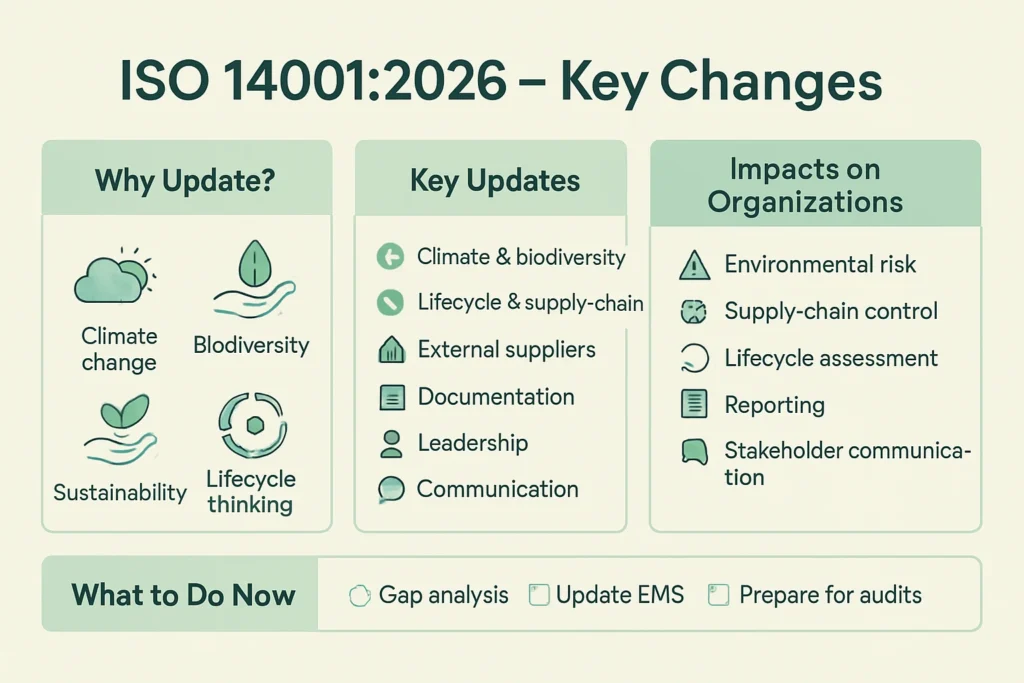
The publication of “ISO 14001:2026-Environmental management systems-Requirements with guidance for use“ marks a significant development in the international framework governing corporate environmental management. Published on 15 April 2026, the fourth edition replaces ISO 14001:2015 and the 2024 climate-action amendment.
ISO describes the revision as:
“an evolution of the established framework rather than a complete redesign”
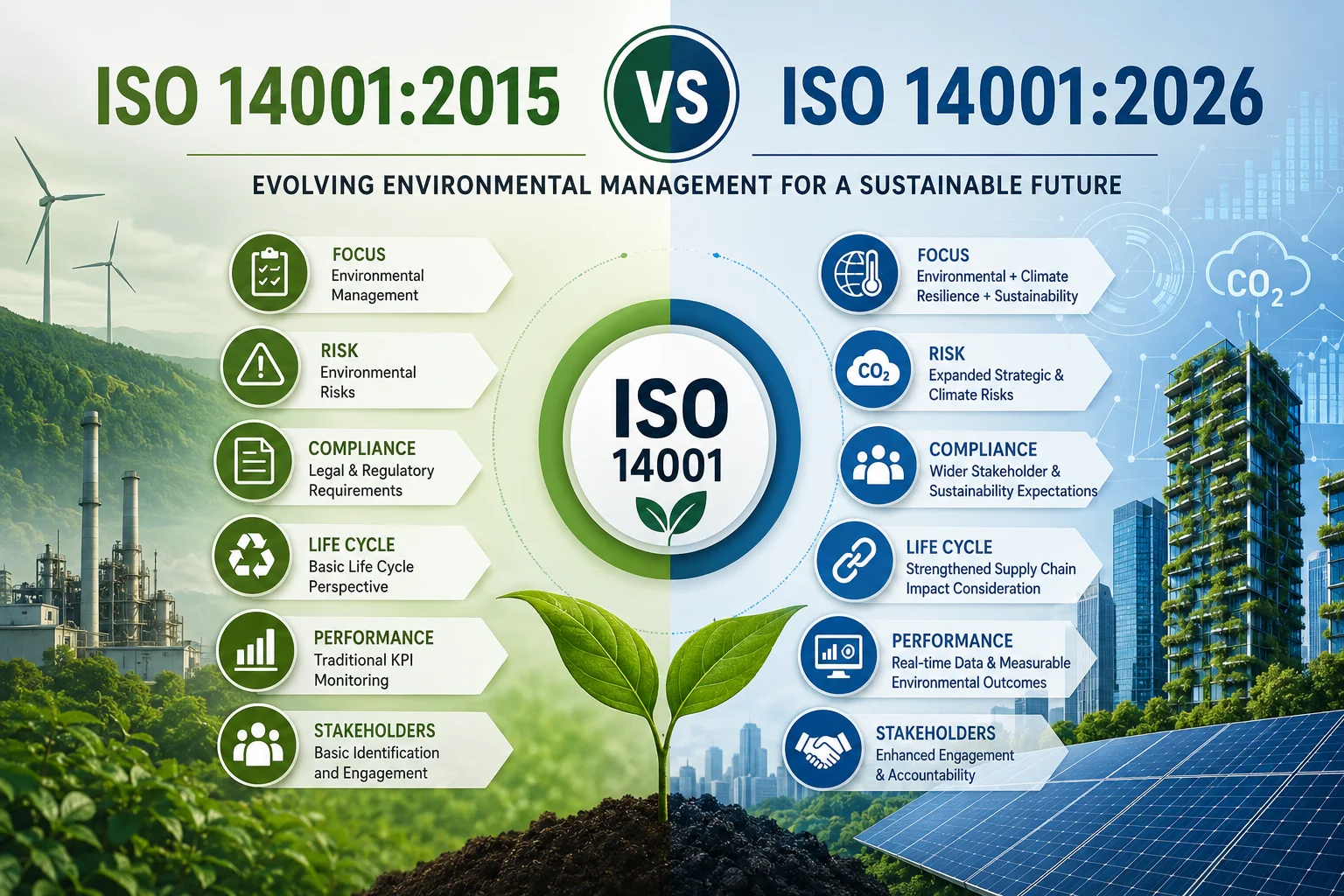
The new edition places greater emphasis on environmental context, leadership, measurable performance, value-chain considerations, governance and the practical evidence supporting an organisation’s environmental management system. That distinction is legally important that ISO 14001 certification is not itself a government-issued environmental licence, and conformity with the standard does not automatically establish compliance with environmental legislation.
ISO expressly states that:
“the standard does not prescribe specific environmental performance criteria.”
Instead, it establishes a management-system framework through which an organisation can identify environmental aspects, understand its compliance obligations, establish objectives, manage risks and opportunities, monitor performance and pursue continual improvement. The legal significance therefore lies in the relationship between the standard and the increasingly complex regulatory environment in which businesses operate.
Environmental laws are becoming more demanding. Regulators increasingly expect businesses to demonstrate environmental due diligence. Investors and financial institutions increasingly examine environmental risks. Supply-chain contracts can impose environmental requirements. Customers increasingly demand evidence behind sustainability claims.
Environmental litigation can involve corporate records, risk assessments and internal compliance systems. Against this background, ISO 14001:2026 can become more than an operational framework. It can become part of the evidence architecture through which an organisation demonstrates how it identifies, manages and responds to environmental risk.
What Is ISO 14001:2026?
ISO 14001:2026 is an international standard establishing requirements for an Environmental Management System (EMS). Its purpose is to help an organisation systematically manage its environmental responsibilities and improve environmental performance.
The standard applies to organisations regardless of their:
- size;
- sector;
- geographical location;
- ownership structure;
- products or services; or
- organisational complexity.
ISO states that the intended outcomes include:
“enhancing environmental performance, meeting compliance obligations and achieving environmental objectives.”
The standard uses the familiar Plan-Do-Check-Act (PDCA) model. This means an organisation is expected to:
Plan its environmental responsibilities and objectives;
Do what is necessary to implement them;
Check whether the system and performance are working; and
Act to correct deficiencies and improve performance.
The legal significance of this approach is that environmental management becomes an ongoing governance process rather than a one-time compliance exercise.
Is ISO 14001:2026 a Law?
No. This is one of the most important distinctions for businesses and legal practitioners. ISO 14001:2026 is an international standard, not an Act of Parliament, regulation or treaty. An organisation can generally choose whether to implement it and whether to obtain third-party certification. ISO states that:
“conformity can be demonstrated through self-determination and self-declaration, confirmation by interested parties, external confirmation, or certification/registration by an external organisation.”
Therefore:
ISO 14001 certification does not replace environmental legislation.
A factory cannot, for example, argue that because it is ISO 14001 certified, it automatically has permission to discharge pollutants, operate without a required environmental permit or disregard waste-management legislation. Legal compliance remains a separate obligation. The standard instead requires organisations to identify and manage their compliance obligations as part of the EMS.
The Legal Difference Between Certification and Compliance
This distinction becomes particularly important during environmental disputes. Imagine that a company has ISO 14001:2026 certification but is subsequently accused of unlawful pollution. The company may produce its EMS documentation, internal audits and certification as evidence of its environmental-management processes. However, certification would not automatically answer the legal question:
“Did the company comply with the applicable environmental law?”
A court or regulator would still need to examine the relevant legislation, permits, factual circumstances and evidence. ISO 14001 therefore, operates primarily at the level of management-system governance, while environmental legislation establishes legally binding obligations. The two can reinforce each other, but they are not interchangeable.
Clause 4: Understanding the Organisation’s Environmental Context
One of the most important areas of the 2026 revision concerns organisational context. ISO 14001:2026 requires organisations to understand their context, interested parties, EMS scope and environmental management system. The revised edition places greater emphasis on environmental conditions such as:
- climate change;
- pollution;
- resource availability;
- biodiversity;
- ecosystem health; and
- other environmental conditions relevant to organisational activities.
ISO describes this as part of a broader understanding of environmental context.
Legal significance
This matters because environmental risk increasingly begins before an organisation actually breaches a regulation. A company may face legal exposure because it failed to identify a foreseeable environmental risk, failed to consider a relevant dependency or failed to respond appropriately to changing environmental conditions.
The 2026 approach encourages organisations to ask:
“What environmental conditions could affect our business?”
and:
“What environmental effects could our business have on its surroundings?”
This creates a more systematic connection between environmental management and corporate risk governance.
Climate Change Is Now a Strategic Legal Risk
Climate change has moved from being primarily an environmental issue to being a significant corporate risk. Organisations can face consequences through:
- extreme weather;
- flooding;
- water shortages;
- supply-chain disruption;
- energy insecurity;
- changing environmental regulations;
- carbon-related requirements;
- climate litigation; and
- changing investor expectations.
ISO 14001:2026 strengthens the broader environmental-context approach and aligns the EMS with contemporary environmental priorities, including climate change. This is important because the 2024 amendment to ISO 14001:2015 had already introduced climate-action changes, but that amendment has now been withdrawn and replaced by ISO 14001:2026. The legal lesson is straightforward:
“Climate considerations are increasingly becoming part of mainstream corporate risk management rather than a separate sustainability initiative.”
Clause 4.2: Interested Parties and Stakeholder Expectations
ISO 14001:2026 requires organisations to determine the needs and expectations of relevant interested parties. These can include:
- regulators;
- customers;
- employees;
- local communities;
- investors;
- suppliers;
- insurers;
- business partners;
- NGOs; and
- owners.
Not every stakeholder demand automatically becomes a legal obligation. This distinction is essential. A customer may demand that a supplier reduce emissions. That does not necessarily mean the supplier is legally required to do so.
However, the requirement could become contractually binding if incorporated into a commercial agreement. This is where ISO 14001 intersects with contract law. Environmental expectations can increasingly move through supply chains from voluntary commitments into contractual obligations.
Clause 6: Environmental Risks and Opportunities
The 2026 edition strengthens the connection between environmental management and organisational decision-making. ISO identifies a clearer framework for addressing risks and opportunities and refers specifically to a new Clause 6.1.4 concerning actions to address them. This represents an important governance development.
Environmental risks are not necessarily limited to pollution. They may include:
- resource scarcity;
- regulatory change;
- climate-related disruption;
- biodiversity impacts;
- environmental accidents;
- supplier risks;
- reputational exposure;
- environmental litigation;
- changing customer requirements.
The legal value of this approach is that it encourages organisations to document why environmental risks were identified, assessed and addressed. Such records can become important evidence when regulators, auditors, insurers, investors or courts examine corporate decision-making.
Clause 6.3: Planning of Changes
Another significant area is the formalised approach to managing organisational change. Environmental risks can change when a company:
- opens a new facility;
- changes production methods;
- introduces new chemicals;
- changes suppliers;
- acquires another business;
- expands internationally;
- changes waste-management arrangements;
- introduces new technology; or
- significantly modifies its products.
A change that appears commercially attractive can create new environmental consequences. ISO 14001:2026 therefore strengthens the requirement to consider environmental management when organisational changes are planned.
Legal implication
This can support a more defensible approach to environmental due diligence during corporate transactions and operational changes. For example, environmental risks identified during an acquisition can affect:
- warranties;
- indemnities;
- valuation;
- insurance;
- regulatory approvals;
- post-acquisition liabilities.
ISO 14001 does not itself regulate mergers and acquisitions, but its risk-management framework can become relevant to those processes.
Leadership Responsibility Becomes More Important
ISO 14001:2026 places stronger emphasis on leadership, governance and accountability. Environmental management cannot simply be delegated to an environmental officer while senior management remains disconnected from the system. Top management must demonstrate leadership and commitment. This is important from a corporate-governance perspective. Environmental failures can create:
- regulatory penalties;
- civil claims;
- remediation costs;
- contractual disputes;
- reputational damage;
- shareholder concerns; and
- business interruption.
The revised standard therefore reinforces the idea that environmental performance is connected to organisational leadership. ISO describes the new edition as strengthening leadership accountability and integrating environmental considerations into strategic direction.
Environmental Policy and Corporate Commitments
An organisation’s environmental policy can become legally significant when it makes specific public commitments. For example, a company might publicly state:
“We will achieve zero waste by 2030.”
If such a statement is merely aspirational, its legal significance may be limited. But if it is incorporated into:
- contracts;
- regulatory commitments;
- financing agreements;
- investor disclosures;
- procurement requirements; or
- formal corporate policies,
its consequences can become considerably more significant.
This creates a growing relationship between environmental management and greenwashing risk. ISO 14001:2026 itself does not constitute an anti-greenwashing law. But stronger documentation, measurement and evidence can help organisations distinguish between environmental claims that are supported by operational evidence and claims that merely represent marketing language.
Environmental Aspects and the Life-Cycle Perspective
One of the core principles retained by ISO 14001 is the life-cycle perspective. Organisations need to consider environmental aspects associated with activities, products and services across relevant stages of their life cycle. This can include:
- raw materials;
- manufacturing;
- transportation;
- use;
- maintenance;
- disposal;
- recycling.
The organisation does not necessarily control every stage. But the standard recognises that it may influence environmental outcomes beyond its direct operations. This is particularly significant for modern supply chains.
A company may have a relatively clean factory while relying on suppliers with substantial environmental impacts. The revised edition strengthens attention to value-chain considerations and externally provided processes, products and services.
Supply-Chain Legal Exposure
This is potentially one of the most important legal consequences of ISO 14001:2026. Environmental responsibility is increasingly moving through supply chains. A major purchaser may require suppliers to:
- hold ISO 14001 certification;
- provide environmental data;
- meet emissions requirements;
- comply with waste standards;
- disclose environmental incidents;
- demonstrate environmental due diligence.
These requirements can become contractual conditions. Consequently, an environmental failure at a supplier can potentially become a commercial risk for the purchaser. ISO 14001:2026’s emphasis on externally provided processes, products and services therefore has significance beyond environmental management itself.
Compliance Obligations: One of the Most Important Legal Elements
ISO 14001 requires organisations to identify their applicable compliance obligations. These may arise from:
- environmental statutes;
- regulations;
- permits;
- licences;
- regulatory conditions;
- contractual requirements;
- voluntary commitments that the organisation chooses to adopt.
The organisation must then determine how these obligations apply to its environmental aspects. This is where ISO 14001 most directly intersects with legal compliance. A properly functioning EMS should help an organisation answer:
- What environmental laws apply to us?
- Which permits do we need?
- What regulatory limits apply?
- Who is responsible for compliance?
- How do we monitor compliance?
- What happens if we identify non-compliance?
This is essentially an environmental compliance-management system.
ISO 14001 Does Not Guarantee Environmental Compliance
There is an important caveat. ISO itself expressly states that adoption of the standard does not guarantee optimal environmental outcomes. Two organisations can conform to ISO 14001 while having different environmental performance because their:
- activities;
- environmental aspects;
- compliance obligations;
- technologies;
- commitments;
- environmental risks; and
- objectives
may be different.
Therefore, certification should not be presented as proof that a company is “environmentally safe”. That would be an overstatement. It demonstrates conformity with a management-system standard.
Documentation Becomes Increasingly Important
One of the practical changes highlighted by UKAS is a greater emphasis on evidence and documentation availability in the 2026 transition. This has significant legal implications. Documentation can demonstrate:
- what management knew;
- what risks were identified;
- what decisions were made;
- who was responsible;
- what corrective action was taken;
- how compliance was monitored.
In an environmental dispute, these records can become extremely important. A company that can demonstrate a structured risk-management process may be in a stronger evidential position than one that merely claims to have an environmental policy.
However, documentation can also create risks. If internal records reveal that management knew about a serious environmental risk but failed to act, those same records could potentially become evidence against the organisation. Therefore:
“Better documentation increases accountability as well as defensibility.”
Internal Audits and Environmental Accountability
Internal auditing is another important component of the EMS. ISO 14001:2026 strengthens attention to internal audit requirements, including documented audit programmes and objectives. An effective audit should test whether the system is actually working. It should not simply confirm that documents exist.
From a legal perspective, internal audits can identify:
- regulatory gaps;
- permit failures;
- environmental incidents;
- inadequate controls;
- training deficiencies;
- monitoring failures.
Early identification allows corrective action before problems become regulatory or litigation issues.
Management Review and Board-Level Governance
Management review provides another bridge between environmental management and corporate governance. Senior management should evaluate whether the EMS remains appropriate and effective. This means environmental performance should not disappear into an operational department. The information can feed into wider corporate decision-making.
For boards and senior executives, this raises questions such as:
- What are our major environmental risks?
- Are we meeting our compliance obligations?
- Have environmental incidents increased?
- Are our environmental objectives being achieved?
- Are regulatory requirements changing?
- Are suppliers creating environmental exposure?
- Are climate risks affecting business continuity?
ISO 14001:2026 therefore encourages environmental issues to be treated as governance issues.
Biodiversity and Natural Capital
One of the most significant developments in modern environmental governance is the increasing attention to biodiversity and natural capital. ISO specifically identifies biodiversity and natural capital among the emerging environmental priorities reflected in the revised edition. This matters because businesses depend on ecosystems.
Agriculture depends on:
- soil;
- water;
- pollination;
- biodiversity.
Manufacturing depends on:
- water;
- raw materials;
- energy.
Tourism can depend on:
- ecosystems;
- landscapes;
- biodiversity.
Environmental degradation can therefore become a business-continuity risk. ISO 14001:2026’s broader environmental-context approach helps organisations consider these dependencies more systematically.
Resource Scarcity and Circular Economy
Resource availability is another major issue. Businesses increasingly face risks associated with:
- water scarcity;
- energy availability;
- raw-material shortages;
- waste;
- supply-chain disruption.
According to DQS:
“The revised ISO framework gives greater consideration to resource use and the circular economy.”
The legal significance is that resource management increasingly overlaps with environmental regulation. Governments may introduce requirements concerning:
- waste reduction;
- recycling;
- producer responsibility;
- resource efficiency;
- water management;
- hazardous materials.
Organisations with structured environmental management systems may therefore be better positioned to respond to changing requirements.
ISO 14001 and Environmental Litigation
ISO 14001:2026 does not provide immunity from litigation. A certified company can still be sued. However, the existence of an EMS may become relevant evidence in disputes concerning environmental governance. The precise legal effect will depend upon the jurisdiction and the particular dispute.
A court may consider evidence concerning:
- environmental policies;
- compliance systems;
- risk assessments;
- monitoring;
- audits;
- corrective actions;
- management decisions.
But organisations should avoid assuming that certification automatically protects them. It does not.
ISO 14001 and Greenwashing
Greenwashing is becoming an increasingly important regulatory and litigation issue. The risk arises when an organisation makes environmental claims that are misleading, exaggerated or insufficiently supported. ISO 14001:2026 can help create evidence supporting legitimate environmental-management claims.
But certification does not authorise a company to make unlimited environmental marketing claims. A company certified to ISO 14001 cannot automatically claim:
“Our products are environmentally friendly.”
Nor can it necessarily claim:
“We have zero environmental impact.”
The standard does not establish those propositions. A legally safer approach is to make claims that accurately describe what the certification actually demonstrates. For example:
“Our environmental management system is certified to ISO 14001:2026.”
That is materially different from claiming that the company’s products have no environmental impact.
22. ISO 14001 and ESG
ISO 14001 should not be confused with an ESG reporting framework. However, the EMS can support the environmental component of broader ESG governance. It can provide structured information concerning:
- environmental objectives;
- environmental risks;
- resource use;
- waste;
- pollution;
- environmental performance;
- compliance.
That information can potentially support wider corporate reporting. But ISO 14001 certification alone does not establish that a company’s overall ESG performance is satisfactory. Environmental governance is only one part of broader ESG considerations.
ISO 14001 and Corporate Due Diligence
Environmental due diligence is increasingly important during:
- mergers;
- acquisitions;
- financing;
- investment;
- insurance;
- supply-chain onboarding.
ISO 14001 can provide a structured framework for identifying environmental risks. For example, during an acquisition, lawyers may examine:
- environmental permits
- contamination risks
- waste obligations
- historic liabilities
- environmental litigation
- regulatory notices
- EMS records
- audit findings
- supplier risks
The presence of an ISO 14001 system does not eliminate those risks. Instead, it may provide an additional source of information for evaluating them.
Certification and the Transition From ISO 14001:2015
ISO 14001:2026 has replaced the 2015 edition. ISO states that certified organisations will need to transition to the new edition within the timeframe established through the certification process, typically around three years. Organisations should confirm the applicable transition arrangements with their certification body.
This is important because businesses should not assume that their existing 2015 certification automatically means compliance with the 2026 requirements. A transition exercise should examine:
- context;
- environmental risks;
- leadership;
- compliance obligations;
- environmental objectives;
- change management;
- suppliers;
- internal audits;
- management review;
- documentation;
- performance measurement.
UKAS has also issued transition guidance for conformity-assessment bodies following publication of the new edition.
What Organisations Should Do Now
For organisations currently certified to ISO 14001:2015, the transition should begin with a gap analysis. The organisation should compare its existing EMS with the 2026 requirements. The review should examine whether:
- environmental context has been adequately reassessed;
- relevant environmental conditions have been identified;
- interested parties and their requirements have been reviewed;
- climate risks have been incorporated appropriately;
- environmental risks and opportunities are documented;
- change-management processes consider environmental consequences;
- leadership responsibilities are clear;
- supply-chain controls are adequate;
- internal audits produce sufficient evidence;
- management reviews address environmental performance; and
- documentation is sufficiently robust to demonstrate conformity.
This should not simply be a paperwork exercise. The objective should be to determine whether environmental management is actually embedded in organisational decision-making.
Legal Risk Matrix for ISO 14001:2026
| Area | Potential legal/regulatory risk | ISO 14001:2026 relevance |
|---|---|---|
| Environmental permits | Operating outside regulatory conditions | Compliance obligations |
| Pollution | Civil/regulatory liability | Environmental aspects and controls |
| Climate change | Physical and regulatory risk | Context and risk planning |
| Supply chain | Supplier environmental failures | Externally provided processes |
| Greenwashing | Unsupported environmental claims | Evidence and performance |
| Waste | Regulatory non-compliance | Operational controls |
| Water | Resource and regulatory disputes | Environmental context |
| Biodiversity | Environmental impact exposure | Broader environmental context |
| Corporate transactions | Hidden environmental liabilities | Risk assessment/change management |
| Internal governance | Failure to identify environmental risks | Leadership and management review |
| Documentation | Weak evidence of compliance | Documented information |
| Auditing | Undetected systemic failures | Internal audit |
| Corrective action | Recurring environmental incidents | Continual improvement |
ISO 14001:2026 and Directors’ Responsibilities
One of the more important questions for corporate lawyers is whether ISO 14001:2026 increases directors’ legal responsibilities. The answer requires caution. The standard itself does not automatically create statutory directors’ duties. Those duties arise from:
“the applicable corporate, environmental and regulatory laws.”
However, where directors have responsibility for environmental governance, the EMS can become part of the organisation’s broader risk-management framework. If senior management receives repeated warnings about environmental risks through audits and management reviews, those warnings may become relevant to questions about corporate decision-making.
The legal significance therefore comes not from ISO 14001 creating a new directors’ duty, but from the standard potentially creating a more structured record of environmental governance and management knowledge.
The Evidential Double-Edged Sword
This may be one of the most interesting legal consequences of ISO 14001:2026. A sophisticated EMS can help an organisation demonstrate:
“We identified the risk, assessed it, implemented controls, monitored it and took corrective action.”
That can be valuable evidence of responsible governance. But the same system may also demonstrate:
“Management knew about the risk and failed to implement the required corrective action.”
Therefore, ISO 14001 should not be treated merely as a certification exercise. Once an organisation creates a sophisticated environmental-management system, it must be prepared to act on the information that system produces. Otherwise, the system can expose governance failures rather than conceal them.
ISO 14001:2026 and International Supply Chains
The international nature of ISO 14001 is particularly important for multinational businesses. A company operating across multiple jurisdictions may face:
- different environmental laws;
- different permitting systems;
- different waste rules;
- different climate regulations;
- different disclosure requirements.
ISO 14001 provides a common management framework across those jurisdictions. That does not harmonise national environmental law. Instead, it gives multinational organisations a common internal system through which different legal obligations can be identified and managed. This may become increasingly valuable as environmental regulation becomes more fragmented internationally.
ISO 14001:2026 and Export Markets
Environmental requirements increasingly affect international trade. Exporters may encounter:
- customer sustainability requirements;
- environmental product standards;
- supply-chain due diligence;
- carbon-related requirements;
- environmental disclosures;
- procurement conditions.
An ISO 14001-certified EMS can demonstrate that an organisation has a structured environmental-management system. However, businesses must avoid presenting certification as proof that every product or supply-chain activity complies with every environmental requirement in every export market. The legal requirements of the destination jurisdiction remain separate.
Is ISO 14001:2026 Stronger Than ISO 14001:2015?
It is more accurate to describe the revision as a strengthening and clarification of the existing framework rather than a completely new standard. ISO says:
“the 2026 edition retains the trusted framework while providing clearer requirements, stronger leadership accountability, improved integration and greater emphasis on measurable environmental performance.”
UKAS similarly identifies updated environmental concepts, linked clauses, structural changes and greater emphasis on evidence and documentation as important aspects of the revision. The result is therefore evolutionary rather than revolutionary. But evolutionary changes can still have significant legal consequences when they affect:
- evidence;
- accountability;
- contracts;
- regulatory compliance;
- supply chains;
- governance.
The Broader Legal Meaning of ISO 14001:2026
The deeper significance of ISO 14001:2026 is that environmental responsibility is increasingly moving from the margins of corporate policy into the centre of governance. Environmental issues are now connected to:
- corporate risk
- financial risk
- supply-chain risk
- regulatory compliance
- consumer protection
- contractual liability
- climate litigation
- investment decisions
- and corporate reputation.
ISO 14001:2026 reflects that transformation. Its central message is not simply that businesses should “be greener”. It is that environmental management should become systematic, documented, measurable and integrated into organisational decision-making.
Conclusion
ISO 14001:2026 does not create environmental law. It does not replace environmental permits. It does not guarantee that an organisation is environmentally responsible. And it does not provide immunity from regulatory enforcement or litigation. Its significance lies elsewhere.
The 2026 edition creates a more structured framework through which organisations can identify environmental risks, understand compliance obligations, establish objectives, manage change, control environmental impacts, evaluate performance and demonstrate continual improvement.
ISO has also emphasised stronger leadership, value-chain oversight, climate and biodiversity considerations, measurable performance and clearer governance. For lawyers, regulators, boards and compliance professionals, the most important development may be the growing connection between environmental management and evidence.
A company increasingly needs to demonstrate not merely that it has an environmental policy, but that it understands its environmental risks, has appropriate controls, monitors performance and responds when problems arise. That makes ISO 14001:2026 particularly relevant to the modern concept of corporate environmental due diligence. The legal future of environmental governance is therefore unlikely to be based solely on government regulation.It will increasingly involve a combination of:
“statutory environmental law + regulatory enforcement + contractual obligations + corporate governance + international standards + supply-chain requirements + environmental disclosure.”
ISO 14001:2026 sits at the intersection of those developments. Its real significance may ultimately be less about the certificate displayed on a company’s wall and more about the quality of environmental decision-making, evidence and accountability behind that certificate.
Frequently Asked Questions
1. What is ISO 14001:2026?
ISO 14001:2026 is the fourth edition of the international standard for Environmental Management Systems. It was published in April 2026 and replaces ISO 14001:2015 and its 2024 climate-action amendment.
2. Is ISO 14001:2026 a law?
No. It is an international voluntary standard. However, it can support an organisation’s environmental compliance, risk management and governance processes.
3. Does ISO 14001 certification prove legal compliance?
No. Certification demonstrates conformity with the ISO management-system requirements; it does not automatically prove compliance with every environmental law, permit or regulatory requirement.
4. What are the major changes in ISO 14001:2026?
The revision strengthens and clarifies areas including environmental context, leadership, environmental risks and opportunities, change management, value-chain considerations, evidence, internal auditing and environmental performance.
5. Does ISO 14001:2026 address climate change?
Yes. Climate change forms part of the broader environmental context addressed by the revised framework, building on the climate-action changes introduced in the previous edition.
6. Does ISO 14001:2026 cover biodiversity?
Biodiversity and ecosystem considerations receive greater attention within the revised environmental context and contemporary environmental priorities.
7. Does ISO 14001:2026 prevent greenwashing?
No. Certification does not automatically validate every environmental claim made by an organisation. Environmental marketing claims must still comply with applicable consumer-protection, advertising and other relevant laws.
8. Will companies certified to ISO 14001:2015 have to transition?
9. Why is documentation important under ISO 14001:2026?
Documentation provides evidence of how an organisation identifies risks, manages compliance obligations, conducts audits, makes decisions and implements corrective actions. The 2026 transition guidance places greater emphasis on evidence and documentation availability.
10. Can ISO 14001:2026 protect a company from environmental litigation?
No. Certification does not provide legal immunity. It may, depending on the circumstances and jurisdiction, provide evidence of an organisation’s environmental-management processes, but legal liability remains determined under applicable law and the facts of the particular case.
11. What is the biggest legal significance of ISO 14001:2026?
Its most important legal significance is the growing expectation that organisations should be able to identify, manage, document and demonstrate their response to environmental risks, rather than merely publish environmental commitments.