
TABUK, Saudi Arabia — A Flydubai flight FZ1073 travelling from Dubai to Tel Aviv was diverted to Saudi Arabia on September 30 after a violent cockpit incident involving the pilots triggered an emergency response and raised the possibility of an attempted hijacking or deliberate attack on the aircraft.
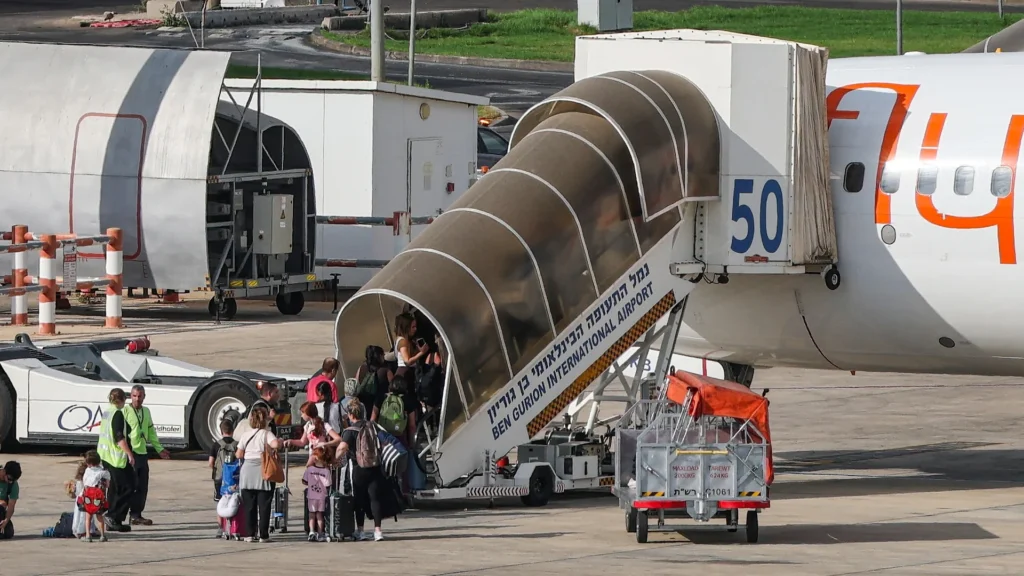
Flight FZ1073, carrying 174 passengers, was travelling towards Tel Aviv when the aircraft experienced a dramatic loss of altitude and transmitted emergency signals. It subsequently landed safely at Prince Sultan bin Abdulaziz International Airport in Tabuk, where both the captain and first officer were reportedly taken to hospital.
Saudi Arabia’s National Transport Safety Center has opened a formal investigation. The legal significance of the incident extends well beyond the safety of one flight. Investigators must now determine whether the event constituted:
” A cockpit assault, unlawful interference with civil aviation, attempted hijacking, attempted destruction of an aircraft or another criminal offence.”
The answer could determine which international aviation-law provisions apply.
What Happened Aboard FZ1073?
According to Israeli officials, one pilot allegedly stabbed the other and then attempted to crash the aircraft. Israeli Prime Minister Benjamin Netanyahu said passengers and crew intervened and helped prevent what he described as a potentially catastrophic attack. Other reporting indicates that passengers and an off-duty pilot or crew members helped restrain the alleged attacker before the aircraft was safely diverted.
Flydubai has adopted more cautious language, describing an “altercation in the flight deck” and saying the aircraft was secured and diverted safely. The airline has said:
“the motives behind the incident remain subject to formal investigation.”
That distinction is legally important. A political statement describing an incident as a terror attack does not itself establish the legal classification of the conduct. That determination belongs to investigators and, ultimately, the relevant judicial authorities.
The 7500 Signal Put Authorities on Hijacking Alert
The aircraft reportedly transmitted the international emergency code 7700, followed by 7500, the transponder code associated with unlawful interference, including a possible hijacking. The 7500 transmission prompted a significant security response, including the reported scrambling of Israeli fighter aircraft.
But the transmission itself is not proof that a hijacking legally occurred. It is an emergency warning mechanism. The investigation must establish:
“why the code was transmitted, who transmitted it and what was happening inside the aircraft at the time.”
Saudi Arabia Launches Formal Aviation Investigation
The National Transport Safety Center confirmed that an aviation-safety investigation had begun following the aircraft’s emergency landing in Tabuk. Saudi investigators are coordinating with other authorities to establish the circumstances, examine aviation safety issues, and collect evidence. The airport said its air-traffic-control centre received the aircraft’s emergency landing request and that the plane subsequently landed safely.
All passengers later departed Saudi Arabia aboard a replacement aircraft. The opening of a formal investigation is significant because the incident involves both aviation safety and potential criminal conduct. Those investigations can overlap, but they serve different purposes.
An aviation-safety investigation seeks to establish what happened and how future accidents or incidents can be prevented. A criminal investigation seeks to establish whether an offence occurred and whether a particular person can be held legally responsible.
Was This Legally a Hijacking?
That remains one of the central unanswered questions. The reported events potentially fall into several different legal categories that includes:
Unlawful interference: The use of the 7500 transponder code indicates that authorities treated the situation as a possible unlawful-interference event.
Attempted hijacking: If investigators establish that a person attempted to seize or exercise control over the aircraft, international hijacking law could become relevant.
Criminal assault: If one pilot deliberately attacked another, ordinary criminal law concerning assault and weapons could also apply.
Attempted destruction of an aircraft: If evidence establishes an intentional attempt to crash the aircraft, considerably more serious aviation-security offences could arise.
Terrorism: A terrorism designation would require evidence satisfying the applicable legal definition, including the necessary intent and purpose. These categories should not be treated as interchangeable.
The Hague Convention and Aircraft Hijacking
The 1970 Hague Convention for the Suppression of Unlawful Seizure of Aircraft is one of the principal international instruments governing aircraft hijacking. It requires states parties to criminalise the unlawful seizure or exercise of control over an aircraft. The convention was created in response to the wave of aircraft hijackings that affected international aviation in the 1960s and early 1970s.
But applying it to FZ1073 will depend on a critical factual question:
“Did the alleged attacker unlawfully seize or exercise control over the aircraft?”
An assault on a pilot does not automatically establish a completed hijacking. Investigators would need to determine what control, if any, the alleged attacker attempted to obtain.
The Montreal Convention May Also Be Relevant
The 1971 Montreal Convention for the Suppression of Unlawful Acts against the Safety of Civil Aviation provides another important legal framework. It addresses:
“unlawful acts that endanger the safety of aircraft in flight, including conduct capable of causing serious harm to aircraft, passengers or crew.”
If investigators conclude that the alleged cockpit attack deliberately endangered the aircraft, the Montreal Convention framework could therefore become relevant alongside domestic criminal law. The precise offences and jurisdiction would depend on the evidence and the states involved.
Jurisdiction Complication
This is not a conventional domestic aviation case. The aircraft:
departed from Dubai, UAE
↓
was travelling toward Tel Aviv, Israel
↓
entered Saudi Arabian airspace
↓
experienced the emergency
↓
landed in Tabuk, Saudi Arabia
That creates potential jurisdictional interests for several states that includes:
Saudi Arabia: The aircraft landed in Saudi territory, the investigation is taking place there and Saudi authorities have reportedly detained or questioned the alleged attacker.
United Arab Emirates: The flight originated in Dubai and the airline is based in the UAE.
Israel: The aircraft was destined for Israel and most passengers were reportedly Israeli.
Oman: Reports have identified the alleged attacker as an Omani national, although this aspect and other personal details remain subject to investigation.
The eventual prosecution could therefore require international legal cooperation.
The Tokyo Convention and Onboard Criminal Jurisdiction
The 1963 Tokyo Convention also forms part of the international framework for offences committed aboard aircraft. International Civil Aviation Organization ICAO describes the convention as applying to offences against penal law and acts that may jeopardize the safety of an aircraft, persons or property aboard, or good order and discipline.
Its relevance illustrates why the legal system treats aircraft incidents differently from ordinary criminal events on the ground. An aircraft can be in one state’s territory, registered in another, operated by a third state’s airline and carrying passengers from multiple countries.
International aviation law therefore has to allocate jurisdiction and facilitate cooperation across borders.
Why the Pilot’s Position Matters
The case presents an unusual aviation-security problem because the alleged threat reportedly originated from inside the cockpit. Traditional hijacking scenarios generally involve an external perpetrator attempting to gain control of an aircraft. Here, the investigation is reportedly focused on a member of the flight crew.

That raises difficult questions concerning:
- crew vetting;
- cockpit access;
- weapons screening;
- psychological and medical assessments;
- airline security procedures;
- pilot identification;
- cockpit-door protocols; and
- emergency response.
The question is not simply whether the pilot allegedly committed an offence. It is also whether existing aviation-security systems were capable of detecting and preventing such a threat.
How Did a Weapon Enter the Cockpit?
One of the most important investigative questions concerns the reported knife. If investigators confirm that one pilot used a knife against another, they will need to establish how the weapon came into the cockpit. Possible lines of investigation include:
- where the weapon was obtained;
- whether it was brought through airport security;
- whether crew screening procedures applied;
- whether it was concealed among personal belongings;
- whether security personnel could reasonably have detected it; and
- whether any existing airline procedures were breached.
The answer could have consequences for aviation-security rules far beyond Flydubai.
Could This Be Treated as Terrorism?
A deliberate attempt to crash an aircraft could be a serious aviation-security offence even if prosecutors ultimately conclude that the legal definition of terrorism is not satisfied.
Israeli Defence Minister Israel Katz described the incident as:
“an attempted jihadist terror attack.”
Prime Minister Netanyahu said:
“the pilot appeared to have attempted to crash the aircraft.”
However, those are statements by political officials and should be distinguished from an established judicial finding. The available reporting does not yet establish the attacker’s motive. For a terrorism charge, prosecutors would generally need evidence satisfying the relevant statutory definition, which may include a particular ideological or political purpose
Passenger Intervention and the Law of Necessity
Reports indicate that passengers and crew members intervened to restrain the alleged attacker. If confirmed, this raises an interesting but secondary legal question. Under ordinary criminal law, physical force can potentially be justified in circumstances involving immediate threats to life or serious injury, subject to the law of the jurisdiction concerned.
On an aircraft experiencing an apparent cockpit takeover, passengers may reasonably perceive an immediate threat to themselves and others. However, the precise legal position would depend on the circumstances, the force used and applicable domestic law.
The reported passenger intervention should therefore be assessed separately from the alleged attack by the pilot.
The 14,000-Foot Descent Could Become Key Evidence
Flight-tracking information reportedly showed a dramatic descent during the incident. Al Jazeera reported that the aircraft dropped more than 14,000 feet in under 30 seconds during the emergency.
That data could become important evidence. Investigators can potentially compare:
- flight-recorder data;
- cockpit voice recordings;
- air-traffic-control communications;
- transponder signals;
- passenger and crew testimony;
- aircraft-control inputs; and
- medical and forensic evidence.
Together, these records could help reconstruct what happened inside the cockpit.
What Will Investigators Nee to Establish?
The investigation is likely to focus on several core questions.
1. Who initiated the cockpit confrontation?
This may determine the criminal starting point of the incident.
2. Was the captain deliberately stabbed?
Medical and forensic evidence could establish the nature of the injuries.
3. Was there an attempt to take control of the aircraft?
This could determine whether international hijacking law applies.
4. Was there an attempt to crash the aircraft?
Aircraft-control data and cockpit recordings could become critical.
5. Why was the 7500 code transmitted?
Investigators will need to establish who transmitted it and why.
6. Was the incident ideologically motivated?
This would be important to any terrorism investigation.
7. How did the alleged weapon enter the cockpit?
This could expose aviation-security failures.
The Germanwings Precedent
The incident is likely to revive discussion about threats posed by flight crew. In 2015, Germanwings Flight 9525 was deliberately crashed into the French Alps by its co-pilot, killing all 150 people aboard. The circumstances of FZ1073 are not established as equivalent.
Nevertheless, the two incidents demonstrate why aviation regulators have long faced difficult questions concerning pilot mental-health confidentiality, fitness to fly, medical information and cockpit security. Any comparison must therefore be made carefully and without speculating about the current pilots’ mental state.
The FZ1073 emergency demonstrates that aviation law must address more than traditional hijacking scenarios. Modern aviation security must also consider:
- insider threats;
- crew-on-crew violence;
- unauthorised cockpit access;
- deliberate aircraft sabotage;
- emergency communications;
- passenger intervention;
- international military responses; and
- cross-border criminal investigations.
The case could therefore become significant not because the aircraft was successfully hijacked, but because:
“it illustrates how unlawful interference can emerge from within the flight crew itself.”
Conclusion:
The Flydubai FZ1073 incident presents an unusually complex test for international aviation law. A violent cockpit confrontation reportedly caused a dramatic descent, triggered an unlawful-interference alert and forced an international passenger aircraft to land in Saudi Arabia. The incident subsequently generated a multinational security response and a formal investigation.
But the central legal question cannot yet be reduced to the word “hijacking.” International law provides several potentially applicable frameworks. The Hague Convention addresses unlawful seizure or attempted seizure of aircraft. The Montreal Convention addresses intentional violence against persons aboard aircraft where the conduct is likely to endanger aviation safety. The Tokyo Convention provides another layer concerning offences and acts affecting safety and order aboard aircraft.
The final legal significance of FZ1073 will therefore depend not on the initial alarm or political description of the event, but on what the evidence establishes about control of the aircraft, intent, violence, motive, jurisdiction and compliance with international aviation law.
For N-LAWS, the case is significant because it sits directly at the intersection of international aviation law, criminal jurisdiction, aviation security and the law governing unlawful interference with civilian aircraft.