
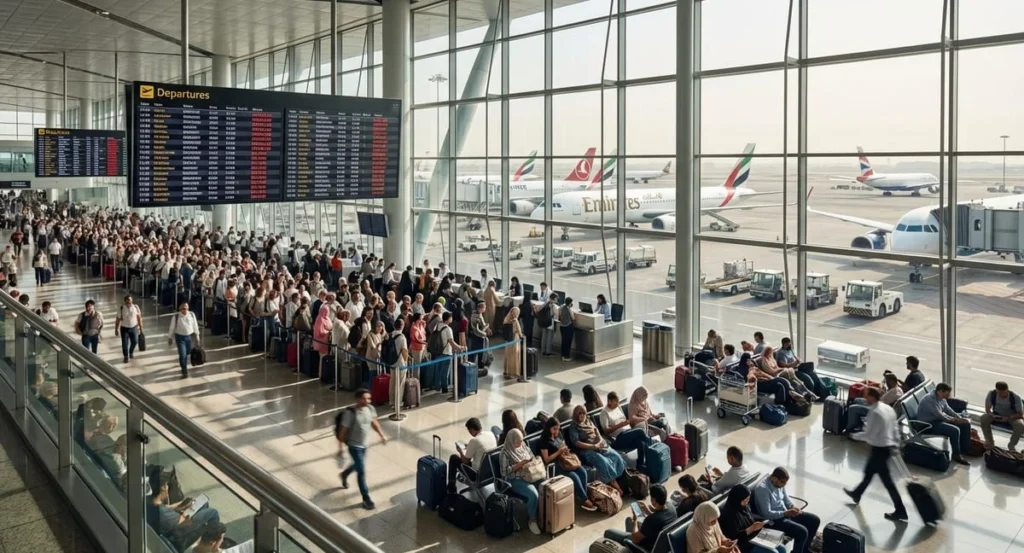
Global air travel faced severe disruption after Iranian retaliatory strikes targeted Dubai International Airport, forcing the closure of one of the world’s busiest aviation hubs and sending shockwaves through international aviation and legal systems. The attack, reportedly part of escalating regional hostilities involving Iran, Israel, and allied states, led to the immediate suspension of airport operations and the closure of surrounding airspace, grounding hundreds of flights and stranding thousands of passengers worldwide.
Airport Shutdown and Immediate Aviation Impact
Dubai International Airport was forced to shut its airspace after Iranian airstrikes hit the facility, damaging infrastructure and injuring several individuals. Airport operations were completely suspended following the attack, causing cascading cancellations and diversions across major global routes connecting Europe, Asia, and Africa.
Airlines began rerouting flights across the Middle East, while several carriers suspended operations entirely due to safety risks. Earlier regional tensions had already led to flight cancellations and route changes around Iranian airspace, but the strike on Dubai intensified disruptions into a full-scale aviation crisis affecting global connectivity.
Major airlines from Asia, Europe, and the Middle East have reported significant operational impacts, including:
- Closure or partial restriction of airspace over the Middle East, particularly around the Strait of Hormuz, Persian Gulf, and Riyadh–Tehran flight corridors, amid missile and drone threats.
- Cancellation and rerouting of hundreds of long-haul flights, with carriers such as Emirates, Qatar Airways, Lufthansa, British Airways, and multiple Asian carriers reporting schedule suspensions or substantial delays.
- Diversion of flights away from conflict zones, resulting in longer routes, increased fuel costs, and logistical challenges for aircraft and crew.
The International Air Transport Association (IATA), in its latest advisory, warned that extended airspace restrictions could lead to a “full-scale global aviation disruption,” particularly if hostilities intensify or spread beyond current hotspots.
Legal Basis for Airspace Closures and Safety Control
Under international law, sovereign states have the authority to control and restrict access to their own airspace. This is grounded in the Chicago Convention on International Civil Aviation (1944), which establishes that:
- States have exclusive sovereignty over the airspace above their territory.
- In situations of conflict or threat to national security, they may limit or close airspace to protect civil aviation.
- Advisory bodies such as ICAO (International Civil Aviation Organization) issue guidance on safe air route planning, but cannot compel states to keep airspace open.
In the current crisis, several states have invoked national security exceptions to close or limit airspace use, while ICAO has issued guidance recommending that airlines avoid specific high-risk areas.
Carrier Liability and Passenger Rights Amid Disruptions
Airlines face complex regulatory and contractual issues as a result of the chaos:
- Under the Montreal Convention (1999), carriers may be liable for passenger injuries or delays, but extraordinary circumstances (such as war or airspace closures due to conflict) can limit liability.
- Many carriers are issuing waivers for change fees and refunds, but economic strain from prolonged rerouting and grounded aircraft is growing.
- Passengers face travel delays, cancellations, and additional costs, leading to disputes over compensation and rights, particularly in jurisdictions with robust consumer protection laws such as the EU’s Regulation 261/2004.
Legal experts have noted that while extraordinary conflict situations can limit airline liability for disruptions, the duration and predictability of closures may influence regulatory treatment and future litigation.
Insurance and Risk Allocation
The aviation industry’s insurance sector is under pressure as war-risk premiums surge. Aircraft flying near conflict zones typically require “war-risk” coverage, which during periods of instability, becomes both more expensive and more difficult to secure. Some insurers have declared certain regions as “exclusion zones,” meaning carriers must operate without coverage or avoid areas entirely.
This raises legal questions about:
- Contract interpretation where exclusions apply
- Carrier obligations to disclose increased risk to passengers
- Dispute resolution mechanisms for claims arising from uninsured losses
Economic and Supply Chain Consequences
The travel disruptions have broader economic impacts:
- Cargo flight cancellations are affecting global supply chains, particularly for time-sensitive goods such as electronics, pharmaceuticals, and perishables.
- Tourism sectors in affected regions are facing sharp downturns.
- Airline financial stability is threatened as longer routes and grounded fleets erode profitability.
Governments and aviation regulators are under pressure to coordinate risk assessments, safety protocols, and contingency plans for continued operations.
ICAO and Multilateral Coordination Efforts
The International Civil Aviation Organization (ICAO) has convened emergency sessions to:
- Update risk advisories for member states
- Coordinate international responses to ensure safe corridors where possible
- Share intelligence on regional threats to civil aviation
However, ICAO’s authority is advisory; enforcement depends on state compliance and bilateral or multilateral agreements among carrier and sovereign entities.
Legal and International Aviation Implications
The attack on a major civilian airport raises serious issues under international law, particularly the Chicago Convention on International Civil Aviation, which obliges states to ensure the safety of civil aviation and avoid targeting civilian air infrastructure. Any deliberate or reckless attack on a civilian airport may constitute a violation of international humanitarian law and could trigger state responsibility and potential claims before international tribunals.
Airlines and insurers are also assessing liability for cancelled flights, passenger compensation, and aviation risk coverage under force-majeure clauses. If the conflict escalates further, prolonged airspace closures could lead to unprecedented disputes over aviation safety obligations, war-risk insurance, and compensation for stranded travelers and cargo losses.
A New Phase of Aviation Security Crisis
The targeting of Dubai International Airport marks a significant escalation in the regional conflict’s impact on global civil aviation. Legal experts warn that attacks on major international transport hubs risk redefining aviation security norms and may prompt emergency measures by the International Civil Aviation Organization (ICAO) and national regulators.
With global air corridors across the Middle East now considered high-risk zones, the incident underscores how regional conflicts can rapidly transform into worldwide transportation and legal crises affecting millions of travelers and the broader global economy.
What This Means for Travelers and Airlines
The shutdown of Dubai, a critical global aviation transit hub, triggered widespread travel chaos. Thousands of passengers were stranded across connecting airports, while cargo shipments faced delays affecting global supply chains, including energy, pharmaceuticals, and high-value goods.
- Travelers: Should expect ongoing delays and cancellations, enhanced security screenings, and changing routing protocols. Refund and compensation rights will vary by jurisdiction.
- Airlines: Must navigate evolving airspace restrictions, rising costs, and complex liability frameworks under international conventions.
- Governments: Face legal and regulatory challenges balancing national security with obligations under international aviation treaties.
Governments across Asia, Europe, and the Gulf issued emergency travel advisories and began evacuating citizens from affected transit zones. Some states established crisis committees to coordinate responses to the growing instability and its impact on international travel and trade.