
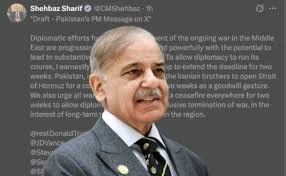
A striking contrast in diplomatic strategy has emerged in the ongoing U.S.–Iran conflict, as two contrasting tweets have resulted in two contrasting outcomes. Pakistan Prime Minister Shehbaz Sharif’s ceasefire tweet appears to have yielded tangible results, while the aggressive rhetoric of U.S President **Donald Trump continues to draw legal and ethical criticism globally.
The contrasting global reactions highlight a deeper transformation in international law, diplomatic practice, and state responsibility in the digital age. This situation is not merely political; it reflects evolving legal norms governing speech, use of force, and legitimacy in international relations.
Ceasefire Diplomacy: Pakistan’s Intervention Changes the Course
Pakistan’s diplomatic intervention, reportedly including direct appeals and public messaging, played a decisive role in securing a two-week ceasefire between the United States and Iran. Sharif had urged restraint and a delay in escalation, calling for dialogue rather than immediate military action. This approach culminated in:
- A halt to imminent U.S. strikes
- Iran agreeing to reopen the Strait of Hormuz
- Global leaders welcoming the move as a step toward de-escalation and legality
From a legal perspective, Sharif’s approach aligns with core principles of international law:
- Peaceful settlement of disputes (UN Charter Article 2(3))
- Preference for diplomatic solutions over use of force
- Reduction of risk to civilian populations and global trade
Trump’s Strategy: Coercive Threats and Legal Criticism
In contrast, Trump’s approach relied heavily on coercive diplomacy backed by explicit threats, including warnings of large-scale destruction if Iran failed to comply.
His rhetoric, widely criticized as inflammatory, has raised serious legal concerns:
- Potential violation of the UN Charter prohibition on the threat of force
- Concerns over intent to target civilian infrastructure
- Ethical criticism for language inconsistent with head-of-state responsibility
Legal experts argue that even before any action is taken:
“threatening disproportionate or indiscriminate force can itself undermine international law.”
Legal Contrast: Diplomacy vs. “Threat-Based” Strategy
The two approaches highlight a fundamental divide in international legal practice:
1. Sharif’s Approach – Lawful Diplomacy
- Encourages negotiation and mediation
- Reduces escalation risks
- Strengthens compliance with international legal norms
2. Trump’s Approach – Coercive Pressure
- Relies on threat of overwhelming force
- Risks violating Article 2(4) of the UN Charter
- Raises concerns about proportionality and intent
While coercive diplomacy can sometimes produce short-term results, it often carries higher legal and reputational risks.
Strategic Outcome: What Actually Worked?
Despite Trump’s threats, the timing and structure of the ceasefire indicate that diplomatic mediation, particularly Pakistan’s role proved to be critical:
- The ceasefire was finalized just before a military deadline
- It followed direct mediation efforts led by Pakistan
- Iran framed the outcome as a negotiated settlement rather than submission
In an era where official communication is instantaneous and public, even a single statement can carry legal weight and geopolitical consequences. This suggests that:
“dialogue, not escalation, ultimately produced the breakthrough.”
Ceasefire Key Terms & Conditions
U.S.–Iran ceasefire, brokered with the assistance of Pakistan, is a 15-day or two-week truce window. It is structured as a transitional framework designed to halt immediate conflict while creating space for broader negotiations toward a permanent settlement.
- At its core, the ceasefire requires an immediate cessation of hostilities between the United States and Iran. Both sides agreed to suspend active military operations, reserving the right to resume hostilities if the terms are violated.
- A central condition of the agreement is the partial reopening of the Strait of Hormuz. Iran agreed to allow controlled maritime passage during the ceasefire period, although shipping remains subject to Iranian coordination and restrictions.
- The United States has indicated potential willingness to consider limited sanctions relief and release of frozen Iranian assets, while Iran has signaled openness to negotiations on its nuclear program.
- While Pakistan framed the agreement as broader in scope, the United States clarified that it does not cover Israeli military operations in Lebanon, creating a major point of tension that could undermine the stability of the truce.
The U.S.–Iran 15-day ceasefire is not a final peace agreement but a conditional, legally sensitive pause in conflict, balancing immediate de-escalation with unresolved disputes. Its success ultimately depends on whether both sides can transform this temporary truce into a durable and legally grounded settlement.
Controversy Over Sharif’s Tweet
The ceasefire breakthrough credited in part to Shehbaz Sharif has been accompanied by an unexpected controversy surrounding the wording and origin of his public statement on social media. What initially appeared to be a routine diplomatic message quickly evolved into a debate over authenticity, influence, and the role of digital communication in international diplomacy.
However, the situation was not without complications. A draft version of Sharif’s tweet sparked controversy, with speculation about its wording and origin. Shortly after the ceasefire announcement, reports emerged that a draft version of Sharif’s tweet, calling for restraint and de-escalation, may have been prepared or influenced externally, with speculation pointing toward U.S.-linked messaging input.
Although no official confirmation established direct authorship by foreign actors, the incident fueled widespread discussion about whether:
- The message reflected Pakistan’s independent diplomatic position, or
- It was shaped to align with U.S. strategic messaging
This ambiguity became the core of the controversy. Despite the controversy, many analysts emphasize that the substantive outcome, a ceasefire, remains intact. From a strategic perspective:
- The tweet contributed to a broader diplomatic effort
- Pakistan’s role as a mediator was reinforced
- The ceasefire reduced immediate risks of escalation
Broader Legal Implications
This episode reaffirms that in modern geopolitics, compliance with international law is judged not only by actions on the battlefield, but also by the language used in public diplomacy. The current situation reinforces several key lessons in international law:
- Diplomatic engagement remains the preferred legal pathway in armed conflict
- Threat-based rhetoric may undermine legitimacy and compliance with legal norms
- Third-party mediation (like Pakistan’s role) can be crucial in de-escalation and conflict resolution
Conclusion
The contrast between Pakistan’s Prime Minister Shehbaz Sharif’s ceasefire appeal and U.S. President Trump’s threatening rhetoric reflects a fundamental principle of modern international law:
“while force may shape outcomes, it is diplomacy that legitimizes them.“
In this case, the ceasefire’s success appears to validate negotiation over intimidation, reinforcing the enduring importance of lawful diplomatic engagement in resolving high-stakes geopolitical crises. This shows that words are no longer merely political; they are legally consequential acts that shape state responsibility, legitimacy, and the boundaries of lawful conduct.