
Spain has deployed additional military personnel and security forces to its North African enclave of Ceuta after thousands of migrants crossed into the territory from neighbouring Morocco within a short period, overwhelming local authorities and reception facilities. The sudden influx has reignited debate over European border security, migration management, asylum obligations and Spain’s cooperation with Morocco.
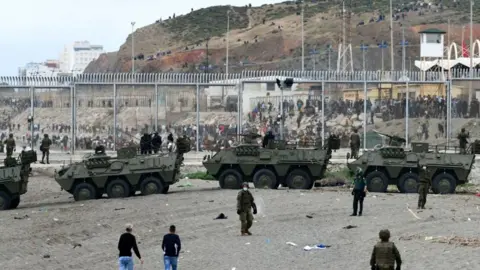
Reports indicate that between 2,000 and 3,000 migrants entered Ceuta by swimming around coastal barriers and climbing border fences, creating chaotic scenes at Tarajal Beach and across the enclave. Local reception centres quickly exceeded capacity, prompting emergency deployments of additional personnel to restore order and reinforce border control.
Why Ceuta Matters
Ceuta occupies a unique position in international law and European migration policy. Although located on the North African coast and surrounded by Morocco, the city is an autonomous territory of Spain and forms part of the European Union’s external border.
Together with Melilla, Ceuta represents the only land frontier between the European Union and mainland Africa. This strategic location has made it one of Europe’s most sensitive migration routes for individuals seeking entry into the EU. Morocco, however, continues to claim sovereignty over both Ceuta and Melilla, adding a diplomatic dimension to any border crisis.
Spain’s Emergency Response
Following the mass arrivals, Spain reinforced Ceuta by deploying additional military personnel alongside Guardia Civil officers to assist local authorities with border security, public order and humanitarian support. The Spanish government stated that the measures were intended to stabilise the situation while avoiding a formal declaration of a national emergency.
Ceuta’s regional government argued that available resources had been overwhelmed and called for greater support from Madrid, describing the situation as a significant security and humanitarian challenge. Opposition politicians also criticised the central government’s response and demanded stronger border protection measures.
Humanitarian Concerns Grow
The border surge has also produced serious humanitarian concerns. Reports indicate that several migrants died while attempting the dangerous crossing into Ceuta, while many others, including women and children, arrived exhausted after swimming around coastal barriers or attempting to climb border fencing. Reception facilities rapidly reached capacity as authorities struggled to provide accommodation, medical care and registration services.
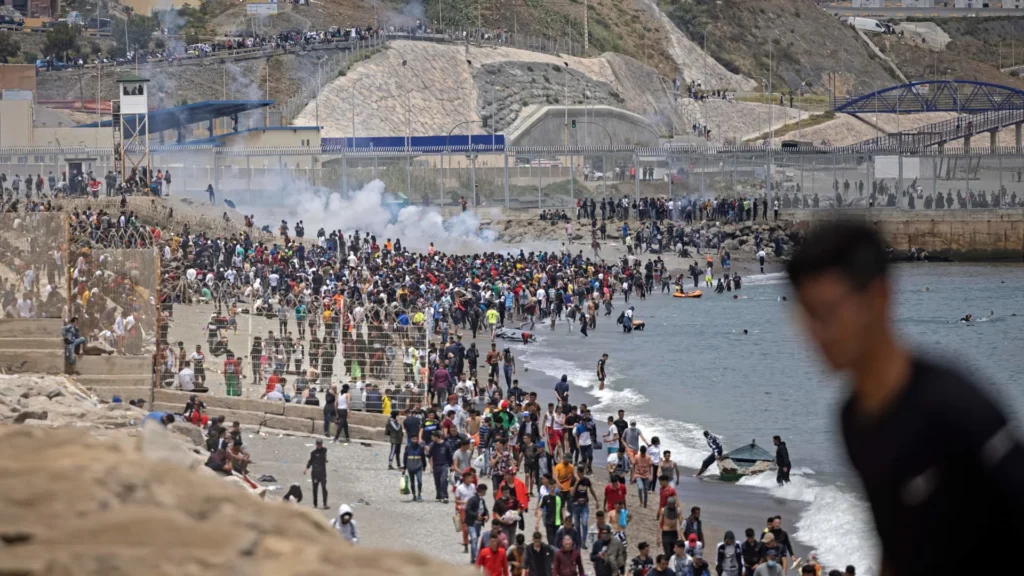
Under international human rights law and refugee protection standards, Spain remains responsible for ensuring humane treatment, access to emergency assistance and the opportunity for individuals to seek international protection where applicable.
The Legal Framework Governing the Crisis
The events in Ceuta engage several overlapping areas of international and European law.
1. State Sovereignty and Border Control
Spain has the sovereign right to protect and manage its internationally recognised borders. As Ceuta is Spanish territory, the government may deploy military and law enforcement personnel to support public authorities in maintaining security and restoring order, provided such measures comply with domestic and international legal obligations.
2. European Union External Border Law
Because Ceuta forms part of the EU’s external frontier, Spain must balance effective border management with obligations arising under European Union law concerning asylum procedures, border controls and fundamental rights.
3. International Refugee Law
Individuals fleeing persecution may have the right to seek asylum under the 1951 Refugee Convention and its 1967 Protocol. States must distinguish between migrants seeking economic opportunities and those requiring international protection.
4. Principle of Non-Refoulement
International refugee law generally prohibits returning individuals to territories where they face persecution, torture or other serious harm without an appropriate assessment of their protection claims.
Morocco’s Role & Political Reactions Across Europe
Morocco attributed the surge largely to criminal smuggling networks while reaffirming its commitment to cooperating with Spain on migration management. Bilateral cooperation between Madrid and Rabat has historically played a central role in reducing irregular migration flows across the western Mediterranean, and developments in Ceuta often reflect the broader state of diplomatic relations between the two countries.
The events have triggered political debate beyond Spain. Some European political leaders have argued that the crisis demonstrates weaknesses in the EU’s external border management and migration policies, while others have emphasised the need for coordinated humanitarian responses and closer cooperation with countries of origin and transit. Italian political figures also raised questions about wider Schengen governance during the crisis.
The situation is likely to renew discussions surrounding the implementation of the EU Pact on Migration and Asylum, burden-sharing among Member States and future reforms to external border management.
Historical Context and What Happens Next
The latest events echo the 2021 Ceuta migration crisis, when thousands of migrants entered the enclave following diplomatic tensions between Spain and Morocco. That incident highlighted how migration pressures can quickly evolve into broader geopolitical disputes affecting bilateral relations, European border security and international migration governance.
Spanish authorities are expected to continue:
- strengthening border security around Ceuta;
- processing newly arrived migrants under Spanish and EU legal procedures;
- coordinating with Moroccan authorities to manage future crossings;
- expanding humanitarian support where necessary; and
- assessing longer-term policy responses to prevent similar mass arrivals.
How the crisis develops may influence future European discussions on asylum reform, external border management and migration cooperation with neighbouring countries.
Key Legal Question
- Can Spain deploy its military to support border security in Ceuta?
- How should authorities distinguish between asylum seekers and irregular migrants?
- What legal limits apply to returns conducted at the EU’s external borders?
- How does international refugee law interact with national border enforcement during mass migration events?
- Could the latest developments accelerate reforms to the EU’s migration and asylum framework?
Conclusion
The deployment of military reinforcements to Ceuta illustrates the growing complexity of migration governance at Europe’s external borders. Spain faces the difficult task of restoring order while complying with its obligations under domestic law, European Union legislation and international refugee and human rights law. As thousands of migrants seek entry into the enclave, the crisis has once again placed Ceuta at the centre of debates over border security, humanitarian protection and the future of European migration policy.
N-LAWS Legal Insight
A large-scale irregular border crossing does not suspend a state’s international legal obligations. Even during migration emergencies, governments must balance border security with refugee protection, due process and respect for fundamental human rights.