The contrasting global reactions highlight a deeper transformation in international law, diplomatic practice, and state responsibility in the digital age. This situation is not merely political; it reflects evolving legal norms governing speech, use of force, and legitimacy in international relations.
Ceasefire Diplomacy: Pakistan’s Intervention Changes the Course
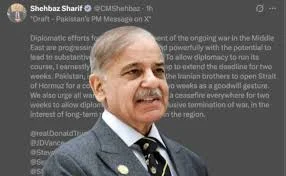
Pakistan’s diplomatic intervention, reportedly including direct appeals and public messaging, played a decisive role in securing a two-week ceasefire between the United States and Iran. Sharif had urged restraint and a delay in escalation, calling for dialogue rather than immediate military action. This approach culminated in:
Preference for diplomatic solutions over use of force
Reduction of risk to civilian populations and global trade
Trump’s Strategy: Coercive Threats and Legal Criticism
In contrast, Trump’s approach relied heavily on coercive diplomacy backed by explicit threats, including warnings of large-scale destruction if Iran failed to comply.
His rhetoric, widely criticized as inflammatory, has raised serious legal concerns:
Potential violation of the UNCharter prohibition on the threat of force
Concerns over intent to target civilian infrastructure
Ethical criticism for language inconsistent with head-of-state responsibility
Legal experts argue that even before any action is taken:
“threatening disproportionate or indiscriminate force can itself undermine international law.”
Legal Contrast: Diplomacy vs. “Threat-Based” Strategy
The two approaches highlight a fundamental divide in international legal practice:
1. Sharif’s Approach – Lawful Diplomacy
Encourages negotiation and mediation
Reduces escalation risks
Strengthens compliance with international legal norms
While coercive diplomacy can sometimes produce short-term results, it often carries higher legal and reputational risks.
Strategic Outcome: What Actually Worked?
Despite Trump’s threats, the timing and structure of the ceasefire indicate that diplomatic mediation, particularly Pakistan’s role proved to be critical:
The ceasefire was finalized just before a military deadline
It followed direct mediation efforts led by Pakistan
Iran framed the outcome as a negotiated settlement rather than submission
In an era where official communication is instantaneous and public, even a single statement can carry legal weight and geopolitical consequences. This suggests that:
“dialogue, not escalation, ultimately produced the breakthrough.”
CeasefireKey Terms & Conditions
U.S.–Iran ceasefire, brokered with the assistance of Pakistan, is a 15-day or two-week truce window. It is structured as a transitional framework designed to halt immediate conflict while creating space for broader negotiations toward a permanent settlement.
At its core, the ceasefire requires an immediate cessation of hostilities between the United States and Iran. Both sides agreed to suspend active military operations, reserving the right to resume hostilities if the terms are violated.
A central condition of the agreement is the partial reopening of the Strait of Hormuz. Iran agreed to allow controlled maritime passage during the ceasefire period, although shipping remains subject to Iranian coordination and restrictions.
The United States has indicated potential willingness to consider limited sanctions relief and release of frozen Iranian assets, while Iran has signaled openness to negotiations on its nuclear program.
While Pakistan framed the agreement as broader in scope, the United States clarified that it does not cover Israeli military operations in Lebanon, creating a major point of tension that could undermine the stability of the truce.
The U.S.–Iran 15-day ceasefire is not a final peace agreement but a conditional, legally sensitive pause in conflict, balancing immediate de-escalation with unresolved disputes. Its success ultimately depends on whether both sides can transform this temporary truce into a durable and legally grounded settlement.
Controversy Over Sharif’s Tweet
The ceasefire breakthrough credited in part to Shehbaz Sharif has been accompanied by an unexpected controversy surrounding the wording and origin of his public statement on social media. What initially appeared to be a routine diplomatic message quickly evolved into a debate over authenticity, influence, and the role of digital communication in international diplomacy.
However, the situation was not without complications. A draft version of Sharif’s tweet sparked controversy, with speculation about its wording and origin. Shortly after the ceasefire announcement, reports emerged that a draft version of Sharif’s tweet, calling for restraint and de-escalation, may have been prepared or influenced externally, with speculation pointing toward U.S.-linked messaging input.
Although no official confirmation established direct authorship by foreign actors, the incident fueled widespread discussion about whether:
The message reflected Pakistan’s independent diplomatic position, or
It was shaped to align with U.S. strategic messaging
This ambiguity became the core of the controversy. Despite the controversy, many analysts emphasize that the substantive outcome, a ceasefire, remains intact. From a strategic perspective:
The tweet contributed to a broader diplomatic effort
Pakistan’s role as a mediator was reinforced
The ceasefire reduced immediate risks of escalation
Broader Legal Implications
This episode reaffirms that in modern geopolitics, compliance with international law is judged not only by actions on the battlefield, but also by the language used in public diplomacy. The current situation reinforces several key lessons in international law:
Diplomatic engagement remains the preferred legal pathway in armed conflict
Threat-based rhetoric may undermine legitimacy and compliance with legal norms
Third-party mediation (like Pakistan’s role) can be crucial in de-escalation and conflict resolution
Conclusion
The contrast between Pakistan’s Prime Minister Shehbaz Sharif’s ceasefire appeal and U.S. President Trump’s threatening rhetoric reflects a fundamental principle of modern international law:
“while force may shape outcomes, it is diplomacy that legitimizes them.“
In this case, the ceasefire’s success appears to validate negotiation over intimidation, reinforcing the enduring importance of lawful diplomatic engagement in resolving high-stakes geopolitical crises. This shows that words are no longer merely political; they are legally consequential acts that shape state responsibility, legitimacy, and the boundaries of lawful conduct.
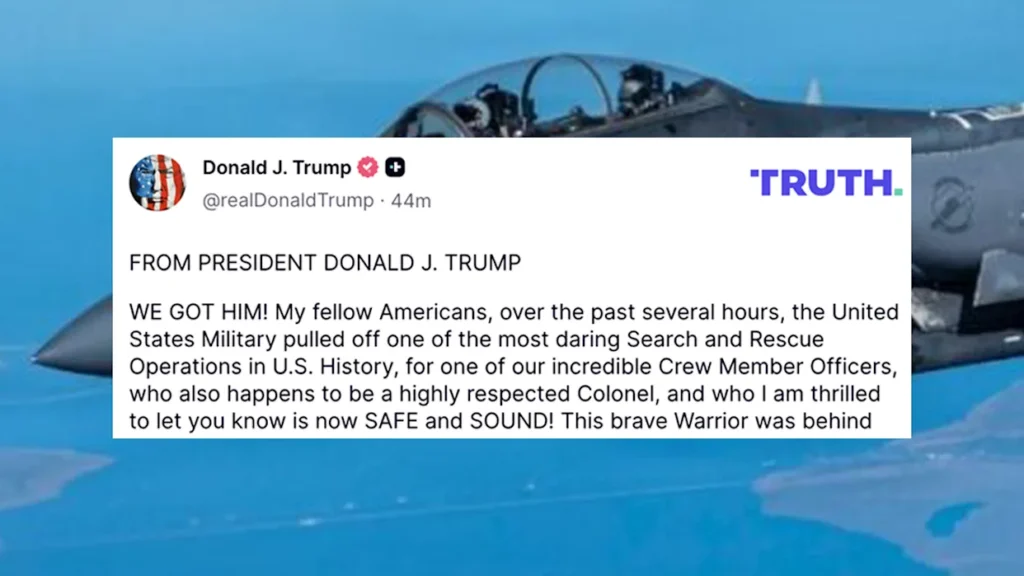
The controversy surrounding the F-15E colonel has brought renewed legal and geopolitical scrutiny to the United States’ large-scale air armada rescue mission in Iran. As details emerge, questions are being raised not only about operational decision-making but also about compliance with international law, including the rules governing the use of force and command responsibility.
The incident sits at the intersection of military necessity and legal accountability, with broader implications for U.S. state conduct, escalation risks, and the evolving framework of the law of armed conflict. This analysis examines the legal basis of the operation and the geopolitical consequences that may follow.
The Incident: From Shootdown to “Air Armada” Rescue
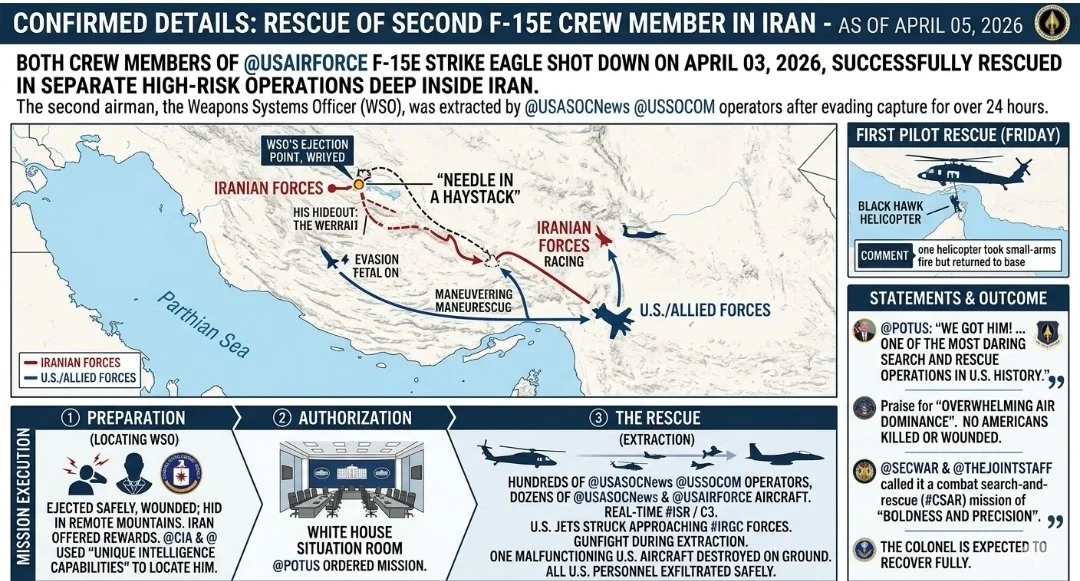
The incident began when a U.S.F-15E Strike Eagle was shot down while operating over Iranian territory during an active combat mission. Initial reports indicate that the aircraft was hit by a surface-to-air threat, possibly a shoulder-fired missile (MANPADS). This marked a significant development as it was the first confirmed loss of a U.S. crewed combat aircraft inside Iran during the conflict.
The two crew members, a pilot and a weapons systems officer, one of whom was a senior-ranking colonel, successfully ejected before the aircraft crashed. However, their descent into hostile territory immediately created a high-risk personnel recovery scenario, with the danger of capture by Iranian forces or affiliated militias.
Within hours of the shootdown, the United States initiated aCombat Search and Rescue (CSAR) operation, one of the most sensitive and complex types of military missions. The priority was to recover the downed aircrew before enemy forces could locate them, as rescue operations in hostile territory are governed by the principle that no personnel areleft behind, and also require rapid escalation of military assets.
What followed was an unprecedented escalation. The U.S. deployed what has been described as an:
“air armada, a massive, coordinated aerial operation involving over 100–150 aircraft.”
The operation was not a simple rescue as it was a full-spectrum military operation, designed to dominate the airspace, confuse enemy defenses, and ensure safe extraction.
Why Was a Colonel Flying in an F-15E?
The presence of a senior-ranking officer, a colonel in the cockpit of an F-15E Strike Eagle during active combat operations over Iran has drawn unusual attention, but within military practice, it is neither unprecedented nor unlawful. However, in the context of a high-intensity conflict, it carries significant strategic, operational, and legal implications.
One of the most debated aspects of the incident is why a colonel (a senior-ranking officer) was flying in a frontline strike aircraft. Military experts clarify that:
Senior officers often maintain combat flight certification
Leadership presence in combat is seen as operationally valuable
It allows commanders to directly oversee missions and maintain credibility
As retired Lt. Gen. Dave Deptula explained, even generals have historically flown combat missions to:
“lead from the front and maintain operational readiness.”
From a legal standpoint, there is no prohibition under international law or military law against senior officers participating in combat missions. In fact:
All uniformed personnel engaged in combat are considered lawful combatants
However, critics argue that deep penetration rescue missions involving 150+ aircraft may exceed what is considered necessary and proportionate.
Strategic Blowback: Limits of U.S. Air Superiority
The shootdown of a U.S. F-15E Strike Eagle over Iran, and the scale of the subsequent rescue operation, have exposed a critical reality in modern warfare that U.S. air superiority, long considered uncontested, is increasingly vulnerable in contested and asymmetric environments.
The incident represents not just a tactical setback but a broader strategic blowback with long-term implications for military doctrine, deterrence, and global power perception. The incident has exposed significant strategic :
The F-15E was reportedly downed by a low-cost, shoulder-fired missile (MANPADS)
This challenges U.S. claims of air dominance over Iran
It demonstrates the effectiveness of asymmetric warfare
Additionally, the rescue mission itself:
Resulted in damaged aircraft and operational risk
Required massive resources, raising questions about cost-benefit proportionality
Controversy: Rescue Mission or Strategic Cover?
The large-scale U.S. operation to recover the downed F-15E crew has sparked a significant debate among legal analysts and geopolitical observers: was the mission purely a humanitarian combat search and rescue (CSAR) operation, or did it also serve broader strategic or intelligence objectives?
The sheer scale, complexity, and depth of the incursion into Iranian territory have fueled suspicions that the rescue may have had dual-use purposes beyond personnel recovery. Iran has alleged that the rescue operation may have been used as a cover for intelligence or strategic objectives, including attempts to access sensitive sites.
The United States maintains that the mission was a legitimate combat search and rescue effort, grounded in long-standing military doctrine and international law principles. Under this view:
States have a recognized right to recover their personnel in hostile territory
Protecting captured or stranded personnel is considered a military necessity and moral obligation
Despite the official justification, several factors have led to widespread skepticism:
Unprecedented Scale of the Operation: Deploying over 100–150 aircraft, including advanced surveillance and electronic warfare platforms, goes far beyond a typical rescue mission. Critics argue that such a large force suggests:
Additional operational objectives
A broader intent to control or map Iranian air defenses
Deep Penetration into Iranian Territory: The mission involved sustained activity deep inside Iran, raising questions about whether the U.S. used the opportunity to:
Gather real-time intelligence on radar systems and missile sites
Test Iranian defensive capabilities under combat conditions
Use of Advanced Electronic Warfare: The deployment of sophisticated electronic warfare systems may have allowed the U.S. to:
Jam and analyze Iranian radar responses
Identify weaknesses in integrated air defense networks
This reflects a shift toward multi-domain operations, where every mission is designed to maximize strategic value. However, this dual-use nature creates tension with legal norms, as it becomes harder to distinguish between legitimate objectives and opportunistic expansion.
Military Law and Command Responsibility
The F-15E shootdown and subsequent large-scale rescue mission bring into sharp focus the doctrine of command responsibility, a core principle of both military law and international humanitarian law (IHL). While frontline actions are executed by pilots and special forces, legal accountability ultimately extends upward to commanders and decision-makers who plan, authorize, and oversee operations.
Command responsibility is a legal principle that holds military and civilian leaders accountable for unlawful acts committed by forces under their control if they:
Ordered the unlawful act, or
Knew or should have known about violations, and
Failed to prevent or punish such conduct
This doctrine has been recognized in international jurisprudence, including cases before war crimes tribunals, and forms part of customary international law.
Broader Legal Implications
Expansion of War Footprint
The rescue mission effectively expanded the conflict:
From targeted strikes to deep territorial operations
The F-15E shootdown and subsequent rescue mission highlight a critical turning point in the Iran conflict. What began as a tactical recovery operation has evolved into a legal and strategic flashpoint, exposing:
The legal ambiguity of cross-border rescue missions
The escalating risks of leadership involvement in combat
Ultimately, the episode demonstrates a key modern reality that even defensive military actions like rescuing a pilot can trigger profound legal consequences, geopolitical backlash, and strategic instability in high-intensity conflicts.
Frequently Asked Questions
What is the F-15E Colonel controversy about?
The controversy stems from the shootdown of a U.S. F-15E fighter jet over Iran and the presence of a senior-ranking colonel (weapons systems officer) among the crew, followed by a massive U.S. rescue operation inside Iranian territory. It has raised questions about military decision-making, escalation risks, and the legality of cross-border operations.
Why was a colonel flying in a combat mission?
Senior officers like colonels often remain qualified combat pilots and may participate in missions to maintain operational readiness and leadership credibility. However, their presence increases: Strategic risk if captured Political pressure for large-scale rescue Potential escalation of conflict
What made the rescue mission controversial?
The rescue operation was unusually large, involving: Hundreds of personnel Over 100–150 aircraft Special forces operating deep inside Iran Critics argue that such scale goes beyond a typical rescue and may have included strategic or intelligence objectives.
The U.S. may justify the mission under: Self-defense (Article 51 of the UNCharter) Protection of military personnel However, legal concerns arise regarding: Violation of Iranian sovereignty Whether the operation met necessity and proportionality standards
What is “command responsibility” in this context?
Command responsibility means senior military and political leaders can be held accountable for decisions that lead to unlawful acts. In this case, scrutiny focuses on: Who authorized the mission Whether risks were properly assessed Whether the scale of force was legally justified
Did the incident expose limits of U.S. air superiority?
Yes. The F-15E was reportedly downed by a low-cost air defense system, highlighting: Vulnerability of advanced aircraft Effectiveness of asymmetric warfare tactics Limits of U.S. dominance in contested airspace
Iran alleged that the rescue operation may have been used as a pretext for intelligence gathering or strategic objectives, such as probing defenses or accessing sensitive sites. While unproven, this claim fueled legal debate about good faith in military operations.
What are the geopolitical implications of the incident?
The incident has: Escalated tensions between the U.S. and Iran Strained international perceptions of U.S.compliance with international law Highlighted risks of rapid escalation from tactical events
Yes. If accepted, such operations could normalize: Large-scale cross-border incursions for rescue missions Broader interpretations of self-defense This risks weakening legal limits on use of force and sovereignty.
What is the key legal takeaway from the controversy?
The main takeaway is that military necessity does not override legal constraints. Even a rescue mission must comply with: Proportionality Necessity Respect for sovereignty The incident shows how a single battlefield event can trigger global legal scrutiny and geopolitical consequences.
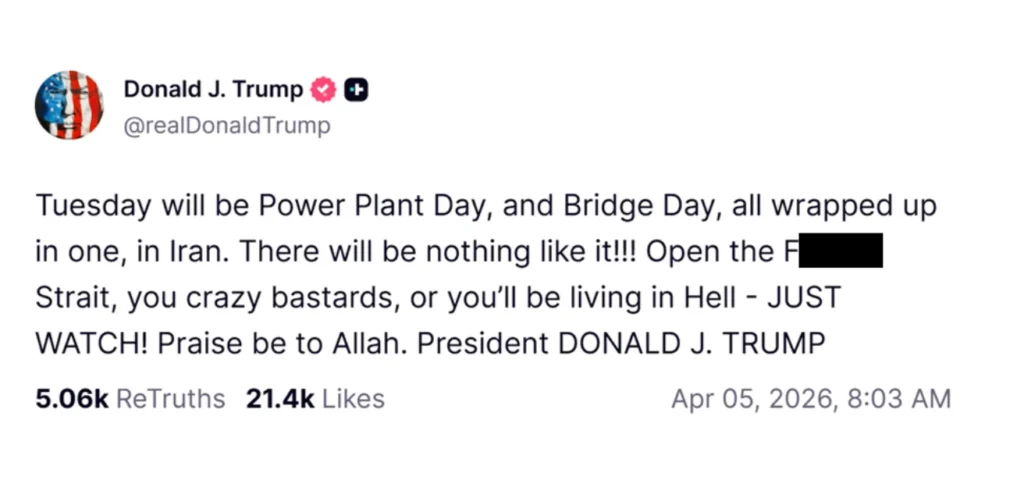
Use profanity and insults such as calling Iranian leaders “bastards” in social media posts
Intensify attacks within weeks if demands were not met
One widely circulated post demanded Iran reopen the Strait of Hormuz using explicit language and threats of destruction. He also reiterated threats to destroy bridges and power plants, warning of massive escalation if U.S. demands are not met. These remarks were widely interpreted as threats of large-scale destruction affecting civilian populations, rather than purely military targets.
Statements explicitly targeting power plants, bridges, and national infrastructure raise concerns under the Geneva Conventions, which prohibit attacks on civilian objects unless they are legitimate military targets. The International Committee of the Red Cross (ICRC) has warned that even rhetoric normalizing such attacks undermines the laws of war.
2. Evidence of Intent
Public threats by state leaders can be used as evidence of intent in international legal proceedings, particularly in cases involving:
Experts have warned that such statements could later be scrutinized in international tribunals or UN inquiries.
3. Collective Punishment Concerns
Broad threats against an entire country rather than specific military targets may violate the principle prohibiting the collective punishment of civilian populations.
Ethical and Constitutional Criticism
Trump’s rhetoric has also triggered ethical and constitutional criticism within the United States. Trump’s language has also drawn widespread criticism for breaching diplomatic and ethical norms expected of world leaders.
His posts included profanity and insults, even during official events such as Easter
Critics argue that such rhetoric undermines diplomatic credibility and global stability
Lawmakers and analysts have called the statements reckless and destabilizing
Critics argue such language undermines international norms and diplomatic efforts
Concerns have been raised about whether such threats align with the War Powers framework and responsible executive conduct
International observers stress that leaders are expected to exercise restraint and precision in wartime communication, especially during active conflicts. Particularly given the risk of misinterpretation during an active conflict, some commentators have described the remarks as
“unethical and dangerous escalation rhetoric”
Military and Institutional Concerns
The rhetoric has also created unease within legal and military circles.
Military legal experts warn that orders consistent with such threats could place soldiers in a dilemma between obeying orders and committing unlawful acts
Concerns have been raised about the erosion of legal oversight and adherence to rules of engagement
This highlights a deeper issue of whether political rhetoric can influence operational conduct on the battlefield. Iran has condemned the statements as provocative and destabilizing, warning of severe retaliation.
“devastating and widespread retaliation”
International organizations cautioned that such rhetoric could intensify regional instability. Global actors, including humanitarian groups and European officials, have warned that threats against civilian infrastructure could breach international law and escalate the conflict further.
Broader Legal Implications
The controversy highlights a critical legal issue in modern warfare: whether public threats by state leaders themselves can constitute violations of international law or evidence of unlawful intent. These include:
How should global institutions respond when leaders publicly endorse potentially unlawful conduct?
Legal experts increasingly argue that words themselves can shape the legality and accountability of war, especially when they signal intent to bypass established legal limits. Key implications include:
Potential use of such statements in future war crimes investigations
Erosion of norms limiting indiscriminate or disproportionate warfare
Conclusion
Trump’s “Stone Age,” “Power Plant Day,” and profanity-laced threats have moved beyond political rhetoric into a serious legal and ethical controversy, raising questions about the boundaries of lawful military threats and the responsibilities of state leaders during armed conflict.
As the war in Iran intensifies, the episode highlights a growing concern among legal experts that, in an age of instant communication, statements by heads of state are not just political messaging. They can carry legal consequences, influence military conduct, and shape the legitimacy of war itself.
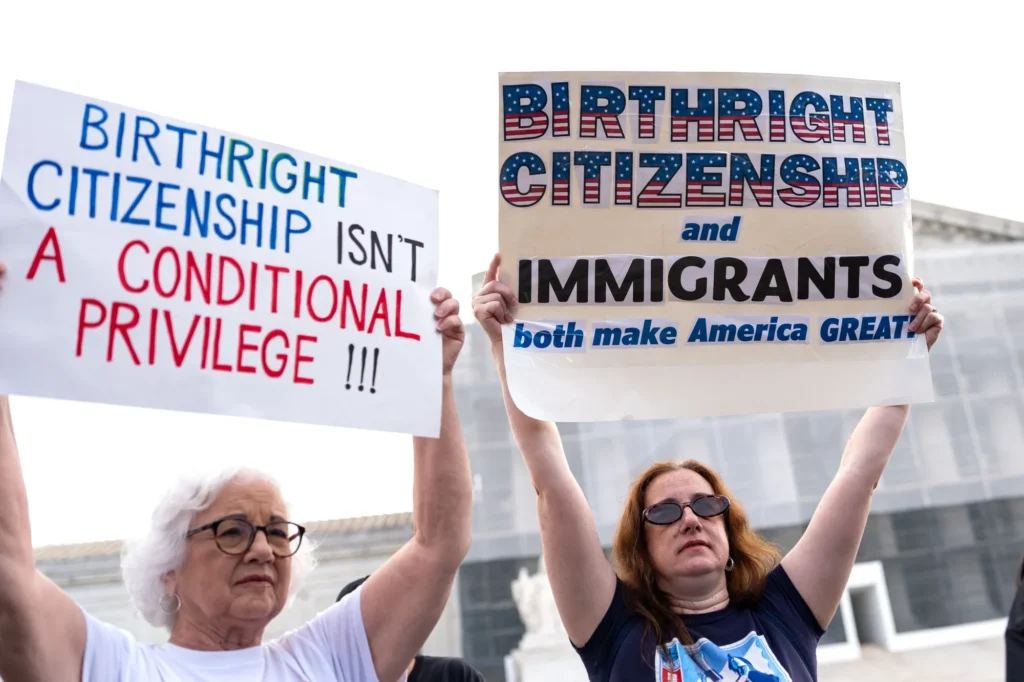
The policy directly challenges the 14th Amendment, which has long guaranteed citizenship to:
“all persons born… in the United States and subject to the jurisdiction thereof.”
The administration argues that children of undocumented immigrants are not fully “subject to U.S. jurisdiction”, and therefore should not automatically receive citizenship.
Supreme Court to Decide Historic Case
The legal dispute has now reached the U.S. Supreme Court, which is set to determine whether a president can reinterpret or limit birthright citizenship without a constitutional amendment.
Lower federal courts have consistently blocked the policy, with judges ruling that it likely violates the Constitution and long-standing precedent. Legal experts note that the case could redefine:
A decision is expected later in 2026 and could affect millions of families and future births in the United States.
Legal Precedent Under Threat
The case revisits the landmark 1898 Supreme Court ruling in United States v. Wong Kim Ark, which affirmed that children born in the U.S. to immigrant parents are citizens. Critics argue that overturning or narrowing this precedent would:
Create a new class of stateless or undocumented individuals
Undermine over a century of constitutional interpretation
Disrupt the legal foundation of American citizenship
Supporters of the policy, however, claim the original intent of the 14th Amendment was narrower and should not extend to all modern immigration contexts.
Human Impact and National Debate
The legal battle is already having real-world consequences. Families across the U.S. fear uncertainty over their children’s citizenship status, with some warning of potential statelessness and loss of legal rights.
Civil rights groups argue that ending birthright citizenship could fundamentally reshape American society by creating a permanent underclass of U.S.-born individuals without citizenship protections. The case has evolved into a broader debate over:
The role of courts in safeguarding constitutional guarantees
Legal scholars widely emphasize that changing birthright citizenship would typically require a constitutional amendment, not an executive order.
Why the Birthright Citizenship Case Matters
The decision by the Supreme Court of the United States to take up a birthright citizenship challenge places one of the most settled principles of U.S.constitutional law under direct review. At issue is the interpretation of the Fourteenth Amendment to the United States Constitution, which guarantees citizenship to “all persons born or naturalized in the United States.”
Reinterpreting a Constitutional Foundation
For over a century, the Citizenship Clause has been understood to grant automatic citizenship to nearly anyone born on U.S. soil. A ruling that narrows this interpretation would mark a major shift in constitutional doctrine, potentially redefining who qualifies as a citizen at birth. Such a move would not only affect future cases but could also invite broader challenges to established constitutional protections.
Direct Impact on U.S. Immigration Policy
Birthright citizenship sits at the center of U.S.immigration law. If the Court limits its scope, it could:
Increase the number of non-citizen residents born in the U.S.
Shift policy debates toward legislative reforms or stricter citizenship criteria
This would fundamentally alter how immigration status is determined and managed across federal and state systems.
Expansion of Judicial Power in Policy Questions
The case underscores the growing role of the Supreme Court in shaping politically sensitive policy areas. By addressing birthright citizenship, the Court is not just interpreting law—it is influencing national policy traditionally debated by Congress. This raises important questions about judicial reach and the balance of powers.
Precedent with Global Implications
The United States has long been one of the strongest proponents of jus soli (citizenship by birth). A departure from this principle could influence global norms, particularly in countries already reconsidering immigration and nationality laws. The ruling may therefore resonate far beyond U.S. borders.
Legal Uncertainty and Administrative Challenges
Any significant change would create immediate legal and administrative complexities:
Questions over the status of children born to non-citizen parents
The Supreme Court’s review of birthright citizenship is more than a legal dispute, as it is a defining moment for constitutional interpretation, immigration policy, and the future scope of citizenship in the United States. At stake is not only immigration policy, but the definition of American citizenship itself, a principle embedded in the Constitution for more than 150 years. The outcome will likely shape not only legal doctrine but also the broader political and social landscape for decades to come.
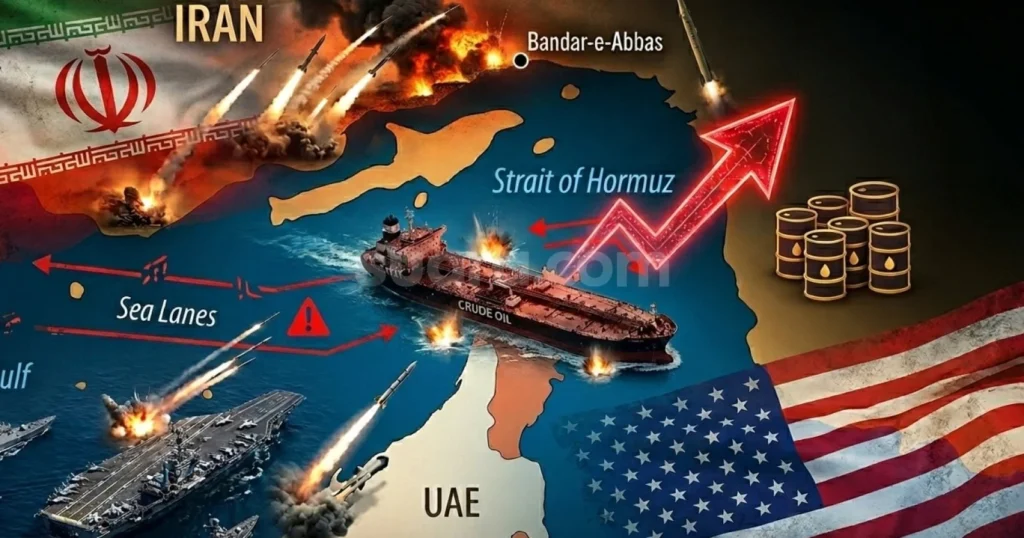
The Strait of Hormuz as a Strategic “Economic Weapon”
The Strait of Hormuz is one of the most critical arteries of the global economy, carrying around 20–25% of global oiltrade and major LNG shipments. By restricting passage through missile threats, naval attacks, and maritime disruption, Iran has demonstrated that control over strategic geography can rival military power.
Analysts describe this as a shift toward “economic coercion through chokepoints”, where states weaponize trade routes rather than territory. Legally, such actions raise serious issues under the United Nations Convention on the Law of the Sea (UNCLOS), which guarantees transit passage through international straits.
The blocking of Hormuz is widely viewed as a violation of this principle, transforming the crisis into not just a military confrontation but a challenge to the international maritime legal order.
Can a State Legally Block the Strait During Conflict?
International law distinguishes between peacetime navigation rights and the law governing naval warfare. During an armed conflict, states may attempt to impose naval blockades against enemy states. However, even in wartime, blockades are subject to strict legal requirements.
It must be formally declared and publicly notified
It must be effective and not purely symbolic
It must not prevent access to neutral ports or international waterways unrelated to the conflict
It must respect humanitarian considerations and allow passage of essential supplies
Because the Strait of Hormuz is used by ships from dozens of neutral states, a blockade that interferes with neutral commerce could be considered unlawful.
Impact of the UN Charter and Use of Force Rules
Blocking the Strait of Hormuz could also raise issues under the UN Charter, particularly the prohibition on the use of force in Article 2(4). If a state attempts to close the strait through military means, such as deploying mines, attacking commercial vessels, or threatening shipping traffic, it could be interpreted as an unlawful use of force against other states whose vessels rely on the waterway.
Only two legal justifications could potentially legitimize such actions:
Without one of these legal grounds, closing an international strait would likely be considered a violation of international law.
Legal Framework Under the United Nations Convention on the Law of the Sea
The principal legal regime governing international straits is contained in Part III of UNCLOS, which establishes the right of transit passage. Transit passage guarantees that ships and aircraft from all countries have the right to move through international straits continuously and expeditiously without interference from coastal states. This right applies even when the waters fall within the territorial seas of the bordering states.
For the Strait of Hormuz, this means that neither Iran nor Oman can lawfully suspend or obstruct transit passage for foreign vessels engaged in lawful navigation. The convention makes clear that coastal states must not hamper transit passage and must refrain from actions that obstruct international shipping.
Risks to Neutral Shipping and Global Trade
A major legal complication arises because the Strait of Hormuz is used primarily by neutral commercial vessels transporting oil and goods between third countries. Interference with these ships could violate the rights of neutral states under international law.
International maritime law protects neutral commerce from interference except under narrowly defined circumstances. Attacks on neutral shipping or indiscriminate mining of international waterways could therefore expose the responsible state to international legal claims and possible sanctions.
International Straits and the Principle of Transit Passage
International maritime law recognizes that certain waterways are so essential to global trade that they must remain open for navigation. Under the United Nations Convention on the Law of the Sea (UNCLOS), such waterways are classified as international straits used for navigation, granting vessels and aircraft the right of transit passage.
Transit passage ensures that ships from all states, whether neutral or belligerent, can travel continuously through these routes without interference. The Strait of Hormuz, like the Suez Canal and several other global chokepoints, falls within this category because it connects two large bodies of water and serves as a critical artery for international commerce.
Any attempt to block or restrict such a strait is therefore subject to intense scrutiny under international law.
Strait of Hormuz Crisis in Light of Past Maritime Blockades
The growing tensions around the Strait of Hormuz during the Iran–Israel–U.S. confrontation have revived longstanding debates in international maritime law regarding the legality of blocking strategic waterways. Historically, attempts to restrict global shipping lanes have triggered major geopolitical crises and legal disputes.
One of the most prominent historical examples of maritime obstruction occurred during the Suez Crisis of 1956. When Egypt nationalized the Suez Canal, Britain, France, and Israel launched a military intervention to regain control of the waterway. The canal was temporarily closed after ships were sunk to block passage.
From a legal perspective, the crisis raised questions about the balance between state sovereignty over territory and international rights of navigation. Although Egypt controlled the canal geographically, international agreements and customary law recognized its importance as a global shipping route.
The United Nations eventually intervened, and the canal reopened under international supervision. The crisis reinforced the principle that strategic waterways must remain accessible to international shipping, even during political disputes.
The Iran–Iraq Tanker War (1980s)
The Tanker War, a phase of the Iran–Iraq conflict during the 1980s, provides a more direct precedent for tensions surrounding the Strait of Hormuz. Both sides targeted oil tankers in the Persian Gulf in an attempt to disrupt each other’s economic lifelines.
Attacks on commercial vessels triggered international condemnation and ultimately prompted foreign naval forces to escort oil tankers through the Gulf. The United States and other powers deployed naval operations to ensure the continued flow of oil shipments.
Legally, these attacks were criticized because they endangered neutral shipping and violated the protections afforded to civilian commercial vessels under international humanitarian law. The episode reinforced the principle that belligerent states must avoid actions that threaten global commerce or neutral trade routes.
The Russia–Ukraine Black Sea Blockade
More recently, the conflict between Russia and Ukraine produced a significant maritime crisis in the Black Sea. Russian naval operations restricted access to Ukrainian ports, disrupting global grain exports and causing major concerns about food security.
The blockade raised questions about whether such restrictions violated international law governing freedom of navigation and the rights of neutral states. Negotiations mediated by international actors eventually produced temporary agreements allowing limited shipments to resume.
This case demonstrated how modern conflicts involving maritime blockades can have far-reaching global consequences, particularly when essential commodities such as food or energy are involved.
Potential Legal Consequences
When compared with these historical cases, the legal issues surrounding the Strait of Hormuz share several common elements.
First, the strait’s status as an international transit route means that any attempt to block it would directly affect numerous states that are not parties to the conflict. This creates strong legal arguments that obstruction would violate international maritime law. Other states could argue that their rights under international maritime law have been violated and could seek remedies through diplomatic protests, international arbitration, or economic sanctions.
Second, the economic stakes are significantly higher than in many past maritime crises. Because a substantial share of the world’s oil supply passes through the strait, interference could destabilize global energy markets and trigger widespread economic disruption.
Third, past precedents show that the international community often responds collectively to threats against major shipping routes. Naval escorts, diplomatic intervention, and economic pressure have historically been used to ensure the continued operation of strategic waterways.
Additionally, interference with global energy supply could trigger collective responses from affected states seeking to ensure freedom of navigation. In extreme cases, military escorts or multinational naval operations might be justified as measures to protect international shipping.
Intersection of War, Energy Markets, and International Trade Law
International trade law traditionally focuses on regulating tariffs, subsidies, and trade barriers. However, modern geopolitical crises demonstrate that military conflict can indirectly reshape global trade flows, particularly in sectors such as energy.
Oil and gas are among the most heavily traded commodities in the global economy. Sudden supply disruptions, such as those caused by conflict near the Strait of Hormuz, can influence prices, shipping routes, and supply chains across multiple industries.
When governments take actions that directly or indirectly affect energy supply, these decisions can raise questions about whether they align with existing international trade obligations.
WTO Framework and Energy Trade
The WTO legal system governs trade in goods through agreements such as the General Agreement on Tariffs and Trade (GATT). Under this framework, member states are generally expected to avoid discriminatory trade practices and restrictions on exports or imports.
However, WTO rules do not specifically regulate the price of commodities like oil. Instead, they focus on preventing governments from imposing unjustified trade barriers that distort international markets.
Military conflict, therefore, usually falls outside the traditional scope of WTO regulation. Nevertheless, if wartime actions lead to trade restrictions, such as blocking shipping lanes, restricting exports, or imposing sanctions, those measures may be scrutinized under WTO rules.
Immediate Economic Shock: Energy, Inflation, and Market Collaps
The economic consequences have been immediate and severe. Iran’s disruption of Hormuz has:
Removed 9–14 million barrels per day from global supply
Triggered the largest energy shock since the 1970s oil crisis
This has cascaded into wider economic instability:
Global stock markets entered correction territory
Inflation surged due to energy costs and supply chain disruptions
Central banks faced stagflation risks—low growth with high inflation
Even a short-term closure can reduce global GDP growth by nearly 3 percentage points, highlighting the fragility of the global economy to energy shocks.
Global Supply Chains Beyond Oil: Food, Fertilizer, and Trade
The impact extends far beyond energy markets. The Hormuz disruption has:
Disrupted fertilizer exports, threatening global food security
Increased costs across manufacturing, shipping, and logistics sectors
Affected LNG supplies, particularly impacting Europe and Asia
For developing countries, especially energy-importing economies, the crisis has triggered:
In effect, the Hormuz crisis has transformed into a multi-sector global economic shock, not just an energy crisis.
Geopolitical Transformation: Fragmentation and New Alignments
Iran’s tactic has fundamentally altered global geopolitics in several ways:
1. Weakening of Western Strategic Control
Despite U.S. naval dominance, reopening the Strait has proven difficult and costly, exposing limits of military power against asymmetric tactics.
2. Strains Within Alliances
The crisis has revealed divisions between the United States and its allies, particularly over military involvement in the Gulf, weakening traditional alliance cohesion.
3. Rise of Regional Mediation
Countries like Pakistan, Turkey, and Gulf states are increasingly acting as diplomatic intermediaries, attempting to negotiate reopening mechanisms and reduce escalation.
Potential classification as economic warfare or coercion
Questions over whether countermeasures (e.g., naval intervention) are lawful under the UNCharter
At the same time, the crisis exposes a deeper legal gap: international law provides limited enforcement mechanisms when chokepoints are militarized by sovereign states.
Long-Term Structural Impact on the Global Economy
The Hormuz crisis is not a temporary disruption, it may mark a structural turning point:
Globalization is increasingly shaped by geopolitical risk rather than efficiency
Energy markets are becoming more volatile and politically driven
Governments are prioritizing economic resilience over cost optimization
Estimates suggest that prolonged disruption could put up to $2.2 trillion of global GDP at risk, underscoring the scale of the crisis.
Conclusion
Iran’s tactic of blocking the Strait of Hormuz has redefined modern geopolitical conflict by demonstrating how strategic geography can be weaponized to influence global economics and international law. The resulting crisis has triggered energy shocks, global inflation, alliance fractures, and legal uncertainty, revealing the vulnerability of an interconnected world dependent on critical trade chokepoints.
Ultimately, the Hormuz strategy signals a new era in international relations, where economic disruption, rather than direct military confrontation, becomes the central battlefield of global power politics. The reported disruption or potential blockade of the Strait of Hormuz during the escalating Iran–Israel–U.S. conflict has raised major questions under international maritime law.
Because the strait is one of the world’s most important energy corridors, any attempt to restrict navigation carries profound legal and economic consequences. The legality of such a blockade depends primarily on the rules contained in the United Nations Convention on the Law of the Sea (UNCLOS) and the broader principles governing the use of force under international law.
The Strait of Hormuz is one of the world’s most critical maritime chokepoints, with around 20–25% of global oil and significant LNG supplies passing through it daily. Any disruption in this route directly affects global energy prices, trade flows, and economic stability.
Generally, no. Under the United Nations Convention on the Law of the Sea (UNCLOS), the Strait of Hormuz is an international strait where transit passage must not be obstructed. Blocking or restricting passage is widely considered a violation of international maritime law unless justified under limited circumstances such as lawful military action during an armed conflict.
Can other countries use force to reopen the Strait?
Potentially, but only under strict legal conditions. States may argue self-defense under Article 51 of the UNCharter if their economic security or vessels are directly threatened. However, any military response must meet the principles of necessity and proportionality, and ideally should have UNSecurity Council authorization to avoid legal controversy.
How has the Hormuz crisis affected global oil prices?
The disruption has caused sharp increases in oil prices, often exceeding $100 per barrel, due to reduced supply and market uncertainty. This has triggered inflation, higher transportation costs, and economic pressure worldwide.
The crisis affects multiple sectors, including: Shipping and logistics costs Food security (due to fertilizer supply disruptions) Manufacturing and tradesupply chains Global inflation and currency stability This makes the crisis a multi-sector economic shock, not just an energy issue.
Why is this considered a form of “economic warfare”?
Iran’s tactic uses control over a strategic trade route to exert pressure on global markets and political decisions. Instead of direct military confrontation, it targets economic systems, making it a form of economic coercion or statecraft.
How has this changed global geopolitics?
The crisis has: Exposed limits of traditional military power Created divisions among Western allies Strengthened regional diplomacy efforts Accelerated a shift toward multipolar global power structures Countries are increasingly prioritizing economic security and resilience over global integration.
While some disruptions may be temporary, the crisis is likely to have long-term effects, including diversification of energy routes, increased reliance on alternative suppliers, and restructuring of global supply chains to reduce dependence on vulnerable chokepoints.
What legal gaps does the crisis expose?
The situation highlights that international law, while prohibiting obstruction of maritime transit, has limited enforcement mechanisms. When a state controls a critical chokepoint, enforcing compliance without escalating conflict becomes legally and politically complex.
What does this mean for the future of global trade?
The Hormuz crisis signals a shift toward a world where geopolitical risk heavily influences trade and economic policy. Governments and corporations are likely to focus more on resilience, diversification, and strategic autonomy, potentially reshaping globalization in the years ahead.
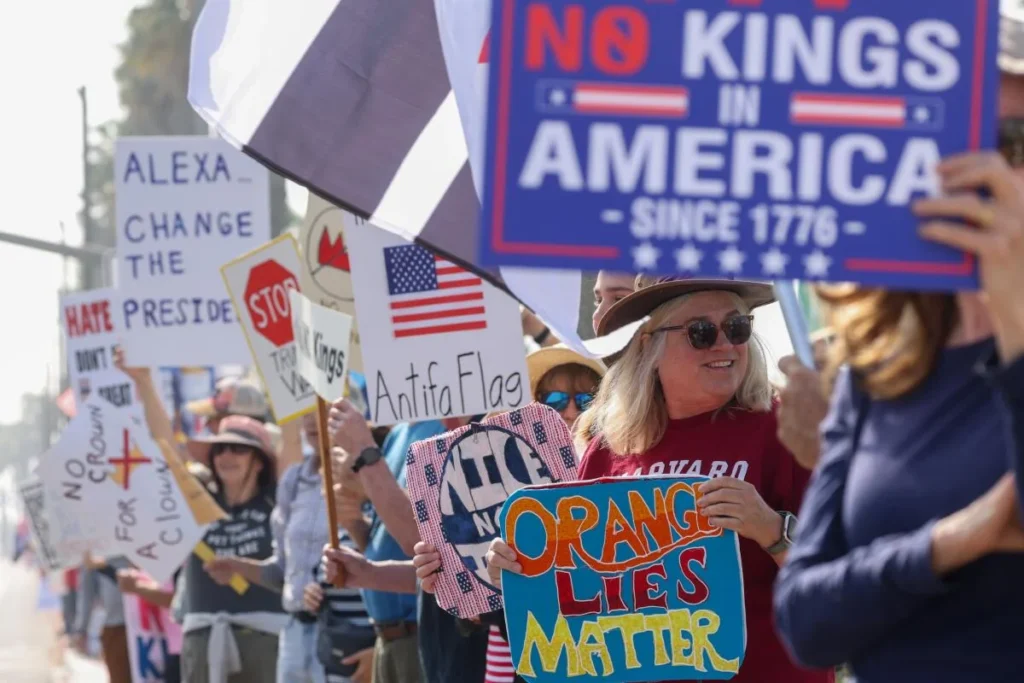
The Iranwar has therefore transformed the protests from primarily domestic dissent into a broader anti-war and constitutional accountability movement.
Nationwide Mobilization and Growing Momentum
The scale of the protests reflects growing political mobilization across the country. Reports indicate that demonstrations were held not only in major urban centers but also in smaller towns and traditionally conservative regions, signaling widening dissatisfaction.
Minnesota emerged as a focal point, with massive rallies drawing tens of thousands of participants, alongside high-profile appearances by activists, public figures, and politicians. International solidarity protests were also reported in cities such as Paris, Tokyo, and Rome, highlighting the global attention surrounding U.S. domestic unrest.
Bernie Sanders Addresses Protesters
A major highlight of the protests was Bernie Sanders’s appearance at the flagship rally in Minnesota, where he joined activists, public figures, and thousands of demonstrators. Sanders’ address focused on what he described as
“dangerous times for American democracy.”
Sanders links the Iranwar to broader concerns about economic inequality, civil liberties, and the concentration of executive power. While he criticized the direction of U.S. policy, his remarks framed the conflict as part of a wider pattern of governance that protesters argue threatens constitutional balance.
His participation added political weight to the movement, signaling that opposition to the war has moved beyond grassroots activism into mainstream political discourse.
Legal Context: Protest Rights vs. National Security Policy
From a legal perspective, the protests highlight a critical intersection between:
1. First Amendment Protections
The demonstrations are largely protected under the First Amendment, which guarantees the right to peaceful assembly and political expression.
2. War Powers and Executive Authority
The protests directly challenge the legality of the Iranwar under:
Legal experts note that sustained public pressure could influence congressional action or trigger investigations into the legal basis of the conflict.
3. Public Accountability and Democratic Oversight
The protests reflect broader concerns about whether the executive branch has exceeded its legal authority in initiating or expanding the conflict.
Political and Legal Fallout
The White House has dismissed the protests as politically motivated, but analysts note that the scale of mobilization may have significant legal and political consequences, including:
Increased pressure on Congress to review or limit war powers
Potential investigations into the legal basis of the Iran conflict
Heightened scrutiny of executive decision-making
The protests are also expected to influence the 2026 midterm elections, with organizers framing the movement as part of a broader push to defend democratic institutions.
Broader Significance
The “No Kings” protests not only represent a political demonstration but also mark a defining moment at the intersection of law, politics, and public dissent in the United States.
As anger over the war in Iran continues to spread, the movement highlights a key legal reality: public protest remains one of the most powerful mechanisms for challenging government action and demanding accountability in a constitutional democracy.
With high-profile figures like Bernie Sanders joining the movement, the demonstrations signal a deepening national debate over war powers, executive authority, and the rule of law. As tensions over the Iran conflict continue, the protests highlight the enduring role of public mobilization as a constitutional check on government action.
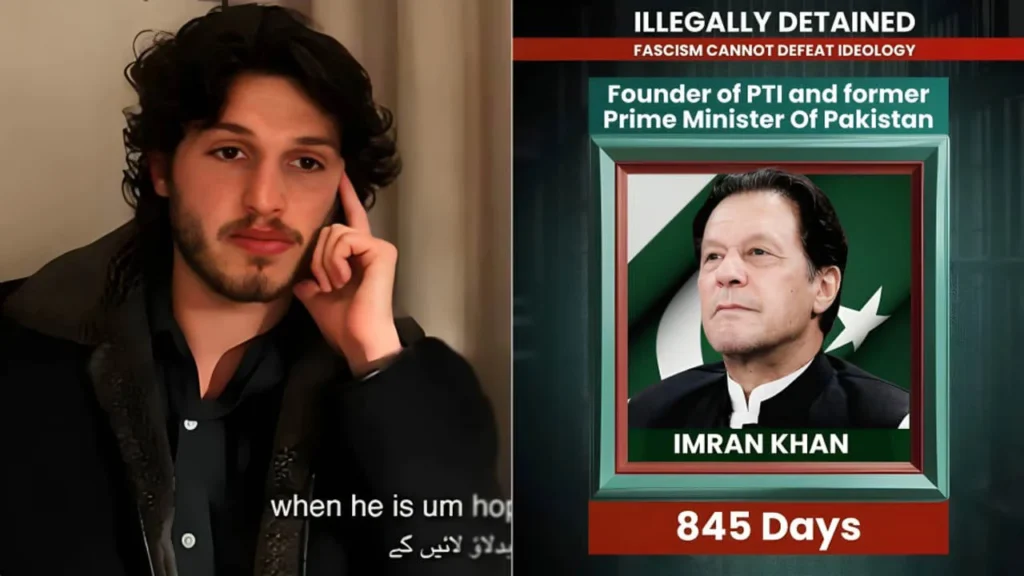
The recent speech by Kasim Khan at the United Nations Human Rights Council (UNHRC) has triggered significant political controversy and legal debate in Pakistan, following viral misinformation about his remarks, which fueled intense government backlash and public debate.
Speech at the UN: Allegations of Human Rights Violations
In his address, Kasim highlighted concerns including:
Alleged denial of fair trial rights
Restrictions on family access
Conditions of detention
The speech forms part of a broader effort by the family to internationalize concerns over alleged due process violations, prison conditions, and access to legal rights. His remarks align with increasing use of global platforms like the UN to spotlight domestic legal disputes.
Viral Claims and Misinformation Controversy
Following the speech, viral clips circulated on social media claiming that Kasim Khan called for the revocation of Pakistan’s GSP+ trade status with the European Union, a move that could have major economic implications.
However, subsequent fact-checking and review of the full UN session confirmed that no such demand was made. The viral narrative was based on edited or misleading excerpts of his speech.
His references to GSP+ were limited to human rights obligations linked to the program
Analysts say the controversy reflects how edited or selective content can distort legal and political narratives, particularly in highly polarized environments.
Government Reaction and Political Fallout
Despite the clarification, the speech sparked strong reactions from Pakistani officials, with some ministers accusing Kasim Khan of undermining national economic interests. Government figures suggested the speech could be part of a broader international lobbying effort, while opposition voices defended it as a legitimate exercise of free expression and human rights advocacy.
The controversy quickly escalated into:
Accusations of a “foreign lobbying campaign” against Pakistan
Claims of a “conspiracy” involving international pressure mechanisms
Renewed tensions between the government and supporters of Imran Khan
The issue quickly escalated into a wider political confrontation, further deepening divisions between the government and supporters of Imran Khan.
Legal Implications: Free Speech vs. State Interest
The controversy raises several important legal questions:
Governments often argue that such speeches may invite external interference in domestic affairs, raising concerns under principles of state sovereignty.
3. Trade Law Sensitivities
The mention of GSP+ status, a preferential trade arrangement with the EU—adds a legal-economic dimension. While Kasim did not call for its removal, the controversy highlights how human rights claims can intersect with international trade obligations.
Broader Significance
Kasim Khan’s UN speech reflects a growing trend where domestic political disputes are increasingly internationalized through global legal and human rights platforms.
The episode also highlights the power of misinformation in shaping legal and political narratives, especially when partial or edited content circulates widely before verification.
Domestic debates over political freedoms and due process
The role of diaspora voices in global legal advocacy
It also reflects a broader global trend where legal battles are increasingly fought not only in courts but also in international institutions and the digital information space.
Conclusion
Kasim Khan’s UNHRC speech has evolved from a human rights appeal into a high-stakes legal and political controversy shaped as much by misinformation as by substance.
As the situation develops, the case highlights the fragile balance between free speech, state sovereignty, and the role of international institutions in domestic legal matters, while also exposing the powerful impact of misinformation on modern legal discourse.
Background: The Iran War and Internal U.S. Policy Divisions
The U.S. entered the current Iran conflict following joint military strikes carried out with Israel, a decision that has been controversial both domestically and internationally. Critics argue the strikes lacked clear congressional authorization and may not meet the legal threshold for self-defense under international law.
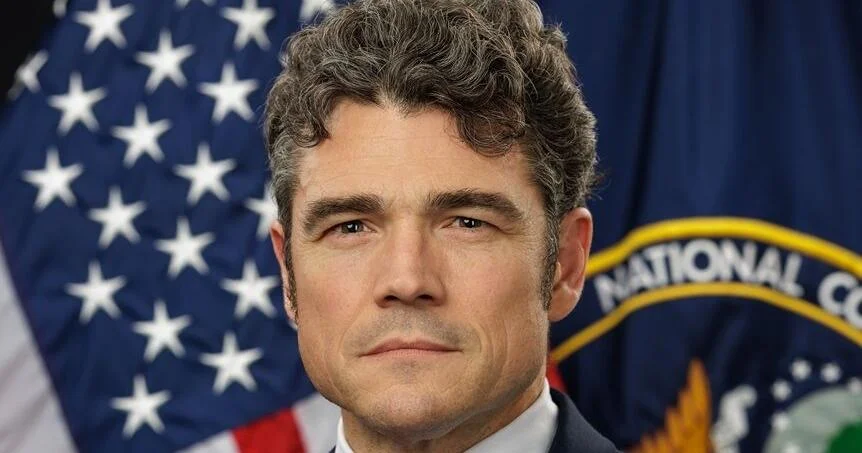
In his resignation letter, Kent stated that:
“The war was not justified by an imminent Iranian threat and suggested that external political pressure contributed to the decision to escalate militarily.”
His comments reflect a growing divide among U.S. officials between:
Interventionist factions supporting military pressure on Iran
Non-interventionist officials who argue the war contradicts earlier “America First” policies
The dispute has become particularly sensitive because the National Counterterrorism Center sits within the U.S. intelligence structure responsible for threat assessments.
Intelligence Community Fallout
Kent’s resignation is particularly significant because it highlights tension inside the U.S. intelligence community. The National Counterterrorism Center is responsible for assessing threats to U.S. national security, meaning Kent’s position placed him at the center of evaluating whether Iran posed a genuine danger.
His public disagreement with the administration suggests that intelligence assessments and political decisions may have diverged, a situation that historically has generated major legal controversies, such as debates over intelligence before the 2003 Iraq War.
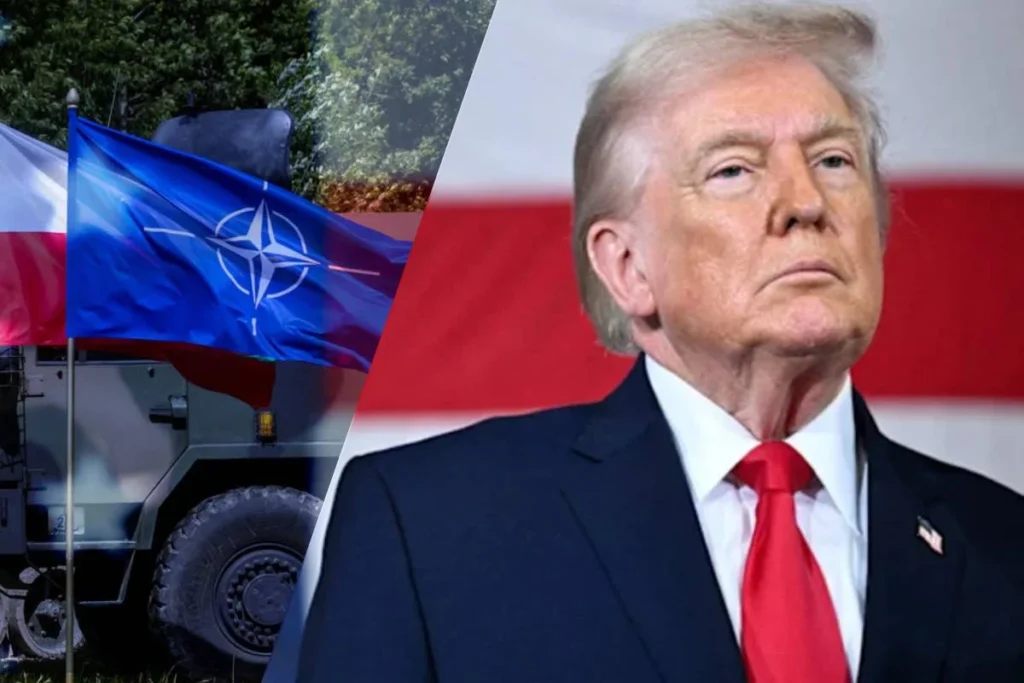
NATO Allies Reject the U.S. Request
At the same time, the White House faced mounting diplomatic frustration after several NATO and partner countries declined Trump’s request to deploy naval forces to protect commercial shipping in the Strait of Hormuz. The strategic waterway carries roughly one-fifth of global oil supplies and has become a flashpoint after Iranian threats to disrupt shipping following U.S. and Israeli strikes.
Major European allies, including the United Kingdom, France, and Germany, have refused to participate in a U.S.-led maritime coalition, emphasizing that NATO is a defensive alliance rather than a mechanism for joining conflicts initiated by individual members. European officials also signalled concern that participating in Hormuz operations could escalate the war and drag NATO into a wider Middle East conflict.
“it would avoid being drawn into a broader war in the Middle East.”
France also rejected claims that it would join U.S. operations in the Gulf, with President Emmanuel Macron clarifying that:
“Paris would only support maritime security missions after hostilities subside and through multilateral frameworks rather than under U.S. command.”
Outside NATO, other U.S. partners, including Japan and Australia, also declined to commit naval forces to the mission immediately.
Trump’s Reaction and Diplomatic Pressure
Trump responded with visible frustration, arguing that many countries benefiting from secure oil shipments should contribute to protecting the route. He criticized both European allies and Asian economies for relying on the United States to maintain maritime security while declining to provide military support. He warned that:
“NATO’s future could be very bad if allies refused to assist the United States in maintaining maritime security in the Gulf.”
Trump also criticized countries that rely heavily on oil transported through the strait, particularly Asian economies, for not contributing military support to keep the corridor open. Despite the pushback, the White House claims it is still negotiating with several countries to form a coalition to escort commercial vessels through the strategic passage.
Legal Context: Collective Defense vs. Optional Military Support
From a legal perspective, NATO allies are not obligated to join the operation. Under Article 5 of the North Atlantic Treaty, members are only required to assist when a member state is attacked.
However, the current Iran conflict was initiated by U.S. and Israeli strikes, meaning that NATO allies are not legally required to join military operations. As a result, European governments have treated the request as a voluntary coalition operation rather than a treaty obligation. Legal analysts note that NATO members often avoid participating in conflicts where:
The conflict lacks UNSecurity Council authorization
The operation risks escalating into a regional war
These factors appear to be influencing European governments’ reluctance.
Conclusion
Kent’s resignation and the allied refusal together raise broader questions about the legal legitimacy and strategic sustainability of the Iranwar. Critics argue that if the administration cannot demonstrate an imminent threat from Iran or obtain congressional authorization, the military campaign could face challenges under both the War Powers Resolution and international law governing the use of force.
The twin developments have exposed deep divisions within the transatlantic alliance and inside the U.S. national security apparatus. As the conflict continues and tensions in the Persian Gulf intensify, the administration may face growing pressure from Congress, allies, and legal experts over both the lawfulness and the long-term strategy of the Iranwar.
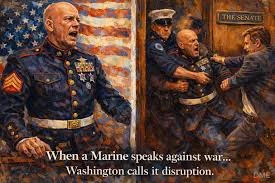
Although congressional hearings are protected spaces governed by strict rules of conduct, the incident highlights a complex intersection of constitutional rights, Capitol security authority, and civil liability law. While maintaining order inside Congress is essential for the functioning of democratic institutions, the authority to use force is generally governed by constitutional protections, congressional rules, and the role of law enforcement, particularly the United States Capitol Police. This raises a complex legal issue about where a senator’s authority ends and the responsibility of official security begins.
Congressional Authority to Maintain Order
The authority of Congress to maintain order within its legislative proceedings is rooted in the U.S. Constitution and long-standing parliamentary practice. Under Article I, Section 5 of the Constitution, each chamber of Congress is granted:
“the power to determine the rules of its proceedings, as well as the authority to discipline its members and ensure the orderly conduct of legislative business.”
This provision establishes the legal basis for the House of Representatives and the Senate to regulate behavior in their chambers, hearings, and committee meetings. Maintaining order during congressional proceedings is considered essential to the functioning of democratic governance. Legislative sessions often involve contentious debate, and Congress’s ability to enforce procedural rules ensures that discussions occur in an organized and lawful manner. Both chambers have established detailed procedural rules that govern how hearings are conducted, how witnesses are treated, and how disruptions are handled.
Congress exercises this authority through a combination of presiding officers, committee chairs, and security personnel. In the House of Representatives, the Speaker of the House oversees chamber proceedings, while in the Senate, the Vice President or the President pro tempore performs a similar role. During committee hearings, the committee chair has the authority to enforce decorum, recognize speakers, and remove individuals who disrupt the proceedings.
To support this authority, Congress relies on institutional security forces such as the U.S. Capitol Police, who are responsible for maintaining safety and order within the Capitol complex. If individuals disrupt hearings, refuse to follow instructions from the presiding officer, or pose a security risk, Capitol Police officers may remove them from the room. This enforcement mechanism ensures that legislative activities can continue without interference or intimidation.
Congress also retains disciplinary authority over its own members. Both the House and the Senate may impose sanctions ranging from formal reprimands and censures to expulsion, depending on the severity of misconduct. These powers allow Congress to enforce internal standards of behavior and maintain institutional integrity.
In the context of public hearings, the authority to maintain order must also be balanced against constitutional protections such as the First Amendment. Members of the public are generally allowed to observe legislative proceedings, and individuals may participate as witnesses or invited speakers. However, the right to free speech does not extend to disrupting official government proceedings, and Congress may impose reasonable restrictions to ensure that hearings proceed in an orderly manner.
Ultimately, congressional authority to maintain order reflects a broader constitutional principle: legislative bodies must be able to regulate their own proceedings in order to carry out their constitutional responsibilities effectively. By establishing procedural rules and enforcement mechanisms, Congress ensures that debate remains structured, respectful, and conducive to democratic decision-making.
Who Has Authority to Remove Protesters
During congressional hearings or legislative proceedings, the authority to remove protesters or disruptive individuals generally rests with the presiding officer of the proceeding and law enforcement officials responsible for security within the U.S. Capitol complex. This authority is grounded in Article I, Section 5 of the U.S. Constitution, which allows each chamber of Congress to determine its own procedural rules and maintain order during legislative activities.
Role of the Presiding Officer or Committee Chair
In congressional hearings, the committee chair or the presiding officer has primary authority to manage the proceedings. This includes recognizing speakers, maintaining decorum, and addressing disruptions. If an individual in the audience or a participant begins to interrupt or obstruct the hearing, the chair may issue warnings and direct that the individual cease the disruptive behavior.
If the disruption continues, the chair may formally order that the individual be removed from the hearing room so that the proceedings can continue without interference. This authority is part of the broader power of Congress to regulate its internal operations.
Role of the U.S. Capitol Police
Once the presiding officer orders removal, the responsibility for physically escorting the individual out typically falls to the U.S. Capitol Police, the federal law enforcement agency tasked with protecting members of Congress, congressional staff, and visitors within the Capitol complex. Capitol Police officers have the legal authority to remove individuals who disrupt official proceedings or refuse to comply with lawful instructions.
In some cases, protesters who refuse to leave voluntarily may be detained or arrested for offenses such as disorderly conduct, unlawful entry, or disruption of congressional proceedings.
Limits on Private Individuals
Private individuals, including members of the public or other attendees, generally do not have legal authority to forcibly remove protesters. Physical intervention by a private person can raise legal concerns, particularly if it involves the use of force. In most situations, enforcement actions are expected to be carried out by authorized security personnel or law enforcement officers.
Balancing Order and Free Expression
Although protests and political expression are protected under the First Amendment, these rights do not extend to disrupting official government proceedings. Courts have recognized that legislative bodies may impose reasonable restrictions on speech within official meetings or hearings in order to ensure that government functions can continue effectively.
As a result, while individuals may express dissent outside the hearing room or through lawful protest, disruptions within congressional proceedings may legally result in removal by security authorities acting under the direction of congressional leadership.
The Doctrine of Legislative Immunity
The doctrine of legislative immunity is a constitutional principle that protects members of legislative bodies from legal liability for actions taken within the scope of their official legislative duties. In the United States, this protection is primarily derived from the Speech or Debate Clause of the U.S. Constitution, found in Article I, Section 6, which states that members of Congress:
“shall not be questioned in any other place for any speech or debate in either chamber.”
This provision ensures that lawmakers can perform their legislative responsibilities without fear of external interference from the executive branch, the judiciary, or private parties. The purpose of legislative immunity is to safeguard the independence of the legislative branch and preserve the separation of powers within the constitutional system.
By shielding lawmakers from lawsuits or prosecution related to their legislative activities, the doctrine allows them to engage in debate, introduce legislation, conduct hearings, and investigate government conduct without intimidation or retaliation. This protection reflects the broader democratic principle that elected representatives must be able to act freely in carrying out their duties on behalf of the public.
Legislative immunity generally applies to actions that are considered legislative acts, such as speeches made during congressional debates, participation in committee hearings, voting on legislation, drafting bills, and issuing official reports. Courts have interpreted these activities as core functions of the legislative process and therefore entitled to constitutional protection.
However, the doctrine does not provide blanket immunity for all conduct by lawmakers. Actions that fall outside the legislative sphere, such as political activities, campaign-related conduct, administrative tasks, or personal behavior, are not protected under the Speech or Debate Clause. In such cases, members of Congress may still be subject to criminal prosecution, civil lawsuits, or ethical investigations.
The scope of legislative immunity has been clarified through several decisions by the U.S. Supreme Court. In cases such as Gravel v. United States (1972) and Eastland v. United States Servicemen’s Fund (1975), the Court affirmed that the Speech or Debate Clause provides broad protection for legislative acts but does not extend to activities unrelated to the legislative process.
In the context of disruptions during congressional hearings or confrontations with protesters, legislative immunity may protect lawmakers from legal consequences if their actions are directly related to maintaining order in the legislative process. However, if a lawmaker engages in conduct that goes beyond legislative functions, such as physically intervening in a situation unrelated to official proceedings, courts may determine that such actions fall outside the scope of legislative immunity.
Ultimately, the doctrine of legislative immunity plays a crucial role in protecting the institutional independence of Congress while still allowing for accountability when lawmakers act outside the boundaries of their constitutional responsibilities.
Potential Civil Liability for Excessive Force
While members of Congress and other officials may have authority to maintain order during legislative proceedings, the use of physical force against protesters or disruptive individuals can raise questions of potential civil liability, particularly if the force used is deemed excessive or unreasonable. U.S. law generally permits reasonable actions to remove individuals who are disrupting official proceedings, but the level of force used must remain proportionate to the situation.
Legal Standard for Excessive Force
Under U.S.civil rights law, the concept of excessive force arises when an individual uses more force than is reasonably necessary to address a situation. Courts typically evaluate excessive force claims using a reasonableness standard, examining whether the force used was appropriate given the circumstances. This analysis considers factors such as:
The level of threat posed by the individual being removed
Whether the individual was resisting lawful instructions
Whether less forceful alternatives were available
The severity and context of the disruption
If the force used exceeds what a reasonable person would consider necessary to restore order, it may be considered excessive and could give rise to legal claims.
Civil Rights Claims Under Federal Law
Individuals who believe their rights were violated during an encounter with government officials may bring civil claims under federal civil rights statutes, particularly 42 U.S.C. § 1983, which allows individuals to seek damages for violations of constitutional rights by government actors. Although members of Congress operate within a unique constitutional framework, actions that fall outside protected legislative functions may still expose individuals to civil liability if constitutional rights, such as freedom from unreasonable force, are violated.
Potential claims could involve violations of:
First Amendment rights, if a protester alleges retaliation for protected speech
Fourth Amendment protections, which guard against unreasonable seizures or excessive force
Limits of Legislative Immunity
The doctrine of legislative immunity, derived from the Speech or Debate Clause, protects lawmakers from legal consequences for actions that are directly tied to the legislative process. However, courts have consistently held that this protection applies only to legislative acts, such as debating, voting, or conducting official investigations.
If a lawmaker’s actions involve physical conduct unrelated to core legislative functions, such as personally using force against an individual rather than directing security personnel to handle the situation, courts may determine that the conduct falls outside the scope of legislative immunity.
Role of Law Enforcement
In most congressional proceedings, the responsibility for handling disruptive individuals lies with trained law enforcement personnel, particularly the U.S. Capitol Police. These officers are authorized to remove protesters and enforce order within the Capitol complex. When lawmakers personally intervene in a physical confrontation, it can complicate the legal analysis and raise questions about whether proper procedures were followed.
Possible Legal Consequences
If a court determines that excessive force was used and that the conduct is not protected by legislative immunity, potential legal consequences may include:
Civil lawsuits seeking monetary damages
Claims for violations of constitutional rights
Investigations by congressional ethics committees
Public and political scrutiny
Even when a court ultimately finds that the actions were justified, incidents involving the use of force during official proceedings often attract significant legal and political attention.
Balancing Authority and Accountability
The ability of Congress to maintain order is essential for the functioning of democratic institutions. However, that authority must be exercised in a manner consistent with constitutional protections and civil rights. As a result, the legal system attempts to balance the need for order in legislative proceedings with the requirement that individuals be protected from unreasonable or excessive use of force.
Self-Defense and Defense of Others
In situations involving physical confrontations during public or governmental proceedings, individuals may sometimes invoke the legal doctrines of self-defense or defense of others to justify their actions. These principles are widely recognized in U.S. law and allow a person to use reasonable force to protect themselves or another person from an imminent threat of harm. However, the application of these defenses depends heavily on the specific circumstances of the incident and the proportionality of the response.
Legal Basis for Self-Defense
Self-defense allows an individual to use force when they reasonably believe that such force is necessary to prevent imminent physical harm. The key legal requirement is that the response must be proportionate to the threat. In other words, the level of force used must be no greater than what is reasonably required to stop the immediate danger. Courts typically evaluate self-defense claims using several factors, including:
Whether the person reasonably believed that they faced an immediate threat
Whether the force used was necessary to prevent harm
Whether the response was proportional to the level of danger
If these conditions are satisfied, the use of force may be considered legally justified.
Defense of Others
The related doctrine of defense of others allows a person to intervene when they reasonably believe another individual is facing imminent harm. Similar to self-defense, the force used must be proportionate and aimed at stopping the threat rather than punishing the individual causing it.
For example, a person may lawfully intervene to protect a colleague, public official, or bystander if they believe that individual is about to be physically attacked.
Limits on the Use of Force
While self-defense and defense of others are recognized legal defenses, they are subject to strict limitations. The use of force must be necessary and reasonable under the circumstances, and courts often examine whether less forceful alternatives were available. If the person claiming self-defense initiated the confrontation or escalated the situation unnecessarily, the defense may not apply.
Additionally, individuals are generally expected to defer to trained law enforcement personnel when they are present and able to handle the situation. In settings such as congressional hearings or public government proceedings, security personnel, including the U.S. Capitol Police, are responsible for maintaining order and addressing security threats.
Application in Government Settings
In the context of legislative hearings or official government events, the doctrines of self-defense and defense of others may still apply if an individual reasonably believes that immediate action is necessary to prevent harm. However, the presence of official security forces and established procedures for handling disruptions often complicates the legal analysis.
If a confrontation occurs and physical force is used, courts may examine whether the person who intervened reasonably believed that immediate action was required or whether the situation could have been handled by security personnel.
Legal and Practical Considerations
Ultimately, claims of self-defense or defense of others depend on the facts of the incident, including the nature of the threat and the proportionality of the response. Even when such defenses are raised, incidents involving physical force in official government settings may still trigger legal scrutiny, civil claims, or internal investigations.
These doctrines illustrate the broader legal principle that individuals may protect themselves or others from immediate harm, but the use of force must always remain reasonable, necessary, and proportionate to the threat faced.
First Amendment and Limits on Protest
The First Amendment to the U.S. Constitution guarantees fundamental freedoms, including the rights to free speech, peaceful assembly, and petitioning the government for redress of grievances. These protections form the legal foundation for public protest and political expression in the United States. Individuals, therefore, have the right to express dissent, criticize government officials, and participate in demonstrations, including protests related to congressional hearings or government policies.
However, the First Amendment does not grant an unrestricted right to protest in all places or in any manner. Courts have long recognized that the government may impose reasonable restrictions on the time, place, and manner of speech to ensure public safety, maintain order, and allow government institutions to function effectively. These limitations are particularly relevant in government buildings and official proceedings, where maintaining order is essential to the legislative process.
Public Forums and Government Spaces
The level of First Amendment protection often depends on the type of location where the protest occurs. Courts generally classify locations into three categories:
Traditional public forums, such as streets, parks, and sidewalks, are areas where free speech rights receive the strongest protection. In these spaces, the government may regulate speech only through narrow, content-neutral restrictions designed to serve important public interests.
Designated public forums are locations that the government intentionally opens for public expression, such as certain meeting rooms or public hearings. Speech restrictions in these areas must also remain neutral and reasonable.
Nonpublic forums, such as government offices, legislative chambers, and restricted areas of the Capitol, are spaces where the government may impose broader restrictions on speech in order to preserve the proper functioning of official activities.
Congressional hearing rooms typically fall within the nonpublic forum category, meaning that officials may limit disruptive conduct that interferes with legislative proceedings.
Disruptions and Legal Consequences
While individuals may attend congressional hearings and observe government proceedings, the First Amendment does not protect actions that disrupt official government functions. Courts have consistently held that government institutions may enforce rules prohibiting interruptions, shouting, or other conduct that prevents the orderly conduct of official meetings.
As a result, protesters who interrupt hearings, refuse to follow instructions from presiding officials, or obstruct proceedings may be removed from the hearing room by security personnel such as the U.S. Capitol Police. In certain cases, individuals who continue disruptive behavior may face charges such as disorderly conduct or unlawful disruption of congressional proceedings.
Balancing Free Speech and Institutional Order
The legal framework governing protests in government settings attempts to balance two important principles: the constitutional right to express dissent and the need for government institutions to carry out their functions without interference. Courts generally support restrictions on disruptive conduct when those restrictions are content-neutral and applied to maintain order rather than suppress particular viewpoints.
In practice, this means that individuals are free to protest government policies, criticize officials, and engage in political advocacy. However, when such activity takes place inside official government proceedings, it must conform to procedural rules designed to ensure that hearings and legislative sessions can proceed without interruption.
The First Amendment, therefore, protects the right to protest, but it also recognizes that democratic institutions require order and structure to function effectively, allowing both political expression and legislative deliberation to coexist within the constitutional system.
Possible Criminal Liability
When physical confrontations or disruptions occur during official government proceedings, participants may face potential criminal liability depending on the circumstances and the severity of the conduct. U.S. law provides several statutes that can apply to incidents involving the use of force, obstruction of proceedings, or disorderly conduct within federal government buildings, including congressional hearing rooms.
Disorderly Conduct and Disruption of Official Proceedings
One of the most common charges in such cases is disorderly conduct or disruption of official proceedings. Federal law allows authorities to prosecute individuals who intentionally disturb or obstruct government operations in places such as the U.S. Capitol or congressional offices. Actions such as shouting, refusing lawful orders, physically interfering with officials, or creating disturbances that prevent a hearing from continuing may fall within this category.
These offenses can result in fines, removal from the premises, or misdemeanor criminal charges, depending on the seriousness of the disruption.
Assault or Physical Contact
If a confrontation involves physical force or unwanted physical contact, the situation may escalate into potential charges for assault or battery. Under federal and state law, assault does not necessarily require serious injury; even unlawful physical contact or attempts to cause harm can qualify as an assault offense. If an individual uses force to remove or restrain another person without legal authority, prosecutors could consider whether the conduct constituted:
The specific charge would depend on the level of force used and whether the person involved suffered injuries.
Obstruction of Government Functions
Another possible charge relates to obstruction of government operations. Federal statutes prohibit interfering with the lawful activities of government officials or proceedings. If a protester or participant prevents a hearing from continuing or obstructs the work of congressional staff or security officers, prosecutors may argue that the conduct interfered with a federal function.
Such offenses are treated seriously because they involve interference with the operations of the legislative branch.
Trespass or Failure to Comply With Security Orders
Government buildings often have strict security rules governing behavior inside hearing rooms and public areas. Individuals who refuse to follow instructions from security personnel, such as orders to leave or cease disruptive conduct, may face trespassing or failure-to-comply charges.
For example, ignoring instructions from Capitol Police or remaining in a restricted area after being directed to leave could constitute a violation of federal security regulations.
Possible Defenses
Individuals facing criminal accusations may raise several legal defenses depending on the circumstances. These may include:
Self-defense or defense of others, if force was used to prevent immediate harm
Lack of intent, arguing that the conduct did not intentionally disrupt proceedings
First Amendment protections, if the actions were part of lawful protest rather than obstruction
However, courts generally hold that the First Amendment does not protect disruptive conduct that interferes with official government proceedings.
Investigations and Prosecutorial Discretion
Whether criminal charges are ultimately filed often depends on investigations conducted by law enforcement authorities, including federal security agencies responsible for Capitol protection. Prosecutors will typically evaluate evidence such as video footage, witness statements, and the level of disruption before deciding whether criminal prosecution is appropriate.
In many cases, authorities may opt for removal and warning rather than prosecution, particularly if the disruption was minor. However, incidents involving violence, injury, or serious interference with government functions are more likely to result in formal criminal charges.
Broader Legal Implications
Incidents involving confrontations during congressional proceedings often raise broader legal questions about the balance between free speech rights, security protocols, and institutional authority. While the law protects the right to protest and express dissent, it also recognizes that government institutions must maintain order to carry out their constitutional responsibilities.
As a result, actions that cross the line from protest into physical interference or violence may trigger both criminal liability and broader legal scrutiny regarding the limits of permissible conduct in government spaces.
Historical Precedents in CongressandComparative Legal Matrix
Although protests frequently occur during congressional hearings, it is rare for members of Congress to personally intervene. In previous cases, protesters disrupting hearings have typically been removed solely by Capitol Police, sometimes resulting in arrests but rarely involving direct physical engagement by lawmakers. This rarity is one reason the incident has drawn significant attention.
The incident involving Senator Tim Sheehy and protester Brian McGinnis highlights an important legal distinction between the roles and authorities of members of Congress, Capitol Police officers, and private citizens inside the U.S. Capitol. The following matrix explains the different legal powers, responsibilities, and liability risks associated with each actor during disruptions or protests in congressional proceedings.
Congressional rules of procedure; U.S. Constitution Article I; ethics and conduct rules.
Federal law governing the Capitol Police; criminal statutes covering disorderly conduct, assault, and obstruction.
Federal criminal law and Capitol regulations governing demonstrations and disruptions.
Typical Outcome During Disruptions
Direct security officers to remove individuals but rarely physically intervene themselves.
Remove the individual, detain them if necessary, and potentially file criminal charges.
Risk arrest or charges if they refuse to comply with removal orders.
The matrix illustrates that while members of Congress possess the authority to direct security measures, they are not normally responsible for enforcing those measures physically. The responsibility for removing protesters or maintaining order lies primarily with Capitol Police, who are legally trained and authorized to use force when necessary.
When a lawmaker personally intervenes in a physical confrontation, the legal protections normally associated with legislative activity may not apply. This can create potential exposure to civil liability claims, especially if injuries occur during the incident.
For protesters and members of the public, the First Amendment protects the right to express political views. However, these rights are subject to restrictions in non-public forums such as congressional hearing rooms, where disruptions can legally result in removal or arrest.
Why This Incident Is Legally Significant
The confrontation has drawn attention not simply because a protest occurred, such disruptions are relatively common, but because a sitting senator physically assisted law enforcement officers in removing a protester.
Such direct involvement raises broader legal and constitutional questions about:
The boundaries between legislative authority and law enforcement powers
The legal risks associated with physical intervention by elected officials
As political protests increasingly occur inside government institutions, courts and policymakers may face growing pressure to clarify the legal boundaries governing such situations.
Conclusion
Incidents involving physical confrontations or the removal of protesters during congressional hearings highlight the complex intersection between constitutional rights, institutional authority, and criminal law. The incident involving Senator Tim Sheehy and protester Brian McGinnis sits at the intersection of congressional authority, protest rights, and civil liability law.
While the First Amendment guarantees robust protections for political speech and peaceful protest, these rights are not absolute when exercised inside official government proceedings where order and security must be maintained. Congress and its presiding officials possess clear authority to regulate conduct within hearing rooms and legislative chambers, including the power to remove individuals whose actions disrupt proceedings.
At the same time, the use of physical force by anyone other than authorized security personnel may raise questions about legal justification, proportionality, and potential civil or criminal liability. In the broader constitutional framework, such incidents highlight the continuing challenge of preserving democratic debate while ensuring that government institutions can function effectively.
Frequently Asked Questions
Do protesters have the right to interrupt congressional hearings under the First Amendment?
No. While the First Amendment protects free speech and the right to protest, it does not protect actions that disrupt official government proceedings. Congressional hearings are considered controlled government spaces where officials may enforce rules to maintain order. Protesters can express dissent but may be removed if they interrupt or obstruct the proceedings.
Who has the authority to remove protesters from a congressional hearing?
Typically, security personnel such as the U.S. Capitol Police have the authority to remove disruptive individuals from congressional hearings or government buildings. Committee chairs or presiding officials may order the removal of individuals who violate rules of conduct, but the physical enforcement of that order is generally carried out by security officers.
Can a lawmaker or private individual physically remove a protester?
This depends on the circumstances. While lawmakers have authority to maintain order within hearings, physical removal is usually the responsibility of trained security personnel. If a private individual or official uses force without proper authority, questions may arise regarding assault, excessive force, or civil liability, depending on how the situation unfolded.
Can someone claim self-defense when force is used during a confrontation?
Yes, self-defense or defense of others may be raised as a legal defense if a person reasonably believed that force was necessary to prevent immediate harm. However, courts will examine whether the force used was proportionate and necessary under the circumstances.
What criminal charges could arise from a confrontation at a congressional hearing?
Possible charges may include disorderly conduct, assault, obstruction of official proceedings, or trespassing if an individual refuses to comply with security orders. The exact charges depend on the severity of the disruption and whether physical force or injuries were involved.
Can protesters be arrested simply for expressing political opinions?
No. Individuals cannot be arrested solely for expressing political views. The First Amendment protects political expression, but arrests may occur if a protester engages in conduct that disrupts proceedings, threatens safety, or violates security rules.
Could someone face civil lawsuits after such an incident?
Yes. Individuals who suffer injuries or unlawful physical contact during a confrontation may pursue civil claims for assault, battery, or excessive force. Courts would assess whether the force used was justified under the circumstances.
How do courts balance free speech with maintaining order in government proceedings?
Courts apply the principle that the government may impose reasonable time, place, and manner restrictions on speech. These restrictions must be content-neutral and designed to ensure that official proceedings, such as congressional hearings, can function without disruption while still respecting constitutional rights.
At the center of the debate is whether the sinking of an Iranian warship can be justified as a lawful act of self-defense or a legitimate military engagement during an armed conflict. Under international law, warships are generally considered legitimate military targets once hostilities exist between states. However, the use of force must still comply with fundamental legal principles such as necessity, proportionality, and distinction, and it must occur within the broader legal context governing the use of force between states.
Determining whether the attack was lawful, therefore, requires examining not only the circumstances of the naval engagement but also whether the broader U.S. military operations against Iran meet the legal thresholds established by international law.
International Legal Framework Governing Naval Warfare
Naval warfare is regulated by a combination of treaty law, customary international law, and humanitarian principles developed over centuries of maritime conflict. Although there is no single comprehensive treaty governing modern naval warfare, key legal frameworks include:
The United NationsCharter provides the foundational rule governing the use of force between states. Article 2(4) prohibits states from using force against the territorial integrity or political independence of another state unless the action is justified as self-defense under Article 51 or authorized by the UNSecurity Council. This rule applies equally to military actions conducted at sea, meaning that naval engagements must be legally justified within the same framework that governs land and air warfare.
Once an armed conflict exists between states, the conduct of naval operations is regulated by international humanitarian law, particularly the law of armed conflict at sea. These rules derive from several sources, including the Geneva Conventions, customary international law, and specialized maritime warfare guidance such as the San Remo Manual on International Law Applicable to Armed Conflicts at Sea (1994). Although the San Remo Manual is not a treaty, it is widely regarded by legal scholars and military practitioners as an authoritative summary of customary rules governing naval warfare.
Under these rules, enemy warships are generally considered legitimate military targets during armed conflict. Naval forces may attack or disable enemy military vessels, including submarines, destroyers, and aircraft carriers, provided that the attack complies with core humanitarian principles. However, the legality of such engagements depends on whether an armed conflict legally exists between the states involved and whether the use of force meets the requirements of necessity and proportionality.
International humanitarian law also requires that naval operations distinguish between military vessels and civilian shipping. Merchant ships, fishing vessels, and other civilian maritime traffic are protected unless they are directly participating in hostilities or transporting military supplies. Naval commanders must take precautions to avoid unnecessary harm to civilian vessels and maritime infrastructure.
The United Nations Convention on the Law of the Sea (UNCLOS) also plays an important role in regulating activities in international waters. UNCLOS establishes the principle of freedom of navigation on the high seas, allowing warships and merchant vessels from all nations to operate freely outside territorial waters. However, during armed conflict, military engagements between belligerent states may still occur in international waters, provided they comply with the rules governing naval warfare.
Taken together, these legal frameworks demonstrate that while naval combat is not prohibited under international law, it is heavily regulated. Any attack on an Iranian warship by U.S. forces would therefore need to be assessed within the broader context of whether a lawful armed conflict exists, whether the target qualifies as a legitimate military objective, and whether the attack complies with the principles of necessity, proportionality, and distinction established under the law of armed conflict.
The UN Charter and the Legality of the Use of Force
The legality of any military engagement between states, including naval warfare, is fundamentally governed by the United NationsCharter, which establishes the modern international legal framework regulating the use of force. Adopted in 1945 following the devastation of World War II, the UN Charter was designed to prevent unilateral aggression by placing strict limits on when states may resort to military force against another sovereign nation. As a result, the Charter forms the cornerstone of the global rules-based order governing interstate conflict.
Article2(4) of the UN Charter sets out the central prohibition, requiring all member states to refrain from the threat or use of force against the territorial integrity or political independence of any state. This rule applies broadly to all forms of military action, including air strikes, land invasions, cyber operations that produce physical destruction, and naval engagements at sea. In principle, therefore, the sinking of an Iranian warship by U.S. forces would fall within this prohibition unless it can be justified under one of the recognized legal exceptions.
The Charter provides two primary exceptions to this rule. The first is the right of self-defense, recognized under Article 51, which allows states to use force if they are responding to an armed attack or preventing an imminent threat of such an attack. In invoking self-defense, a state must demonstrate that the use of force was both necessary and proportionate to the threat it faced. If a naval engagement occurs as part of an ongoing armed attack or to prevent an imminent hostile action by an enemy warship, the state may argue that the strike is legally justified under this provision.
The second exception arises when the UNSecurity Council authorizes the use of forceunder Chapter VII of the Charter. In such cases, military action is undertaken collectively to restore international peace and security. However, Security Council authorization is often difficult to obtain due to the veto power of its permanent members, leading many modern conflicts to involve states relying primarily on claims of self-defense rather than on collective authorization.
In the context of naval engagements between the United States and Iran, the legal question therefore centers on whether the circumstances meet the threshold for lawful self-defense under Article 51. If the Iranian warship posed an imminent threat or was actively engaged in hostilities against U.S. forces or allied vessels, the attack could potentially be justified as a defensive action. Conversely, if the engagement occurred without an immediate threat or outside the context of an ongoing armed conflict, critics may argue that the strike constitutes an unlawful use of force under the UN Charter.
Status of Warships in Armed Conflict
Under international law, warships occupy a distinct legal status during armed conflict, as they are considered sovereign military assets of the state that operates them. Unlike civilian vessels, warships are not protected from attack during hostilities because they represent part of a nation’s armed forces and therefore constitute legitimate military objectives. The legal treatment of warships in armed conflict is primarily governed by international humanitarian law, customary maritime law, and the law of armed conflict at sea.
A warship is generally defined under the United Nations Convention on the Law of the Sea (UNCLOS) as a vessel belonging to the armed forces of a state, bearing external markings identifying it as a military ship, commanded by a commissioned officer, and manned by a crew subject to military discipline. Because warships represent the sovereign authority of their state, they also enjoy sovereignimmunity, meaning that they cannot be boarded, seized, or subjected to jurisdiction by another state in peacetime.
However, once an armed conflict exists between two states, the legal protection afforded by sovereignimmunity changes significantly. In wartime, enemy warships become lawful military targets, meaning they may be attacked, disabled, or destroyed by opposing naval forces. This principle reflects the reality that warships are designed to carry out combat operations and therefore form part of a state’s military capabilities.
The legality of attacking a warship during conflict is further clarified in the San Remo Manual on International Law Applicable to Armed Conflicts at Sea, which provides widely accepted guidance on maritime warfare. According to these principles, warships engaged in hostilities may attack enemy naval vessels without prior warning, provided the engagement complies with the broader humanitarian rules governing warfare.
Nevertheless, even attacks on enemy warships must respect certain legal constraints. Military operations at sea must still comply with the core principles of necessity, proportionality, and distinction. For example, commanders must ensure that the attack is directed at a legitimate military objective and that the method of attack does not cause excessive harm to civilians or neutral vessels operating nearby.
Another important aspect of the legal status of warships involves their treatment after they are disabled or surrendered. If a warship becomes incapable of fighting or its crew abandons ship, the vessel and its personnel may be considered hors de combat, meaning they are no longer legitimate targets. In such circumstances, international humanitarian law requires opposing forces to respect the safety of surviving sailors and provide assistance where feasible.
In the context of potential U.S.–Iran naval engagements, the legal status of Iranian warships is therefore relatively clear under international law. If hostilities between the two states legally exist, Iranian warships operating in international waters may be considered legitimate military targets. However, the legality of attacking them still depends on whether the broader use of force between the states itself is lawful under the UN Charter, as well as whether the specific naval engagement complies with the rules governing the conduct of warfare at sea.
Location of the Attack and Maritime Jurisdiction
The location of a naval attack is a key factor in determining its legality under international law. Maritime law divides the oceans into different jurisdictional zones, each governed by specific legal rules regarding sovereignty, navigation rights, and military activity. These zones are primarily defined by the United Nations Convention on the Law of the Sea (UNCLOS), which establishes the framework for maritime jurisdiction and the rights of states operating at sea.
Territorial Waters
A coastal state exercises sovereignty over its territorial sea, which extends up to 12 nautical miles from its coastline. Within this zone, the coastal state has full authority similar to its control over land territory. Foreign vessels, including warships, may pass through these waters under the principle of innocent passage, provided their activities do not threaten the peace, security, or order of the coastal state.
If a naval attack occurs within the territorial waters of a state, it may be viewed as a violation of sovereignty unless it can be justified under international law, such as in cases of self-defense or when authorized by the state’s. Military action in another state’s territorial waters therefore carries significant legal consequences and may be interpreted as an act of aggression if not legally justified.
Exclusive Economic Zone (EEZ)
Beyond the territorial sea lies the Exclusive Economic Zone (EEZ), which extends up to 200 nautical miles from the coast. In this area, the coastal state has sovereign rights primarily related to natural resources, such as fishing, oil exploration, and seabed minerals. However, the EEZ is not fully sovereign territory, and other states retain freedoms of navigation, overflight, and military operations.
As a result, naval forces from different states may legally operate in the EEZ of another state, including conducting exercises and transiting through the zone. Nevertheless, the use of force within an EEZ during peacetime could still raise legal questions if it threatens regional stability or violates the broader prohibition on the use of force under the UN Charter.
High Seas (International Waters)
Areas beyond national jurisdiction are known as the high seas, commonly referred to as international waters. In these regions, all states enjoy the principle of freedom of navigation, meaning that ships from any country may sail, conduct lawful activities, and operate naval forces without interference from other states.
Even in international waters, however, the use of military force is not unrestricted. Naval engagements must still comply with the UN Charter’s rules governing the use of force as well as the laws of armed conflict at sea. If a lawful armed conflict exists between two states, their naval forces may engage enemy warships on the high seas. Conversely, if no lawful basis for the use of force exists, attacking another state’s vessel, even in international waters, may constitute an unlawful act under international law.
International Humanitarian Law at Sea
Once armed conflict exists between states, military operations conducted at sea are regulated by International Humanitarian Law (IHL), often IHLreferred to as the law of armed conflict at sea. These rules are designed to limit the humanitarian consequences of naval warfare by protecting civilians, neutral vessels, and individuals who are no longer participating in hostilities. Although naval combat has historically played a major role in interstate conflicts, modern international law imposes strict legal constraints on how naval forces may conduct military operations.
The legal foundations of maritime humanitarian law derive from several sources, including the Geneva Conventions of 1949, customary international law, and guidance such as the San Remo Manual on International Law Applicable to Armed Conflicts at Sea (1994). While the San Remo Manual is not a treaty, it is widely recognized as an authoritative restatement of customary legal principles governing naval warfare and is frequently referenced by military planners and legal scholars.
Principle of Distinction
A central rule of international humanitarian law is the principle of distinction, which requires belligerent forces to distinguish between military targets and civilian objects at all times. In the maritime context, this means that naval forces may attack enemy warships, submarines, and other military vessels, as these constitute legitimate military objectives.
However, civilian vessels, including merchant ships, fishing boats, and passenger vessels, are generally protected from attack unless they are directly participating in hostilities or being used to support military operations. Naval commanders must therefore carefully identify their targets to ensure that attacks are directed only at lawful military objectives.
Principle of Proportionality
Naval operations must also comply with the principle of proportionality, which prohibits attacks expected to cause excessive civilian harm relative to the anticipated military advantage. Even when a legitimate military target is identified, commanders must evaluate whether the potential damage to civilian vessels, ports, or coastal infrastructure would be disproportionate.
For example, if an enemy warship is operating in close proximity to civilian shipping lanes, commanders must consider the risk to nearby civilian vessels before launching an attack.
Precautions in Naval Attacks
International humanitarian law also requires naval forces to take feasible precautions to minimize civilian harm during maritime operations. These precautions may include verifying targets through intelligence and surveillance, selecting weapons that limit collateral damage, and delaying or canceling attacks if new information indicates that civilian vessels may be at risk.
In modern naval warfare, these precautionary measures often involve the use of advanced surveillance systems, radar tracking, and intelligence analysis to ensure that military operations comply with legal requirements.
Protection of Shipwrecked Sailors and Survivors
International humanitarian law also addresses the treatment of sailors and individuals who become shipwrecked during naval combat. Under the Second Geneva Convention, sailors who are wounded, captured, or shipwrecked must be treated humanely and provided with medical assistance whenever feasible.
Once individuals are no longer participating in hostilities, often referred to as being hors de combat, they cannot be deliberately targeted. This rule reflects a broader humanitarian principle that individuals who are no longer capable of fighting should be protected from further harm.
Neutral Shipping and Maritime Safety
Another important aspect of maritime humanitarian law concerns the protection of neutral states and their commercial shipping. Neutral vessels operating in international waters must not be attacked unless they are clearly assisting one side in the conflict by transporting military supplies or engaging in hostile acts. Even in such cases, international law traditionally requires warning and verification before force is used against civilian shipping.
Implications for U.S.–Iran Naval Engagements
Even if the sinking of an Iranian warship were legally justified under the UN Charter’s rules on the use of force, the operation would still need to satisfy the humanitarian standards of distinction, proportionality, and precaution established by international humanitarian law. These rules ensure that naval warfare, while permitted under certain circumstances, remains subject to legal constraints designed to protect civilians and maintain humanitarian standards during armed conflict.
Rescue Obligations and Treatment of Survivors
International humanitarian law places significant obligations on naval forces regarding the rescue and treatment of survivors after a naval engagement. Even when the sinking of an enemy warship is considered a lawful military act, the rules governing armed conflict at sea require that those who are wounded, shipwrecked, or otherwise no longer participating in hostilities must be protected and treated humanely. These obligations are primarily derived from the Second Geneva Convention of 1949, which specifically addresses the protection of wounded, sick, and shipwrecked members of armed forces at sea.
Under these rules, once sailors abandon a sinking vessel or are thrown into the water as a result of combat, they are considered hors de combat, meaning they are no longer lawful targets. Attacking or deliberately harming individuals in this condition is strictly prohibited. Instead, naval forces are required, whenever circumstances permit, to take all feasible measures to search for and rescue survivors, regardless of whether they belong to friendly or enemy forces.
The obligation to provide assistance extends beyond simple rescue. Survivors who are captured become prisoners of war (POWs) and must be treated in accordance with international humanitarian law. This includes providing adequate medical care, humane treatment, protection from violence or intimidation, and respect for their dignity. The detention and interrogation of captured sailors must also comply with the legal protections outlined in theThird Geneva Convention, which governs the treatment of prisoners of war.
However, the obligation to rescue survivors is not absolute. Naval commanders may delay or limit rescue operations if immediate assistance would place their own forces at serious risk, such as when enemy combat operations are still ongoing or when rescue vessels could be exposed to further attack. In such cases, commanders must balance humanitarian obligations with operational security and the safety of their crews.
International law also requires belligerent states to respect the safety of neutral rescue vessels and humanitarian ships, such as hospital ships and maritime search-and-rescue units. These vessels are granted special protection during armed conflict and must not be targeted or interfered with while carrying out humanitarian missions.
In the context of a naval confrontation between the United States and Iran, the sinking of a warship would therefore trigger immediate humanitarian responsibilities under international law. Even if the initial attack were legally justified as part of an armed conflict, the attacking forces would still be expected to assist shipwrecked sailors when feasible and ensure that captured personnel are treated in accordance with the Geneva Conventions. These obligations reflect the broader humanitarian principle that, while warfare may permit the use of force against military targets, it must still respect
Domestic Legal Issues in the United States
In addition to international law governing naval warfare, any U.S. military action against an Iranian warship must also comply with domestic legal constraints within the United States. These constraints arise primarily from the U.S. Constitution, congressional war-making powers, and statutory frameworks such as the War Powers Resolution of 1973. Together, these legal rules define the balance of authority between the executive branch and Congress when the United States engages in military hostilities abroad.
Constitutional Allocation of War Powers
The U.S. Constitution divides authority over war between Congress and the president. Article I grants Congress the power to declare war, raise and support armed forces, regulate the military, and control funding for military operations. At the same time, Article II designates the president as Commander-in-Chief of the armed forces, giving the executive branch authority to direct military operations and respond to immediate threats.
This dual allocation of authority has historically produced tension over who has the ultimate authority to initiate military action. While Congress possesses the formal power to declare war, presidents have often relied on their commander-in-chief authority to conduct limited military operations without a formal declaration of war, particularly when responding to urgent security threats.
The War Powers Resolution
The War Powers Resolution of 1973 was enacted after the Vietnam War to limit unilateral presidential military action and restore congressional oversight. The law requires the president to notify Congress within 48 hours whenever U.S. forces are introduced into hostilities or situations where hostilities are likely.
Under the statute, the president may continue military operations for up to 60 days without congressional authorization, after which U.S. forces must be withdrawn unless Congress approves the action. A 30-day withdrawal period is provided to allow for the safe removal of troops if authorization is not granted.
In the context of a naval engagement with Iran, if the sinking of an Iranian warship were part of a broader military campaign, Congress could argue that the administration must seek explicit authorization for continued hostilities.
Authorization for Use of Military Force (AUMF)
In some cases, Congress provides authorization for military operations through an Authorization for Use of Military Force (AUMF) rather than a formal declaration of war. These authorizations give the president legal authority to conduct military operations against specific enemies or threats.
For example, the 2001 AUMF authorized military action against those responsible for the September 11 attacks, while the 2002 AUMF authorized the use of force against Iraq. Whether these existing authorizations could be used to justify military action against Iran is highly contested, and many lawmakers argue that a new AUMF would be required for any sustained conflict with Iran.
Congressional Oversight and Funding Authority
Congress also retains significant power over military operations through its control of federal spending. Even if the president initiates military action, Congress may pass legislation restricting or prohibiting the use of funds for certain military activities. This authority can effectively limit the scope or duration of military operations.
In addition, congressional committees may conduct oversight hearings and investigations into the legality and strategic justification of military actions. Such scrutiny can influence public debate and shape future legislative responses.
Conclusion
The sinking of an Iranian warship by a U.S. submarine represents a significant escalation in the ongoing conflict and raises complex legal questions under both international and domestic law. In such circumstances, naval engagements must comply with international humanitarian law, including the principles of distinction, proportionality, and precaution. Commanders must ensure that attacks are directed at lawful military objectives and that civilian vessels and neutral shipping are not placed at unnecessary risk.
Additionally, humanitarian obligations remain in force after the attack, requiring naval forces to assist shipwrecked sailors and treat captured survivors in accordance with the Geneva Conventions. From an international law perspective, the attack could be lawful if:
The Iranian vessel was a legitimate military target
The strike complied with necessity and proportionality requirements
However, if the conflict lacks a valid self-defense justification or if the vessel was not actively participating in hostilities, the legality of the operation could be contested. As the crisis continues to unfold, international legal scrutiny from governments, scholars, and multilateral institutions will play a crucial role in shaping how the event is interpreted and what precedents it may establish for future naval conflicts.
Frequently Asked Questions
Can the United States legally sink an Iranian warship in international waters?
Yes, but only under certain legal conditions. Under international law, particularly the UN Charter, the use of force is generally prohibited unless it is justified as self-defense against an armed or imminent attack or authorized by the UNSecurity Council. If an armed conflict legally exists between the United States and Iran, Iranian warships could be considered legitimate military targets under the law of armed conflict at sea.
Are warships protected under international maritime law?
Warships enjoy sovereignimmunity during peacetime, meaning they cannot be boarded, seized, or subjected to the jurisdiction of another state. However, during an armed conflict, enemy warships become legitimate military targets and may be attacked or disabled by opposing naval forces.
Yes. Maritime jurisdiction plays an important role in determining the legal implications of a naval engagement. Attacks occurring in territorial waters may violate a state’s sovereignty unless justified under international law. However, engagements on the high seas (international waters) may be lawful if they occur during a legitimate armed conflict and comply with the rules governing naval warfare.
What legal rules regulate naval warfare?
Naval warfare is governed by international humanitarian law, including the Geneva Conventions, customary international law, and guidance such as the San Remo Manual on International Law Applicable to Armed Conflicts at Sea. These rules require military operations to follow the principles of distinction, proportionality, and precaution.
Can civilian vessels be targeted during naval conflict?
Generally, civilian vessels are protected from attack under international humanitarian law. Merchant ships, fishing vessels, and passenger ships may only be targeted if they are directly participating in hostilities or transporting military supplies that support the enemy’s war effort.
What happens to sailors who survive a sinking warship?
Sailors who are wounded, captured, or shipwrecked after a naval engagement are protected under the Second Geneva Convention. They must be rescued when feasible and treated humanely. If captured, they are considered prisoners of war and must be treated according to the protections outlined in the Third Geneva Convention.
Yes. Under the U.S. Constitution, Congress has the power to declare war, while the president serves as commander-in-chief. The War Powers Resolution of 1973 requires the president to notify Congress within 48 hours of introducing U.S. forces into hostilities and limits the duration of military operations without congressional authorization.
Could sinking an Iranian warship lead to legal challenges in the United States?
Potentially. If the action is part of a broader military campaign, members of Congress may argue that the president must obtain congressional authorization for continued hostilities. Legal and political debates may arise regarding the scope of the president’s authority under the Constitution.
Are neutral countries affected by naval warfare in international waters?
Yes. International law requires belligerent states to respect the rights of neutral states and their shipping. Neutral vessels must not be attacked unless they are directly assisting one side in the conflict. Even then, specific procedures and precautions must be followed.
Why is the legality of naval warfare important in modern conflicts?
The legal framework governing naval warfare helps ensure that military operations remain consistent with international humanitarian standards and the broader prohibition on unlawful use of force. These rules aim to protect civilians, maintain stability in global maritime trade, and uphold the international legal order even during armed conflict.