Saturday, October 24, 2026
Home Blog Page 15

What Is Magecart E-Skimming? Complete Guide to Detection and Prevention

Learn how hackers steal credit card data from online stores, real-world attack examples, and the best 2025 detection and prevention strategies to protect your eCommerce website and customers from Magecart e-skimming.

magecart_credit_cards

Magecart attacks represent one of the most dangerous threats facing e-commerce businesses today, silently stealing payment card data from thousands of online stores.

According to Imperva’s security analysis:

“Magecart is a threat actor involved in payment card skimming operations with a focus on insecure e-commerce websites.”

Source Defense reports that:

“Magecart infections skyrocketed by 103% in just six months, understanding this threat is critical for every online merchant.”

This comprehensive guide explains what Magecart is, how e-skimming works, the anatomy of attacks, detection methods, and proven prevention strategies.
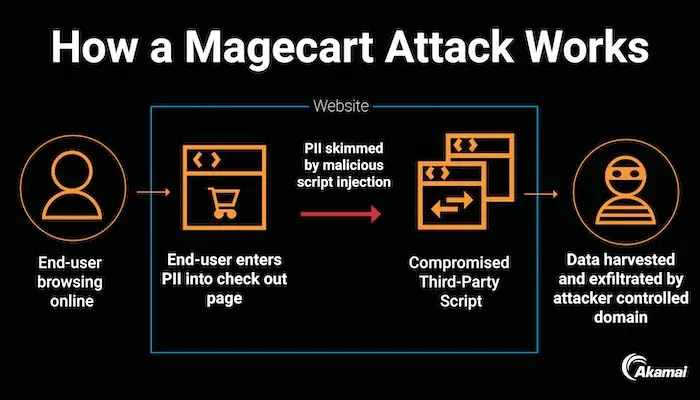
magecart_attack

Source: Akami Magecart Attack

What Is Magecart? Understanding Digital Card Skimming

Magecart refers to both a specific cybercriminal group and a broader category of attacks involving digital credit card skimming on e-commerce websites.

Akamai explains that:

“Magecart attack refers to a type of cyberattack that targets ecommerce sites by injecting malicious code into checkout pages, allowing threat actors to ‘skim’ user credit card details.”

The name “Magecart” comes from early attacks targeting Magento shopping cart platforms, though modern Magecart attacks affect all e-commerce platforms including Shopify, WooCommerce, custom-built stores, and even major retailers.

E-Skimming Explained: Client-Side Payment Theft

E-skimming, also called client-side skimming or JavaScript skimming, is the technique Magecart attackers use to steal payment information. Unlike traditional data breaches that steal stored payment data from databases, e-skimming captures payment information in real-time as customers enter it during checkout.

How Client-Side Skimming Differs: Traditional security focuses on server-side threats, protecting databases, servers, and backend systems. Client-side attacks happen in the customer’s browser, invisible to traditional security tools. This makes e-skimming particularly dangerous and difficult to detect.

The stolen data goes directly from the customer’s browser to criminal servers before legitimate payment processing occurs, so neither merchants nor customers realize theft has happened until fraudulent charges appear.

The Evolution of Magecart Attacks

Trustwave SpiderLabs reveals that:

“They first blogged about Magecart back in 2019; fast forward five years and it is still here going strong.”

The threat has evolved from simple script injections to sophisticated, multi-stage attacks using advanced obfuscation and evasion techniques.

Modern Magecart groups operate as organized criminal enterprises with specialized roles: some compromise websites, others develop skimming scripts, and dedicated teams collect and monetize stolen payment data.
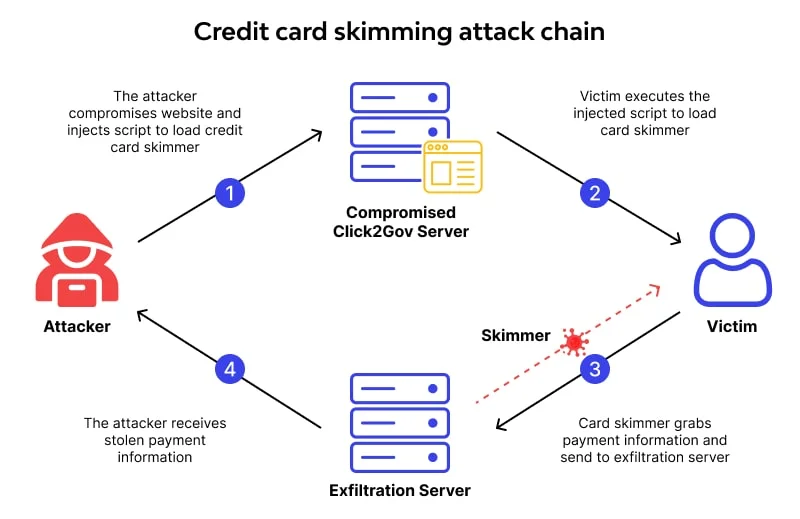
card_skimming

Source: What Is Magecart

How Magecart E-Skimming Works: The Attack Process

Understanding the attack process helps merchants recognize vulnerabilities and implement effective defenses:

Step 1: Initial Compromise and Access

Magecart attacks begin when criminals gain access to e-commerce websites through various methods:

Third-Party Supply Chain Compromise: Attackers compromise legitimate third-party services like analytics tools, chat widgets, payment processors, or advertising networks that e-commerce sites use.

According to Jscrambler’s analysis:

“typical Magecart behavior includes third-party scripts tampering with payment forms.”

Direct Website Compromise: Criminals exploit vulnerabilities in e-commerce platforms, plugins, or custom code to inject malicious scripts directly into websites. Unpatched software, weak credentials, and SQL injection vulnerabilities provide common entry points.

Supply Chain Attacks on Service Providers: Attackers target hosting providers, content delivery networks (CDNs), or payment gateway providers, compromising multiple e-commerce sites simultaneously through single exploits.

Insider Threats: In some cases, malicious insiders or social engineering attacks against employees provide access to inject skimming code.

Step 2: Payment Form Injection and Malicious Code

Once attackers gain access, they inject malicious JavaScript code into checkout pages.

Human Security suggest that:

“criminals inject malicious scripts into real payment pages to change form behavior or add or modify JavaScript code to create fake payment forms.”

Code Injection Methods Include:

Direct Script Injection: Malicious code embedded directly into payment page HTML or JavaScript files.

Third-Party Script Modification: Legitimate third-party scripts compromised to include skimming functionality while maintaining normal operations.

Payment Form Replacement: Entire payment forms replaced with identical-looking fake versions that capture data while appearing legitimate.

DOM Manipulation: JavaScript code that modifies payment forms dynamically in customer browsers, adding invisible data capture functionality.

The injected code is typically heavily obfuscated to evade detection during security scans. Attackers use encryption, encoding, dynamic code generation, and anti-debugging techniques to hide malicious functionality.

Step 3: JavaScript Skimming and Data Capture

When customers enter payment information, the malicious JavaScript activates and captures data. The Feroot detection guide details how skimming scripts target multiple data types:

Primary Targets:

  • Credit card numbers and CVV codes
  • Expiration dates
  • Cardholder names
  • Billing addresses
  • Email addresses and phone numbers

Advanced Data Collection: Some Magecart variants also capture login credentials, personal information from account creation forms, session tokens for account takeover, and complete checkout data including order details.

The skimming code monitors input fields, detects when customers enter payment information, captures data through keylogging or form submission interception, and triggers data transmission to criminal servers.

Step 4: Data Exfiltration to Criminal Servers

Stolen payment data gets sent to criminal-controlled servers through various methods designed to avoid detection:

Direct Transmission: Data sent immediately to external servers using XMLHttpRequest or Fetch API calls.

Image Beacon Technique: Data encoded in fake image requests that look like legitimate tracking pixels but actually transmit stolen information.

WebSocket Connections: Persistent connections established for real-time data streaming.

DNS Tunneling: Data hidden in DNS queries to evade network monitoring.

Delayed Transmission: Some sophisticated variants store data locally and transmit in batches or only under specific conditions to avoid detection.

According to Jscrambler:

“payment data being sent out to an unknown domain represents typical Magecart behavior that security systems should monitor.”

Step 5: Checkout Compromise and Ongoing Operations

The malicious code allows normal checkout to proceed, so customers complete purchases successfully without realizing their payment information was stolen. This stealth enables Magecart infections to operate for months, stealing thousands of payment cards before detection.

Attackers often implement persistence mechanisms ensuring the skimming code remains active even after website updates, security scans, or attempted removals. Sophisticated groups use multiple injection points, regularly update malicious code, and monitor infected sites to restore compromised scripts if removed.

Anatomy of Magecart Attacks: Real-World Examples

Understanding specific attack patterns helps recognize threats:

The CosmicSting Attack: 75% Platform Compromise

Trustwave documented that:

“CosmicSting impacted 75% of Adobe Commerce and Magento platforms,”

This represents one of 2024’s most widespread e-commerce compromises. This massive attack demonstrated how a single vulnerability in popular platforms can affect thousands of online stores simultaneously.

CosmicSting exploited an XML External Entity (XXE) vulnerability in Adobe Commerce allowing remote code execution. Attackers injected Magecart skimmers into checkout pages across thousands of infected stores, stealing payment data for months before detection.

Third-Party Widget Compromises

Several Magecart campaigns have targeted third-party services that e-commerce sites integrate:

Chat Widget Attack: Criminals compromised a popular customer support chat widget used by thousands of online stores. The compromised widget included hidden Magecart code affecting every site using the service.

Analytics Service Breach: A web analytics provider was compromised, and malicious code was injected into their tracking scripts. Since these scripts load on every page including checkout, attackers gained access to payment forms across hundreds of e-commerce sites.

Payment Gateway Compromise: Attackers compromised a payment gateway provider’s scripts, directly accessing payment information as it was entered across multiple merchant sites.

Supply Chain Attacks Through NPM Packages

Some Magecart groups compromise JavaScript packages in NPM (Node Package Manager) repositories. When developers install these compromised packages, they unknowingly include Magecart code in their e-commerce sites. This supply chain attack method scales efficiently, potentially affecting thousands of websites through single compromised packages.

Major Retailer Breaches

Magecart attacks have affected major retailers including British Airways (380,000 customers affected), Ticketmaster (40,000 customers), and Newegg. These high-profile breaches demonstrate that even large companies with security teams can fall victim to sophisticated Magecart campaigns.
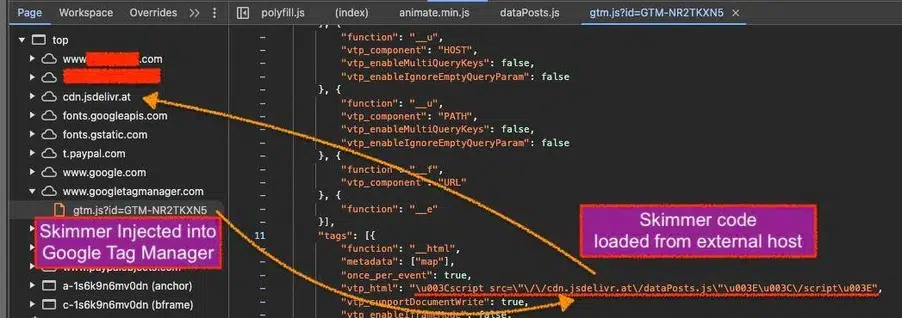
malicious_GTM_script

Source: Trustwave – State of Magecart

Detecting Magecart E-Skimming: Signs and Methods

Early detection limits damage from Magecart infections. Here are detection approaches:

Behavioral Monitoring for Suspicious Activity

Jscrambler emphasizes that:

“Detecting typical Magecart behavior, like third-party scripts tampering with payment forms or payment data being sent to unknown domains, requires continuous monitoring.”

Warning Signs Include:

  • Unexpected JavaScript modifications to payment forms
  • New or modified third-party scripts loading on checkout pages
  • Payment data transmitted to unfamiliar domains
  • Obfuscated or encoded JavaScript on payment pages
  • Unusual network requests during checkout processes
  • Scripts loading from suspicious or newly registered domains

Client-Side Security Monitoring

Traditional server-side security tools can’t see client-side attacks happening in customer browsers. Specialized client-side security solutions monitor JavaScript execution, detect unauthorized form modifications, identify data exfiltration attempts, and block suspicious script behavior in real-time.

DataDome’s prevention guide highlights that:

“Client-side third-party management represents a critical defense against Magecart.”

Regular Security Audits and Code Reviews

Conduct regular reviews of:

  • All JavaScript loading on payment pages
  • Third-party services and their security practices
  • Recently modified files, especially on checkout pages
  • Unexpected changes to payment processing code
  • New or unfamiliar domains in network requests

Subresource Integrity (SRI) Monitoring

Implement Subresource Integrity checks that verify third-party scripts haven’t been modified. SRI uses cryptographic hashes to ensure scripts load exactly as expected. When hash mismatches occur, browsers block the scripts, preventing compromised versions from executing.

Content Security Policy (CSP) Implementation

Content Security Policies restrict which scripts can execute and where data can be sent. Properly configured CSP prevents unauthorized scripts from loading and blocks data transmission to suspicious domains. Monitor CSP violation reports to identify attempted attacks.

Network Traffic Analysis

Monitor outbound traffic from payment pages for:

  • Connections to unknown or suspicious domains
  • Data transmissions during payment form interactions
  • Unusual patterns in image requests or API calls
  • DNS queries to newly registered domains
  • Encrypted data in query parameters or headers

Third-Party Script Inventory and Monitoring

Maintain comprehensive inventories of all third-party scripts used on your site. Monitor for:

  • Unauthorized new scripts
  • Modifications to existing scripts
  • Changes in script behavior or data access
  • New domains hosting familiar scripts
  • Expired SSL certificates on third-party domains
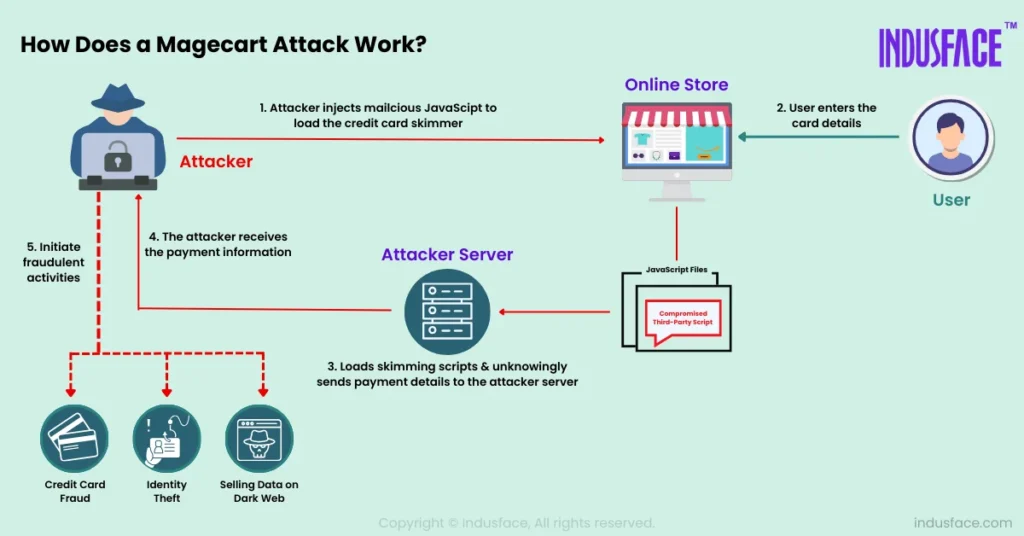
Magecart_attack

Source: Detect Magecart Attacks

Preventing Magecart Attacks: Comprehensive Protection

Effective Magecart prevention requires multiple security layers:

PCI DSS 4.0 Compliance Requirements

DataDome points out that:

“PCI DSS 4.0 includes specific requirements addressing client-side security.”

Requirement 6.4.3 mandates that all payment page scripts are managed and that merchants maintain inventories and justify the necessity of each script.

Key PCI DSS 4.0 Client-Side Requirements:

  • Maintain inventories of all scripts on payment pages
  • Implement integrity checks for payment page scripts
  • Monitor for unauthorized script modifications
  • Implement Content Security Policies
  • Regularly review third-party script security

Client-Side Security Solutions

Deploy specialized client-side security platforms that:

  • Monitor JavaScript execution in real-time
  • Detect payment form tampering
  • Block unauthorized data exfiltration
  • Enforce script behavior policies
  • Provide visibility into client-side activity

These solutions operate in customer browsers, providing protection where Magecart attacks occur.

Content Security Policy (CSP) Implementation

Implement strict CSP headers that:

  • Whitelist only authorized script sources
  • Prevent inline JavaScript execution
  • Block data transmission to unauthorized domains
  • Require integrity checks for third-party scripts
  • Log policy violations for investigation

CSP provides powerful defense against script injection attacks when properly configured.

Subresource Integrity (SRI) for Third-Party Scripts

Use SRI attributes on all third-party script tags to verify scripts haven’t been modified. Include cryptographic hashes that browsers verify before executing scripts. Update hashes when legitimate script updates occur.

Third-Party Risk Management

Carefully vet all third-party services before integration by assessing their security practices, reviewing security certifications and audits, checking incident history, evaluating update and patch management, and requiring contractual security obligations.

Continuously monitor integrated third-party services and limit the number of third-party scripts to only essential services.

Regular Security Updates and Patch Management

Keep all software current including e-commerce platforms, plugins and extensions, themes and templates, server software and dependencies, and security tools. Subscribe to security bulletins for technologies you use and apply critical patches immediately.

Web Application Firewall (WAF) Protection

Deploy WAFs configured to detect and block Magecart indicators including suspicious script injections, unauthorized payment form modifications, data exfiltration attempts, and connections to known malicious domains.

Security Monitoring and Incident Response

Implement 24/7 monitoring for Magecart indicators with automated alerts for suspicious activity. Develop incident response procedures specifically for Magecart infections including rapid script removal, customer notification protocols, payment processor communication, and forensic investigation processes.

Payment Tokenization and Hosted Payment Pages

Use payment tokenization replacing card data with tokens or hosted payment pages where customers enter payment information on payment processor sites rather than merchant sites. These approaches reduce or eliminate the need to handle raw payment data, significantly reducing Magecart risk.

Employee Training and Awareness

Train staff to recognize phishing attempts targeting administrative access, follow secure coding practices, properly manage third-party integrations, respond appropriately to security alerts, and understand Magecart risks and indicators.

Conclusion

Magecart e-skimming represents a persistent and evolving threat to e-commerce security, with infections surging 103% in recent months and affecting major platforms like Adobe Commerce. The sophisticated client-side nature of these attacks makes them particularly dangerous, operating invisibly in customer browsers while traditional security tools focus on server-side threats.

Understanding how Magecart works from initial compromise through third-party services or direct exploitation, to payment form injection with obfuscated JavaScript, real-time data capture during checkout, and stealthy exfiltration to criminal servers helps merchants recognize vulnerabilities and implement effective defenses.

Detection requires specialized client-side security monitoring, behavioral analysis for suspicious script activity, regular security audits, SRI and CSP implementation, and comprehensive third-party script management. Prevention demands multiple security layers including PCI DSS 4.0 compliance, client-side security solutions, strict CSP policies, third-party risk management, regular updates, WAF protection, security monitoring, and employee training.

The 75% platform compromise rate from CosmicSting and major retailer breaches demonstrate that no e-commerce business is too large or too secure to ignore Magecart threats. By implementing the detection and prevention strategies outlined in this guide, merchants can significantly reduce their risk of becoming the next Magecart victim while protecting customer payment data and maintaining the trust essential for e-commerce success.

Glossary of Magecart E-Skimming Terms

Client-Side Attack: Cyberattack targeting code executing in user browsers rather than on servers

Content Security Policy (CSP): HTTP header restricting which resources can load and execute on web pages

E-Skimming: Digital theft of payment card data from online checkout forms

JavaScript Skimming: Using malicious JavaScript to capture payment information in customer browsers

Magecart: Cybercriminal groups specializing in e-commerce payment card skimming

Payment Form Injection: Inserting malicious code into e-commerce checkout pages to steal payment data

PCI DSS 4.0: Latest Payment Card Industry Data Security Standard including client-side security requirements

Subresource Integrity (SRI): Security feature verifying third-party resources haven’t been tampered with

Supply Chain Attack: Compromising third-party vendors to access multiple target organizations

Third-Party Script: JavaScript code from external sources loaded on websites

Frequently Asked Questions

What is Magecart e-skimming?

Magecart e-skimming is a type of cyberattack where hackers inject malicious JavaScript code into eCommerce websites to steal customers’ payment and personal information during checkout.

How do Magecart e-skimming attacks work?

Attackers exploit vulnerabilities in website code, plugins, or third-party integrations to insert hidden scripts that capture and transmit credit card data to their remote servers in real time.

What are the common signs of a Magecart infection?

Unusual JavaScript files, unauthorized code changes, slow checkout pages, or customer complaints about fraudulent charges may indicate a Magecart compromise.

How can businesses detect Magecart attacks?

Detection involves using web integrity monitoring tools, scanning scripts for unauthorized changes, employing Content Security Policies (CSP), and running regular vulnerability audits.

What are the best ways to prevent Magecart e-skimming?

Businesses can prevent e-skimming by keeping software and plugins updated, limiting third-party scripts, implementing Subresource Integrity (SRI), and using real-time monitoring to detect suspicious activities.


Crisis in South Asia: India, Pakistan, and Afghanistan on the Brink of War as Blasts Rock Capital Cities

Blasts in India and Pakistan’s capital cities intensify South Asian tensions, as Afghanistan’s involvement raises growing fears of an emerging war.

Recent violent incidents across India and Pakistan have exposed the fragile security fabric of South Asia, pushing the region toward a heightened conflict risk. South Asia faces a deepening security crisis as deadly explosions hit the capitals of India and Pakistan, alongside a major terrorist assault on a military cadet college in Pakistan’s border region.

Escalating Tensions in the Last 48 Hours

On Monday, a car bomb exploded near New Delhi’s historic Red Fort, killing at least 10 people and injuring over 30. Just a day earlier, Islamabad experienced a devastating suicide blast outside the city’s High Court, killing 12 and injuring more than 20. Pakistan’s Defense Minister Khawaja Asif declared the country in a:

“State of war”

This statement came following this attack, and attributed responsibility to militants linked to Afghanistan and India, framing it as a warning from Kabul.

afghanistan-pakistan

Simultaneously, security forces in Pakistan successfully thwarted a coordinated terrorist attack on Cadet College Wana in South Waziristan. The attackers, affiliated with the outlawed Tehrik-i-Taliban Pakistan (TTP) and allegedly supported by Indian and Afghan handlers, attempted to take cadets hostage.

Swift military response led to the deaths of two terrorists, with three cornered inside the college’s administrative block. While no cadets or staff were harmed, a suicide car bomb severely damaged infrastructure and wounded at least 16 civilians in the nearby area.

Car Explosion Shakes India in New Delhi’s Historic Heart

A devastating car explosion struck near New Delhi’s iconic Red Fort on Monday, resulting in at least 10 fatalities and multiple injuries. The blast disrupted one of India’s most historic and bustling areas, causing chaos in the crowded bazaars surrounding the 17th-century monument, a powerful symbol of Indian independence.

Eyewitnesses and footage reveal thick, orange flames lighting the night sky and severely damaged vehicles scattered around. The cause of the explosion remains unconfirmed, but Indian authorities are treating it as a deliberate act, with an ongoing investigation under anti-terror laws.

delhi_blast

Prime Minister Narendra Modi, speaking from Bhutan, condemned the attack as a:

“horrific incident”

Prime Minister Modi assured the public that all responsible parties will be held accountable. Defense Minister Rajnath Singh echoed this, pledging transparency and swift justice.

Delhi police and emergency responders have described the scene as tragic, with more than 30 individuals suffering serious injuries. The blast occurred when a slow-moving vehicle stopped near a traffic light before detonating, also causing fires in several surrounding vehicles.

The explosion has triggered a nationwide security lockdown. Airports, railway stations, government offices, and tourist landmarks like the Red Fort remain on high alert, with closures and increased vigilance expected to continue as investigations proceed.

Terrorist Attack on Wana Cadet College-Pakistan

In neighboring Pakistan, security forces thwarted a major terror attempt at a military-run cadet college in Wana, South Waziristan. Two terrorists affiliated with the Tehrik-i-Taliban Pakistan (TTP) were killed during the assault, which involved a suicide car bombing and multiple armed attackers trying to take hostages.

wana_cadet_attack

The attackers breached the perimeter but were contained before reaching the main building. No cadets or staff were harmed, though surrounding residential areas suffered significant damage, and at least 16 civilians sustained injuries.

Pakistan’s authorities allege involvement and support from India and militant handlers in Afghanistan, escalating tensions in the region. The TTP, listed as a terrorist organization by the U.S. and U.N., maintains loose ties with the Afghan Taliban but operates independently.

Deadly Blast Strikes Islamabad’s Judicial Court

Islamabad suffered a severe explosion near its High Court, killing 12 and injuring over 20 people, including civilians and officials. The blast, believed to be a suicide attack, took place in a highly secured zone housing several government offices.

President Asif Ali Zardari condemned the attack, labeling it a:

“suicide blast”

President Zardari instantly called for national resolve. A security source identified militant groups linked to the Afghan Taliban and Indian actors as responsible, though no formal claim has been made.

Defense Minister Khawaja Asif is urging vigilance and signaling increased hostility toward Afghanistan amid failed peace talks and escalating cross-border tensions. He described the attack as a warning from Kabul, affirming Pakistan’s readiness to respond.

Historical Context Deepening the Crisis

This surge in violence occurs against a backdrop of decades-long rivalry and numerous wars between India and Pakistan. The most recent intensification during the May 2025 conflict was sparked by a terrorist attack in Kashmir.

India’s retaliatory “Operation Sindoor” saw strikes across Pakistan but resulted in notable Indian air force losses, including several advanced Rafale fighter jets shot down by Pakistani defenses in their reply in “Operation Bunyan al Marsoos“.

india_pakistan_war

These complex aerial engagements revealed Pakistan’s upgraded weapons and tactical prowess, prolonging hostilities until a fragile truce was negotiated.

Diplomatic relations among India, Pakistan, and Afghanistan are further strained. The failure of peace talks in Istanbul between Pakistan and Afghanistan last month exacerbates suspicions.

Islamabad accuses Kabul of harboring militant groups such as the TTP, which it claims are proxies of India conducting suicidal attacks in Pakistan. Afghanistan rejects these allegations, denying any proxy activities.
Heightened Security and Diplomatic Strains

Following these attacks, India and Pakistan have ramped up security across critical urban centers, government facilities, and cultural landmarks. Vigilance remains elevated amid fears of further militant provocations and proxy warfare.

Pakistan’s official narrative blames Indian and Afghan interference for the recent uptick in violence, while New Delhi emphasizes its fight against terrorism and vows to protect its sovereignty.

The diplomatic aftermath is fraught with distrust and stalled negotiations. Efforts by international mediators to bridge divides have so far been unsuccessful, leaving the region vulnerable to escalations that could spiral into larger-scale conflict.

The reopening of India’s diplomatic mission in Kabul, as Afghanistan navigates Taliban rule, adds further complexity to the geopolitical dynamics.

Urgent Need for De-escalation

South Asia stands at a precipice where historical enmity, militant proxy warfare, and current violent episodes converge, severely challenging regional peace and security.

The combined impact of the recent explosions in Delhi and Islamabad, paired with the foiled terrorist attack in Wana, highlights the tense and perilous state of affairs. A concerted push for coordinated counterterrorism measures and renewed diplomatic dialogue is critical to prevent a further slide into open conflict.

The fragile balance between military preparedness and diplomatic engagement must be carefully managed to safeguard millions of lives dependent on peace in this volatile region.

BBC Leadership Resigns As Trump Threatens Legal Action Over Speech Editing Scandal

BBC leadership has resigned following a major controversy over the editing of Donald Trump’s speech. The fallout deepens as Trump threatens legal action against the broadcaster.

BBC_Leadership

BBC Director General Tim Davie and Head of News Deborah Turness resigned on Sunday following intense backlash over the editorial choices in a BBC Panorama documentary. The documentary included an edited version of former President Donald Trump’s January 6, 2021, speech before the US Capitol attack, which critics say misleadingly suggested Trump incited the riot by splicing comments made nearly 50 minutes apart.

Fallout from Editing Dispute

The resignations came after The Daily Telegraph reported on a leaked internal memo by Michael Prescott, a former independent editorial standards advisor to the BBC, who argued the documentary’s editing distorted Trump’s message.

Telegraph_memo

The report criticized the documentary’s handling of Trump’s speech, arguing it was misleading because it omitted the section where Trump urged supporters to protest peacefully and instead created the false impression that he urged them to:

“fight like hell.”

Prescott’s report also flagged that BBC management did not acknowledge this breach until after the memo was leaked.

Why BBC’s Director Faced Resignation

The BBC, as a publicly funded British institution, faces stricter oversight compared to commercial broadcasters. It relies on an annual TV license fee mandated by law and must uphold impartiality under its royal charter. Any perceived bias often triggers swift and intense responses from politicians, viewers, and competitors.

The controversy over the Trump documentary not only incited complaints but also initiated a regulatory investigation by the UK media watchdog. Industry analysts suggest such intense scrutiny contributed to the resignations of Davie and Turness.

The high-profile resignations are viewed as necessary amid escalating pressure and may prompt a significant reassessment of editorial policies and leadership culture within the corporation.

Broader Editorial Standards Issues

This incident is part of wider concerns about the BBC’s impartiality. Prescott’s memo cited systemic bias problems within the broadcaster, including allegations of anti-Israel bias in BBC Arabic’s Gaza coverage and controversial reporting on transgender issues.

At the center of the turmoil is evidence that the BBC knowingly aired a manipulated version of a January 6, 2021, speech by former US President Donald Trump, misleadingly implying he incited the Capitol riot.

trump_speech

Internal reports showed that senior leadership knew this editorial failing for six months without corrective action, prompting accusations of a cover-up and severe breaches of journalistic standards

These internal challenges have compounded public scrutiny and political criticism, including pointed remarks from the White House branding the BBC as:

“fake news.”

Despite the turmoil, Turness affirmed the broadcaster’s commitment to fairness, stating in a letter to staff:

“While mistakes have been made, I want to be absolutely clear recent allegations that BBC News is institutionally biased are wrong.”

Pressure from Regulatory and Public Stakeholders

The BBC’s unique position as a publicly funded and charter-bound institution demands strict neutrality. The controversy triggered an investigation by the UK’s media regulator, intensifying pressure on the leadership.

BBC

Both Davie and Turness cited the escalating debate and its impact on the broadcaster as factors in their decisions to step down, acknowledging mistakes but emphasizing the BBC’s overall commitment to impartial journalism.

Consequences for UK Media Trust and Global Reputation

The controversy marks a significant challenge to the BBC’s credibility domestically and internationally. It jeopardized the fragile trust placed in publicly funded UK media, especially when editorial lapses suggest broader systemic issues.

The crisis extends its influence beyond the UK, affecting the BBC’s global reputation and credibility, particularly in regions like East Africa, where the BBC World Service remains an authoritative news source.

BBCWorld

Recent tensions with governments in Kenya over investigative reports illustrate the fragile balance the BBC must maintain internationally as it navigates accusations of bias and strives to retain trust among diverse audiences.

The leadership void and ongoing debates about impartiality could reshape the broadcaster’s future editorial direction, especially as it approaches critical funding and regulatory milestones in the coming years.

With ongoing debates about impartiality and governance, the BBC faces critical decisions ahead to restore confidence and reinforce its role as a reliable news source worldwide.

Latest Development: Trump Threatens BBC with Legal Action

The BBC has confirmed that it received a legal threat from Trump following the broadcast of a documentary that manipulated a speech he gave in January 2021. Trump’s legal team has demanded a formal retraction of the documentary by November 14, 2025, warning that failure to comply would lead to a lawsuit seeking damages of at least $1 billion.

They described the edited documentary as “false and defamatory,” asserting it was meant to interfere with the presidential election. Trump’s representatives accused the BBC of defaming the president through deliberate and deceptive editing.

The documentary, aired as part of the Panorama series titled “Trump: A Second Chance?” was broadcast days before the 2024 US presidential election. The BBC defended its integrity but apologized for the misleading edit. Despite the apology, the BBC faces intense scrutiny and is reviewing how to respond to the legal threat.​

Bottom Line

This leadership shakeup illustrates the difficulties faced by the BBC as it balances editorial integrity with public expectations under intense scrutiny. Restoring trust will require transparent reforms, stronger oversight, and a renewed focus on unbiased reporting to maintain its status as a leading global broadcaster.​

Cybercrime Laws Explained: Complete 2025 Global Legal Guide

Explore the 2025 Global Legal Guide to Cybercrime Laws, a comprehensive overview of international regulations, key legal frameworks, and penalties for online offenses worldwide.

cyber_laws

Cybercrime laws form the legal backbone for prosecuting digital criminals and protecting individuals, businesses, and nations from cyber threats.

According to Wikipedia, as of August 2025,

“81 states have ratified” the Budapest Convention on Cybercrime.”

Thereby making it the most widely adopted international cybercrime treaty. With cyber-attacks causing $10.5 trillion in annual damages globally, understanding cybercrime regulations has become essential for everyone navigating the digital world.

This comprehensive guide explains what cybercrime laws are, international conventions, country-specific regulations, enforcement bodies, penalties, and emerging trends shaping the cybersecurity legal framework in 2025.

Council_of_European_Union

Source: Budapest Convention

What Is a Cybercrime Law?

Cybercrime law is a legal framework that defines computer-related criminal offenses, establishes procedures for investigating digital crimes, and facilitates international cooperation in prosecuting cybercriminals.

Council of Europe explains that:

“Cybercrime laws establish that certain behaviours are not acceptable in cyberspace and codify these prohibitions into national legal systems with specific penalties.”

These laws typically address three categories of offenses:

Offenses Against Confidentiality, Integrity, and Availability

Illegal access to computer systems, illegal interception of data, data interference, system interference, and misuse of devices designed for committing cybercrimes.

Computer-Related Offenses

Computer-related forgery, computer-related fraud, identity theft, and financial crimes are conducted through digital means.

Content-Related Offenses

Distribution of illegal content including child sexual abuse material, terrorism-related content, and content violating intellectual property rights.

Cybercrime laws also establish procedural measures enabling law enforcement to investigate digital crimes including expedited preservation of computer data, production orders for electronic evidence, search and seizure of stored data, real-time collection of traffic data, and interception of content data.

Key International Cybercrime Conventions

Budapest Convention on Cybercrime

The Budapest Convention, officially the Convention on Cybercrime, remains the primary international treaty addressing cybercrime. Opened for signature on November 23, 2001, by the Council of Europe, it came into effect on July 1, 2004.

As of August 2025, 81 states have ratified the convention, including the United States, Canada, Japan, Australia, most European nations, and increasingly, countries from other regions recognizing its comprehensive framework.

The Budapest Convention has three main objectives:

  • Harmonization of Domestic Laws: The Convention requires signatory states to criminalize specific cybercrimes, including illegal access, illegal interception, data interference, system interference, misuse of devices, computer-related forgery and fraud, and child pornography offenses.
  • Procedural Tools for Investigation: Member states must provide law enforcement with powers to preserve computer data rapidly, order production of data, search and seize stored data, collect real-time traffic data, and intercept content data.
  • International Cooperation: The Convention establishes mechanisms for mutual legal assistance, extradition for cybercrimes, and 24/7 network of contact points for urgent assistance.

Significance: The Budapest Convention provides a model legal framework that non-signatory countries often reference when developing their own cybercrime laws, making it influential beyond its formal membership.

UN Cybercrime Convention (2024)

A competing UN Cybercrime Convention was adopted in 2024, led by Russia and China, despite significant opposition from Western democracies, human rights organizations, and tech companies concerned about potential misuse for suppressing dissent and targeting journalists, activists, and political opponents.

The UN Convention takes a broader approach to cybercrime but includes provisions that critics warn could be used to criminalize legitimate activities like security research, whistleblowing, and journalism. The Convention’s future impact remains uncertain as many democratic nations have expressed reservations about ratification.

Regional Frameworks

African Union Convention on Cyber Security and Personal Data Protection: The African Union Convention on Cyber Security and Personal Data Protection, adopted in 2014, addresses cybercrime and data protection across African nations.

Arab Convention on Combating Information Technology Offences: The Arab Convention on Combating Information Technology Offences is a regional framework for Middle Eastern countries addressing cybercrimes.

Commonwealth Cybercrime Initiative: The Commonwealth Cybercrime Initiative promotes cybercrime law development and capacity building among Commonwealth nations.

Cyber_Conventions

Cybercrime Laws by Country: Regional Analysis

United States: Comprehensive Federal Framework

Computer Fraud and Abuse Act (CFAA): CFAA is America’s primary federal cybercrime law, enacted in 1986 and amended multiple times, criminalizes unauthorized access to computer systems, exceeding authorized access, trafficking in passwords, transmission of malicious code, and threatening to damage protected computers.

CFAA violations carry penalties ranging from fines to 20 years’ imprisonment for aggravated offenses. The law applies to “protected computers,” which include any computer used in interstate commerce, effectively covering all internet-connected devices.

Digital Millennium Copyright Act (DMCA): DMCA addresses copyright infringement online and criminalizes circumventing technological protection measures controlling access to copyrighted works.

USA PATRIOT Act: The USA Patriot Act serves as an expanded law enforcement surveillance and investigation powers for terrorism-related offenses, including cyberterrorism, enhanced penalties for computer crimes, and improved information sharing between agencies.

Electronic Communications Privacy Act (ECPA): ECPA protects wire, oral, and electronic communications from unauthorized interception and access.

Identity Theft and Assumption Deterrence Act: The Identity Theft and Assumption Deterrence Act makes identity theft a federal crime with penalties up to 15 years’ imprisonment.

European Union: NIS2 Directive and Comprehensive Regulations

NIS2 Directive: The Network and Information Security Directive 2, effective October 2024, significantly strengthens cybersecurity requirements across the EU. It covers 18 sectors, including energy, transport, banking, health, and digital infrastructure.

Key requirements include comprehensive risk management measures, incident reporting within 24 hours (early warning) and 72 hours (detailed notification), supply chain security obligations, and penalties up to €10 million or 2% of global turnover for essential entities.

General Data Protection Regulation (GDPR): While primarily a privacy regulation, GDPR includes security requirements mandating appropriate technical and organizational measures, breach notification within 72 hours, and penalties reaching €20 million or 4% of annual global revenue.

Digital Operational Resilience Act (DORA): DORA focuses on financial sector cybersecurity with comprehensive ICT risk management requirements effective January 2025.

Cybersecurity Act: The Cybersecurity Act establishes an EU-wide cybersecurity certification framework and strengthens the mandate of ENISA (European Union Agency for Cybersecurity).

India: IT Act 2000 and CERT-In Regulations

Information Technology Act 2000 (IT Act): India’s IT Act 2000 is a comprehensive legislation that criminalizes hacking (Section 66), tampering with computer source documents (Section 65), data theft (Section 43), cyber terrorism (Section 66F), publishing obscene material (Section 67), and child pornography (Section 67B).

Penalties range from fines to imprisonment up to life for cyber terrorism offenses. Section 70 protects critical information infrastructure with penalties including 10 years imprisonment.

CERT-In Cyber Security Directions 2022: CERT-In Cyber Security Directions 2022 requires mandatory incident reporting within 6 hours to the Indian Computer Emergency Response Team, maintenance of system logs and traffic logs for a rolling 180 days.

Digital Personal Data Protection Act 2023: While DPDPA 2023 primarily focused on privacy, it also includes security obligations for data processing with penalties up to INR 250 crores.

Middle East: UAE and Saudi Arabia Frameworks

UAE Cybercrime Law (Federal Decree-Law No. 34 of 2021): The UAE Cybercrime Law is a comprehensive legislation addressing rumors, cybercrimes, illegal access, data interference, identity theft, electronic fraud, and terrorism-related online activities.

Penalties include imprisonment up to 25 years for serious offenses, substantial fines, and deportation for non-citizens. The law criminalizes using VPNs or proxy servers to commit crimes, spreading false information, and violating privacy through electronic means.

Saudi Anti-Cybercrime Law: The Saudi Anti-Cybercrime Law defines cybercrime comprehensively with penalties including imprisonment and fines. Specific provisions address illegal access, data interception, identity theft, cyberterrorism, and content crimes.

The law empowers the Bureau of Investigation and Public Prosecution to investigate cybercrimes and coordinate with international law enforcement.

Asia-Pacific: Singapore, Japan, and South Korea

Singapore Cybersecurity Act 2018: SCA 2018 protects critical information infrastructure through the designation of CII sectors, mandatory security audits and risk assessments, incident reporting (2 hours for critical incidents), and participation in cybersecurity exercises.

Violations result in fines up to SGD 100,000 and/or imprisonment up to 2 years for individuals and fines up to SGD 1 million for organizations.

Japan Cybersecurity Basic Act: The Japan Cybersecurity Basic Act establishes a national cybersecurity policy framework coordinated by NISC (National Center of Incident Readiness and Strategy for Cybersecurity). Designates 14 critical infrastructure sectors requiring cybersecurity measures.

South Korea: The South Korean Act on Promotion of Information and Communications Network Utilization and Information Protection addresses various cybercrimes with comprehensive enforcement mechanisms and international cooperation provisions.

Penalties and Enforcement Bodies

International Enforcement: Interpol and UNODC

Interpol: The International Criminal Police Organization coordinates global cybercrime investigations through its Cybercrime Program, facilitating information sharing, joint operations, and capacity building. Interpol maintains databases of cyber threats and provides member countries with intelligence and operational support.

Interpol

UNODC: The United Nations Office on Drugs and Crime supports countries in developing cybercrime legislation, building investigative capacity, and fostering international cooperation. UNODC provides technical assistance and training programs, helping nations implement effective cybercrime frameworks.

Regional Enforcement Bodies

FBI (Federal Bureau of Investigation): FBI leads U.S. federal cybercrime investigations through specialized cyber divisions, Internet Crime Complaint Center (IC3), and partnerships with the private sector and international agencies.

IC3_Report

NCA (National Crime Agency): NCA is the UK’s lead agency for cybercrime, coordinating national response, supporting law enforcement partners, and engaging in international operations.

EU Cybercrime Centre (EC3): EC3, established within Europol, coordinates European law enforcement response to cybercrime, supports member states’ investigations, and facilitates cross-border cooperation.

CERT-In (India): CERT-In India serves as the national nodal agency for responding to cybersecurity incidents, coordinating crisis management, and issuing cybersecurity guidelines.

Penalty Structures

Criminal Penalties: Imprisonment ranging from months to life depending on offense severity and jurisdiction. Financial crimes, child exploitation, and cyberterrorism carry longest sentences.

Civil Penalties: Regulatory fines under laws like GDPR (up to €20 million or 4% revenue), NIS2 (up to €10 million or 2% revenue), and sector-specific regulations.

Administrative Sanctions: License revocations, business operation restrictions, mandatory security improvements, and enhanced regulatory oversight.

Restitution: Courts may order criminals to compensate victims for financial losses and damages.

Legal Responsibilities for Individuals and Businesses

Organizational Obligations

Organizations must implement appropriate cybersecurity measures proportionate to risks, report security incidents to authorities within mandated timeframes, conduct regular security audits and vulnerability assessments, train employees on cybersecurity awareness, maintain incident response and business continuity plans, manage third-party and supply chain security risks, and ensure compliance with applicable regulations.

Failure to meet these obligations can result in regulatory penalties, civil liability from affected customers or partners, criminal prosecution for gross negligence, and reputational damage affecting business operations.

Individual Responsibilities

Individuals face criminal liability for unauthorized access to computer systems, data theft or destruction, spreading malware or ransomware, conducting fraud or identity theft, harassment or stalking online, and distributing illegal content.

Even unintentional violations like weak security practices enabling breaches can result in liability under negligence theories.

Recent 2025 Amendments and Future Trends

Budapest Convention Updates

In July 2025, the Second Additional Protocol to the Budapest Convention entered into force, enhancing provisions for direct cooperation with service providers, joint investigations, disclosure of subscriber information, and expedited mutual legal assistance.

NIS2 Implementation and Enforcement

European member states continue implementing NIS2 into national law throughout 2025, with enforcement actions beginning against non-compliant entities. The directive’s expanded scope affects thousands of medium and large organizations previously unregulated.

AI and Emerging Technology Legislation

Governments worldwide are developing legislation addressing AI-powered cybercrimes, deepfakes and synthetic media misuse, quantum computing threats to encryption, and IoT device security vulnerabilities.

Enhanced International Cooperation

Recognizing cybercrime’s borderless nature, nations are improving mutual legal assistance mechanisms, establishing joint cybercrime task forces, sharing threat intelligence more effectively, and harmonizing investigative procedures.

Conclusion

Cybercrime laws in 2025 represent a complex, evolving landscape of international conventions, national regulations, and enforcement mechanisms addressing digital threats that transcend borders. From the Budapest Convention’s 81 signatory states to comprehensive frameworks like the U.S. CFAA, EU’s NIS2 Directive, and India’s IT Act, governments worldwide recognize that effective cybersecurity requires robust legal foundations.

Understanding cybercrime regulations matters for individuals avoiding criminal liability and for businesses ensuring compliance with mandatory security requirements. As cyber threats evolve with AI, quantum computing, and emerging technologies, cybercrime laws continue adapting through amendments, new legislation, and enhanced international cooperation.

The future of cybercrime law lies in harmonization enabling seamless cross-border enforcement while respecting human rights and fostering innovation. Organizations and individuals must stay informed about applicable regulations, implement appropriate security measures, and engage with evolving legal requirements in our increasingly digital world.

Frequently Asked Questions

Can you go to jail for cybercrime?

Yes, cybercrime convictions result in imprisonment ranging from months to 20+ years depending on offense severity. Serious crimes like cyber terrorism, child exploitation, and large-scale financial fraud carry the longest sentences.

What are the different levels of cybercrime punishment?

Minor offenses may result in probation and fines. Moderate offenses carry 1-5 years imprisonment. Major offenses result in 5-20+ years and substantial fines. Some jurisdictions impose life imprisonment for cyber terrorism.

Which countries have the strongest cybercrime laws?

The European Union (NIS2, GDPR), United States (CFAA and related laws), Singapore, Japan, and India maintain comprehensive frameworks with strong enforcement mechanisms.

Do cybercrime laws apply internationally?

While each country has jurisdiction within its borders, treaties like the Budapest Convention facilitate cross-border cooperation, evidence sharing, and extradition for cybercrimes.

What should businesses do to comply with cybercrime laws?

Implement appropriate security measures, establish incident response procedures, train employees, conduct regular audits, maintain compliance documentation, and report incidents as required by applicable laws.

Meet Jaafar Jackson: Nephew Bringing Michael Jackson Iconic Biopic ‘Michael’ to the Big Screen

Meet Jaafar Jackson stars as the legendary Michael Jackson in the highly anticipated biopic ‘Michael’, to the big screen, premiering in April 2026.

Michael_biopic

Jaafar Jackson is stepping into the spotlight to portray his iconic uncle, Michael Jackson, in the eagerly awaited biopic Michael, set to premiere on April 24, 2026. Directed by Antoine Fuqua and produced by Graham King, this film promises an all-encompassing look at the King of Pop’s extraordinary career, showcasing his unforgettable performances as well as the controversies that shaped his complex life.

Antoine Fuqua praised Jaafar’s casting, noting a deep “spiritual connection” and an effortless ability to capture Michael’s magnetic presence on screen. This biopic aims to be a rich and balanced narrative, revealing the genius talent and personal struggles behind the legend.

Roots in a Family That Changed Music Forever

Born in July 1996 to Jermaine Jackson (Michael Jackson’s brother) and Alejandra Genevieve Oaziaza, Jaafar Jackson belongs to a family that revolutionized music. Jermaine, a founding member of The Jackson 5, passed down a profound musical heritage. This legendary group, featuring Jackie, Marlon, Tito, Michael, and Randy Jackson, reshaped R&B and pop globally, inspiring generations.

Jaafar_Jackson

For Jaafar, growing up immersed in this legacy naturally sparked his passion for music and entertainment, guiding him toward the family footsteps.

From Rising Musical Talent to Movie Star

Starting at 12, Jaafar showcased his singing and dancing talent, covering greats like Sam Cooke and Marvin Gaye. In 2019, he made his mark with original music, including the single “Got Me Singing.” He also appeared in family documentaries like The Jacksons: Next Generation and featured in Tito Jackson’s 2021 music video “Love One Another.”

michael_jackson_biopic

Michael represents Jaafar’s first major acting role, a bold leap from music to cinema. His dedication to faithfully portraying Michael’s life has earned him widespread acclaim, highlighting his on-screen charisma and respect for the story.

Family Endorsements and Emotional Bonds

Katherine Jackson, Michael’s mother, fully supports Jaafar’s portrayal, saying he truly “embodies” her son’s spirit. She expressed pride in seeing Jaafar carry the family’s artistic torch, a sentiment echoed by producers and fans alike. Jaafar himself shared heartfelt gratitude and commitment to honoring Michael’s legacy upon his casting announcement.

Katherine_Jackson

Jaafar fondly recalls cherished moments with Michael at Neverland Ranch and family events. Though Michael passed away in 2009, before Jaafar’s career took off, his uncle’s influence remains a guiding light. He openly reflects on the emotional impact of Michael’s loss and how it fuels his dedication.

Years in the Making: Commitment to Authenticity

The global casting search for Michael lasted nearly two years, ultimately identifying Jaafar as the perfect fit due to his natural connection with the pop icon. Producer Graham King praised Jaafar’s authentic embodiment of Michael’s essence.

To prepare, Jaafar meticulously trained to replicate Michael’s distinctive vocal tone, underscoring his devotion to accuracy. The film also features acclaimed actors like Colman Domingo and Nia Long as Michael’s parents, adding depth to the story.

A Candid Biopic of Triumph and Turmoil

Michael promises an unbiased, compelling narrative that does not shy away from difficult topics, including the sensitive child sexual abuse allegations. Producer Graham King emphasized their goal to “humanize but not sanitize” the King of Pop’s story, granting audiences the space to form their own judgments.

King_of_pop

Michael Jackson’s estate has entrusted creative freedom to the filmmakers while stepping back from daily involvement. This unique partnership ensures the film remains respectful, thorough, and true to the King of Pop’s far-reaching cultural impact.

The Anticipated Journey on Screen

Directed by Antoine Fuqua and written by John Logan, Michael charts Michael Jackson’s rise from The Jackson 5’s lead singer to a global superstar. Featuring over 30 iconic performances, the film immerses viewers in both his dazzling public persona and private challenges.

The November 2025 teaser has already electrified audiences, showcasing Jaafar’s flawless homage to Michael’s signature dance moves and stage presence.

MJ_dance

Despite delays caused by the 2023 SAG-AFTRA strike and necessary reshoots, the cast and crew remain dedicated to delivering a truthful and heartfelt portrayal.

The Definitive Michael Jackson Story

This film aims to be the ultimate tribute to Michael Jackson, a cultural icon, creative genius, and man facing intense personal battles. Told through Jaafar’s unique lens as family, the movie offers unprecedented insight into a figure whose influence continues to echo worldwide.

Michael isn’t just a biopic; it’s an immersive experience capturing the brilliance, controversy, and lasting legacy of one of music’s most enduring legends told by someone who knows the King of Pop best.

Australia’s Aging Population Now Holds More Wealth Than Ever Before

New data shows Australia’s aging population now holds more wealth than ever before, driven by rising property values and strong superannuation returns.

aging_population

Australians are retiring with record levels of wealth, largely concentrated in housing, investment properties, and superannuation. This financial security helps retirees draw consistent incomes to support their retirement lifestyles.

Government Spending on Seniors Continues to Rise

Despite rising personal wealth, government spending on social safety nets for older Australians has increased in real per-person terms. This suggests that public support remains a key component in securing retirees’ wellbeing.

Pension_age

Research shows that earnings have increased at every stage of life, with peak incomes still occurring in people’s 50s. Moreover, retirees today benefit from higher passive income than previous generations, reflecting improved financial resilience.

Evolution of the Tax and Transfer System

In the past, older Australians earned modest incomes and relied heavily on pensions and government support to maintain an income comparable to younger workers starting their careers.

Today’s average Australian in their 60s enjoys significantly higher private income along with increased government transfers, resulting in a post-tax income similar to that of a typical 40-year-old, but without saving or family financial pressures.

tax_transfer_1

This shift represents a fundamental change in Australia’s tax and transfer system. While most government support remains means-tested, many benefits for older Australians are now age-based, reflecting the fact that age is no longer a reliable indicator of economic disadvantage.

Government Expenditure Shifts and Generational Impact

Statistics reveal that government spending on older Australians has grown substantially, funded largely by the working-age population. Simultaneously, seniors’ wealth and incomes have increased faster than other age groups.

tax_taransfer_2

This trend is partly driven by policies that have successfully boosted retirement incomes and wellbeing compared to decades ago. Nonetheless, these positive outcomes raise concerns about the long-term sustainability of the federal budget and call for tax system reform.

Currently, about one-third of income in Australia is untaxed. A dual income tax applying a low, uniform rate to all asset income could help address this imbalance.

Balancing Wealth Distribution Over a Lifetime

Governments attempt to smooth income across the life cycle. However, younger Australians face substantial financial challenges such as housing affordability, family expenses, and compulsory superannuation contributions of 12.5%.

Older Australians, by contrast, often maintain similar income levels without these burdens and frequently pass away with significant superannuation balances.

Income_Wealth_DIstribution

This dynamic results in a transfer of resources from younger Australians at their greatest need to older Australians when their needs typically diminish. Sensible reforms are needed to encourage retirement income spending and provide safeguards against financial hardship, preserving the successes of current policies while ensuring fairness for future generations.

Housing Wealth Fuels Generational Inequality

House price increases over recent decades have significantly increased the wealth of older Australians, boosting private income through capital gains and imputed rent, the hypothetical rental value homeowners avoid paying.

wealth_difference_australia

This gain comes at the expense of younger Australians and migrants trying to enter the housing market, effectively delaying their ability to build wealth through homeownership. Those supported by asset-rich parents benefit substantially, while others may face lifelong exclusion from homeownership.

The fundamental inequality lies between young people who will inherit assets and those who will not, a gap heavily influenced by government policy.

Policy Drivers of Housing Market Distortions

Government policies that preferentially tax housing increase demand and push up prices. Zoning and planning regulations account for about 40% of housing costs in Sydney and Melbourne, and approximately 25% of land within 10 kilometers of Sydney’s CBD is protected under heritage laws.

housing_cost

Additional policies discourage downsizing among older homeowners. These include capital gains exemptions for primary residences, means test exemptions for owner-occupied housing, subsidies for rates and utilities, aging-in-place initiatives, and the absence of broad-based property taxes or reform of stamp duty.

Bottom Line

Australia’s aging population is wealthier than ever, yet government spending on age-related benefits keeps increasing. This growing imbalance highlights how rising private wealth hasn’t eased public dependence, putting more financial pressure on younger Australians and raising concerns about the long-term sustainability of the nation’s retirement system.

8 Best LinkedIn Alternatives for Professional Networking in 2025

Explore the 8 best LinkedIn alternatives for professional networking in 2025, featuring top platforms to build professional connections, find career opportunities, and grow your network.

Best_LinkedIn_Alternatives

For professionals looking to progress beyond LinkedIn, there are other platforms out there that provide narrower and more appealing opportunities to network for literally every imaginable need or industry.

Why Look Beyond LinkedIn?

LinkedIn is also the biggest professional network in the world, with over 1.2 billion users spread across 200 countries. One of its growth moments was when a number of users moved away from X (formerly Twitter), aiming to preserve their networks and audience.

LinkedIn

However, LinkedIn’s news feeds have become increasingly crowded with AI-generated content and heavy self-promotion. Algorithm changes now favor ads and sponsored posts, making it harder to see valuable content from your desired contacts.

Luckily, there are other platforms where professionals can engage in meaningful interactions with peers and industry.

Event-Based Networking Platforms

1. Meetup

Meetup has more than 52 million users and is a great way to meet people through common interests. It introduces you to local like-minded groups and facilitates remarkable personal networking.

Meetup

You can choose or create events from AI workshops to entrepreneurial gatherings and form real connections with others.

2. Eventbrite Communities

Eventbrite has almost 4.7 million events held yearly in 180 countries, which primarily include professional conferences and festivals.

Eventbrite

It would be wise to consider virtual (or in-person) networking where you can comfortably network with colleagues, discuss projects and ideas, and grow your network.

Community and Group-Centric Platforms

3. Discord

Beyond gaming (around 90% users play games), Discord has around 200 million monthly active users, including professionals who have used the service for real-time collaboration.

Discord

Its server-based organization allows you to engage with users in voice, video and text channels specific to your niche, creating genuine, interactive connections not often found on traditional job sites.

4. Slack Communities

Best known as a work messaging platform, Slack also allows communities to form around specialized professions. (Groups such as Measure and LocallyOptimistic are geared to data experts, with discussions that are focused.)

Slack

But Slack’s work-related notifications are often distracting, making it more appealing for professionals who can handle frequent alerts.

5. Facebook Groups

Although it’s more of a personal network, Facebook is home to a vast array of professional groups. Facebook can be a more casual yet effective alternative to LinkedIn, especially through its Groups feature, which continues to be widely used for professional networking.

Simply enter relevant keywords for your field or interests in the Facebook search bar, select “Groups,” and filter the results by location to find active, niche communities.

group_facebook

With 3 billion monthly active users, its groups often serve as hubs for expert advice, freelance opportunities, and industry networking in a more informal environment than LinkedIn.

Open and Social Networking Platforms

6. Reddit

Reddit is an influential niche professional networking source where you can find thousands of active communities (subreddits) such as r/PPC and r/SEO.

reddit

These groups are all free to join, and create an opportunity for you to share expertise, establish a brand presence, contacts job opportunities within the dedicated classified subreddits like r/RemoteJobs or r/forhire.

7. X (formerly Twitter) Threads

X (formerly Twitter) is still a vibrant public forum where thought-leaders come together to share ideas and participate in live conversations.

Twitter_X

It offers customers a free ai assistant, Grok to provide input on topics that are performing well which is useful for marketers and SEOs. Hashtag communities like #SEOChat bring about thoughtful communication that can result in career expansion.

Startup and Career-Focused Networking

8. AngelList

Especially made for start-up lovers and techies, AngelList helps you find your right partner among 13000+ active startups.

AngelList

This allows for focused profiling, job applications and engaging directly with founders, making the networking here a more focused version of LinkedIn for people in entrepreneurship and tech.

Final Thoughts

LinkedIn may reign supreme when it comes to professional networking, but these eight alternatives offer a more community-focused approach to establishing connections around business interests and industries. Through casual meetups and social platforms to more event-focused meetups, people in the profession can find something that suits their personal style and goals. The trick is to meet peers where you are, demonstrate your expertise and establish real relationships that will help you advance in your career.

After Trump Called London’s Sadiq Khan the ‘Worst Mayor,’ Zohran Mamdani Makes History as New York City’s First Muslim Mayor

Zohran Mamdani makes history as New York City’s first Muslim mayor, years after Trump labeled London’s Sadiq Khan the “worst mayor.” A symbolic turn in global politics.

Zohran_win

President Trump once ignited controversy by calling London Mayor Sadiq Khan the “worst mayor”, criticizing his handling of crime and public safety in the British capital. The comments sparked backlash across the UK and beyond, highlighting Trump’s strained relationship with Muslim leaders.

Karma or Coincidence? Now, in a striking turn of events, New York City has elected Zohran Mamdani as its first Muslim mayor, a historic milestone that many see as a symbolic reversal of the rhetoric once used against London’s mayor Sadiq Khan.

Zohran Mamdani, New York City’s First Muslim Mayor

Zohran Mamdani, a 34-year-old democratic socialist, secured a landmark victory in New York City’s mayoral race on Tuesday, marking a rapid rise from a relatively unknown state legislator to a prominent Democrat on the national stage.

Mamdani_mayor

CBS reports Mamdani earned 1,035,645 votes (50.4%) compared to 854,783 (41.6%) for former New York Governor Andrew Cuomo, who ran as an independent, and 146,127 (7.1%) for Curtis Sliwa.

Mamdani’s win breaks new ground as he becomes the first Muslim mayor of America’s largest city. He triumphed over Cuomo, 67, who lost the Democratic primary nomination to Mamdani and opted to run independently.

Their contest highlights an ideological and generational clash with potential national consequences for the Democratic Party.

Campaign Controversies and Historic Background

Born in Uganda to an Indian family, Mamdani moved to the United States at age seven and became a naturalized citizen in 2018. His victory speech reflected hope and determination. Mamdani declared in his victory speech:

“Hope is alive”

Mamdani says:

“We won because New Yorkers allowed themselves to hope that the impossible could be made possible.”

Mamdani further adds:

“We won because we insisted that no longer would politics be something that is done to us. Now, it is something we do,”

He also cited Jawaharlal Nehru, emphasizing historic change:

“A moment comes, but rarely in history, when we step out from the old to the new, when an age ends, and when the soul of a nation, long suppressed, finds utterance.”

Mamdani pledged an end to Islamophobia in New York politics and warned that the city will no longer tolerate such prejudices. Addressing the U.S. President who is also a New Yorker, Mamdani says:

“Donald Trump, since I know you are watching, I have four words for you: Turn the volume up!”

He vowed to dismantle the “culture of corruption” that benefits billionaires like Trump through tax evasion and lost revenues. Mamdani expressed strong support for unions and labor rights, promising to shrink the power of exploitative bosses.

In the final stretch, former President Donald Trump intervened by labeling Mamdani a “Jew hater,” an allegation Mamdani’s campaign firmly rejected.

Commitment to Diversity and Fighting Discrimination

Mamdani promised inclusive governance for immigrants, trans community members, Black women displaced by Trump administration policies, and struggling single mothers.

He reiterated a commitment to Jewish New Yorkers and vowed to combat anti-Semitism while assuring New York’s Muslim population of belonging and respect.

During his historic inaugural speech, New York Mayor Zohran Mamdani recited verses from the Holy Quran, speaking of compassion, resilience, and unity, a moment that symbolized both his faith and the city’s growing embrace of diversity.

The celebration was capped with the upbeat Bollywood track ‘Dhoom Machale’. Closing his speech, Mamdani thanked the city’s residents:

“This power is yours. This city belongs to you.”

National Leaders Congratulate Mamdani

Several prominent Democrats lauded Mamdani’s victory.

Former President Bill Clinton wished him success in transforming campaign energy into practical improvements for New York City. Clinton said:

“I’m wishing you success as you work to transform the passion of your campaign into building a better, fairer, more affordable New York.”

Hillary Clinton noted a historically high voter turnout. Hillary said:

“More people voted in New York City’s election this year than they have in 50 years.”

Senator Bernie Sanders hailed Mamdani’s triumph as one of the major political upsets in recent American history, emphasizing that government must represent working people, not the elite 1%. Bernie said:

“Mamdani had pulled off one of the great political upsets in modern American history. Yes. We CAN create a government that represents working people and not the 1pc.”

Former President Barack Obama praised all Democratic winners, stressing the power of unity behind forward-looking leadership devoted to key issues. Obama says:

“When we come together around strong, forward-looking leaders who care about the issues that matter, we can win”. We’ve still got plenty of work to do, but the future looks a little bit brighter.”

Ghazala Hashmi Breaks Barriers in Virginia

In a related historic win, Ghazala Hashmi defeated Republican John Reid to become Virginia’s lieutenant governor. She is the first South Asian to hold statewide office in Virginia and the first Muslim woman elected to such a role in the U.S.

Ghazala_Hashmi

Hashmi obtained 747,773 votes (53.8%) versus Reid’s 659,421 (46.4%) after a competitive campaign. She claimed the Democratic nomination earlier by narrowly defeating former Richmond Mayor Levar Stoney and State Senator Aaron Rouse.

A progressive Democrat, she received key endorsements including from California Congressman Ro Khanna. Originally from Hyderabad, India, Hashmi earned a PhD in English and taught for over 20 years before entering politics. She was the first Muslim woman elected to the Virginia state Senate in 2019.

Democratic Gains in Virginia and New Jersey Governorships

Democrat Abigail Spanberger made history as Virginia’s first female governor, defeating Republican Earle-Sears. Spanberger emphasized economic issues, public safety, and abortion rights, focusing her campaign on pragmatic leadership over partisanship.

She said:

“We sent a message to the world that in 2025 Virginia chose pragmatism over partisanship.”

Spanberger said in her victory speech:

“We chose our Commonwealth over chaos.”

She further adds:

“You all chose leadership that will focus relentlessly on what matters most: lowering costs, keeping our communities safe and strengthening our economy for every Virginian.” 

In New Jersey, Democrat Mikie Sherrill won the governor’s race against Republican Jack Ciattarelli, extending Democratic control for a third consecutive term—a political milestone not seen since the 1960s.

Democratic Party’s Path After 2024 Losses

These races tested Democratic strategies ahead of the 2026 midterms, as the party rebuilds after significant setbacks in 2024. With congressional control up for grabs, Democrats are evaluating how best to regain momentum.

Trump_shutdown

In response to Republican losses, Donald Trump blamed the ongoing government shutdown and his absence from the ballot for those setbacks, citing unnamed pollsters on his Truth Social platform.

Trump wrote on his Truth Social platform:

“‘TRUMP WASN’T ON THE BALLOT, AND SHUTDOWN, WERE THE TWO REASONS THAT REPUBLICANS LOST ELECTIONS TONIGHT,’ according to Pollsters.”

Google Reveals the Top Trending Holiday Gifts for 2025

Google reveals the top trending holiday gifts for 2025, highlighting the most searched and in-demand products shaping this year’s shopping season.

Holiday_100

Curious to know what the top trending holiday gifts will be this year? Google has just revealed its new “Holiday 100” list, which features the biggest trending items that people are likely to give for Christmas. The overview is based on real-time Google search interest data, offering a snapshot of what consumers are interested in as the holidays draw near.

google_holiday

How Google’s Holiday 100 Works

Google’s “Holiday 100” showcases trending gifts across categories to help consumers find in-demand products. From Google’s mobile app, you’re able to browse this categories and be taken straight through to associated Google Shopping listings, making that purchase one step simpler.

According to Google:

“The Google Holiday 100 brings the year’s most sought-after products together into one list – perfect for gifting.“

Google further reveals:

“Holiday 100 insights are based on U.S. Google Trends data from trends.google.com, and were measured and validated from May through September 2025 using the Google Trends Explore tool and Google’s proprietary internal tools.”

That means the list is not simply a round-up of the most searched for items throughout the year as a whole. This is, instead, shopping momentum that’s been gathered as we close in on the holiday shopping season.

Criteria Behind the Trending Holiday Gifts

Google’s choice is motivated by several contributing factors spanning May through September:

• Interest picking up to all- time high in search

• Search volume well above historical levels

• Uneven regional patterns of U.S. search terms

All of these things make the list more responsive to emerging trends than long-term bestsellers. It’s a directional tool that can help determine the specific things shoppers are interacting with now, rather than a hard and fast ranking of the year’s best selling products.

A Note on Sponsored Listings

Google also notes:

“Products featured across Holiday 100 editorial collections and categories may include branded merchant partnerships.”

That implies that a few could have come up because of partnership arrangements, and this could distort which brands are being represented.

Significantly, a couple of Google brand products like the Pixel Buds and Pixel Watches are highlighted among some of the top trending tech gadgets. How much of this is real interest, and how much is paid promotion?

Trending Categories and Marketing Opportunities

The products on the Google Holiday 100 list are trend leaders in seven categories and bring insights for both holiday shoppers and marketers. The most notable of these includes:

  • The Nintendo Switch 2 console, a highly anticipated tech gift, has soared in popularity since its launch
  • The Ninja Creami Swirl ice cream maker, gaining viral buzz for its innovative soft-serve feature
  • The Google Pixel Watch 4, which continues to draw considerable consumer interest
  • Popular lifestyle gifts like styling wands, weighted vests, and red-light therapy masks are also prominent.​
google_holiday_list

And for those of us buying gifts, it is a curated set of ideas just when we need them. Marketers who realize these expanding trends can better promote their businesses and leverage seasonal selling opportunities.

The lack of total search volumes limits the scale with which we can look at the dat, but the insights still provide value in being able to identify emergent and developing consumer trends through a critical holiday period.

Final Thoughts

The Holiday 100 is not a perfect predictor of all-time gift hits, but it provides a rough pulse-check on rising demand. This is probably the smart way to look at these trends, in conjunction with other evidence.

You can check out Google’s “Holiday 100” list here.

One Visa, Six Destinations: Schengen-Style GCC Unified Tourist Visa Set for 2026 Launch

GCC is in the process of launching the Schengen-style GCC Unified tourist visa in 2026 to help boost Gulf tourism and make it easier to travel between some of the most popular Middle East destinations.

GCC_Unified_Visa

The highly anticipated GCC universal tourist visa, officially named the GCC Grand Tours Visa (or GCC Unified Visa), has been officially approved and is in the final stages of technical implementation. A pilot launch is expected in late 2025, with full implementation anticipated by the end of 2025 or early 2026.  

Abdulla bin Touq Al Marri, UAE Minister of Economy and Tourism and Chairman of the Emirates Tourism Council, confirmed this by releasing statements to Emirates News Agency (WAM).

Al Marri described the initiative as:

“The strategic step towards deeper regional integration”

This initiative will help increase the appeal of the Gulf region as a single destination for tourism. Before that, Jassim Al-Budaiwi, GCC Secretary-General, confirmed that the visa approval process is in its final stage, which will see applications scheduled to be accessible through an online portal.

Tourism Growth Sets the Perfect Stage

The tourism industry of the United Arab Emirates is growing rapidly and making the necessary preparations for the unification of visas. 

In mid-September 2025, commercial licenses for tourism-related areas, including hospitality aviation, aviation, air transportation and digital tourism services had increased to 39,546, which is an increase of 275% since the year 2020.

GCC_Unified_Tourist_Visa2

The increase in tourism is due to the ongoing reforms in business that are taking place in the UAE and policies for investment that appeal to foreign investors and partnerships. 

Al Marri reaffirmed tourism as the mainstay in the country’s overall economic strategy and was in line to the UAE Tourism Strategy 2031, which aims to attract 40 million guests to hotels annually, and increase the country’s tourism revenue to Dh450 billion by the end of the decade.

Completely seamless GCC Journey with Only One Visa

This Schengen-style GCC tourism visa allows travellers to stay for more than a month within the area.

Al Marri said:

“Through the GCC Grand Tours, that we are working on and aiming to finish, will allow tourists to spend more than 30 days in the region.”

He also intends to make travel within the GCC region more convenient and accessible, thus increasing tourism numbers across the US.The GCC Unified Tourist Visa is known as the GCC Grand Tourist Visa that allows travel across the six states of the GCC.

It includes the UAE, Saudi Arabia, Oman, Qatar, Kuwait and Bahrain with the same entry permit. GCC ministers ratified the plan in 2023. It is supported by an application system that is digital for an easy itinerary for multi-country travel.

GCC

Al-Budaiwi confirmed that the visa is at the end of its technical and digital implementation. The visa is expected to increase the growth of regional tourism and economic development while increasing the competitiveness of the world. 

The visa rollout will start with a pilot project by the end of 2025 or in early 2026 and will then move to full implementation throughout the Gulf Cooperation Council.

GCC Grand Tours Visa for Residents

GCC Grand Tours Visa GCC Grand Tours Visa is an innovative initiative to include expatriates in GCC nations, and to acknowledge the diversity of the workforce in the region. 

Eligible candidates must possess an active residency permit, like an Iqama or an Emirates ID or an active passport that has at minimum one year’s validity and be free of any entry restrictions.

Emirates ID

Although the full list of criteria is still in development the initial filters could comprise professional classes (favoring white collar jobs) as well as income thresholds for the month (estimated between 4,000 and 8,000 AED) and access based on nationality based on diplomatic ties as well as security assessments.

Required Documents and Application Process

Candidates should prepare all the required documents prior to applying via GCC’s digital platform.

  • A valid passport (minimum 6-month validity)
  • Application form completed with the correct information for the type of visa (single-country or united)
  • Recent passport-style photographs that meet biometric standards
  • Other documents could include confirmation of lodging, travel itinerary as well as financial statements, insurance and return/onward tickets.

The process for applying is completely online. You can fill out the application fill in the form, upload your documents as well as pay the visa fees and then receive an email confirmation. A printed copy of the visa is recommended, even if the visa is electronically issued.

Visa Validity, Coverage, and Fees

The visa unified will be valid for between 30 and 90 days and offers one- and two-entry options. It permits travel between the 6 GCC countries. 

GCC_Visa

It is possible to apply for a single-country visa or a full GCC Grand Tour visa, with the requirement that they start travel in the country that issued the visa.

Fees range from $90-$130 Processing times are typically 3 to 7 days. Options for expedited processing could be added in the future.

Benefits of the Unified GCC Visa

The visa facilitates travel within the region by combining permits to create one document that can be used in six countries. This helps tourists with distant locations and makes it easier to plan.

UAE

The applicants save money by applying in each country individually as well, and the visa is a boon for short trips as well as business trips that require mobility in the region.

Growing Regional Tourism Dynamics

The Gulf region is already an important source market to UAE tourism. By 2024, almost 3.3 million GCC visitors comprised 11% of all hotel guests:

  • Saudi Arabia: 1.9 million (58%)
  • Oman: 777,000 (24%)
  • Kuwait: 381,000 (12%)
  • Bahrain: 123,000 (4%)
  • Qatar: 93,000 (3%)

Visitors are likely to rise significantly once the unified visa is released, which will ease travel and create new opportunities for hotels, airlines and tourism technology platforms.

GCC_States

The Future of GCC Tourism

The unified visa is set to enter the pilot phase before the end of 2025 or early next year. It is a crucial event for Gulf tourism. The initiative will transform travelling across countries into a seamless experience similar to Europe’s Schengen zone.

With a solid policy framework with a growing infrastructure and a steady growth in tourism with a strong infrastructure, the UAE is the leader in this transition. 

The promise for travellers is evident as in the coming days, one visa will allow entry to the six Gulf countries, easing travel and expanding the region’s appeal globally.