Saturday, October 24, 2026
Home Blog Page 17

Global Weather Disasters Made The First Half of 2025 The Costliest Period in History

The global weather disasters made the first half of 2025 the costliest period in history, with record-breaking damages caused by storms, floods, and heatwaves across the globe.
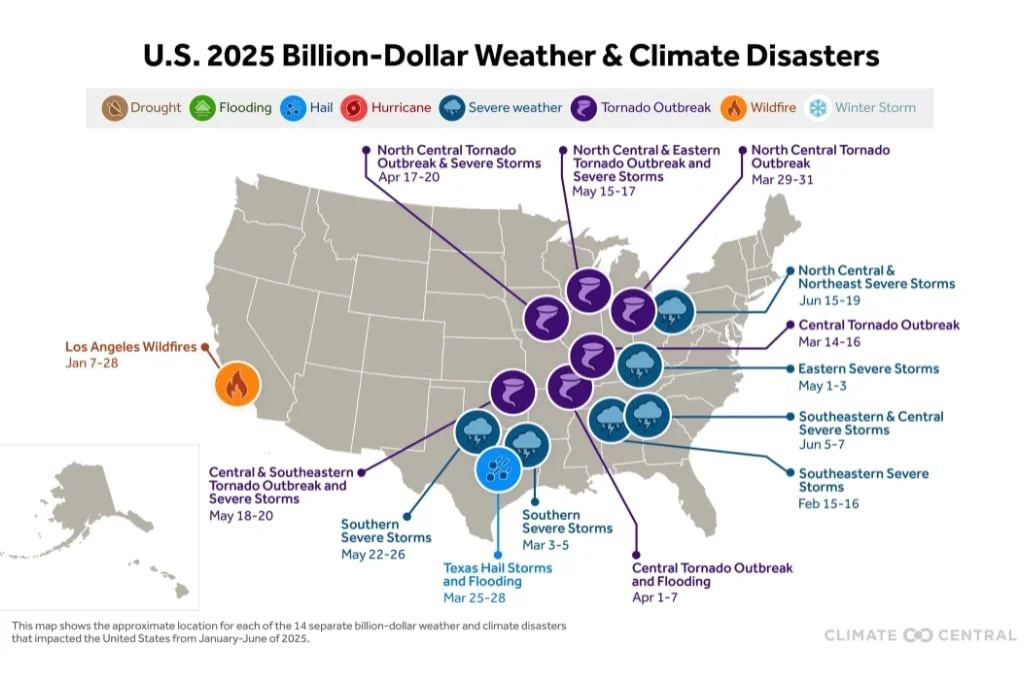
U.S_2025_Billion

Source: earth.org

The first half of 2025 has been confirmed as the costliest period ever recorded for U.S. weather and climate-related disasters, thanks to an effort by nonprofit Climate Central to revive data tracking discontinued by the Trump administration. This critical information might never have reached the public if not for their intervention.

NOAA Program Cut Under Trump Administration

In the past it was it was the National Oceanic and Atmospheric Administration (NOAA) had an initiative that tracked weather events that cause at least $1 billion worth of damages across the nation. 
noaa_logo

In spring 2025 the program was shut down, which led the researcher in charge, Adam Smith, to quit NOAA. Climate Central then hired Smith to revamp the database keeping records going up to the year 1980.

Record-Breaking Damage Costs and Extreme Weather

In the latest Climate Central analysis, 14 weather events have surpassed the threshold of $1 billion in damage in one of the first six months. In January, the wildfires that erupted and ravaged Los Angeles alone generated more than $61 billion in losses, making it the most expensive wildfire ever recorded.

wild_fire

The rising costs are a reflection of not just the increase in intensity and frequency of extreme weather events, but also the increased population who live in areas at risk to flooding and wildfires.

Filling the Data Void Left by Federal Cuts

This development shows how nonprofit organizations are increasingly taking on the functions previously assigned to federal programs. The Trump administration’s cut in funding for climate science and the rejection of the concept that climate change is a “con job” led to significant cuts in funding and also attempts to weaken the Environmental Protection Agency’s powers to regulate greenhouse gas pollution that is fueling global warming.

Jennifer Brady, a senior data analyst at Climate Central, emphasized the information’s significance:

“It tells the climate change story. It is a story about where people live and what they’re doing to stay safe. We’re thrilled to see it come back.”

NOAA expressed its appreciation for the research project was able to find alternatives to funding, but said it will redirect funds towards projects that are in line with the administration’s emphasis on:

“sound, unbiased research”

Political Controversies and Efforts to Restore Tracking

The database of disasters worth billions of dollars became controversial politically. House Republicans have complained to NOAA of providing “deceptive data,” leading to the cancellation of the program. 

Senate Democrats have introduced legislation to reinstate and require biannual updates of the dataset to inform disaster relief decisions, but the bill remains stalled in the Republican-controlled Senate.

Trump administration officials asserted that the database was cost-effective at approximately $300,000 per year in addition to being “purely informational,” claiming that it overstated the link between the effects of climate change on disasters and did not take into account other factors like populations growth in areas of vulnerability.

Methodology and Scope of Climate Central’s Analysis

Climate Central follows the same methodology and data sources that are used by NOAA as well as data sources such as National Flood Insurance Program claims, NOAA storm data, and private insurance records. 

Their analysis considers “direct costs” such as damage to crops, infrastructure and buildings, which are adjusted to reflect inflation. However, it doesn’t include indirect effects like health impacts and loss of life or damages to ecosystems.

Rising Disaster Costs Without Hurricanes

The record-breaking costs for 2025 were primarily driven by extreme storms and wildfires, and there have been no major hurricanes to strike up to now. 

hurricane_damage

In the year 2000, NOAA recorded 27 billion-dollar catastrophes, resulting in $182.7 billion in damage making it some of the more destructive years in history.

Federal Climate Science Programs Challenged and Replaced

Beyond tracking disasters, the other federal climate science resources have also suffered setbacks. The laid-off NOAA employees launch climate.us which is a non-profit successor to climate.gov with the goal of ensuring the public’s access to data on climate and analysis following the time that the governmental website was shut down. 

Furthermore climate.us will be a joint venture between the American Geophysical Union and American Meteorological Society are planning to release a climate-specific collection in response to the enactment removal of the National Climate Assessment.

Walter Robinson of the American Meteorological Society has described the decision of the administration to be an “abrogation” of governmental responsibility. However, he sees these non-profit efforts as crucial to preserving and expanding knowledge about climate science.

It is important to note that the research will be released across several scientific journals.

Iranian Human Rights Activist’s Perspective on Women’s Rights in Iran

An Iranian Human Rights activist’s perspective on women’s rights in Iran highlights the challenges and the ongoing struggle for equality between men and women, and their fundamental rights.

Fariba_Nawa_radio_story

In a recent radio story, journalist Fariba Nawa explores the ongoing struggle for women’s rights in Iran, shedding light on the social, legal, and political barriers facing Iranian women. Drawing from years of reporting on human rights in Iran, Nawa highlights the resilience of women activists who continue to demand equality and freedom despite government crackdowns and cultural restrictions.

Fariba Nawa’s story is about Mahshid Nazemi, an Iranian human rights activist who is still active in fighting for women’s rights. Her story reflects a similar pattern in which activists like her face continuous intimidation by proxies who are against these views. In exile, Nazemi frequently encounters harassment and threats that aim at stifling her voice and defying her efforts.

Harrowing Encounter in Turkey

At the end of fall 2022, when she was living in Isparta, Turkey, Nazemi was pursued by suspicious cars. One day, when she was walking to get dinner, a dark-colored car was following her slowly. Its driver was a shaved man, scolded her with insults that were vulgar insults and threats, telling her:

“Shut your mouth or we’ll send you to Iran in a suitcase,”

Nazemi recounted the man saying:

“Your sister is on death row. You want to go to Iran in a suitcase?”

In a state of fear, Nazemi fled to seek assistance. The incident was the first of a string of terrifying incidents designed to scare her.

Deep Roots in Iranian Women’s Rights Struggle

Nazemi was born under severe female discrimination within Iran, in a country in which women’s rights have been severely limited. The Iranian system is called a system of gender discrimination and women are barred from performing in public, their legal testimony is valued at a fraction of men, and their inheritance rights are restricted. 

In spite of these restrictions, many women defy the system by riding bicycles and demanding equal rights.

Nazemi has been through the rigours of prison and threats to kill, sexual harassment, as well as being deported to a camp. The 2022 Woman, Life, Freedom protests that were triggered by the death of Mahsa Jina Amini Nazemi spent time in Turkey campaigning for political prisoners and assisting other dissidents. Her responsibilities included the coordination of legal assistance and providing financial assistance for activists throughout Turkey.

Family Ties in the Activist Movement

She is the sister of Pouran Nazemi, who is a well-known human rights activist and was imprisoned numerous times in Iran. Even though they are physically separated, they maintain an enduring bond and work on the internet to push for changes in the regime and democratic reforms. Mahshid’s sacrifices to Pouran Nazemi have inspired her activism.

Pouran_Nazemi_sisters

It is clear that the Iranian administration hasn’t just been adamant about repressing protesters in Iran but also seeks to repress opposition groups abroad. 

Marcus Michaelsen from the University of Toronto’s Citizen Lab explained it as:

Iran continues to target women human rights defenders abroad, and among the typical and easy-to-use methods are digital threats, such as phishing and hacking attempts, smear and defamation campaigns, as well as threats against family members in Iran”

Detention and Abuse in Deportation Camp

Nazemi was a victim of these tactics in person and was a victim of assaults in Turkey. After she reported the incident, Turkish authorities initially denied them until CCTV evidence was discovered. In the next few days the incident, a Turkish immigration official claimed that she had falsified documents and placed her in the deportation centre.

In the deportation camp Nazemi was subjected to beatings and humiliation and the abuse of fellow prisoners. To prevent further abuse she was required to establish her biological sex. The abuse forced her to consume a huge amount of medicine in an effort to show the severity of her conditionwhich caused her to be hospitalized and later release.

Path to Safety and Continued Advocacy in France

After extensive coverage in the media of her experience, Nazemi secured a visa to France in the latter half of 2023. Resettling in the French community, Nazemi is continuing her work, and is currently helping Afghan refugees and collaborating with international human rights organizations to help those who are political dissidents.

Despite security improvements, Nazemi remains vigilant, still receiving death threats on the internet from regime loyalists who claim them “Soldiers of the Islamic Republic.” Nazemi is under the protection of the police and can report every threat she gets.

Ongoing Fight for Democratic Freedom

And while her sibling Pouran was removed of Evin prison and is awaiting the outcome of her trial, both women remain in opposition to the oppressive regime in Iran. The results of the Woman, Life, Freedom protests has led to some progress in society and more women are refusing to wear a head scarf and participating in public activities previously considered to be forbidden.

Nazemi expressed it as:

“The most important thing to come out of this movement was that it showed how influential women can be inside Iran, it became an example,” she said. “People learned the power of civil disobedience and it gave them confidence and courage.”

Nazemi is still dedicated to promoting broader democratic reform.

Read the full story here: “From Turkey to France” By Fariba Nawa

Meta Breaks Record on New AI Data Center Project

Meta breaks record on new AI data center project, marking a massive infrastructure investment to power its future in AI and the metaverse.

AI_Data_center

Meta has broken ground on a gigantic new AI-optimized data center in El Paso, Texas, that´s being built to host the company’s increasingly enormous amount of artificial intelligence workloads. This will be Meta’s 29th data center worldwide and the third it has built in Texas, marking the company’s aggressive expansion into AI infrastructure as it hurtles toward superintelligence and ever-explosive AI power. ​

meta_el_paso

A Powerhouse for AI

This massive power scale is necessary to train advanced AI models, high-performance computing chips, and satisfy the incredible amount of compute needed for Meta’s AI applications running on platforms such as Facebook, Instagram, WhatsApp, and the nascent metaverse. ​

According to Meta:

“This will be a powerhouse data center optimized to support our growing AI workloads and will be essential to bringing our technologies to life. An example of industry-leading infrastructure, this data center can scale to 1GW and represents a pivotal moment as we invest in our AI work.”

Meta’s El Paso endeavor is expected to cost the company a record-breaking $1.5 billion plus, and represents part of the “hundreds of billions” in AI infrastructure planned over the next several years.

Indeed, at present, just in the U.S. alone, Meta has 29 data centers or in-development projects, the latest two of which, its Prometheus (in Ohio) and Hyperion (Louisiana) efforts, have been primarily about how it is powering AI services, or building that Zuckerberg “superintelligence” vision stage two along.

meta_data_centers

Environmental Considerations and Sustainability

This data center alone will be allowed to use up to 750,000 gallons of potable water a day during the initial construction period, which will increase to 1.5 million gallons once the campus is fully built out by Meta and is also bringing employment and offering support to the area.

The project will be Meta’s third data center in Texas, and overall, the company says it’s committed more than $10 billion to the state, which supports over 2,500 full-time employees across Texas with its data center offices and research lab.

So there is a bal­ance to be struck, but it’s worth reiterating the massive scale of resources required for such endeavours and the strain that AI pro­cess­ing, and then rushing to be at the front of the AI race, will have on local economies.

Strategic Value in the Arms Race for AI

This facility is a critical part of Meta’s broader AI infrastructure and builds on similarly significant investments that’ve set the stage for recent developments.

With leading technology companies competing to take the lead in AI, Meta’s emphasis on capacity, advanced technology, and sustainability sees it ready to rival any.

The El Paso center is part of an established strategy to create massive infrastructures that can drive innovation in AI, personal AI assistants, immersive digital experiences, and AI-enabled social media functionalities. ​

Bottom Line

The El Paso facility by Meta sets a new benchmark for investment in AI infrastructure, one that showcases both scale and sustainability, as well as genuine economic opportunity. For the stakeholders and local communities, it is expected to be a technological powerhouse as well as an economy-transforming engine.

New Data Show Concerns About the Rise of AI

New research and data show concerns about the rapid rise of AI, highlighting anxieties about ethics, jobs, and societal impact.

AI_rise

New research from the Pew Research Center highlights that while tech companies aggressively promote AI tools, many consumers worldwide are increasingly wary about AI’s long-term impacts. The study surveyed adults across 25 countries to gauge public awareness and sentiment towards AI, along with trust in regulators.

AI Concern is Regionally Varied

Regional breakdown of the data is telling. Individual countries including the United States, Italy, Australia, Brazil and Greece have particularly high levels of concern, with around half or more of all adults more worried than optimistic about AI’s impact on daily life.

And as you can see in this chart, concerns about AI are particularly high in some regions:

pew_ai_study

According to Pew:

“Concerns about AI are especially common in the United States, Italy, Australia, Brazil and Greece, where about half of adults say they are more concerned than excited. But as few as 16% in South Korea are mainly concerned about the prospect of AI in their lives.”

Pew proposes this may stem from familiarity, as more AI is used correlates with higher levels of public concern. ​

Concerns Extend Beyond Employment

Fears about A.I. often center on job displacement. But studies while studies have also raised significant concern about the impacts of AI tools on social interaction could erode social skills and human interaction.

Hundreds of thousands of jobs have been decimated or put at risk by growing automation and intelligence more widespread use of AI bots for companionship. This includes romantic engagement by teenagers, raising questions about shifting emotional norms and expectations in relationships.

These wider impacts contribute to uncertainties around AI’s social role and implications beyond the professional domain. ​

Challenges for AI Regulation

While they acknowledge the need for AI regulation, many respondents lack confidence that politicians can responsibly and intelligibly regulate AI.

pew_ai_study2

National governments and the European Union are still relatively trusted (at 55% and 53% on median, respectively) compared to heavy AI users like the U.S. (37%) and China (27%), where the need for innovation seems to be prevalent enough to discount cautious governance of emerging technologies.

pew_ai_study3

This is a game that could play out as a race to regulation where countries are reluctant to impose strict regulations for fear of losing the competitive advantage in spite of public concern. ​​

Younger Generations Are More AI-Aware

Younger people are also more were widely about AI and its applications they incorporate them into all areas of life, from content generation to decision making. And as the influence of these digital natives increases, AI’s societal impact will continue to stimulate adoption and amplify the demand for protection. ​

Given the huge sums being poured into AI and the desire of governments to stimulate progress, the rapid adoption of AI tools is probably unstoppable. However, these discoveries highlight the importance of robust, transparent policy and approach to take preventive measures to mitigate ethical, social, and economic risks before it is too late.

Bottom Line

Site owners, publishers, and policy makers at Google need to be mindful of where these attitudes may shift as AI increasingly upends the tech landscape. Thoughtfully wrestling with AI’s potential and pitfalls will be essential to ensure a safer, more inclusive digital future.

Study Reveals 2-5 Weekly TikToks Increase Views

A new study reveals that publishing just 2-5 weekly TikToks increase views and engagement, offering insights into the platform’s growth algorithm.

how_often_post_tiktok

Buffer looked at 11.4 million TikTok posts made by more than 150K accounts and reported that 2-5 posts per week gives you the highest lift in views per post. This investigation supports the advice that posts should be scheduled every day or even several times a day on the grounds that the benefit reduces after 2–5 posts each week.

Data Science Behind Posting Frequency

Over the past year, data scientist Julian Winternheimer conducted a fixed-effects regression analysis on how posting frequency affects views per post. His analysis looked at views while adjusting based on account-specific attributes such as the number of followers and the strength as a brand.

  • Posting 2-5 times per week increases views per post by 17% compared to posting once weekly.
  • Posting 6-10 times weekly lifts views per post by 29%.
  • Posting more than 11 times weekly sees a 34% gain per post.

The biggest leap is from one post to 2-5 posts a week; after that, the returns taper off. No matter how often accounts post, median views per post remain near the 500 mark:

  • Once weekly, 489 views per median time slot
  • 459 median views at 11+ posts a week (down slightly)

But the top end of the performance behaves differently.

Viral Potential Grows with Frequency for Top Performers

For the top 10% of posts (90th percentile):

  • 14,401 views at 11+ posts weekly.
  • 3,722 views at one post weekly.
  • 6,983 views when posting 2-5 times weekly.
  • 10,092 views at 6-10 posts weekly.

Buffer refers to this as the “Viral Potential” (90th percentile views/median views). Top posts for 11+ times weekly accounts achieved 31.4 times the engagement of their median post; that number dropped down to just 7.6 times for once-weekly accounts.

Important Takeaways For TikTok Creators

If you create TikTok content, the sweet spot is 2-5 posts a week, where you get the most views per post for the least effort. More frequent posting increases the likelihood of a viral post, but that just raises the average, not improves it.

Winternheimer explains:

“Posting more helps — but mostly because it increases your chances of getting lucky. TikTok is heavy-tailed. You only need one post to pop off. Posting more just increases your odds.”

In other words, adding more posts raises the ceiling for your best-performing potential, without raising the floor for your average posts.

Study Limitations and Future Outlook

The analysis appeals to claims associated with Buffer, which could overstate smaller and mid-sized organizations. Trends like these tend to change quickly, though, as platforms make changes to their ranking algorithms.

Winternheimer advises:

“If we wanted to provide a blanket recommendation that applies to most people, I’d recommend starting with 2-5 posts per week on TikTok.”

Winternheimer further suggests:

“However, if you have more posts to share, you’ll give yourself a better chance at having a breakout post.”

Bottom Line

It is important to note that social media algorithms are highly dynamic. Strategies based on past TikTok data may require adjustment as the platform evolves.

Meta Discontinues Messenger Apps for Windows and Mac

Meta has announced it will discontinue its standalone Messenger Apps for Windows and Mac, aiming to simplify support across its platforms.

RTP_messenger

Once deprecated, users of the Messenger desktop app for Mac will no longer be able to log in, as per Meta’s Help page. Instead, redirected to the Facebook website to message.

Official Notice and Transition Details

As reported by Appleinsider, on Meta’s Help page for its Messenger desktop apps, there’s now an explainer outlining the retirement of the apps and your alternatives.

As per Meta:

“The Messenger app for Mac is being deprecated. After deprecation, you won’t be able to log into this app and will be automatically redirected to use Facebook website for messaging.”

Meta says that users of its desktop apps will soon receive an in-app notification about the deprecation process, from which they’ll have 60 days to use the app before it’s removed.

“Once the 60 days are over, you’ll be blocked from using the Mac Messenger app. We encourage you to delete the app since it will no longer be usable.”

You can read the same for the Windows version here.

Chat History and Data Storage

Meta says in a blog explaining the new features:

“For people using the new secure storage system and using the desktop app, chat history will be preserved by proxy (it is stored with an optional PIN).”

While most conversations remain available in the app, we recommend all users update their storage settings out of an abundance of caution.

Desktop Messenger Background

Messenger desktop apps were launched in 2020 amid the COVID-19 pandemic to boost video calling and communication as more people shifted to remote interaction.

Zoom and Facebook experienced exponential growth in video conferencing that year, with 2X more video calls on Messenger and WhatsApp.

Declining Usage Leads to App Retirement

Video chat has proven a massive bust since then, and people are not using the desktop Messenger apps as well. Meta’s move is in line with this trend, refining its messaging suite for core platforms and eliminating separate desktop clients.

Via Facebook’s web interface, desktop users will still be able to message. That means Messenger functionality is not lost, just the dedicated Mac and Windows Messenger apps.

Bottom Line

It is a small change overall, but may be a rattle for anyone who likes to sign into a standalone desktop app, as opposed to going through the browser.

Pinterest Expands More Elements to Its Academy Education Platform

Pinterest expands more elements to its academy education platform to help users master marketing and content creation on Pinterest.

Pinterest_Academy

Pinterest has been busy building out its educational tools lately. This week, Pinterest has added a range of new content to its Pinterest Academy education resources. This includes video from its recent “Pinterest Presents” event, covering all of the latest announcements and updates.

Pinterest Academy drives for new courses

Pinterest Academy introduced three new types of courses which aim at the core skills for marketing on Pinterest:

  • Pinterest Performance Playbook: Discusses performance marketing fundamentals along with tools and top practices covering everything from measurement tactics to ignite your success.
  • Creating Great Creative on Pinterest: Describes the ‘four Cs’ of creative strategy context, content, craft and colour to inspire better campaign performance results.
  • The Measurement System of Truth: Guides both types of measurement in today’s privacy-forward world and explains how incrementality analysis can be applied to Pinterest campaigns.
pinterest_academy_update

Better Video Content and Event Coverage

In addition to those new courses, Pinterest has included video sessions from its recent “Pinterest Presents” event, as well as actionable tips on marketing moments and festive seasonal tactics.

pinterest_academy_update2

You can watch these videos on YouTube and on the Pinterest Academy platform, where they are available on demand.

Why This Matters for Marketers

Pinterest is home to over 578 million monthly users looking to shop, so these resources educate you to sharpen your strategy.

So, whether you are just starting to use Pinterest for your business or are looking to perfect your craft, Pinterest Academy has a range of updated courses and resources to help you make more impactful Pins and engage a more precise audience.

Bottom Line

Participation in Pinterest Academy is free. These are self-paced courses for which you can earn certificates that can be displayed on your website or when presenting yourself on professional networks to improve your professionalism.

YouTube Offers Second Chance to Previously Banned Creators to Return to the App

YouTube offers a second chance to previously banned creators to return to the app under specific conditions, promoting accountability and second chances.

second_chance

YouTube has announced the opening of ‘Second Chance’ experiment: A pilot program to give some previously banned creators who might have had a permanent ban a second chance on its platform. This is a major policy reversal that will give suspended users a way back instead of leaving them just hanging.

Strict Qualification Criteria for Banned Creators Return

According to YouTube:

“We’ve heard loud and clear from our creator community that they want more options to return to YouTube.”

YouTube further emphasizes:

“So we’re happy to share that we’re introducing a pilot program to offer some qualified creators an opportunity to rebuild their presence on YouTube.”

The word “qualified creators” is important here, as YouTube notes that it’s not just going to allow all previously banned creators back on its service and will consider a number of factors before doing so.

These factors include whether the person has committed severe or repeated violations of YouTube’s Terms of Service, and if the individual’s on- or off-platform behaviour could pose harm to the community.

Meaning, this is not an open ticket for all banned users to come back. But some thick-necked figures have already started trying to claw their way back into the app, seeking to rebuild their stores of followers and worth in the form of reach and monetisation.

Recent False Starts and Enforcement

Last week, several controversial figures, including conspiracy theorist Alex Jones and far-right commentator Nick Fuente, attempted to return to YouTube prematurely by creating new channels, only to have those accounts promptly removed.

The programme was not yet in operation at the time, highlighting that it is still being enforced on the platform.

As the program goes live, some banned creators may now reapply for reinstatement, leading to more contentious content reappearing, though all will have to strictly follow YouTube rules.

Procedure of Application

Creators eligible for new channels will be prompted with the option to apply for a new channel as they sign in through YouTube Studio on desktop with their terminated account.

Authorised creators can then start a new channel from the beginning, without carrying over any existing videos, subscribers or monetization eligibility. That is a clean slate, provided very restrictive guidelines are adhered to.

The timing of the program also comes amid increased political scrutiny, particularly from U.S. Republican lawmakers and former President Donald Trump, who have accused platforms like YouTube of censorship and bias.

YouTube states:

“Over the next several weeks, eligible creators will begin to see an option to request a new channel when they log into YouTube Studio on desktop with their previously terminated channel. Creators whose requests are accepted will be able to create new channels.”

Impact on the Platform Dynamics

It is not clear whether YouTube will take a looser approach, but the program is emblematic of an approach that attempts to square the circle with strict moderation but an attempt at a cautious opening.

With more than three million channels in the YouTube Partner Program and over $100 billion paid to creators in recent years, having access to the platform remains highly lucrative.

Final Thought

The “Second Chance” initiative may now increase the number of creators who can write in this ecosystem, but as long as they do not cross YouTube. This will all depend on how well returning creators comply and rebuild responsibly will determine the success of the program.

Meta Includes More Languages in AI Translations for Reels

Meta includes more languages in AI translations for Reels, adding support for more languages to reach global audiences and enhance cross-cultural engagement.

Meta_language_translation

Meta is expanding the AI-driven translation abilities of Facebook and Instagram Reels to include Hindi and Portuguese, growing out from its first release with English and Spanish in August. The feature is designed to help creators reach bigger, multilingual audiences in Facebook’s largest markets.

Breaking the Language Barrier to Global Audiences

According to Meta:

“Many creators want to reach global audiences, and their feedback helped shape our work on translation features.”

Meta further emphasizes:

“With Meta AI, creators can now seamlessly translate and dub reels, breaking down language barriers so they can share their work with more viewers worldwide.”

Also, Meta suggests:

“With multi-lingual translations between English, Spanish, Portuguese, and Hindi, creators can now share their content across some of the largest Reels markets on both Instagram and Facebook.”

The inclusion of Hindi is particularly important due to the fact that India ranks as Facebook’s biggest single market, with a large user base for Instagram.

Meta AI Translates and Dubs Reels

Meta AI mimics the tone and cadence of the original creator’s voice when translating content, creating reels that feel both naturally authentic and even in a foreign language.

Meta says:

“Meta AI mimics the sound and tone of a creator’s voice to translate reels, so the end result is content that feels authentically like the creator, just in another language.“

Meta further elaborates:

“A creator can also choose to enable the lip syncing feature, which syncs the translated audio to the creator’s mouth’s movements, creating a more natural viewing experience.”

User Control and Transparency

The translated reels are prominently labelled with “Translated with Meta AI” so viewers can easily tell when content has been translated automatically.

According to Meta:

“Every translated reel is clearly labeled with ‘Translated with Meta AI,’ so you’ll always know when you’re watching translated content.”

Also, Meta suggests:

“You can also choose to turn translations on or off, or to watch reels in their original language – simply select ‘Don’t translate’ in the audio and language section of the three-dot settings menu. “

Developers need to enable translation, but then can vet translations before content is published, keeping control of how their material is localized.

Unlocking New Opportunities for Creators

This translation proliferation enables creators to access various markets, opening up opportunities for a much wider audience.

For instance, an Indian creator who posts in Hindi can now tackle Spanish-speaking viewers on Instagram and Facebook just as easily.

Meta’s continued dedication to enhancing AI translator capabilities suggests additional language support and deeper democratization of content exchange for the world.

Bottom Line

Meta’s AI translation for Reels brings us into a new age of cross-cultural connection, enabling creators to reach more people and cultivate deeper engagement around the world.

Facebook Introduces Topic Search and Friend Likes To Reels

Facebook introduces Topic Search and Friend Likes to reels to improve content discovery and social interaction on the site.

Facebook_reels

Facebook has introduced a number of features to boost user engagement on its Reels platform, such as friend bubbles to bring attention to photos that friends have liked and AI-generated topic search links to help you immediately find more related content.

This move is likely to encourage users to spend even more time watching Reels, and with over 3.5 billion shared daily across Facebook and Instagram, it’s clear why Facebook is investing further in the format.

Friend Bubbles Add Social Context to Reels and the Feed

Facebook is introducing “friend bubbles” on Reels and feed posts. As you scroll through Reels or your feed, friend bubbles show up on posts, letting you know the content that your friends have liked.

fb_friend_bubbles

Clicking a bubble starts a private chat, so you can connect right away to talk about your favorite topics.

The feature is a copy of one that Instagram introduced earlier this year, and it reflects Facebook’s efforts to revive core social experiences by surfacing what friends find enjoyable and encouraging conversation.

AI-Powered Topic Search Helps Users Explore Interests

At the bottom of Reels, Facebook will now surface AI-generated topic search suggestions to help you discover more videos on a subject, whether you’re interested in “soup dumpling recipes” or something similarly niche.

fb_friend_bubbles2

In turn, this integration provides an easier way for users to continue down the rabbit hole of interests without having to leave the Reels player, helping to retain user engagement and discovery flow that’s already inspired by TikTok’s own successful design.

According to Facebook:

“Facebook continues to be the home for all types of video, and our recommendations will help ensure you see fresher content in the formats you enjoy most, regardless of length.”

Facebook further briefs:

“If you prefer longer videos, you’re in luck – reels over a minute make up a quarter of reels produced by creators with over 10,000 followers and over 50% of watch time on Facebook.”

Also, Facebook suggests:

“Our recommendation engine is also now surfacing 50% more reels from creators published that day, so you see the newest content faster.”

The system also takes your preferred video length into account, and it learns to recognize your interests quickly for an even more personalised experience.

New Controls to Refine Content You See

Users can now tap “Not Interested” on reels or flag comments that violate guidelines to help guide the recommendation algorithm toward more relevant content.

Also included in the update is a redesigned Save experience that neatly stores your saved reels and posts in one personal save folder, fine-tuning your recommendations and improving watch time worldwide.

According to Facebook:

“You can tap ‘Not Interested’ on a reel or flag a comment that doesn’t fit the spirit of the conversation, and the recommendations engine will respond to these signals, making your reels even more personalized.“

Also, Facebook adds:

“Plus, we’ve made updates to the Save feature to make it simpler to collect your favorite reels and posts in one place.“

With a final suggestion:

“You’ll help Facebook fine-tune your recommendations with each save, resulting in a more tailored experience that we’ve seen lead to increased watch time globally.”

Balancing Connection and Attention

While friend bubbles and AI-driven suggestions are promoting social interaction and content discovery, the updates also work toward Meta’s larger mission of increasing user time spent on its platform by propping up popular video formats.

For many of them, that will mean more shared experiences. For Meta, it amounts to a strategic push to keep the audience engaged and connected. More broadly, these updates again underline Meta’s ongoing focus on video content and working to get as much engagement from its uploads.

Although Facebook believes that it will emphasize user connections by featuring Reels that friends have liked, the overriding agenda looks to hold onto users on app floors rather than fostering meaningful social interaction.

Bottom Line

These updates position Facebook’s Reels experience as more interactive, social, and tailored, blending the best of Instagram and TikTok features to capture continued growth in short-form video consumption.