
A scholar’s name can represent years of research, professional credibility and intellectual achievement. But what happens when that name appears on a conference programme or a published research paper without the scholar’s knowledge or consent?
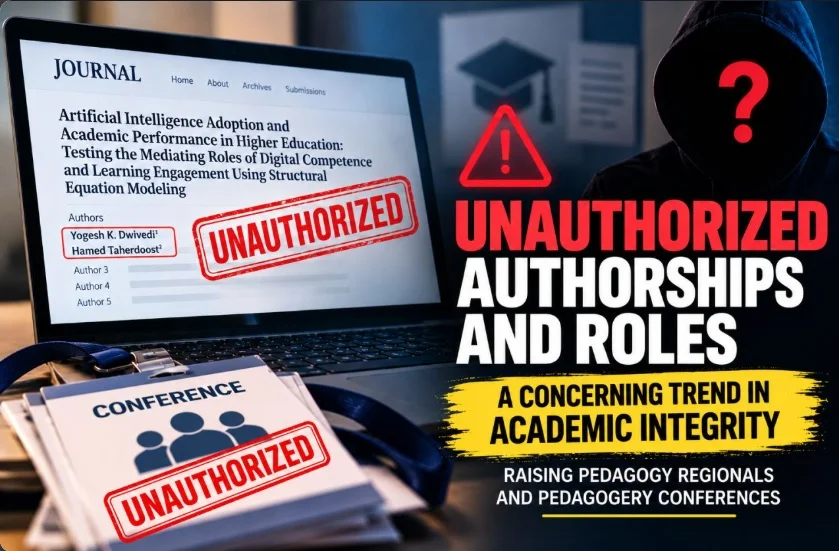
A case described by Professor Hamed Taherdoost, Professor and Associate Vice President, Academic, at the University Canada West, raises precisely this question. According to his account, his name was listed as a conference chair for events with which he had no involvement. He subsequently reported that he had been notified by the Indonesian Journal of Quantitative Research and Theory (JQRT) that a manuscript submitted in the name of Professor Yogesh K. Dwivedi listed him as a co-author.
Taherdoost says:
“He had not contributed to or approved the paper.”
While Dwivedi also reportedly confirmed that:
“He had neither submitted the manuscript nor authoriZed the use of his name.”
The account further states that the article had already appeared online and remained available despite requests for its removal and a reported commitment from a journal representative to address the issue.
The article in question is identified by the supplied link to JQRT publication record 177. These allegations require proper investigation, and responsibility should not be attributed to a particular person or organisation without sufficient evidence.
Nevertheless, the underlying legal question is clear:
“can an individual’s professional identity be used to create the appearance of authorship, endorsement or participation without permission, and what legal remedies are available when it happens?”
The answer involves several overlapping areas of law: intellectual property, personal data protection, civil liability, fraud-related offences where their elements are established, and the rules governing research integrity.
There is no single international law specifically titled “academic identity theft” that resolves every case of false authorship. Instead, the conduct may engage several different legal rules, depending on the circumstances and the jurisdiction.
The first distinction is between an ethical breach and a legal violation. Listing someone as an author without their knowledge can plainly raise serious research-integrity concerns. Whether it also constitutes a civil wrong or criminal offence depends on matters such as the person’s actual contribution, the use of their identity, the publisher’s knowledge, any resulting harm and the applicable national legislation.
A paper containing a false author list may mislead readers, universities, funders, research evaluators and indexing services. It may also imply that the named scholars stand behind the research methods, evidence and conclusions when they have never reviewed the manuscript.
However, the existence of a false author listing does not automatically establish every possible offence. For example, fraud generally requires additional legal elements beyond a false statement, while a defamation claim may require proof of a defamatory publication, identification, fault and legally recognised harm under the applicable law.
The correct legal approach is therefore to identify the precise conduct, establish the evidence and select the appropriate remedy rather than treating every incident as the same offence because a scholar’s name is:
“not a credential that anyone may borrow.”
Whereas authorship is:
” a claim of intellectual contribution and responsibility and the integrity of academic publishing depends on ensuring that the claim is true.”
Authorship Is Not a Decorative Credential
Academic authorship carries responsibilities. It is commonly associated with intellectual contribution, accountability for the work, disclosure of relevant interests and approval of the final manuscript.
The Committee on Publication Ethics (COPE) provides guidance on publication integrity and the circumstances in which retraction may be appropriate. Its updated retraction guidance identifies misrepresentation, including identity theft or fictitious authorship, as potential grounds for retraction when the problem compromises confidence in a publication.
COPE also stresses that:
“The purpose of retraction is to correct the scholarly record, rather than simply to punish an individual.”
This creates an important distinction between two situations. In a genuine authorship dispute, researchers may disagree about who contributed sufficiently to a project or whether someone deserves credit. That may require an institutional investigation and a correction to the author list.
In a case of alleged fictitious or unauthorised authorship, a named scholar may deny participating in the work altogether. If the evidence supports that account, the issue is more serious than a disagreement over the amount of credit owed. It potentially concerns the authenticity of the submission and the accuracy of the publication record.
A journal cannot reasonably resolve such a matter merely by asking the named scholar to accept responsibility for work they deny having undertaken.
Copyright and Moral Rights: Does a False Author Listing Violate Intellectual Property Law?
Copyright law may be relevant, but it is important to understand its limits. Copyright generally protects original expression in a work, rather than a person’s name or academic reputation in isolation. If a paper was written by someone else and merely carries a scholar’s name, the false attribution does not automatically mean that the scholar’s own copyright has been infringed.
The precise claim depends on who created the work, what material was used and how the relevant law applies. Nevertheless, authorship and attribution are important components of copyright law in some jurisdictions.
Indonesia’s Copyright Law
Because the publication identified in the account is associated with an Indonesian journal, Indonesian law deserves consideration. Indonesia’s Law No. 28 of 2014 on Copyright recognizes moral rights, including the author’s right to have their name included or excluded in connection with public use of their work and to defend against distortion or modification that prejudices their honour or reputation. Articles 5–7 address moral rights and related copyright-management information.
These provisions may become relevant where a person’s actual work has been misattributed, distorted or used in a manner covered by the statute. But they should not be overstated such as a claim based solely on someone’s name appearing beside a paper they did not write requires a more careful legal analysis than a conventional claim involving the unauthorized use of a copyrighted work.
Article 2 of the Indonesian law also contains rules concerning its application to foreign works and foreign parties. That makes the international circumstances relevant when the named scholars, publisher, authors and readers are located in different countries.
Legal implication: Copyright and moral rights should be examined, but they should not be treated as the only or necessarily strongest route to relief. Personal data, misrepresentation, reputation and publication-ethics mechanisms may be more directly relevant, depending on the facts.
Personal Data Protection: Can a Scholar’s Name Be Used Without Consent?
A person’s professional name is not merely a convenient label. When linked to employment, institutional affiliation, academic credentials or a published research record, it can identify an individual and communicate information about their professional activities.
Indonesia’s Personal Data Protection Law, Law No. 27 of 2022, identifies a full name as a category of general personal data and establishes rules governing the processing of personal data, including data-subject rights, controller and processor obligations, and potential administrative and criminal consequences.
This may be relevant if personal data were collected, submitted, altered or published unlawfully. But the legal conclusion is not automatic. A name appearing on a website does not, by itself, prove an unlawful data-processing offence. Authorities or courts would need to examine the processing involved, its legal basis, the responsibilities of the relevant actors and the applicable statutory exceptions.
The central questions would include:
- Who entered the scholars’ names into the submission system?
- Was any person’s identity, email address, institutional affiliation or digital signature used?
- Did the journal collect or process personal data in accordance with applicable law?
- What verification measures were used before publication?
- What did the journal do after receiving credible notice that the named individuals denied authorship?
The answers may help determine whether the case is simply a publication-ethics failure, a data-protection issue, a more serious act of deception or a combination of these.
For international scholars, another complication arises as the law applicable to the processing may depend on where the relevant parties are established, where the data were processed and whether a particular jurisdiction’s territorial rules apply.
Could the Conduct Amount to Fraud, Impersonation or Defamation?
Three additional legal routes deserve careful examination.
If someone deliberately impersonated a scholar, forged an authorization, used an email account without permission or submitted fabricated declarations to obtain publication, funding, money or another benefit, the conduct might engage fraud, forgery, computer misuse or identity-related offences under the applicable national law.
But evidence of an unauthorized name alone is not enough to establish every element of these offences. Investigators would need to identify the actual conduct, the responsible individual and the relevant statutory requirements.
Useful evidence could include submission-system records, email headers, account-registration information, authorship declarations, document metadata and payment records. Such material should be preserved lawfully and obtained through appropriate procedures.
Defamation and reputational harm
A false author listing may create the impression that a scholar endorses claims, research methods or conclusions they have never examined. In some circumstances, that may damage professional standing, affect employment or promotion decisions, or undermine trust in a scholar’s research.
However, defamation law varies substantially between jurisdictions. A false statement is not necessarily defamatory in every legal system, and a claimant may need to prove additional elements such as reputational damage, fault or publication to third parties.
A claimant should therefore document concrete consequences rather than relying solely on the fact that their name appeared online.
Misrepresentation and civil liability
Even where the facts do not satisfy a criminal offence, civil remedies may be available if a recognised legal duty was breached and legally recoverable harm resulted. Depending on the jurisdiction, possible relief may include an injunction, damages, a declaration, a correction or another order requiring the conduct to stop.
The existence of a civil claim against a journal or publisher will depend on its own role, contractual obligations, knowledge, conduct after notification and the relevant legal rules. Publication of an article under false authorship does not automatically make every publisher liable for the original deception.
What Is the Journal’s Legal and Ethical Responsibility?
A journal’s role should be assessed separately from that of the person who allegedly submitted the manuscript. A journal may be deceived by a dishonest submitter. The mere fact that a false author list was published does not prove that the journal knowingly participated in wrongdoing.
However, once a journal receives credible evidence that named authors deny involvement, its response becomes an important part of the analysis. The journal should investigate the submission, preserve relevant records, assess whether the author declarations were authentic and take proportionate steps to protect the integrity of the scholarly record.
COPE’s guidance states that retraction may be warranted where there is clear evidence of misrepresentation, including fictitious authorship, that undermines confidence in a publication. It also recommends prompt, accessible and clearly linked notices when retraction is required.
The International Committee of Medical Journal Editors (ICMJE) similarly advises that expressions of concern and retraction notices should be prominently identified and linked to the original article. Retraction notices should explain the reason for the action and make the publication’s status clear to readers. Although ICMJE guidance is particularly directed at medical journals, these principles are relevant to broader discussions of publication integrity.
A journal that receives credible notice should not necessarily remove an article instantly without investigation. It should, however, act promptly and transparently. If the evidence is inconclusive but the concerns are substantial, an expression of concern may be appropriate while the investigation continues.
If unauthorized authorship is established, the journal should correct the record in a way that prevents readers from continuing to mistake the named scholars for the work’s authors. A silent deletion may be inadequate because it can obscure what happened and leave indexing services or third-party databases with outdated information.
The legal and ethical objective is not to protect a journal from embarrassment. It is to ensure that the publication record accurately represents who did the work and who accepts responsibility for it.
The Remedies Available to Affected Scholars
The most effective response combines evidence preservation, formal notice, institutional escalation and, where justified, legal action.
First: Preserve the evidence
Before a page is changed or removed, the affected scholar should preserve:
- The article’s URL, title, author list, publication date and DOI, if available.
- Copies of the webpage, PDF and relevant journal metadata.
- The original notification from the journal.
- Emails in which the alleged co-authors deny submitting or approving the paper.
- Correspondence requesting correction or removal, including any response or undertaking from the journal.
- Records showing any professional, financial or reputational consequences.
Screenshots can be useful, but they should be supplemented by original emails, downloaded files and other records where possible. The purpose is to establish what was published, when it appeared, who was notified and what happened afterwards.
Second: Send a formal written demand
The affected scholars should write jointly, where appropriate, to the editor-in-chief, publisher and journal’s designated research-integrity contact. The notice should identify the article, expressly deny authorship or approval, request preservation of the submission records and ask for a documented investigation.
The requested remedy should be precise. Depending on the evidence, it may include:
- Immediate removal of the disputed author attribution while the matter is investigated, where technically and ethically appropriate.
- A formal expression of concern or retraction if the evidence justifies it.
- A clear notice stating that the named individuals deny authorship and did not approve the publication.
- Correction of the article’s author metadata and notification of relevant indexing services.
- Preservation of submission records and disclosure of the investigation’s outcome to the affected scholars, subject to applicable privacy and procedural rules.
The demand should set a reasonable response deadline and reserve the right to pursue regulatory or legal remedies. It should avoid accusing a named individual of fraud unless the evidence supports that allegation.
Third: Escalate to the publisher and research-integrity bodies
If the journal does not respond adequately, the scholars should escalate the matter to the publisher’s senior management, the journal owner and any relevant research-integrity or publication-ethics body.
COPE provides guidance and resources for publication-ethics cases, but it is not a court and does not replace legal proceedings. Its relevance also depends on the journal’s relationship with the organisation and the procedures available in the particular case.
The scholars may also contact their universities’ research-integrity offices. Their institutions can help verify that no authorisation was given, investigate the misuse of institutional affiliations and communicate with the publisher through formal channels. COPE has specifically addressed cooperation between institutions and journals in investigations involving authorship misattribution and other publication-integrity concerns.
Fourth: Seek correction of scholarly databases
Removing a page from a journal website may not remove the false author attribution from search engines, repositories or indexing services.
Once the journal has corrected or retracted the article, the affected scholars should request corresponding updates from relevant databases. They should also review their institutional profiles, ORCID records and publication lists to ensure that the paper has not been incorporated into their official scholarly records.
If third-party services continue to display demonstrably inaccurate information, the scholars can submit documented correction requests under those services’ procedures and consider applicable data-protection remedies.
Fifth: Consider civil or criminal proceedings
If the conduct is deliberate, continues after notice or causes substantial harm, legal advice should be obtained in the jurisdictions with a meaningful connection to the incident.
Depending on the evidence, possible routes may include a civil claim for reputational or other legally recognised harm, an application for injunctive relief, a personal-data complaint, or a report to law enforcement where the elements of a relevant offence are present.
The appropriate defendant or respondent may not be obvious at the outset. The person who submitted the manuscript, the journal, the publisher and a service provider may have different legal responsibilities. A lawyer should assess jurisdiction, applicable law, available evidence, limitation periods, costs and enforceability before proceedings begin.
Why International Cases Are Difficult to Resolve
Academic publishing operates across borders. A scholar may live in one country, work at a university in another, be listed on a paper hosted by a journal in a third, and discover the article through a global indexing platform. This creates several complications.
Jurisdiction: A court must have a proper legal basis to hear the claim. The location of the publisher, the parties, the relevant conduct and the harm may all matter.
Applicable law: Different countries have different rules on personal data, defamation, copyright, online publication and civil liability. The law governing a particular claim may not be the same as the law governing another aspect of the dispute.
Enforcement: Even if a scholar obtains a favourable judgment, enforcing it against a foreign person or organisation may require additional proceedings.
Digital persistence: Search engines and academic databases may retain cached pages, metadata or citations after a journal changes the original record.
Evidence: Submission logs, IP addresses and account records may be held by a foreign publisher or service provider. Their preservation and disclosure may require formal requests or court orders.
These difficulties do not mean that scholars have no remedy. They mean that an effective strategy should begin with preservation of evidence, identification of the relevant entities and a careful jurisdictional assessment.
The legal response should not depend entirely on individual scholars discovering the problem after publication. Journals and publishers can reduce the risk through stronger verification procedures.
Every listed author should receive a direct confirmation request through an independently verified email address. The confirmation should cover the author’s participation, approval of the final manuscript and acceptance of responsibility for their contribution. A submitting author’s declaration should not be treated as conclusive proof that every co-author has consented.
Secure identity verification
Journals should use institutional email verification, ORCID authentication where appropriate, secure author-confirmation links and risk-based checks for suspicious submissions. No single identifier should be treated as definitive proof of identity, and verification systems must protect personal data.
Auditable submission records
The submission system should retain reliable records of who created an account, uploaded a manuscript, changed the author list and completed the relevant declarations. These records should be preserved under a clear retention policy and disclosed through appropriate procedures when a credible complaint requires investigation.
Clear correction and retraction policies
Journals should publish accessible procedures for authorship complaints, identity misuse, expressions of concern and retractions. Complaints should be acknowledged promptly, investigated by an appropriately independent person and resolved with a written explanation.
Stronger accountability for persistent failures
Where a publisher repeatedly ignores substantiated complaints, affected scholars may have grounds to seek review by relevant regulators, professional bodies or courts, depending on the applicable law. The response should be evidence-based and proportionate, distinguishing a journal that was deceived but acted responsibly from one whose own conduct may have contributed to ongoing harm.
A Practical Legal Framework for Resolving These Cases
The following framework can guide scholars, universities and publishers.
| Stage | Recommended action | Intended result |
|---|---|---|
| 1. Discovery | Preserve the article, metadata and correspondence | Establish an evidential record |
| 2. Verification | Obtain written confirmation from each named scholar | Clarify whether authorship was authorised |
| 3. Formal notice | Notify the editor and publisher in writing | Trigger a documented investigation |
| 4. Interim protection | Request an expression of concern or other appropriate warning | Reduce ongoing reliance on disputed authorship |
| 5. Resolution | Seek correction or retraction according to the evidence | Restore the accuracy of the scholarly record |
| 6. Database updates | Contact relevant indexing and profile services | Reduce continued circulation of inaccurate records |
| 7. Legal escalation | Assess data protection, intellectual property, civil and criminal routes | Obtain enforceable relief where justified |
| 8. Prevention | Improve identity verification and author approval procedures | Reduce the risk of recurrence |
This approach is more effective than relying exclusively on a demand to delete a webpage. It addresses both the immediate harm and the systems through which inaccurate authorship can continue to circulate.
A Significant Development: The Author List Changes
Following the scholars’ objections, the journal’s online publication record appears to have changed significantly. The earlier version listed Professor Yogesh K. Dwivedi and Professor Hamed Taherdoost as authors, whereas the subsequent version displays Haqqul Yaqin as the sole author, with the disputed scholars’ names no longer appearing in the author list.
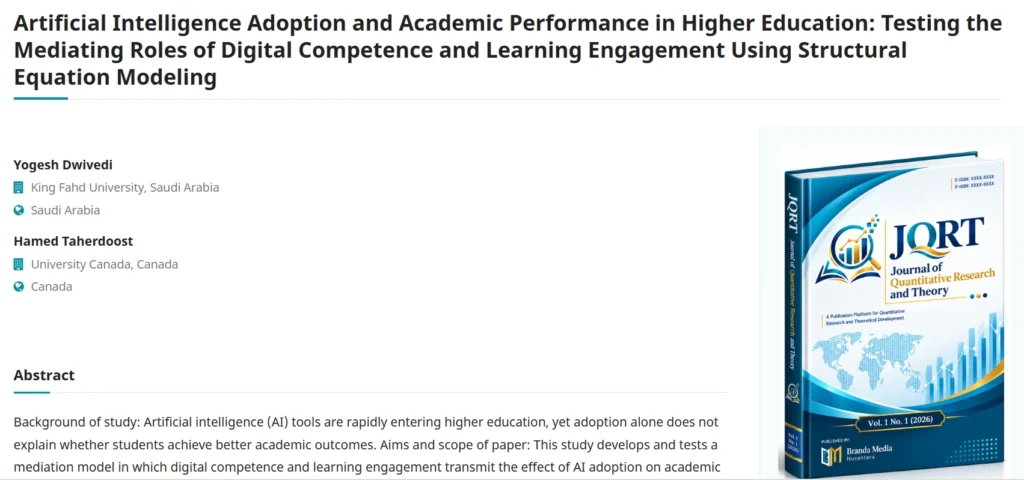
This change represents an important development in the dispute because it suggests that the public authorship record has been amended.
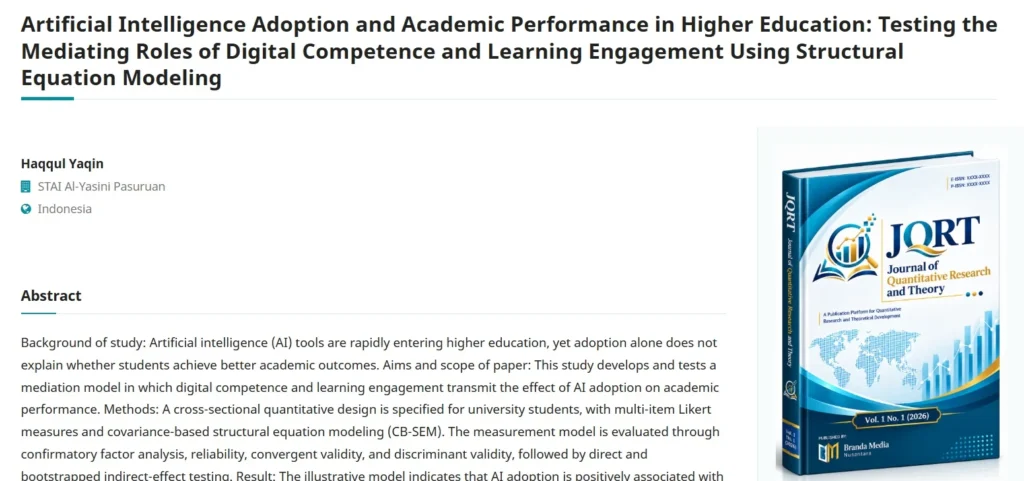
However, the screenshots alone do not establish whether the journal conducted a formal investigation, obtained an explanation from the submitting party, issued an official correction or retraction, or preserved the original submission records. Nor does the revised author list, by itself, resolve questions about how the original attribution occurred or whether the remaining publication accurately reflects the actual research and its authorship.
Vigilance Exposed the Problem: But How Many Still Remain Undetected?
The apparent amendment to the journal’s author list highlights the importance of the scholars’ vigilance, persistence and willingness to challenge the unauthorized use of their names. By questioning the publication, contacting the individuals involved and repeatedly seeking corrective action, they brought an alleged authorship irregularity into the open and appear to have prompted a change to the public record.
Yet this development raises a much larger and deeply concerning question:
“how many other research papers, conference programmes and academic records currently carry scholars’ names without their knowledge, while remaining unchallenged and unaccountable?”
Not every researcher will receive a notification, discover a questionable publication or have the time and resources to pursue a complaint across borders. Some may never learn that their professional identities have been used, while inaccurate records may continue to circulate through journal websites, search engines and academic databases.
The real concern, therefore, extends beyond one publication:
“it is whether existing safeguards are capable of detecting and correcting such cases before the affected scholars discover them themselves.”
Journals and publishers must establish reliable author-verification procedures, investigate credible complaints and maintain transparent correction mechanisms. If the public record changes only when a scholar insists on being heard, the question is not simply how many cases have been corrected, but how many remain hidden because nobody has yet challenged them.
Conclusion: Academic Identity Requires Legal Protection
The unauthorized use of a scholar’s name can undermine more than personal reputation. It can distort the scholarly record, create false impressions of endorsement and accountability, and potentially expose individuals to professional consequences for research they did not conduct or approve.
The law offers several possible routes to protection, but no single remedy fits every case. Copyright and moral rights may be relevant where protected authorship or attribution interests are affected. Personal-data protection may apply where identity information has been processed unlawfully. Civil or criminal proceedings may be available where the evidence establishes the elements required by the relevant law. Publication-ethics procedures provide an essential route to correcting the record even where a court case is unnecessary or unavailable.
For journals, the central responsibility is to investigate credible complaints, preserve evidence and correct demonstrably false author attribution through a transparent process. For universities, it is to support affected scholars and cooperate with legitimate investigations. For researchers, it is to preserve evidence and use formal channels rather than relying on informal assurances.
Ultimately, a publication is not trustworthy merely because it appears on a journal website. Its author list must be credible, its submission process must be reliable, and its record must be capable of correction when serious errors or misrepresentations are established.
Frequently Asked Questions
1. What is unauthorized academic attribution?
It is the use of a scholar’s name, credentials or affiliation on research without their knowledge or consent in a way that falsely represents their authorship or involvement.
2. Is publishing a paper under someone else’s name illegal?
3. Is unauthorized authorship the same as plagiarism?
No. Plagiarism concerns the improper use or attribution of another person’s work. Unauthorized authorship concerns falsely representing a person’s involvement. The two can occur together.
4. Can a journal retract a paper because a scholar’s name was used without consent?
A journal may consider correction, an expression of concern or retraction, depending on the evidence and whether the problem undermines the publication’s reliability or integrity.
5. Is the publisher automatically liable?
No. Liability depends on applicable law and the publisher’s own conduct, obligations and knowledge. Publication alone does not establish legal liability.
6. What should a scholar do after discovering an unauthorized publication?
Preserve the evidence, contact the journal and relevant institution in writing, request an investigation and correction of the record, and obtain jurisdiction-specific legal advice where necessary.
7. Can the affected scholar claim compensation?
Potentially, if a recognized legal claim is available and its requirements, including any necessary proof of harm are established. Compensation is not automatic.
8. Can a journal simply delete the article?
Deletion may not be sufficient. A correction, expression of concern or formal retraction may be needed to explain the problem and ensure that readers and indexing services understand the publication’s status. COPE recommends transparent and appropriately prompt action where retraction is justified.
9. Does Indonesia’s law protect foreign scholars whose names are used by an Indonesian journal?
10. Is correcting a scholar’s name enough to resolve the issue?
Not necessarily. The journal may also need to correct the publication record, notify indexing services and investigate how the unauthorized attribution occurred.