
The conflict between Saudi Arabia and Yemen’s Houthis has entered a dangerous new phase, with missile and drone attacks reaching Saudi territory, fighting intensifying along Yemen’s western coast and the Houthis advancing toward the strategically vital Bab el-Mandeb Strait.
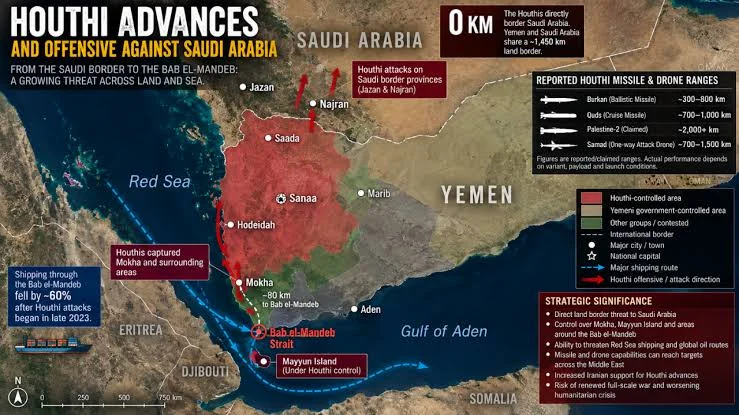
On September 19, 2026, Saudi authorities issued overnight warnings of possible aerial attacks around Riyadh and Al-Kharj after loud explosions were heard near the Saudi capital. Reuters reported that smoke and flames were subsequently visible near Riyadh’s main airport. The escalation follows weeks of Houthi attacks against Saudi cities, energy infrastructure and maritime interests.
At the same time, Houthi forces have been expanding their position along Yemen’s Red Sea coast. The United Nations has warned that the situation around Bab el-Mandeb has become increasingly volatile. UN officials reported that fighting had intensified along Yemen’s western coast and that the Houthis had reportedly captured several islands in the southern Red Sea.
The crisis is now occurring against the backdrop of a new regional security arrangement.
On August 7, 2026, Saudi Arabia, Pakistan and Türkiye signed the Mecca Joint Defence Agreement, declaring that an armed attack against one of the three states would be regarded as an attack against all three. The agreement expressly refers to the right of individual and collective self-defence under Article 51 of the UN Charter.
That creates a potentially explosive legal question:
“If Houthi attacks against Saudi Arabia continue to intensify, could the Makkah Accord transform a Yemen-Saudi confrontation into a wider conflict involving Pakistan and Türkiye?”
For now, there is no indication that Pakistan or Türkiye has entered offensive military operations against the Houthis. But the legal architecture for collective defence is now being built. And that changes the geopolitical calculation.
Why Bab el-Mandeb Has Become the Centre of the Crisis
Bab el-Mandeb is not simply another waterway in the Yemen conflict. It is one of the world’s strategically important maritime chokepoints. The strait connects the Red Sea with the Gulf of Aden and provides the maritime gateway between the Indian Ocean and the Suez Canal route. Any prolonged disruption can therefore affect:
- global shipping;
- oil transportation;
- LNG and energy markets;
- insurance costs;
- food supply chains;
- European-Asian trade;
- Gulf exports; and
- military deployments.
The United Nations has already emphasised the legal importance of navigation through the Red Sea. Under the UN’s description of the applicable law of the sea framework, different navigation regimes apply in the Red Sea, including transit passage through international straits.
UNCLOS provides that ships and aircraft enjoy a right of transit passage through qualifying international straits, and states bordering such straits may not suspend that passage. That means the Bab el-Mandeb crisis is not only a Yemen-Saudi security dispute. It is also a law-of-the-sea and international-navigation crisis.
Houthis Move Toward Bab el-Mandeb
The military geography has changed rapidly. According to the Council on Foreign Relations‘ September 2026 conflict tracker, Houthi forces seized Perim Island, also known as Mayyun Island, in the middle of Bab el-Mandeb after government forces withdrew. The Houthis also reportedly captured the Yemeni port city of Mokha and extended their control along significant portions of Yemen’s Red Sea coastline.
The United Nations separately confirmed that the Houthi advance toward Bab el-Mandeb had intensified and that several islands in the southern Red Sea were reportedly captured. This development matters because control of territory surrounding a maritime chokepoint can dramatically change the security environment. The legal right of navigation remains one issue.
The practical ability of commercial vessels to navigate safely is another. A shipping route may technically remain open under international law while becoming commercially unusable because of missiles, drones, mines, insurance costs or military threats. That distinction could become increasingly important.
Saudi Arabia Is Facing a Multi-Layered Security Crisis
Saudi Arabia is now confronting threats on several fronts. The Houthis have targeted or threatened:
- southern Saudi cities;
- military facilities;
- energy infrastructure;
- shipping;
- Red Sea routes; and
- potentially strategic infrastructure around the kingdom.
On September 16, AP reported that Saudi Arabia was seeking assistance from regional and Western partners as its stocks of missile interceptors came under pressure. Requests reportedly included assistance from France, Britain, Pakistan and Egypt. That development is legally and strategically significant. Saudi Arabia is not simply asking for political solidarity. It is facing questions about:
“collective defence, air defence, maritime security and the limits of foreign military assistance.”
The Mecca Drone Controversy Raises the Stakes
One of the most sensitive developments occurred when Saudi Arabia said it had intercepted a Houthi drone heading toward the vicinity of Mecca. Saudi authorities described the incident as an attempted threat to the holy city. The Houthis denied targeting Mecca or any Islamic holy site.
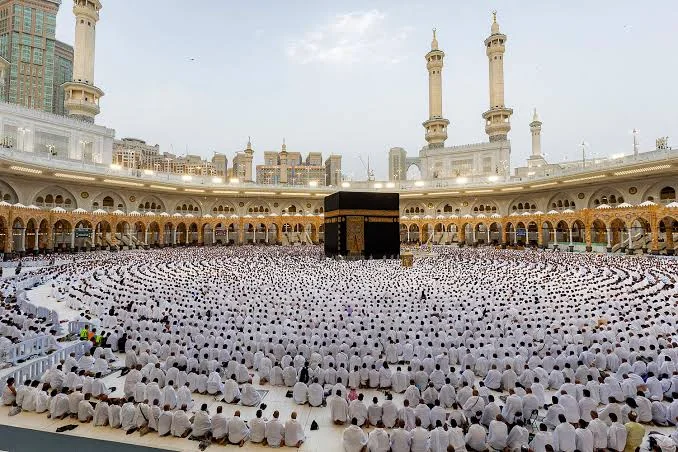
Al Jazeera, citing Saudi and Houthi statements, reported that Saudi authorities said the drone had been intercepted before entering restricted airspace, while Houthi officials rejected the accusation.This distinction is critical. The allegation of an attack directed toward Mecca is extremely serious.
But legally and journalistically, it must be distinguished from an independently established fact. The Houthis have denied targeting the holy city. Iranian officials also questioned whether the available information was sufficient to establish that the drone was actually directed toward Mecca. The incident nevertheless demonstrates how rapidly the conflict can acquire religious, political and regional dimensions.
What Is the Makkah Accord?
The Makkah Joint Defence Agreement was signed on August 7, 2026, by Saudi Arabia, Pakistan and Türkiye. The agreement is designed to strengthen collective security and deterrence. Its central provision is that an armed attack against one of the participating states will be regarded as an attack against all three.
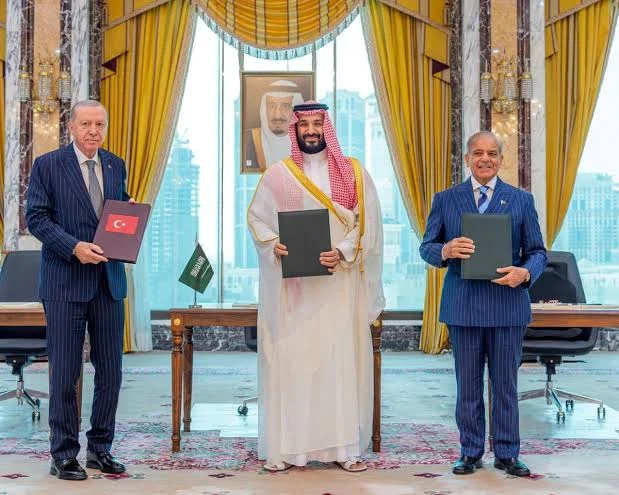
The agreement also provides for broader defence cooperation. Pakistan has publicly described the agreement as defensive rather than directed against a particular country. Pakistan’s Foreign Ministry has stated that:
“the pact is based on the inherent right of individual and collective self-defence under Article 51 of the UN Charter.”
This distinction is important. The agreement does not automatically mean Pakistan or Türkiye will attack the Houthis. Indeed, Pakistan’s Foreign Office said on September 11 that:
“the agreement was still being institutionalised and that Pakistani participation in strikes against Houthi targets was, at that stage, hypothetical.”
The Makkah Accord Is Becoming Operational – Not Yet a NATO-Style Alliance
The agreement should not be described as an established Middle Eastern equivalent of NATO. That comparison can be politically attractive but legally misleading. The three governments have been working to institutionalise the arrangement. On August 31, Pakistan, Türkiye and Saudi Arabia held the first meeting of the Strategic Political and Defence Committee established under the agreement.
The three countries agreed to create a secretariat in Saudi Arabia and to strengthen defence cooperation, including military capabilities, technology and defence-industry cooperation.Pakistan’s Foreign Ministry has also emphasised that:
“the pact is defensive and does not formally constitute a new bloc directed against another country.”
Therefore, the current legal picture is better described as:
“a developing collective-defence framework rather than a fully integrated military alliance.”
Article 51 of the UN Charter Becomes Central
The legal foundation of the Makkah Accord is particularly important. Article 51 of the UN Charter recognises the inherent right of individual and collective self-defence if an armed attack occurs against a UN member state. It also requires states taking measures in self-defence to report those measures to the Security Council.
This creates several questions. If Saudi Arabia suffers an armed attack:
“Can Saudi Arabia invoke individual self-defence?”
Potentially, subject to the requirements of international law. If Pakistan or Türkiye assists Saudi Arabia:
“Could that constitute collective self-defence?”
Potentially, if the legal conditions for collective self-defence are satisfied. But a defence agreement cannot simply override the UN Charter. A treaty between three states does not create an unlimited right to wage war. Any military response would still have to be assessed under international law.
Collective Self-Defence Does Not Mean Unlimited War
This is one of the most important legal points in the entire crisis. An armed attack against Saudi Arabia could potentially trigger collective-defence obligations under the Makkah Accord. But that does not mean:
“Any attack permits any military response.”
International law places constraints on the exercise of self-defence. The response must be connected to the armed attack and must comply with the broader rules governing the use of force. The Security Council also retains its authority under the UN Charter. Therefore, the Makkah Accord should not be interpreted as a blank cheque for military action.
The legal issue would be:
“What attack occurred, who was responsible, what response was necessary, and whether the response remained within the limits of international law?”
Are Houthi Attacks an “Armed Attack” Against Saudi Arabia?
This could become the central legal dispute. The Houthis are a non-state armed group. Saudi Arabia is a sovereign state. The international law of self-defence against non-state actors has been heavily debated, particularly since the September 11 attacks.
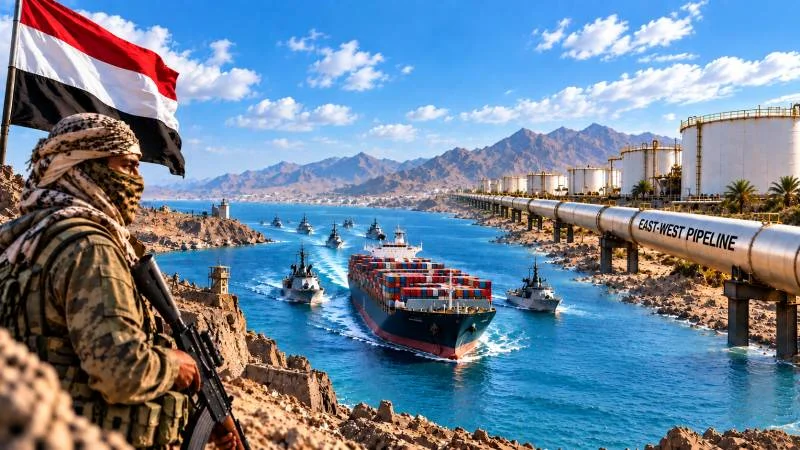
If Houthi missiles or drones strike Saudi territory, civilian infrastructure or military targets, Saudi Arabia could argue that it has suffered an armed attack. The more sustained and severe the attacks become, the stronger the factual basis for such an argument may become.
But another question remains:
“Can attacks by a non-state group automatically trigger the collective-defence commitments of Pakistan and Türkiye?”
That depends not only on the Makkah Accord but also on the factual and legal circumstances of the attacks and the interpretation applied by the participating states. This is precisely where the conflict could move from regional politics into international law.
Iran’s Role Creates Another Legal Layer
The Houthis are widely described by governments and international observers as Iran-aligned. But political alignment and legal attribution are not identical. That distinction matters enormously. If a Houthi missile hits Saudi Arabia, that does not automatically establish that Iran legally carried out the attack.
For Iran to face direct legal responsibility for an attack by another armed group, additional evidence concerning Iranian involvement, control, direction or other legally relevant conduct would need to be established.
This is why statements describing the Houthis simply as an extension of Iran should be treated carefully in legal analysis. The geopolitical relationship is significant. The legal question of attribution is separate.
The Red Sea Is Now a Global Legal Issue
The Bab el-Mandeb crisis has implications far beyond Saudi Arabia and Yemen. Commercial vessels from countries around the world use the Red Sea. The UN has previously condemned Houthi attacks on merchant and commercial vessels and reaffirmed the importance of navigational rights and freedoms in the Red Sea.
The UN has also recognised that states have rights under international law to defend vessels from attacks that undermine navigation. Therefore, a prolonged Houthi attempt to control or disrupt shipping could create legal issues involving:
- freedom of navigation;
- maritime security;
- state responsibility;
- protection of merchant vessels;
- use of force;
- naval self-defence;
- neutral shipping;
- blockade law; and
- international humanitarian law.
The longer the crisis continues, the more difficult it becomes to treat it solely as a domestic Yemeni conflict.
Could the Houthis Legally Block the Red Sea?
The Houthis have described their maritime operations as a blockade against Saudi interests. But the word “blockade” has a specific significance in international law. A naval blockade is not simply a political announcement.
The legality of a blockade depends on the circumstances, including whether an international armed conflict exists, whether the blockade complies with applicable rules of international humanitarian law and whether it unlawfully targets civilian populations or neutral shipping.
Commercial shipping also raises separate law-of-the-sea issues. A group cannot simply acquire a strategic position near an international maritime chokepoint and thereby acquire unlimited authority over international navigation. UNCLOS provides a legal framework protecting transit through qualifying international straits.
Could Saudi Arabia Launch a Major Offensive in Yemen?
Saudi Arabia has already conducted military operations in Yemen during the long-running conflict. The present question is whether the latest escalation could lead to a renewed large-scale campaign. That would create significant legal and humanitarian consequences. A Saudi military response would have to consider:
- the legal basis for the use of force;
- distinction between military and civilian targets;
- proportionality;
- precautions in attack;
- treatment of detainees;
- humanitarian access;
- protection of civilians; and
- potential accountability for violations.
The history of the Yemen conflict makes this especially sensitive. Any expansion of military operations would attract scrutiny under international humanitarian law.
Why Pakistan’s Position Is Particularly Important
The Makkah Accord makes Pakistan one of the most important potential actors in the crisis. Pakistan has longstanding defence relations with Saudi Arabia. But Islamabad has also publicly emphasised diplomacy and has not indicated that it intends to launch offensive operations against the Houthis.
Pakistan’s Foreign Office stated that Islamabad was not considering strikes on Houthi targets at that stage and distinguished its defence obligations from participation in offensive operations inside Yemen. That distinction could become extremely important. There is a major legal and strategic difference between:
“defending Saudi territory and conducting offensive military operations inside Yemen.”
The first could potentially be framed as collective defence. The other would raise additional questions concerning the legality and scope of military operations against a non-state armed group operating inside another sovereign state.
Türkiye’s Position Adds Another Dimension
Türkiye is also a party to the Makkah Accord. Unlike Pakistan, Türkiye is already a major regional military power and a NATO member. But NATO membership does not automatically make NATO a participant in the Makkah Accord.
The Makkah arrangement remains legally separate.
That distinction is important because a conflict involving Saudi Arabia, Pakistan and Türkiye would not automatically become a NATO conflict. NATO’s treaty obligations are separate from Türkiye’s bilateral or trilateral commitments. This could become increasingly important if the crisis expands.
What Happens If Pakistan Is Asked to Defend Saudi Arabia?
This may become the most politically sensitive question. The Makkah Accord says an armed attack against one participant will be regarded as an attack against all three. But the practical response depends on the agreement’s implementation mechanisms and decisions by the participating governments.Pakistan could theoretically distinguish between:
Defensive assistance
- air-defence personnel;
- intelligence;
- logistics;
- surveillance;
- protection of Saudi territory;
- training.
Offensive assistance
- strikes against Houthi positions;
- operations inside Yemen;
- naval attacks;
- ground operations.
The second category carries considerably greater legal and political risk. Pakistan has so far emphasised the defensive nature of the pact and the need for diplomacy.
The Risk of a Wider Regional War
The danger is not simply Saudi Arabia versus the Houthis. The potential chain could look like this:
Houthi attack
↓
Saudi military response
↓
Invocation of Makkah Accord
↓
Pakistan and/or Türkiye provide military assistance
↓
Iran becomes more directly involved
↓
Red Sea shipping is disrupted
↓
Other states deploy naval forces
↓
Conflict expands beyond Yemen
This is not a prediction that the sequence will occur. It is the principal escalation pathway that policymakers and international-law experts have to consider. The UN has described the situation around Bab el-Mandeb as increasingly volatile. It has also warned that the latest fighting risks widening the Yemen conflict and returning the country to sustained large-scale hostilities.
That warning matters because Yemen had experienced a period of relative calm following the UN-mediated truce of 2022. The current escalation threatens to reverse that progress. A renewed large-scale war would not only affect Saudi Arabia. It could produce:
- new displacement;
- humanitarian shortages;
- disruption of aid;
- destruction of infrastructure;
- increased civilian casualties;
- further maritime insecurity; and
- renewed regional intervention.
Mecca Makes the Crisis Uniquely Sensitive
The alleged drone incident involving Mecca adds another dimension that few other military incidents would carry. Mecca is Islam’s holiest city. Any credible threat against the city or its worshippers could generate a reaction far beyond the immediate Saudi-Houthi confrontation. But this also makes careful verification particularly important.
Saudi Arabia says a drone was intercepted near the holy city. The Houthis deny targeting Mecca. The difference is crucial. Therefore, the legal and journalistic distinction between:
“an alleged attack, an intercepted drone, and an independently verified attempt to strike a holy site must be preserved.”
The International Humanitarian Law Problem
If the conflict expands, international humanitarian law will become increasingly important. The key principles include:
Distinction
Parties must distinguish between civilians and combatants and between civilian objects and military objectives.
Proportionality
Even where a legitimate military target exists, attacks cannot lawfully be carried out if expected civilian harm would be excessive in relation to the anticipated military advantage.
Precautions
Parties must take feasible precautions to minimise civilian harm.
Protection of humanitarian operations
Humanitarian relief and civilian populations must not be deliberately targeted.
These rules would apply irrespective of the political justification offered by the parties.
What Happens to Commercial Shipping?
This could become the world’s most immediate economic consequence. If shipping companies believe Bab el-Mandeb is unsafe, vessels may divert around the Cape of Good Hope. That can add:
- thousands of nautical miles;
- additional fuel costs;
- longer delivery times;
- increased insurance premiums;
- pressure on freight rates; and
- delays in energy and consumer-goods markets.
The legal significance is equally important. International law protects navigation rights, but it does not make shipping companies immune from the physical risks of an armed conflict. That creates a gap between:
“legal freedom of navigation and commercially viable navigation.”
Why Bab el-Mandeb Matters to Europe and Asia
The Red Sea route is strategically important because it connects the Indian Ocean with the Mediterranean through the Suez Canal. A prolonged closure or major disruption could affect trade between:
- Asia and Europe;
- the Gulf and Europe;
- Africa and Europe; and
- Asian manufacturing centres and Western markets.
Therefore, even states that have no direct role in the Yemen conflict could become economically and strategically involved. That is why the UN and major maritime powers continue to monitor the situation closely.
The Legal Test for the Makkah Accord
Potentially, the Makkah Accord is creating a new Middle Eastern security architecture but it is too early to describe the arrangement as a fully established alliance system. The agreement has already moved beyond symbolism. A Strategic Political and Defence Committee has been created.
The three states have agreed to institutionalise cooperation. A secretariat is being established in Saudi Arabia. Defence cooperation is expected to include technology, training and industrial cooperation. But its real significance will depend on what happens during an actual military crisis.
The current Houthi escalation is therefore the first major test of the pact. The most important questions are now becoming concrete.
- What constitutes an armed attack?
The treaty refers to armed attack, but future disputes may concern the scale and nature of attacks by a non-state actor.
- Who determines that an attack has occurred?
The agreement will need mechanisms for consultation and decision-making.
- What assistance is mandatory?
Collective-defence language does not necessarily mean every member must deploy combat troops.
- Can members provide only defensive assistance?
This could become particularly important for Pakistan.
- Can the pact authorise offensive operations in Yemen?
That would raise significantly more difficult international-law questions.
How does the agreement interact with Article 51?
The UN Charter remains the higher-level legal framework governing the international use of force.
The Bigger Iran Question
The regional crisis cannot be understood without considering Iran. Saudi Arabia and Iran have spent years competing for influence across the Middle East. The Houthis’ relationship with Iran has therefore become central to Saudi security calculations.
But the danger is escalation by assumption. If Saudi Arabia concludes that every Houthi attack is effectively an Iranian attack, the conflict could move rapidly from:
“Saudi Arabia vs Houthis to Saudi Arabia and partners vs Iran-aligned forces and potentially toward direct confrontation with Iran.”
That would represent an entirely different geopolitical crisis.
The Legal Problem of Fighting a Non-State Actor
The Houthi issue exposes one of the hardest questions in modern international law. Traditional international law was largely designed around conflicts between states. Modern conflicts frequently involve:
- armed groups;
- militias;
- proxy forces;
- transnational networks;
- private military actors; and
- state-supported non-state organisations.
The Houthis control territory and exercise governmental functions in parts of Yemen while also operating as an armed movement. That makes the legal characterisation of the conflict complicated. The international response cannot simply assume that the rules governing a conventional interstate war apply in exactly the same way.
Yemen’s Sovereignty Cannot Be Ignored
Another major legal question is Yemen’s territorial sovereignty. If Saudi Arabia, Pakistan or Türkiye conduct military operations inside Yemen, the legal basis for those operations matters. Possible legal arguments could include:
- self-defence;
- collective self-defence;
- consent by the internationally recognised Yemeni government;
- Security Council authorisation.
But the existence of a security threat does not automatically eliminate the sovereignty of the state where military operations occur. That is why the scope and legal justification of any future operation will be critical.
The International Shipping Question Could Trigger Foreign Intervention
The Bab el-Mandeb Strait is sufficiently important that attacks on merchant vessels could attract military responses from states far beyond the Middle East. The United Nations has already recognised the importance of protecting commercial navigation in the Red Sea and has affirmed that international law provides a framework for defending vessels from attacks.
This creates another escalation pathway:
Houthi maritime attacks
↓
international naval protection
↓
Houthi attacks on foreign warships
↓
foreign military retaliation
↓
wider regional conflict
The more states that become directly involved, the harder it becomes to contain the conflict.
What Happens Next?
The immediate issues to watch are clear.
Saudi Arabia
Will Riyadh intensify air operations against Houthi positions?
Houthis
Will the group continue attacks against Saudi cities, energy infrastructure and shipping?
Pakistan
Will Islamabad provide defensive military assistance if Saudi Arabia formally requests it?
Türkiye
Will Ankara become directly involved in Saudi defence?
Iran
Will Tehran attempt to restrain the Houthis or increase political and military support?
United States
Will Washington expand intelligence, air-defence or naval assistance?
United Nations
Can diplomacy prevent the renewed conflict from becoming a wider regional war?
Shipping companies
Will commercial operators continue using Bab el-Mandeb at current levels?
These questions will determine whether the current escalation remains contained or develops into a much larger crisis.
Legal Risk Matrix: Where the Crisis Could Go
| Development | Main legal issue | Potential consequence |
|---|---|---|
| Houthi attacks on Saudi territory | Article 51 self-defence | Saudi military response |
| Saudi strikes inside Yemen | Sovereignty and use of force | International legal scrutiny |
| Pakistan defends Saudi territory | Collective self-defence | Makkah Accord becomes operational |
| Pakistan attacks Houthi targets inside Yemen | Scope of collective self-defence | Major international-law dispute |
| Türkiye joins Saudi defence | Collective-defence obligations | Wider regional involvement |
| Houthi attacks on merchant ships | Law of the sea | International naval response |
| Bab el-Mandeb closure | Freedom of navigation | Global shipping disruption |
| Attack on religious sites | Protection of civilians/religious sites | Major regional escalation |
| Iranian direct involvement | Attribution and use of force | Potential interstate conflict |
| Renewed large-scale Yemen war | International humanitarian law | Civilian and humanitarian crisis |
Could the Makkah Accord Be Tested by Bab el-Mandeb?
Yes. In fact, the current crisis may become the first serious test of whether the agreement can function as a credible collective-defence framework. The test will not simply be military. It will be legal. A functioning collective-defence agreement requires clarity concerning:
- what activates it;
- who determines activation;
- what assistance is required;
- whether assistance can be limited to air defence;
- whether offensive action is permitted;
- how international law constrains the response; and
- how disagreements between members are resolved.
The current crisis may force these questions to be answered much sooner than the three governments expected.
Conclusion
The latest Saudi-Houthi escalation is no longer simply another episode in Yemen’s long war. The conflict is moving toward one of the world’s most strategically important maritime chokepoints. At the same time, Saudi Arabia now has a new defence relationship with Pakistan and Türkiye through the Makkah Joint Defence Agreement.
The pact creates a legal framework for collective defence if one of its members suffers an armed attack. The greatest danger is therefore not necessarily that Saudi Arabia and the Houthis are already in a formally declared regional war. It is that a conflict which began within Yemen could acquire a wider legal architecture capable of drawing additional states into the confrontation.
Bab el-Mandeb makes the stakes even higher. If the Houthis consolidate control around the strait and continue threatening shipping, the crisis could evolve from a Saudi-Yemeni security confrontation into a global maritime-security emergency. If Saudi Arabia invokes collective defence under the Makkah Accord, Pakistan and Türkiye could face the most consequential foreign-policy test of the agreement’s existence.
Frequently Asked Questions
Are Saudi Arabia and the Houthis on the brink of war?
They are already engaged in serious armed hostilities, including Houthi attacks on Saudi territory and Saudi military operations against Houthi positions. The more significant question is whether the current escalation develops into a sustained, broader regional war.
Did the Makkah Accord cause the Saudi-Houthi conflict?
No. The current escalation began before the August 2026 agreement. The Makkah Accord potentially changes the consequences of an attack on Saudi Arabia by creating a collective-defence framework involving Pakistan and Türkiye.
What is the Makkah Accord?
It is a joint defence agreement signed by Saudi Arabia, Pakistan and Türkiye on August 7, 2026. It provides that an armed attack against one of the three states will be regarded as an attack against all three.
Does the Makkah Accord mean Pakistan will fight the Houthis?
Not automatically. Pakistan has stated that the agreement is defensive and that participation in strikes against Houthi targets was not under discussion at the time of its September 11 briefing.
Why is Bab el-Mandeb so important?
It is a strategic maritime chokepoint connecting the Red Sea with the Gulf of Aden and the wider Indian Ocean. Disruption can affect international shipping, energy supplies and trade between Asia, Europe and the Middle East.
Can the Houthis legally block Bab el-Mandeb?
Could an attack on Saudi Arabia trigger the Makkah Accord?
Potentially, depending on the facts and the interpretation of the agreement. The agreement expressly links an armed attack against one member to the collective-defence commitment of the three states.
Could Pakistan legally attack Houthi targets inside Yemen?
That would raise substantially more difficult legal questions than defending Saudi territory. The issues would include the scope of collective self-defence, Yemen’s sovereignty, attribution of the attacks and the requirements of international humanitarian law.
Is Iran directly at war with Saudi Arabia because of the Houthis?
Not necessarily. Iran’s relationship with the Houthis is a major geopolitical factor, but political alignment or support does not automatically establish that Iran itself carried out every Houthi attack. Legal attribution requires a separate analysis of the evidence and applicable international-law rules.