
Iran’s decision to block and militarily threaten the Strait of Hormuz represents one of the most consequential uses of economic statecraft in modern history. By leveraging geography rather than conventional military superiority, Iran has effectively turned a narrow maritime chokepoint into a global pressure mechanism, reshaping international law debates, energy markets, and geopolitical alignments.
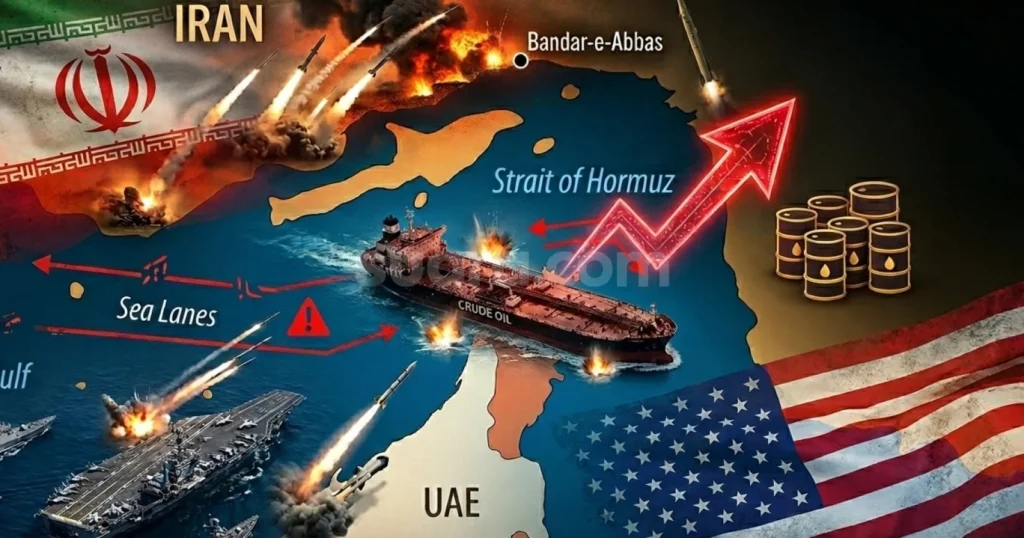
The implicit threat to disrupt one of the world’s most vital energy corridors has already amplified volatility in oil markets and raised urgent legal questions under the law of the sea. As tensions deepen, Iran’s Hormuz strategy is emerging as a defining case study in modern economic coercion, where control over trade routes, rather than territory alone, shapes geopolitical outcomes.
The Strait of Hormuz as a Strategic “Economic Weapon”
The Strait of Hormuz is one of the most critical arteries of the global economy, carrying around 20–25% of global oil trade and major LNG shipments. By restricting passage through missile threats, naval attacks, and maritime disruption, Iran has demonstrated that control over strategic geography can rival military power.
Analysts describe this as a shift toward “economic coercion through chokepoints”, where states weaponize trade routes rather than territory. Legally, such actions raise serious issues under the United Nations Convention on the Law of the Sea (UNCLOS), which guarantees transit passage through international straits.
The blocking of Hormuz is widely viewed as a violation of this principle, transforming the crisis into not just a military confrontation but a challenge to the international maritime legal order.
Can a State Legally Block the Strait During Conflict?
International law distinguishes between peacetime navigation rights and the law governing naval warfare. During an armed conflict, states may attempt to impose naval blockades against enemy states. However, even in wartime, blockades are subject to strict legal requirements.
Under customary international law and the San Remo Manual on International Law Applicable to Armed Conflicts at Sea, a blockade must satisfy several conditions:
- It must be formally declared and publicly notified
- It must be effective and not purely symbolic
- It must not prevent access to neutral ports or international waterways unrelated to the conflict
- It must respect humanitarian considerations and allow passage of essential supplies
Because the Strait of Hormuz is used by ships from dozens of neutral states, a blockade that interferes with neutral commerce could be considered unlawful.
Impact of the UN Charter and Use of Force Rules
Blocking the Strait of Hormuz could also raise issues under the UN Charter, particularly the prohibition on the use of force in Article 2(4). If a state attempts to close the strait through military means, such as deploying mines, attacking commercial vessels, or threatening shipping traffic, it could be interpreted as an unlawful use of force against other states whose vessels rely on the waterway.
Only two legal justifications could potentially legitimize such actions:
- Self-defense under Article 51 of the UN Charter
- Authorization by the UN Security Council
Without one of these legal grounds, closing an international strait would likely be considered a violation of international law.
Legal Framework Under the United Nations Convention on the Law of the Sea
The principal legal regime governing international straits is contained in Part III of UNCLOS, which establishes the right of transit passage. Transit passage guarantees that ships and aircraft from all countries have the right to move through international straits continuously and expeditiously without interference from coastal states. This right applies even when the waters fall within the territorial seas of the bordering states.
For the Strait of Hormuz, this means that neither Iran nor Oman can lawfully suspend or obstruct transit passage for foreign vessels engaged in lawful navigation. The convention makes clear that coastal states must not hamper transit passage and must refrain from actions that obstruct international shipping.
Risks to Neutral Shipping and Global Trade
A major legal complication arises because the Strait of Hormuz is used primarily by neutral commercial vessels transporting oil and goods between third countries. Interference with these ships could violate the rights of neutral states under international law.
International maritime law protects neutral commerce from interference except under narrowly defined circumstances. Attacks on neutral shipping or indiscriminate mining of international waterways could therefore expose the responsible state to international legal claims and possible sanctions.
International Straits and the Principle of Transit Passage
International maritime law recognizes that certain waterways are so essential to global trade that they must remain open for navigation. Under the United Nations Convention on the Law of the Sea (UNCLOS), such waterways are classified as international straits used for navigation, granting vessels and aircraft the right of transit passage.
Transit passage ensures that ships from all states, whether neutral or belligerent, can travel continuously through these routes without interference. The Strait of Hormuz, like the Suez Canal and several other global chokepoints, falls within this category because it connects two large bodies of water and serves as a critical artery for international commerce.
Any attempt to block or restrict such a strait is therefore subject to intense scrutiny under international law.
Strait of Hormuz Crisis in Light of Past Maritime Blockades
The growing tensions around the Strait of Hormuz during the Iran–Israel–U.S. confrontation have revived longstanding debates in international maritime law regarding the legality of blocking strategic waterways. Historically, attempts to restrict global shipping lanes have triggered major geopolitical crises and legal disputes.
By comparing the Hormuz situation with earlier conflicts, particularly the Suez Canal crisis (1956), the Iran–Iraq Tanker War (1980s), and the Black Sea blockade during the Russia–Ukraine war, a clearer legal understanding emerges of how international law treats the obstruction of vital maritime corridors.
The 1956 Suez Canal Crisis
One of the most prominent historical examples of maritime obstruction occurred during the Suez Crisis of 1956. When Egypt nationalized the Suez Canal, Britain, France, and Israel launched a military intervention to regain control of the waterway. The canal was temporarily closed after ships were sunk to block passage.
From a legal perspective, the crisis raised questions about the balance between state sovereignty over territory and international rights of navigation. Although Egypt controlled the canal geographically, international agreements and customary law recognized its importance as a global shipping route.
The United Nations eventually intervened, and the canal reopened under international supervision. The crisis reinforced the principle that strategic waterways must remain accessible to international shipping, even during political disputes.
The Iran–Iraq Tanker War (1980s)
The Tanker War, a phase of the Iran–Iraq conflict during the 1980s, provides a more direct precedent for tensions surrounding the Strait of Hormuz. Both sides targeted oil tankers in the Persian Gulf in an attempt to disrupt each other’s economic lifelines.
Attacks on commercial vessels triggered international condemnation and ultimately prompted foreign naval forces to escort oil tankers through the Gulf. The United States and other powers deployed naval operations to ensure the continued flow of oil shipments.
Legally, these attacks were criticized because they endangered neutral shipping and violated the protections afforded to civilian commercial vessels under international humanitarian law. The episode reinforced the principle that belligerent states must avoid actions that threaten global commerce or neutral trade routes.
The Russia–Ukraine Black Sea Blockade
More recently, the conflict between Russia and Ukraine produced a significant maritime crisis in the Black Sea. Russian naval operations restricted access to Ukrainian ports, disrupting global grain exports and causing major concerns about food security.
The blockade raised questions about whether such restrictions violated international law governing freedom of navigation and the rights of neutral states. Negotiations mediated by international actors eventually produced temporary agreements allowing limited shipments to resume.
This case demonstrated how modern conflicts involving maritime blockades can have far-reaching global consequences, particularly when essential commodities such as food or energy are involved.
Potential Legal Consequences
When compared with these historical cases, the legal issues surrounding the Strait of Hormuz share several common elements.
First, the strait’s status as an international transit route means that any attempt to block it would directly affect numerous states that are not parties to the conflict. This creates strong legal arguments that obstruction would violate international maritime law. Other states could argue that their rights under international maritime law have been violated and could seek remedies through diplomatic protests, international arbitration, or economic sanctions.
Second, the economic stakes are significantly higher than in many past maritime crises. Because a substantial share of the world’s oil supply passes through the strait, interference could destabilize global energy markets and trigger widespread economic disruption.
Third, past precedents show that the international community often responds collectively to threats against major shipping routes. Naval escorts, diplomatic intervention, and economic pressure have historically been used to ensure the continued operation of strategic waterways.
Additionally, interference with global energy supply could trigger collective responses from affected states seeking to ensure freedom of navigation. In extreme cases, military escorts or multinational naval operations might be justified as measures to protect international shipping.
Intersection of War, Energy Markets, and International Trade Law
International trade law traditionally focuses on regulating tariffs, subsidies, and trade barriers. However, modern geopolitical crises demonstrate that military conflict can indirectly reshape global trade flows, particularly in sectors such as energy.
Oil and gas are among the most heavily traded commodities in the global economy. Sudden supply disruptions, such as those caused by conflict near the Strait of Hormuz, can influence prices, shipping routes, and supply chains across multiple industries.
When governments take actions that directly or indirectly affect energy supply, these decisions can raise questions about whether they align with existing international trade obligations.
WTO Framework and Energy Trade
The WTO legal system governs trade in goods through agreements such as the General Agreement on Tariffs and Trade (GATT). Under this framework, member states are generally expected to avoid discriminatory trade practices and restrictions on exports or imports.
However, WTO rules do not specifically regulate the price of commodities like oil. Instead, they focus on preventing governments from imposing unjustified trade barriers that distort international markets.
Military conflict, therefore, usually falls outside the traditional scope of WTO regulation. Nevertheless, if wartime actions lead to trade restrictions, such as blocking shipping lanes, restricting exports, or imposing sanctions, those measures may be scrutinized under WTO rules.
Immediate Economic Shock: Energy, Inflation, and Market Collaps
The economic consequences have been immediate and severe. Iran’s disruption of Hormuz has:
- Removed 9–14 million barrels per day from global supply
- Driven oil prices above $100–$120 per barrel
- Triggered the largest energy shock since the 1970s oil crisis
This has cascaded into wider economic instability:
- Global stock markets entered correction territory
- Inflation surged due to energy costs and supply chain disruptions
- Central banks faced stagflation risks—low growth with high inflation
Even a short-term closure can reduce global GDP growth by nearly 3 percentage points, highlighting the fragility of the global economy to energy shocks.
Global Supply Chains Beyond Oil: Food, Fertilizer, and Trade
The impact extends far beyond energy markets. The Hormuz disruption has:
- Disrupted fertilizer exports, threatening global food security
- Increased costs across manufacturing, shipping, and logistics sectors
- Affected LNG supplies, particularly impacting Europe and Asia
For developing countries, especially energy-importing economies, the crisis has triggered:
- Rising fuel and food prices
- Currency pressure and trade deficits
- Increased risk of economic instability
In effect, the Hormuz crisis has transformed into a multi-sector global economic shock, not just an energy crisis.
Geopolitical Transformation: Fragmentation and New Alignments
Iran’s tactic has fundamentally altered global geopolitics in several ways:
1. Weakening of Western Strategic Control
Despite U.S. naval dominance, reopening the Strait has proven difficult and costly, exposing limits of military power against asymmetric tactics.
2. Strains Within Alliances
The crisis has revealed divisions between the United States and its allies, particularly over military involvement in the Gulf, weakening traditional alliance cohesion.
3. Rise of Regional Mediation
Countries like Pakistan, Turkey, and Gulf states are increasingly acting as diplomatic intermediaries, attempting to negotiate reopening mechanisms and reduce escalation.
4. Shift Toward Multipolar Economic Security
States are now accelerating efforts to:
- Diversify energy routes
- Build strategic reserves
- Develop alternative payment and trade systems
This signals a broader move away from globalization toward “security-driven economic blocs.”
Legal Implications: A Challenge to International Norms
Iran’s actions have triggered a major legal debate:
- Violation of transit passage rights under UNCLOS
- Potential classification as economic warfare or coercion
- Questions over whether countermeasures (e.g., naval intervention) are lawful under the UN Charter
At the same time, the crisis exposes a deeper legal gap: international law provides limited enforcement mechanisms when chokepoints are militarized by sovereign states.
Long-Term Structural Impact on the Global Economy
The Hormuz crisis is not a temporary disruption, it may mark a structural turning point:
- Globalization is increasingly shaped by geopolitical risk rather than efficiency
- Energy markets are becoming more volatile and politically driven
- Governments are prioritizing economic resilience over cost optimization
Estimates suggest that prolonged disruption could put up to $2.2 trillion of global GDP at risk, underscoring the scale of the crisis.
Conclusion
Iran’s tactic of blocking the Strait of Hormuz has redefined modern geopolitical conflict by demonstrating how strategic geography can be weaponized to influence global economics and international law. The resulting crisis has triggered energy shocks, global inflation, alliance fractures, and legal uncertainty, revealing the vulnerability of an interconnected world dependent on critical trade chokepoints.
Ultimately, the Hormuz strategy signals a new era in international relations, where economic disruption, rather than direct military confrontation, becomes the central battlefield of global power politics. The reported disruption or potential blockade of the Strait of Hormuz during the escalating Iran–Israel–U.S. conflict has raised major questions under international maritime law.
Because the strait is one of the world’s most important energy corridors, any attempt to restrict navigation carries profound legal and economic consequences. The legality of such a blockade depends primarily on the rules contained in the United Nations Convention on the Law of the Sea (UNCLOS) and the broader principles governing the use of force under international law.
Frequently Asked Questions
Why is the Strait of Hormuz so important globally?
The Strait of Hormuz is one of the world’s most critical maritime chokepoints, with around 20–25% of global oil and significant LNG supplies passing through it daily. Any disruption in this route directly affects global energy prices, trade flows, and economic stability.
Is Iran legally allowed to block the Strait of Hormuz?
Generally, no. Under the United Nations Convention on the Law of the Sea (UNCLOS), the Strait of Hormuz is an international strait where transit passage must not be obstructed. Blocking or restricting passage is widely considered a violation of international maritime law unless justified under limited circumstances such as lawful military action during an armed conflict.
Can other countries use force to reopen the Strait?
Potentially, but only under strict legal conditions. States may argue self-defense under Article 51 of the UN Charter if their economic security or vessels are directly threatened. However, any military response must meet the principles of necessity and proportionality, and ideally should have UN Security Council authorization to avoid legal controversy.
How has the Hormuz crisis affected global oil prices?
The disruption has caused sharp increases in oil prices, often exceeding $100 per barrel, due to reduced supply and market uncertainty. This has triggered inflation, higher transportation costs, and economic pressure worldwide.
What are the broader economic impacts beyond oil?
The crisis affects multiple sectors, including:
Shipping and logistics costs
Food security (due to fertilizer supply disruptions)
Manufacturing and trade supply chains
Global inflation and currency stability
This makes the crisis a multi-sector economic shock, not just an energy issue.
Why is this considered a form of “economic warfare”?
Iran’s tactic uses control over a strategic trade route to exert pressure on global markets and political decisions. Instead of direct military confrontation, it targets economic systems, making it a form of economic coercion or statecraft.
How has this changed global geopolitics?
The crisis has:
Exposed limits of traditional military power
Created divisions among Western allies
Strengthened regional diplomacy efforts
Accelerated a shift toward multipolar global power structures
Countries are increasingly prioritizing economic security and resilience over global integration.
Are global supply chains permanently affected?
While some disruptions may be temporary, the crisis is likely to have long-term effects, including diversification of energy routes, increased reliance on alternative suppliers, and restructuring of global supply chains to reduce dependence on vulnerable chokepoints.
What legal gaps does the crisis expose?
The situation highlights that international law, while prohibiting obstruction of maritime transit, has limited enforcement mechanisms. When a state controls a critical chokepoint, enforcing compliance without escalating conflict becomes legally and politically complex.
What does this mean for the future of global trade?
The Hormuz crisis signals a shift toward a world where geopolitical risk heavily influences trade and economic policy. Governments and corporations are likely to focus more on resilience, diversification, and strategic autonomy, potentially reshaping globalization in the years ahead.