
International law governs relations between nations through treaties, customs, judicial doctrine, and foundational principles. In 2026, it stands at the center of global governance as states confront overlapping crises, geopolitical rivalry, climate instability, digital transformation, armed conflict, artificial intelligence, and economic fragmentation.
Once viewed as a narrow discipline regulating diplomacy and war, international law has evolved into a complex system shaping trade, human rights, environmental protection, technology governance, and corporate conduct. While its enforcement remains decentralized, its influence on global behavior has expanded dramatically.
Understanding international law in 2026 is no longer optional for governments, businesses, legal professionals, or civil society; it is essential. This analysis explains what international law is, how it functions, who it binds, where it succeeds, where it fails, and how it is being reshaped by contemporary global pressures.
What Is International Law
International law, often referred to as public international law or the law of nations, consists of rules and principles recognized as binding between sovereign states and international organizations, and increasingly applicable to individuals and corporations.
Unlike domestic legal systems, international law operates without a centralized legislature or enforcement authority. Its legitimacy derives from state consent, customary practice, and shared legal principles, reinforced through diplomacy, adjudication, sanctions, and reputational consequences.
The authoritative articulation of its sources appears in Article 38 of the Statute of the International Court of Justice, which identifies treaties, customary international law, general principles of law, and judicial decisions and scholarly writings as subsidiary means of interpretation.
According to the American Society of International Law:
“International law now encompasses over 75,000 treaties registered with the UN, countless customary rules, and an expanding body of jurisprudence from international courts and tribunals.”
This vast legal framework addresses everything from diplomatic immunity to climate change, from trade regulations to human rights protection.
Primary Sources of International Law
International law draws its authority from a limited set of recognized sources that guide how rules are created, interpreted, and applied among states and other international actors. These primary sources are formally identified in Article 38(1) of the Statute of the International Court of Justice (ICJ) and form the backbone of the international legal system.
Treaties and International Conventions
Treaties are written agreements governed by international law and voluntarily entered into by states. Once ratified, they create binding legal obligations. The global treaty system regulates peace and security, trade, human rights, environmental protection, arms control, and digital cooperation. Treaties represent the most visible and explicit source of international law.
As defined by the Vienna Convention on the Law of Treaties:
“A treaty is an international agreement concluded between States in written form and governed by international law.”
The UN Treaty Collection currently registers over 560 major multilateral treaties covering subjects from arms control to environmental protection. Treaties create binding legal obligations between the parties that ratify them. Major examples include the UN Charter, which established the United Nations in 1945, the Geneva Conventions protecting war victims, and the Paris Agreement on climate change, with 195 parties as of 2025.
Customary International Law
Customary international law arises from consistent state practice accompanied by opinio juris, the belief that such practice is legally obligatory. Customary norms bind all states except persistent objectors and include prohibitions on genocide, torture, aggressive war, and the principle of sovereign equality.
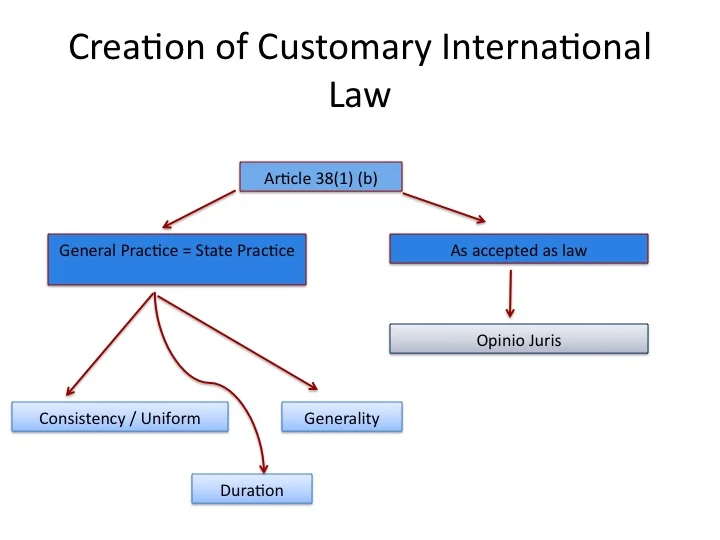
Source: ICJ Statute Article 38 Visualization
The International Law Commission has identified:
“customary international law as arising from general practice accepted as law.”
Unlike treaties, customary law binds all states except those that have persistently objected during its formation. Classic examples of customary international law include diplomatic immunity, the prohibition against genocide, and the principle of non-refoulement (not returning refugees to persecution).
According to research published by the Max Planck Encyclopedia of Public International Law, customary international law continues to evolve, with recent developments in areas like cyber warfare and environmental protection.
General Principles of Law
General principles of law recognized by civilized nations constitute the third primary source of international law. These include fundamental legal concepts found across different legal systems, such as good faith, equity, res judicata (finality of judgments), and the principle that no one should profit from their own wrongdoing.
General principles operate as gap-fillers where treaties and customs are silent. International courts rely on these principles to ensure coherence and fairness. The Permanent Court of International Justice and its successor, the ICJ, have regularly applied these principles when treaty law and custom provide insufficient guidance.
How International Law Differs from Domestic Law
International law and domestic (municipal) law operate in distinct legal spheres, differing in their sources, scope, enforcement mechanisms, and subjects. Understanding these differences is essential to grasp how law functions at both national and global levels.
Sovereignty and Consent
The fundamental difference between international and domestic law lies in sovereignty. Domestic law operates within a hierarchical system where a central government possesses authority to create and enforce laws over its territory and citizens, such as a parliament, legislature, or constitution, and applies automatically within the national territory.
International law derives its authority from the consent of states, expressed through treaties, customary practices, and general principles of law. There is no single global legislature that creates binding rules for all states.
As the European Journal of International Law explains, this consensual foundation means states cannot be bound by treaties they have not ratified, though they remain bound by customary international law and jus cogens norms (peremptory norms that permit no derogation).
Subjects of Law
The primary subjects of international law are states and international organizations. Over time, individuals have gained a more prominent role, particularly through international human rights law and international criminal law, where individuals can hold rights and, in some cases, bear direct legal responsibility.
Domestic law primarily governs individuals, corporations, and other entities within the state, and the state exercises direct authority over these subjects.
Scope and Application
International law regulates relations that extend beyond national borders. It addresses issues such as diplomacy, the use of force, international trade, environmental protection, and global human rights standards.
Domestic law applies within a state’s territorial boundaries and governs internal matters such as criminal justice, civil disputes, administrative regulation, and taxation.
Enforcement and Compliance
Enforcement is one of the most significant distinctions between international and domestic law. International law lacks a centralized enforcement mechanism. Compliance depends largely on voluntary adherence, diplomatic engagement, reciprocity, political pressure, and adjudication by international courts and tribunals.
Domestic law, by contrast, is enforced through established institutions such as police forces, courts, and regulatory agencies, backed by the coercive power of the state.
Legal Hierarchy and Sovereignty
In international law, states are legally equal under the principle of sovereign equality, and no state has authority over another. Obligations arise through consent rather than command.
Domestic legal systems operate within a clear hierarchical structure, where constitutions are supreme, followed by legislation, regulations, and judicial decisions, each with defined authority and precedence.
Relationship Between International and Domestic Law
The interaction between international and domestic law varies from state to state. Under a monist approach, international law becomes part of domestic law automatically once accepted.
Under a dualist approach, international rules must be incorporated through national legislation before they can take effect internally. This relationship plays a critical role in determining how international legal obligations are implemented and enforced at the national level.
Subjects of International Law
The subjects of international law are entities that possess international legal personality, meaning they have the capacity to hold rights, bear obligations, and, in some cases, bring claims under international law. While states remain the primary subjects, the scope of international legal personality has expanded over time.
States as Primary Actors
States are the original and principal subjects of international law. They possess full international legal personality, including the capacity to enter into treaties, establish diplomatic relations, claim rights, incur obligations, and be held responsible for internationally wrongful acts.
To be recognized as a state under international law, an entity must satisfy the criteria established by the Montevideo Convention on the Rights and Duties of States, in which Statehood is generally defined by criteria such as:
“a permanent population, defined territory, government, and the capacity to enter into relations with other states.”
International Organizations
International organizations like the United Nations, World Trade Organization, and World Health Organization possess international legal personality, enabling them to enter into treaties, own property, and bring legal claims.
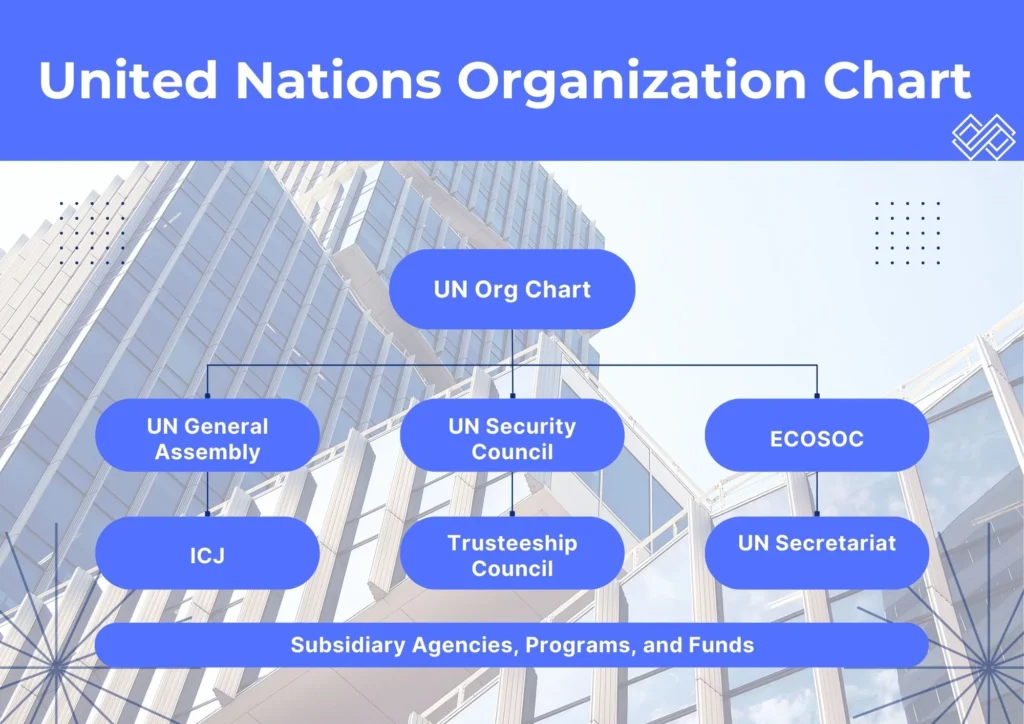
Source: UN System Chart
The UN Charter grants the United Nations broad powers to maintain international peace and security, develop friendly relations among nations, and promote human rights and social progress. Their legal personality is derived from their constituent treaties, which define their powers, rights, and responsibilities. Unlike states, their legal capacity is limited and functional in nature.
Individuals and Non-State Actors
Although individuals were traditionally not regarded as subjects of international law, modern international law increasingly recognizes individuals as holders of rights and obligations. The Universal Declaration of Human Rights (UDHR), adopted in 1948, and subsequent human rights treaties establish individual protections enforceable through international mechanisms.
The Rome Statute of the International Criminal Court criminalizes genocide, crimes against humanity, war crimes, and aggression, making individuals directly accountable under international law. Meanwhile, multinational corporations face increasing scrutiny under international law, particularly regarding human rights and environmental standards, as reflected in the UN Guiding Principles on Business and Human Rights.
International human rights law grants individuals enforceable rights, while international criminal law imposes direct responsibility for crimes such as genocide, war crimes, and crimes against humanity. Individuals may also access certain international complaint mechanisms and tribunals.
National Liberation Movements and Insurgent Groups
In specific contexts, national liberation movements and organized armed groups may acquire limited international legal personality. This recognition often arises in situations of armed conflict or self-determination, allowing such entities to be bound by certain international humanitarian law obligations and, in some cases, to participate in international agreements.
Corporations and Non-State Actors
Multinational corporations and other non-state actors do not generally possess full international legal personality. However, they increasingly play a role in the international legal system, particularly in areas such as international investment law, environmental law, and business and human rights. Certain treaties and mechanisms impose obligations or grant rights that affect corporate conduct at the international level.
Special Entities
Certain entities, such as the Holy See, the International Committee of the Red Cross, and, historically, belligerent communities, occupy a unique position in international law. They are recognized as having limited legal personality due to their special functions and roles within the international legal order.
Major Branches of International Law
International law is a broad and evolving legal system governing relations among states, international organizations, and, increasingly, individuals. Over time, it has developed several major branches, each addressing distinct areas of global interaction and regulation.
Public International Law
Public international law governs the relationships between states and international organizations. It covers fundamental principles such as state sovereignty, jurisdiction, diplomatic relations, treaty law, the law of the sea, and the peaceful settlement of disputes. It also regulates the use of force and collective security under frameworks such as the United Nations Charter.
International Human Rights Law
International human rights law focuses on the protection of fundamental rights and freedoms of individuals at the international level. This branch imposes obligations on states to respect, protect, and fulfill human rights without discrimination. The framework comprises nine core international human rights treaties overseen by the Office of the High Commissioner for Human Rights, including:
- International Covenant on Civil and Political Rights (ICCPR)
- International Covenant on Economic, Social and Cultural Rights (ICESCR)
- Convention on the Elimination of All Forms of Discrimination Against Women (CEDAW)
- Convention on the Rights of the Child (CRC)
Regional systems complement these universal mechanisms through the European Court of Human Rights, Inter-American Court of Human Rights, and African Court on Human and Peoples’ Rights.
International Humanitarian Law
International humanitarian law (IHL), also known as the laws of war, regulates armed conflict to protect civilians and combatants who are no longer participating in hostilities. The four Geneva Conventions of 1949 and their Additional Protocols form the core of IHL. The International Committee of the Red Cross serves as the guardian of IHL, monitoring compliance and providing humanitarian assistance.
International Criminal Law
International criminal law establishes individual criminal responsibility for serious international crimes, including genocide, crimes against humanity, war crimes, and the crime of aggression. It is enforced through international tribunals such as the International Criminal Court and ad hoc tribunals, as well as through national courts exercising universal or extraterritorial jurisdiction.
The International Criminal Court exercises jurisdiction over genocide, crimes against humanity, war crimes, and aggression. With 123 states parties as of 2025, the ICC has opened investigations in 17 situations and issued numerous arrest warrants for individuals accused of grave international crimes.
International Environmental Law
International environmental law addresses the protection of the environment at a global and regional level. It regulates issues such as climate change, biodiversity conservation, pollution control, and sustainable development through treaties like the UN Framework Convention on Climate Change, the Convention on Biological Diversity, and the Basel Convention on Hazardous Wastes.
The Paris Agreement represents the most comprehensive climate legal framework, requiring countries to limit global temperature increase to well below 2°C above pre-industrial levels. This branch reflects growing international concern over environmental degradation and shared natural resources.
International Economic and Trade Law
This branch governs international economic relations, including trade, investment, finance, and development. International trade law governs economic exchanges between nations, primarily through the World Trade Organization framework. It aims to promote stable and predictable economic relations between states.
The WTO administers agreements, including the General Agreement on Tariffs and Trade (GATT), General Agreement on Trade in Services (GATS), and Agreement on Trade-Related Aspects of Intellectual Property Rights (TRIPS). According to WTO statistics:
“Global merchandise trade reached $25.3 trillion in 2024, all governed by this comprehensive legal framework.”
Law of the Sea
The law of the sea regulates maritime rights and obligations, including territorial seas, exclusive economic zones, continental shelves, navigation rights, and marine resource exploitation. The United Nations Convention on the Law of the Sea serves as the primary legal instrument in this field.
International Refugee and Migration Law
International refugee law provides protection to individuals fleeing persecution, conflict, or violence, primarily through the 1951 Refugee Convention and its 1967 Protocol. International migration law addresses broader issues related to cross-border movement, including labor migration, border control, and the rights of migrants.
Comparative International Law Matrix (2026)
| Domain | Primary Legal Sources | Key Institutions | Enforcement Mechanisms | Current Challenges |
|---|---|---|---|---|
| Human Rights | ICCPR, ICESCR, CRC, CEDAW, Customary Law | UN Human Rights Council, Regional Courts | Treaty bodies, judicial rulings, reputational pressure | Digital rights, climate displacement, surveillance |
| Armed Conflict | Geneva Conventions, Customary IHL | ICRC, ICC, ICJ | Criminal prosecution, sanctions | Urban warfare, autonomous weapons |
| Trade | WTO Agreements (GATT, GATS, TRIPS) | WTO DSB | Retaliation, compliance panels | Trade paralysis, economic coercion |
| Environment | Paris Agreement, CBD, UNCLOS | UNFCCC, ITLOS | Reporting, litigation, sanctions | Climate liability, loss and damage |
| Criminal Law | Rome Statute | ICC | Arrest warrants, prosecutions | Jurisdiction gaps, political resistance |
| Digital & AI | Soft law, regional regulations | EU, OECD, UN bodies | Regulatory enforcement, fines | AI accountability, platform power |
| Cybersecurity | Customary norms, UN GGE reports | UN, regional bodies | Diplomatic pressure | Attribution, norm fragmentation |
| Space Law | Outer Space Treaty | UNOOSA | State responsibility | Commercialization, debris |
The Enforcement Challenge: Compliance and Sanctions
Enforcement and compliance are central challenges in international law because the system operates without a centralized global authority. Unlike domestic legal systems, international law relies on a combination of legal, political, and institutional mechanisms to ensure that states and other actors follow their international obligations.
Why States Comply
Despite lacking centralized enforcement, international law achieves remarkable compliance rates. Research by the American Journal of International Law indicates that states comply with international law over 90% of the time. Compliance stems from several factors:
- Reciprocity: States comply to ensure others reciprocate
- Reputation: Violation damages credibility in future negotiations
- Domestic politics: International commitments constrain government actions
- Internalization: States incorporate international norms into domestic law
- Cost-benefit analysis: Compliance often serves national interests
Sanctions and Countermeasures
When states violate international law, various enforcement mechanisms activate. The UN Security Council can impose mandatory sanctions under Chapter VII of the UN Charter, including arms embargoes, travel bans, and financial restrictions. According to the UN Security Council Sanctions Database, 14 sanctions regimes were active as of 2025.
Individual states may also take countermeasures, actions that would otherwise be illegal but are permitted in response to another state’s violation. The International Law Commission’s Articles on State Responsibility codifies the conditions and limits for such countermeasures.
International Courts and Tribunals
International judicial institutions provide authoritative interpretations and settle disputes. Key tribunals include:
- International Court of Justice (UN’s principal judicial organ)
- International Criminal Court (prosecuting individuals)
- International Tribunal for the Law of the Sea (maritime disputes)
- WTO Dispute Settlement Body (trade disputes)
- Permanent Court of Arbitration (flexible dispute resolution)
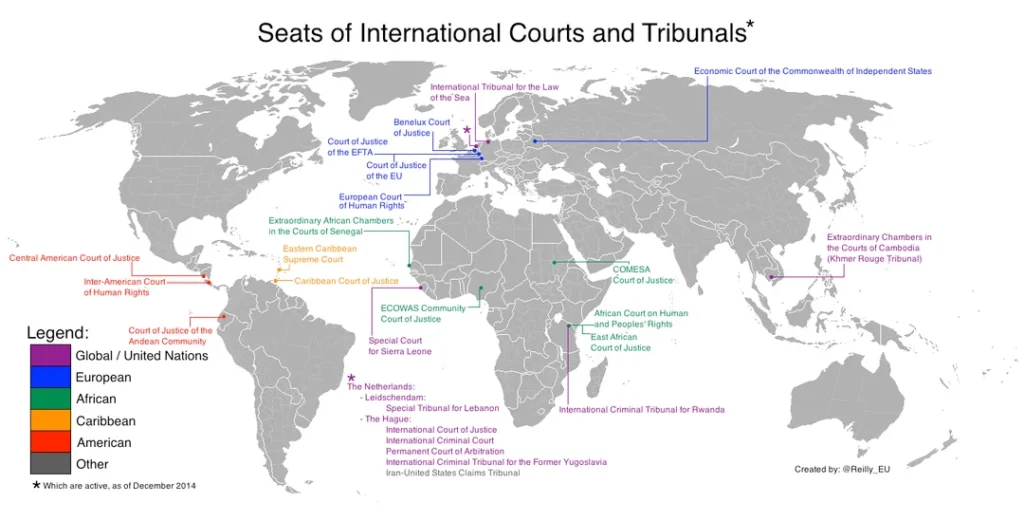
Source: Project on International Courts and Tribunals
Contemporary Challenges in International Law in 2026
International law in 2026 faces mounting pressure from rapid geopolitical change, technological disruption, and evolving global risks. While the legal framework continues to provide a basis for international cooperation, its effectiveness is increasingly tested by new and complex challenges.
Geopolitical Fragmentation and Great Power Rivalry
Rising strategic competition among major powers has weakened multilateral cooperation and strained respect for international legal norms. Selective compliance with international law, particularly in areas such as territorial integrity, use of force, and sanctions, has undermined the authority of international institutions. Geopolitical polarization has also made consensus within bodies like the United Nations Security Council more difficult, limiting collective enforcement.
Armed Conflicts and Erosion of Humanitarian Norms
Ongoing and emerging conflicts have intensified concerns over compliance with international humanitarian law. Attacks on civilians, use of prohibited or controversial weapons, and disregard for humanitarian access continue to challenge the enforcement of the Geneva Conventions. Accountability mechanisms face political resistance, limited jurisdiction, and difficulties in securing arrests and cooperation.
Human Rights Backsliding and Democratic Decline
In 2026, several states continue to adopt restrictive laws affecting freedom of expression, digital rights, minority protections, and civil society space. Emergency powers, national security laws, and surveillance technologies are often justified on security grounds but raise serious human rights concerns. Enforcement of international human rights obligations remains uneven, particularly where domestic courts lack independence.
Regulation of Artificial Intelligence and Emerging Technologies
Emerging technologies like artificial intelligence lack comprehensive international legal frameworks. The rapid deployment of artificial intelligence, autonomous weapons systems, and algorithmic governance has outpaced existing international legal frameworks. Questions around accountability, bias, transparency, and responsibility for AI-driven decisions remain unresolved.
Efforts to develop global norms on AI governance face fragmentation, with states adopting divergent regulatory approaches. Organizations, including the OECD and UNESCO, are developing AI principles and ethical guidelines, while the Council of Europe negotiates a framework convention on AI and human rights.
Climate Change and Environmental Accountability
Climate change continues to pose one of the most significant challenges to international law. Disputes over climate finance, loss and damage, state responsibility, and enforcement of environmental commitments persist. Small island states and developing countries increasingly turn to international courts and advisory opinions to clarify legal obligations, testing the adaptability of international environmental law.
Climate change presents existential challenges requiring unprecedented international legal cooperation. The Intergovernmental Panel on Climate Change reports that:
“limiting warming to 1.5°C requires global emissions to decline by 45% from 2010 levels by 2030, necessitating robust legal frameworks for implementation and enforcement.”
Cyber Operations and Hybrid Warfare
The digital revolution has created unprecedented challenges for international law. Cyberattacks, disinformation campaigns, and hybrid warfare tactics blur the line between peace and armed conflict. International law struggles to clearly define attribution, proportionality, and state responsibility in cyberspace.
The UN Group of Governmental Experts on Cybersecurity has worked to establish norms for responsible state behavior in cyberspace, while the Council of Europe’s Budapest Convention provides the most comprehensive treaty on cybercrime, with 68 parties. While normative efforts exist, binding legal rules remain limited, creating uncertainty and uneven compliance.
Migration, Refugees, and Border Control
Large-scale displacement driven by conflict, climate change, and economic instability continues to strain international refugee and migration regimes. States increasingly prioritize border security over protection obligations, challenging the effectiveness of the Refugee Convention and related human rights norms. Burden-sharing mechanisms remain politically contentious.
Weak Enforcement and Selective Compliance
A persistent challenge in 2026 is the gap between legal obligations and enforcement. International courts and monitoring bodies often lack coercive power, relying on state cooperation that is not always forthcoming. Selective compliance weakens legal predictability and risks normalizing violations of international law.
Sovereignty vs. Global Governance
Tension between state sovereignty and global governance needs intensifies as transnational challenges multiply. The Responsibility to Protect (R2P) doctrine exemplifies this tension, asserting that sovereignty entails responsibility to protect populations from mass atrocities, and when states fail, the international community must intervene.
The Role of International Law in Daily Life
International law impacts individuals and businesses more than commonly recognized, shaping everyday life beyond formal diplomacy. International agreements govern:
- Air travel: Chicago Convention regulates international aviation
- Postal services: Universal Postal Union enables international mail
- Telecommunications: International Telecommunication Union coordinates global telecom
- Maritime shipping: UNCLOS governs ocean activities
- Intellectual property: WIPO treaties protect patents, trademarks, and copyrights across borders
- Consumer products: International standards ensure product safety and compatibility
Former US Supreme Court Justice Anthony Kennedy is of the view that:
“International law is part of the law of the land. We have to comply with it and apply it.”
Conclusion
International law in 2026 faces unprecedented strain but unprecedented necessity. In a world of interconnected risks, it remains the most viable framework for managing coexistence, preventing disorder, and advancing collective survival. Its effectiveness depends not on perfection, but on continued commitment, adaptation, and institutional reinforcement.
The rules-based international order faces challenges from great power competition, rising nationalism, and urgent global threats requiring collective action. Yet international law has demonstrated remarkable resilience and adaptability since the establishment of the modern system after World War II.
The expansion of international law from purely state-centric concerns to encompass human rights, environmental protection, criminal accountability, and economic governance reflects humanity’s growing recognition of shared interests transcending borders. As global interconnectedness deepens through trade, technology, and climate interdependence, effective international legal frameworks become not merely aspirational but essential for peace, prosperity, and survival.
Success requires strengthening existing institutions, ensuring equitable participation of all nations in legal development, addressing emerging challenges through innovative legal mechanisms, and maintaining political will for multilateral cooperation. The alternative—a return to pure power politics unrestrained by law, risks catastrophic consequences in an age of nuclear weapons, climate change, and pandemic threats.
Frequently Asked Questions
Is international law really “law” if there’s no world government to enforce it?
Yes, international law is genuine law despite lacking centralized enforcement. Law doesn’t require a sovereign enforcer, it requires a system of rules that actors recognize as binding and generally comply with. States comply with international law over 90% of the time due to reciprocity, reputation concerns, and self-interest. Enforcement occurs through diplomatic pressure, sanctions, international courts, and collective action, proving effective despite being decentralized.
Can international law override a country’s domestic laws?
This depends on the country’s constitutional system. Some states (monist systems) automatically incorporate international law into domestic law, while others (dualist systems) require legislative action to implement international obligations domestically. Under international law itself, the Vienna Convention on the Law of Treaties states that countries cannot invoke domestic law to justify violating international obligations, but enforcement of this principle varies.
What happens when powerful countries violate international law?
Powerful countries face fewer immediate consequences for violations due to their political and economic influence, creating a persistent challenge for the international legal system. However, even major powers face costs including diplomatic isolation, economic sanctions, reputational damage, and reduced influence in international institutions. The long-term legitimacy of the international system depends on holding all states, regardless of power, accountable to shared rules.
What is the difference between public and private international law?
Public international law governs relations between states and international organizations, addressing issues like treaties, diplomacy, armed conflict, and human rights. Private international law (also called conflict of laws) determines which country’s domestic law applies in private disputes with international elements, such as cross-border contracts, divorces, or inheritance matters. Both fields address international dimensions but involve different actors, rules, and mechanisms.
Why do powerful states face fewer consequences?
Power affects enforcement, not legality. Long-term reputational, economic, and strategic costs still apply.
Is international law weakening?
It is evolving. While politically contested, its scope and relevance continue to expand.