
The United States is entering a historic constitutional battle over birthright citizenship, as the U.S. Supreme Court prepares to hear a high-stakes case that places the scope of the Fourteenth Amendment to the United States Constitution under renewed scrutiny. The outcome could reshape long-standing interpretations of citizenship rights, challenging President Donald Trump’s efforts to restrict automatic citizenship for children born on American soil, carrying far-reaching implications for U.S. immigration law and constitutional doctrine.
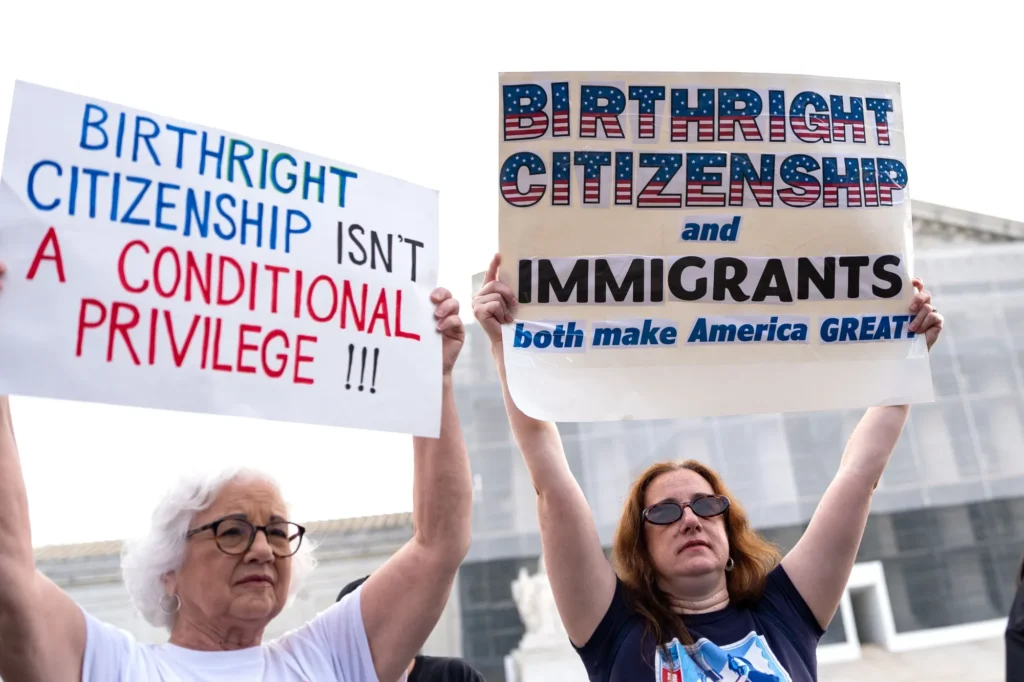
The U.S. is one of the few countries with broad “jus soli” (right of soil) citizenship. The U.S. birthright citizenship debate in 2026 represents one of the most consequential legal battles in modern constitutional history, as this single Supreme Court ruling could reshape immigration law, redefine citizenship, and impact millions of lives for generations.
Trump Policy Sparks Constitutional Crisis
At the center of the controversy is a 2025 executive order issued by President Donald Trump, which seeks to deny citizenship to children born in the U.S. to parents who are undocumented or hold only temporary immigration status.
The policy directly challenges the 14th Amendment, which has long guaranteed citizenship to:
“all persons born… in the United States and subject to the jurisdiction thereof.”
The administration argues that children of undocumented immigrants are not fully “subject to U.S. jurisdiction”, and therefore should not automatically receive citizenship.
Supreme Court to Decide Historic Case
The legal dispute has now reached the U.S. Supreme Court, which is set to determine whether a president can reinterpret or limit birthright citizenship without a constitutional amendment.
Lower federal courts have consistently blocked the policy, with judges ruling that it likely violates the Constitution and long-standing precedent. Legal experts note that the case could redefine:
- The scope of the 14th Amendment
- The limits of presidential executive power
- The future of U.S. immigration law
A decision is expected later in 2026 and could affect millions of families and future births in the United States.
Legal Precedent Under Threat
The case revisits the landmark 1898 Supreme Court ruling in United States v. Wong Kim Ark, which affirmed that children born in the U.S. to immigrant parents are citizens. Critics argue that overturning or narrowing this precedent would:
- Create a new class of stateless or undocumented individuals
- Undermine over a century of constitutional interpretation
- Disrupt the legal foundation of American citizenship
Supporters of the policy, however, claim the original intent of the 14th Amendment was narrower and should not extend to all modern immigration contexts.
Human Impact and National Debate
The legal battle is already having real-world consequences. Families across the U.S. fear uncertainty over their children’s citizenship status, with some warning of potential statelessness and loss of legal rights.
Civil rights groups argue that ending birthright citizenship could fundamentally reshape American society by creating a permanent underclass of U.S.-born individuals without citizenship protections. The case has evolved into a broader debate over:
- Executive authority vs. constitutional limits
- Immigration control vs. civil rights protections
- The role of courts in safeguarding constitutional guarantees
Legal scholars widely emphasize that changing birthright citizenship would typically require a constitutional amendment, not an executive order.
Why the Birthright Citizenship Case Matters
The decision by the Supreme Court of the United States to take up a birthright citizenship challenge places one of the most settled principles of U.S. constitutional law under direct review. At issue is the interpretation of the Fourteenth Amendment to the United States Constitution, which guarantees citizenship to “all persons born or naturalized in the United States.”
Reinterpreting a Constitutional Foundation
For over a century, the Citizenship Clause has been understood to grant automatic citizenship to nearly anyone born on U.S. soil. A ruling that narrows this interpretation would mark a major shift in constitutional doctrine, potentially redefining who qualifies as a citizen at birth. Such a move would not only affect future cases but could also invite broader challenges to established constitutional protections.
Direct Impact on U.S. Immigration Policy
Birthright citizenship sits at the center of U.S. immigration law. If the Court limits its scope, it could:
- Increase the number of non-citizen residents born in the U.S.
- Complicate immigration enforcement and residency rights
- Shift policy debates toward legislative reforms or stricter citizenship criteria
This would fundamentally alter how immigration status is determined and managed across federal and state systems.
Expansion of Judicial Power in Policy Questions
The case underscores the growing role of the Supreme Court in shaping politically sensitive policy areas. By addressing birthright citizenship, the Court is not just interpreting law—it is influencing national policy traditionally debated by Congress. This raises important questions about judicial reach and the balance of powers.
Precedent with Global Implications
The United States has long been one of the strongest proponents of jus soli (citizenship by birth). A departure from this principle could influence global norms, particularly in countries already reconsidering immigration and nationality laws. The ruling may therefore resonate far beyond U.S. borders.
Legal Uncertainty and Administrative Challenges
Any significant change would create immediate legal and administrative complexities:
- Questions over the status of children born to non-citizen parents
- Increased litigation over citizenship claims
- Pressure on federal agencies to reinterpret existing policies
This uncertainty could persist for years as courts and policymakers adjust to the new legal framework.
Conclusion
The Supreme Court’s review of birthright citizenship is more than a legal dispute, as it is a defining moment for constitutional interpretation, immigration policy, and the future scope of citizenship in the United States. At stake is not only immigration policy, but the definition of American citizenship itself, a principle embedded in the Constitution for more than 150 years. The outcome will likely shape not only legal doctrine but also the broader political and social landscape for decades to come.