
A dramatic confrontation erupted inside the U.S. Capitol when U.S. Senator Tim Sheehy assisted police in forcibly removing an anti-war protester from a Senate hearing, an incident that has triggered widespread legal and political scrutiny over the use of force inside Congress.
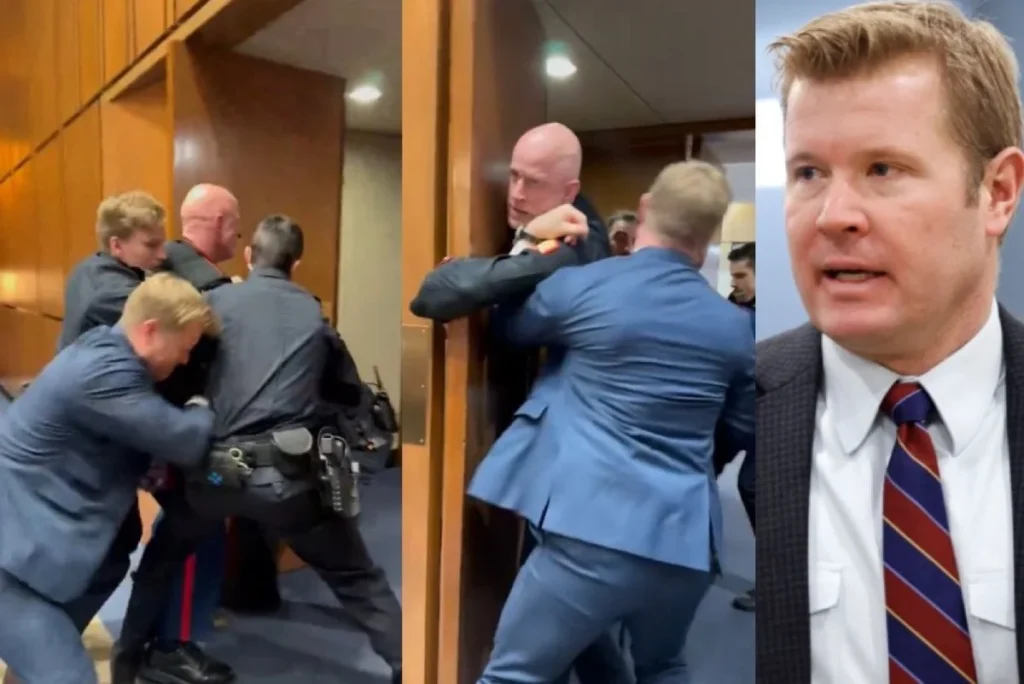
The altercation occurred during a Senate Armed Services subcommittee hearing on U.S. military readiness and the escalating Iran conflict, when a protester disrupted proceedings with loud objections to U.S. involvement in the war.
Disruption During Senate Armed Services Hearing
The protester, identified as Brian McGinnis, a Marine veteran and Green Party candidate for the U.S. Senate in North Carolina, stood up during the hearing and shouted:
“anti-war slogans, including opposition to the United States fighting for Israel.”
Capitol Police officers quickly moved to remove him from the chamber, as protests are prohibited during congressional proceedings. When McGinnis resisted arrest and clung to a doorway, the situation escalated into a physical struggle.
Video footage from the hearing shows Senator Sheehy leaving the dais and assisting officers in lifting and pulling the protester from the room, eventually forcing him through the doorway and out of the chamber.
Injury Claims and Chaotic Scenes
During the struggle, McGinnis’ hand reportedly became stuck in the door frame while officers and the senator attempted to pull him free. Witnesses reported hearing a loud “snap,” after which the protester claimed his arm had been broken.
The confrontation left McGinnis and three Capitol Police officers injured, according to official statements. Authorities later escorted McGinnis out of the building and transported him to a hospital for treatment.
Criminal Charges Filed Against Protester
Following the incident, U.S. Capitol Police charged McGinnis with multiple offenses, including:
- Three counts of assaulting a police officer
- Three counts of resisting arrest
- Unlawful demonstration inside the Capitol complex
Police said:
“The protester violently resisted removal, putting officers and others in the room at risk.”
Senator Sheehy Defends His Actions
Senator Sheehy, a former Navy SEAL, defended his decision to intervene, saying he was trying to support law enforcement and de-escalate the situation.
He stated that:
“The protester came to the Capitol looking for a confrontation, and he got one.”
Senator Sheehy emphasized that McGinnis was actively fighting officers attempting to remove him. Critics, however, questioned whether a sitting senator should physically engage with a civilian during a hearing.
Legal and Constitutional Questions Raised
The incident has sparked debate among legal analysts about the limits of protest, congressional security authority, and the use of force inside legislative buildings.
Key legal issues include:
First Amendment vs. Congressional Rules – While citizens have the right to protest, demonstrations inside congressional hearing rooms are prohibited under Capitol security rules.
Authority of Lawmakers – Although Capitol Police are responsible for maintaining order, it is unusual for a sitting senator to physically intervene in removing a protester.
Potential Civil Liability – If the protester pursues legal action over injuries, courts may examine whether excessive force was used during the removal.
Political Context: Protests Over the Iran War
The confrontation occurred amid rising tensions over U.S. military operations in Iran and increasing protests across the United States against the war. The Senate hearing itself focused on defense policy and military readiness related to the growing Middle East conflict.
The clash between Senator Tim Sheehy and anti-war protester Brian McGinnis inside a Senate hearing has become a flashpoint in the broader national debate over the Iran war, protest rights, and the limits of force in government institutions.
Investigations and potential legal challenges could determine whether the incident remains a political controversy or evolves into a broader constitutional dispute.