
Economic sanctions and global trade represent two interconnected forces shaping the modern international economy. While global trade facilitates economic growth and interdependence, sanctions serve as powerful policy instruments through which nations pursue foreign policy objectives without military force. Tariffs, on the other hand, occupy a legally distinct but strategically connected space between traditional trade regulation and economic sanctions. While tariffs are formally trade policy instruments governed by domestic and international trade law, in modern geopolitics, they increasingly function as tools of economic coercion similar to sanctions.
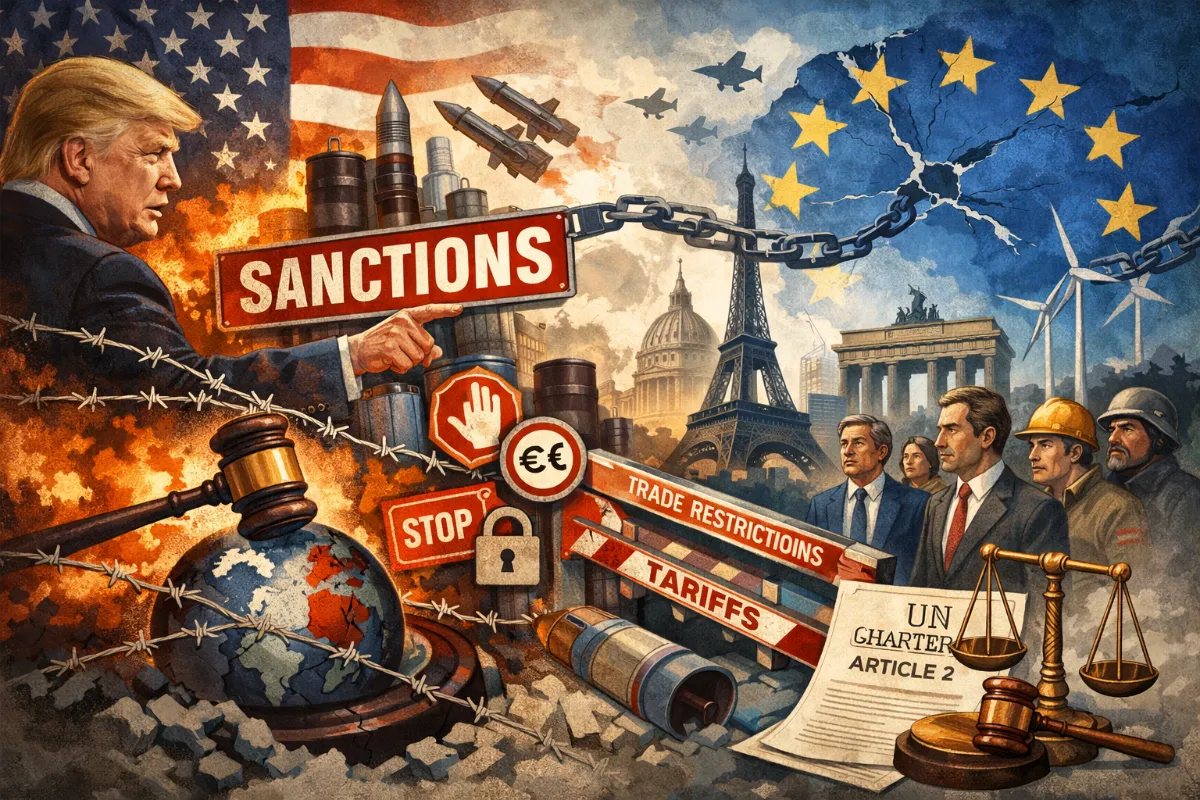
As geopolitical tensions intensify and economic warfare becomes increasingly sophisticated in 2026, understanding sanctions and tariffs mechanisms, trade dynamics, and their far-reaching consequences has become essential for businesses, policymakers, investors, and engaged citizens worldwide. This comprehensive guide explores the nature of sanctions, their impact on global commerce, enforcement mechanisms, and the evolving landscape of economic statecraft.
Understanding Economic Sanctions: Definition and Purpose
Economic sanctions are deliberate, government-imposed commercial and financial penalties applied by one or more countries against a targeted country, group, or individual. They are primarily used to achieve national security and foreign policy objectives. Modern sanctions regimes are built on domestic legislation, executive powers, and multilateral legal instruments such as UN Security Council resolutions.
The U.S. Department of the Treasury defines sanctions as:
“economic and trade restrictions designed to promote national security and foreign policy objectives.”
Sanctions serve multiple strategic purposes. They function as tools of coercion by compelling policy change, as mechanisms of constraint by limiting access to technology and finance, and as instruments of signaling and punishment to enforce international norms. Increasingly, sanctions are also used to reinforce global standards relating to human rights, nuclear non-proliferation, and cyber governance.
According to the Peterson Institute for International Economics:
- Coercion: Compelling target countries to change policies or behaviors
- Constraint: Limiting a target’s ability to develop threatening capabilities
- Signaling: Demonstrating resolve and commitment to allies and adversaries
- Punishment: Imposing costs for violations of international norms
- Norm reinforcement: Upholding international legal standards and values
The institutional backbone of sanctions enforcement lies in agencies such as the U.S. Office of Foreign Assets Control (OFAC), the European External Action Service (EEAS), and UN sanctions committees. These bodies maintain designated lists of individuals and entities whose assets may be frozen or whose commercial access is restricted. By 2026, thousands of individuals, companies, and vessels remain subject to such designations across multiple jurisdictions.
The Office of Foreign Assets Control (OFAC), established in 1950, administers and enforces U.S. economic sanctions programs, currently maintaining over 30 active sanctions regimes. According to OFAC data, over 9,000 individuals, entities, vessels, and aircraft are currently designated on the Specially Designated Nationals (SDN) List.
Former U.S. Treasury Secretary Jacob Lew is of the view that:
“Sanctions have become the tool of choice for policymakers seeking to respond to international crises without resorting to military force.”
Types of Economic Sanctions
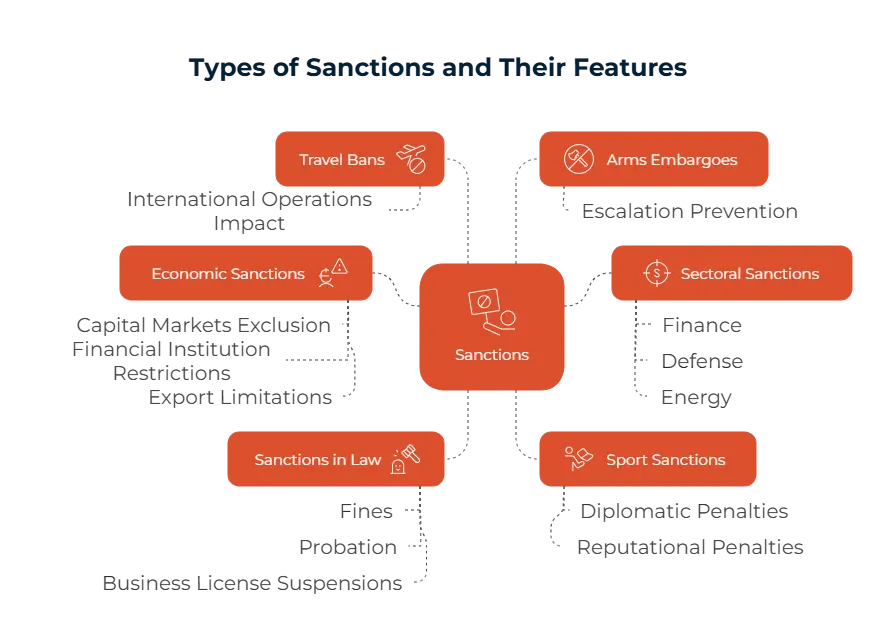
Sanctions regimes have evolved from broad embargoes to more targeted measures designed to minimize humanitarian harm while maximizing political pressure.
Comprehensive Sanctions
Comprehensive sanctions prohibit virtually all trade and financial transactions with a target country. Historically applied to countries like Cuba, Iran, and North Korea, comprehensive sanctions represent the most severe form of economic pressure. The Congressional Research Service suggest that:
“comprehensive sanctions have become less common due to humanitarian concerns and limited effectiveness, with targeted sanctions now preferred.”
Current comprehensive sanctions programs include:
- North Korea: UNSCR sanctions prohibiting arms, luxury goods, and limiting trade
- Cuba: U.S. embargo maintained since 1962 under the Trading with the Enemy Act
- Syria: EU and U.S. sanctions targeting the Assad regime
Targeted (Smart) Sanctions
Targeted sanctions focus on specific individuals, entities, or sectors to minimize humanitarian impact while maximizing pressure on decision-makers. The United Nations Security Council pioneered targeted sanctions in the 1990s to address concerns about civilian suffering under comprehensive embargoes.
Common targeted sanction types include:
Asset Freezes: Blocking access to financial assets and property under sanctioning jurisdiction. The European Union sanctions database lists thousands of individuals and entities subject to EU asset freezes.
Travel Bans: Prohibiting entry into sanctioning countries. The UN Travel Ban List includes individuals associated with terrorism, conflict, and human rights abuses.
Sectoral Sanctions: Restricting specific economic sectors (energy, finance, defense) while allowing other commerce. U.S. sectoral sanctions against Russia target financial institutions, energy companies, and defense entities.
Arms Embargoes
Arms embargoes prohibit weapons sales and military equipment transfers to targeted countries or groups. The Stockholm International Peace Research Institute (SIPRI) maintains a database of multilateral arms embargoes, documenting 31 active UN arms embargoes as of 2026.
Financial Sanctions
Financial sanctions restrict access to international financial systems, particularly the dollar-denominated global economy. Measures include:
- Prohibition on U.S. dollar transactions
- Exclusion from SWIFT payment system
- Restrictions on correspondent banking relationships
- Limits on sovereign debt transactions
- Blocking access to international capital markets
The Bank for International Settlements estimates that dollar-denominated transactions account for approximately 88% of global foreign exchange trades, making U.S. financial sanctions particularly powerful.
Major Sanctions Regimes in 2026
Russia Sanctions: Unprecedented Scope and Coordination
Following Russia’s 2022 invasion of Ukraine, the United States, the European Union, the United Kingdom, Japan, Canada, and allies implemented the most comprehensive sanctions ever imposed on a major economy. According to Castellum.AI’s Russia Sanctions Dashboard:
“over 13,000 Russian individuals and entities face sanctions as of 2026.”
Key measures include:
- Asset freezes on Russian Central Bank reserves (approximately $300 billion frozen)
- Export controls on advanced technology and dual-use goods
- Oil price cap mechanism limiting Russian petroleum revenues
- SWIFT exclusion for major Russian banks
- Luxury goods and services prohibitions
- Restrictions on Russian energy imports (phased implementation in EU)
The Atlantic Council’s Russia Tracker monitors implementation and impact, noting Russia’s GDP contracted 2.1% in 2022 but showed resilience through 2024 via sanctions evasion and trade reorientation toward China, India, and Turkey.
Iran Sanctions: Maximum Pressure Campaign
U.S. sanctions on Iran, particularly those reimposed after withdrawing from the Joint Comprehensive Plan of Action (JCPOA), targets Iran’s oil exports, banking sector, and nuclear program. The U.S.-Iran sanctions regime includes:
- Secondary sanctions penalizing third parties conducting business with Iran
- Designation of Iran’s Revolutionary Guard Corps as a terrorist organization
- Restrictions on oil exports (reduced from 2.5 million barrels/day in 2018 to under 1 million by 2023)
- Banking sector isolation limiting international transactions
The International Crisis Group reports that:
“sanctions contributed to 40% inflation in Iran by 2023, though the regime has adapted through sanctions evasion networks and regional proxy relationships.”
North Korea Sanctions: Countering Nuclear Proliferation
North Korea faces some of the world’s most stringent sanctions due to its nuclear weapons program. UN Security Council resolutions prohibit:
- Arms and luxury goods exports to North Korea
- North Korean coal, textiles, and seafood exports
- Joint ventures with North Korean entities
- Supply of refined petroleum products beyond capped amounts
- Financial transactions supporting prohibited activities
Despite comprehensive sanctions, North Korea has developed sophisticated evasion techniques including ship-to-ship transfers, cryptocurrency theft, and cyber operations. The Center for Strategic and International Studies (CSIS) Beyond Parallel program tracks sanctions implementation and North Korean circumvention efforts.
China-Related Sanctions: Technology and Human Rights
U.S. sanctions targeting China focus on technology transfer, human rights violations in Xinjiang, and entities supporting China’s military modernization. The Entity List administered by the Bureau of Industry and Security includes hundreds of Chinese companies restricted from receiving U.S. technology.
Key programs include:
- Export controls on semiconductor manufacturing equipment
- Sanctions on officials responsible for human rights abuses under the Global Magnitsky Act
- Restrictions on Chinese telecommunications companies
- Investment prohibitions in companies supporting China’s military-industrial complex
Export controls on advanced semiconductor technologies and restrictions on telecommunications firms demonstrate how sanctions now operate as tools of technological competition and strategic containment rather than solely traditional foreign policy pressure.
Global Trade: The Foundation of Economic Interdependence
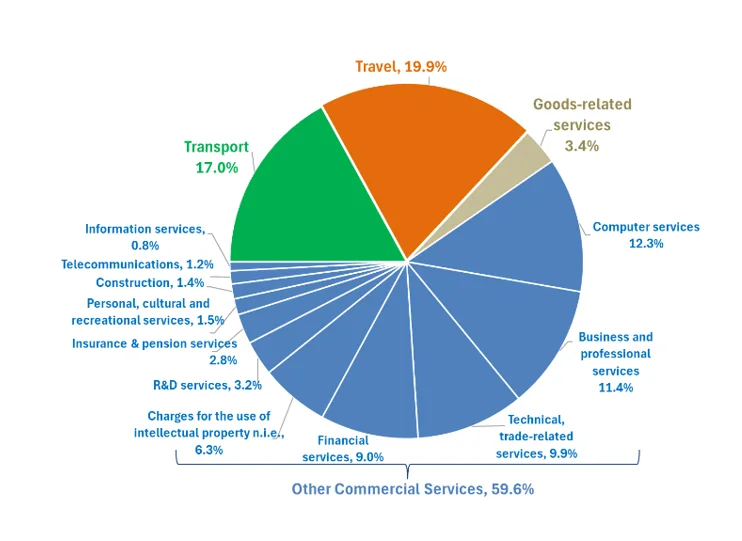
Global trade, the exchange of goods and services across international borders, forms the backbone of the modern world economy. The World Trade Organization (WTO) reports that global merchandise trade reached $25.3 trillion in 2024, with services trade contributing an additional $7.5 trillion.
Benefits of International Trade
International trade generates substantial economic benefits according to the International Monetary Fund (IMF):
- Economic growth: Trade expansion contributes 1-2% annually to global GDP growth
- Consumer welfare: Access to diverse, affordable products improves living standards
- Efficiency: Comparative advantage allows countries to specialize in production
- Innovation: Competition and knowledge transfer drive technological advancement
- Development: Trade integration lifts countries from poverty (China, Vietnam examples)
The Peterson Institute for International Economics estimates that:
“trade liberalization since 1945 has increased U.S. GDP by approximately $2.1 trillion annually, equivalent to $18,000 per household.”
Source:WTO Trade Statistics Database
Key International Trade Agreements
World Trade Organization: The WTO, established in 1995, provides the multilateral framework governing international trade through agreements including GATT (goods), GATS (services), and TRIPS (intellectual property). With 164 member countries representing 98% of global trade, the WTO facilitates negotiations and resolves disputes through its Dispute Settlement Body.
Regional Trade Agreements: The WTO Regional Trade Agreements Database documents 355 active regional trade agreements as of 2025, including:
- USMCA (United States-Mexico-Canada Agreement)
- European Union Single Market
- RCEP (Regional Comprehensive Economic Partnership) covering 15 Asia-Pacific countries
- AfCFTA (African Continental Free Trade Area) creating a single African market
- CPTPP (Comprehensive and Progressive Trans-Pacific Partnership)
Frédéric Bastiat, French economist is of the view that:
“When goods don’t cross borders, soldiers will.”
Tariffs as Trade Law Instruments
Tariffs are taxes imposed on imported goods and are traditionally justified under domestic trade statutes and World Trade Organization (WTO) rules. In the United States, tariffs are imposed through statutory authorities such as:
- Section 301 of the Trade Act of 1974 (unfair trade practices)
- Section 232 of the Trade Expansion Act of 1962 (national security)
- International Emergency Economic Powers Act (IEEPA) in emergency contexts
- Presidential trade powers and executive orders
Under WTO law, tariffs are generally permitted but must comply with bound tariff rates and non-discrimination principles. However, national security exceptions and unilateral trade remedies provide legal flexibility, allowing tariffs to be used for geopolitical objectives.
Tariffs as De Facto Economic Sanctions
Although legally distinct from sanctions, tariffs often operate as de facto sanctions when imposed to compel policy change or punish geopolitical behavior. The key difference lies in legal framing:
- Sanctions: Usually imposed under national security or foreign policy emergency powers, often targeting specific entities or sectors.
- Tariffs: Imposed as trade measures but increasingly used to exert political pressure.
When tariffs are imposed to influence foreign policy—such as pressuring allies over defense spending, technology transfers, or geopolitical alignment, they function as economic coercive tools similar to sanctions.
Strategic Functions of Tariffs in Economic Statecraft
Modern U.S. tariff policy serves several strategic purposes within the broader sanctions–trade framework.
First, tariffs function as coercive leverage. By threatening or imposing tariffs on key exports, the U.S. can pressure states to alter trade relationships, technology cooperation, or security policies without invoking formal sanctions regimes.
Second, tariffs serve as signaling mechanisms. Announcing tariffs communicates geopolitical dissatisfaction or strategic red lines while avoiding the legal escalation associated with formal sanctions.
Third, tariffs act as supply-chain control tools. Tariffs targeting strategic industries—such as semiconductors, electric vehicles, or critical minerals—aim to reshape global production networks and reduce dependency on geopolitical competitors.
Fourth, tariffs operate as alternatives to sanctions where formal sanctions may be diplomatically or legally difficult. Tariffs allow economic pressure without triggering the full legal and diplomatic consequences of sanctions regimes.
Legal Overlap Between Tariffs and Sanctions
The boundary between tariffs and sanctions is increasingly blurred. In many cases, tariffs complement or reinforce sanctions frameworks. For example:
- Tariffs may precede sanctions as warning measures.
- Tariffs may accompany export controls and investment restrictions.
- Tariffs may target allies rather than adversaries, reflecting trade imbalance or strategic concerns.
- Tariffs can be imposed under national security justifications similar to sanctions.
From a legal perspective, tariffs are easier to impose because they rely on domestic trade statutes rather than emergency powers or UN authorization. However, when used coercively, they may raise questions under WTO law, particularly regarding discrimination and misuse of national security exceptions.
Tariffs, WTO Law, and International Legal Controversy
The use of tariffs as geopolitical tools has generated significant legal debate. WTO rules generally prohibit discriminatory tariffs and require adherence to agreed tariff ceilings. However, states increasingly invoke national security exceptions under Article XXI of the General Agreement on Tariffs and Trade (GATT) to justify unilateral measures.
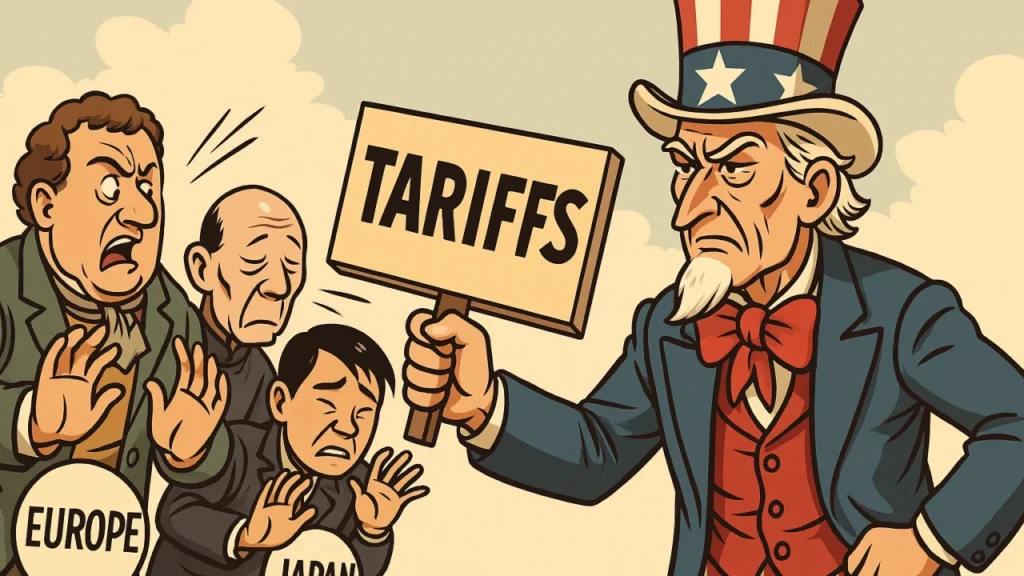
The expanded use of tariffs for geopolitical purposes risks undermining the multilateral trading system. If tariffs are widely used as coercive instruments, the distinction between trade regulation and sanctions becomes largely symbolic, potentially weakening WTO dispute settlement mechanisms and encouraging retaliatory trade measures.
Tariffs in the 2026 Economic Statecraft Framework
By 2026, tariffs are best understood as part of a continuum of economic statecraft tools that includes:
- Trade restrictions and export controls
- Investment screening regimes
- Financial sanctions
- Technology restrictions
- Full economic embargoes
Within this continuum, tariffs represent the most flexible and politically deployable instrument. They allow governments to apply pressure without formally invoking sanctions law while still producing significant economic impact.
The Intersection: How Sanctions Affect Global Trade
Sanctions fundamentally disrupt normal trade patterns, creating winners and losers while reshaping commercial relationships. The International Monetary Fund estimates that sanctions imposed since 2022 affect countries representing approximately 40% of global GDP.
Direct Trade Disruption
Sanctions directly prohibit trade in specific goods, services, or with designated entities. According to UN Conference on Trade and Development (UNCTAD), Russia sanctions disrupted approximately $400 billion in annual bilateral trade between Russia and sanctioning countries.
Commodity Markets: Russia and Ukraine accounted for 30% of global wheat exports and 80% of sunflower oil exports before the war. Food and Agriculture Organization (FAO) data shows grain prices spiked 40% in 2022, impacting food security in developing countries.
Energy Markets: Russian energy sanctions reshaped global oil and gas flows. The International Energy Agency (IEA) reports European natural gas imports from Russia fell from 155 bcm in 2021 to 80 bcm in 2023, replaced by Norwegian pipeline gas and LNG from Qatar, U.S., and other sources.
Financial System Fragmentation
Financial sanctions accelerate trends toward payment system diversification and de-dollarization. The Bank for International Settlements notes:
- Increased bilateral currency arrangements bypassing dollar settlement
- Development of alternative payment systems (CIPS in China, SPFS in Russia)
- Rising gold purchases by central banks seeking sanctions-proof reserves
- Cryptocurrency adoption for sanctions evasion (though limited in scale)
Supply Chain Reorientation
Sanctions drive supply chain restructuring as companies de-risk exposure to sanctioned jurisdictions. The McKinsey Global Institute identifies “friend-shoring” and “near-shoring” trends where companies relocate production to politically aligned or geographically proximate countries.
Technology Sector: U.S. semiconductor export controls require companies to restructure supply chains excluding Chinese manufacturers from advanced chip production. The Semiconductor Industry Association estimates this affects $15 billion in annual equipment sales.
Third-Party Effects and Sanctions Evasion
Sanctions create opportunities for third countries to serve as intermediaries or substitute suppliers. The Carnegie Endowment for International Peace documents sanctions evasion through:
- Transshipment through neutral jurisdictions
- Corporate restructuring to obscure ownership
- Use of shell companies and offshore financial centers
- Trade with non-sanctioning countries (China, India, Turkey for Russia)
- Maritime deception (turning off transponders, ship-to-ship transfers)
Sanctions Compliance and Enforcement
Corporate Compliance Requirements
Companies operating internationally face complex sanctions compliance obligations. The Association of Certified Financial Crime Specialists identifies key compliance elements:
- Screening: Checking customers, vendors, and transactions against sanctions lists
- Due diligence: Investigating business partners and beneficial ownership
- Training: Educating employees on sanctions requirements
- Monitoring: Ongoing transaction surveillance for red flags
- Reporting: Filing suspicious activity reports with regulators
- Auditing: Regular compliance program assessments
Violations carry severe penalties. OFAC has assessed over $8 billion in civil penalties since 2008, with individual violations reaching hundreds of millions. The U.S. Department of Justice pursues criminal prosecutions for willful sanctions violations.
Enforcement Mechanisms
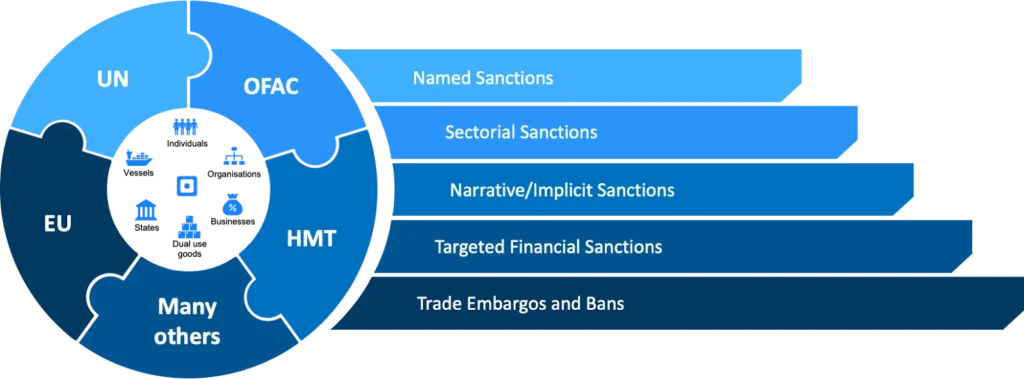
Sanctions enforcement operates through multiple channels:
Financial System Controls: Banks screen transactions against OFAC’s SDN List and other sanctions lists, blocking or rejecting prohibited payments. The Wolfsberg Group provides industry guidance on sanctions compliance.
Export Controls: The Bureau of Industry and Security enforces export controls through licensing requirements, end-use monitoring, and violations investigations.
Customs Enforcement: U.S. Customs and Border Protection intercepts prohibited imports and enforces trade sanctions at ports of entry.
International Cooperation: The Financial Action Task Force (FATF) coordinates international standards for sanctions implementation and countering sanctions evasion.
Source: ACAMS Sanctions Compliance Guidelines
Effectiveness and Limitations of Sanctions
Measuring Sanctions Success
Assessing sanctions effectiveness remains contentious. The Peterson Institute database analyzing 200+ sanctions episodes since 1914 finds only 34% achieved their objectives. Factors affecting success include:
- Target vulnerability: Economic dependence on sanctioning countries
- Multilateral coordination: Broad participation prevents evasion
- Duration: Longer sanctions face diminishing effectiveness
- Regime type: Authoritarian regimes more resilient than democracies
- Objective clarity: Specific, achievable goals versus vague aspirations
Unintended Consequences
Sanctions generate various unintended effects documented by the International Crisis Group:
- Humanitarian impact: Civilians suffer more than ruling elites
- Rally-around-the-flag effect: Nationalism strengthens targeted regimes
- Economic adaptation: Black markets and smuggling networks emerge
- Collateral damage: Third-party businesses and countries harmed
- Strategic reorientation: Targets develop alternative partnerships (Russia-China deepening)
Conclusion
Sanctions and global trade represent complementary aspects of economic interdependence; trade creates connections that sanctions can leverage or sever. Legally grounded in trade law but strategically deployed for geopolitical objectives, tariffs have become central to modern economic statecraft. As geopolitical competition intensifies in 2026, economic statecraft increasingly supplements or substitutes for military force in pursuing national interests.
The effectiveness of future sanctions depends on maintaining multilateral coordination, developing sophisticated evasion countermeasures, minimizing humanitarian harm, and integrating economic pressure with diplomatic and strategic initiatives. Meanwhile, global trade faces pressures from sanctions fragmentation, supply chain security concerns, and technology competition, potentially reversing decades of liberalization.
As global economic competition intensifies, tariffs are likely to remain a preferred tool for exerting pressure on both adversaries and allies. Their increasing use for strategic purposes signals a transformation in international economic law, where the boundary between trade policy and sanctions policy continues to blur, reshaping the global trading system and redefining how economic power is exercised in international relations.
Success requires balancing economic efficiency gains from trade integration with strategic resilience needs, calibrating sanctions to achieve objectives without undermining long-term economic prosperity, and developing international frameworks managing the intersection of commerce and security in an increasingly contested global economy.
Frequently Asked Questions
What is the difference between sanctions and embargoes?
An embargo is a specific type of sanction prohibiting all trade with a target country, essentially a comprehensive trade ban. Sanctions is a broader term encompassing embargoes plus other measures like asset freezes, travel bans, financial restrictions, and targeted sector prohibitions. Modern policy favors targeted sanctions over comprehensive embargoes to minimize humanitarian impact while maintaining pressure on decision-makers.
Are tariffs the same as economic sanctions?
No. Tariffs and sanctions are legally different tools. Tariffs are taxes on imports imposed under trade laws, while sanctions are restrictions imposed for national security or foreign policy reasons under emergency or sanctions legislation. However, in practice tariffs can function like sanctions when used to pressure countries politically or economically.
Can sanctions be imposed without UN Security Council approval?
Yes. Individual countries can impose unilateral sanctions based on their domestic law and foreign policy objectives. Regional organizations like the EU can also implement collective sanctions. However, UN Security Council sanctions under Chapter VII of the UN Charter are binding on all member states and carry greater international legitimacy and enforcement coordination.
Can tariffs be used against allies, or only adversaries?
Yes. Unlike traditional sanctions that usually target adversaries, tariffs can be imposed on allies as well. The U.S. has used tariff threats or measures against partners over trade imbalances, technology cooperation with rival states, and strategic economic policies. This reflects tariffs’ role as a negotiation and leverage tool.
Do sanctions actually work?
Effectiveness varies significantly based on objectives, implementation, and context. Research shows sanctions achieve complete policy goals only 30-40% of the time but may partially succeed more often. Sanctions work best when: objectives are limited and specific, implementation is multilateral, targets are economically vulnerable, and pressure combines with diplomatic engagement providing compliance pathways.
Are U.S. tariffs legal under international trade law?
Tariffs are legal under World Trade Organization (WTO) rules if they comply with agreed tariff limits and non-discrimination principles. However, disputes arise when tariffs are imposed for political or security reasons. Countries often invoke the national security exception under WTO law to justify such tariffs, though this remains controversial.
How do tariffs affect global trade and supply chains?
Tariffs can significantly reshape global trade by increasing costs, redirecting supply chains, and encouraging companies to shift production. They can trigger retaliatory tariffs, trade disputes, and new trade alliances, leading to fragmentation of global commerce and the rise of “friend-shoring” or regional supply chains.
How do sanctions affect ordinary people?
Sanctions typically harm civilians more than targeted elites, causing unemployment, inflation, shortages of essential goods, and reduced access to medicine and food, particularly under comprehensive sanctions. This led to the development of “smart sanctions” targeting specific individuals and sectors. However, even targeted sanctions create economic ripple effects impacting broader populations, raising ongoing debates about humanitarian consequences versus policy effectiveness.
Could widespread tariff use weaken the global trading system?
Yes. If tariffs are increasingly used for geopolitical pressure rather than trade regulation, they may undermine WTO rules and encourage retaliatory trade wars. This could weaken multilateral trade governance and shift the global economy toward more fragmented and politically driven trade relations.