
The rule of law and due process represent foundational pillars of democratic governance and individual liberty. These interrelated principles ensure that governmental power operates through established legal procedures rather than arbitrary discretion, that all persons receive equal treatment under law, and that fundamental fairness guides legal proceedings affecting life, liberty, and property.

This guide provides a detailed examination of the rule of law and due process in 2026, including their legal foundations, international standards, institutional enforcement mechanisms, contemporary challenges, and future trajectory.
Why Rule of Law and Due Process Matter in 2026
In 2026, the concepts of rule of law and due process stand at the center of global legal and political debates. From digital surveillance and national security laws to political prosecutions and international sanctions, legal systems worldwide are being tested on whether they can ensure fairness, accountability, and equal protection under law. The rule of law is no longer viewed merely as a constitutional principle; it is increasingly seen as a foundational requirement for democratic governance, economic stability, and international legitimacy.
As authoritarian trends threaten legal systems worldwide and debates intensify over criminal justice reform, immigration procedures, and administrative accountability in 2026, understanding rule of law frameworks and due process protections has become essential for citizens, legal practitioners, policymakers, and human rights advocates globally.
Due process serves as the operational core of the rule of law. It ensures that state power is exercised according to established legal procedures, that individuals are treated fairly by courts and authorities, and that no one is deprived of life, liberty, or property without lawful justification. Together, rule of law and due process form the backbone of modern legal systems and remain essential safeguards against arbitrary state action.
Understanding the Rule of Law: Core Principles
The rule of law means that law governs society rather than the arbitrary decisions of individual rulers. The World Justice Project defines the rule of law as a system where laws are clear, publicized, stable, just, and applied evenly. Under the rule of law, government and private actors are accountable under the law, laws protect fundamental rights, and justice is delivered by competent, ethical, independent representatives.
Key elements of the rule of law include:
- Equality before the law
- Accountability of government and public officials
- Independent and impartial judiciary
- Transparent and predictable legal processes
- Access to justice and legal remedies
- Protection of fundamental rights
The historical development of the rule of law traces to ancient civilizations, with foundational contributions from Greek philosophy, Roman law, and English common law traditions. The Magna Carta of 1215 established that even kings must obey the law, while the U.S. Constitution embodied the rule of law through written limitations on governmental power, separation of powers, and enumerated rights protections.
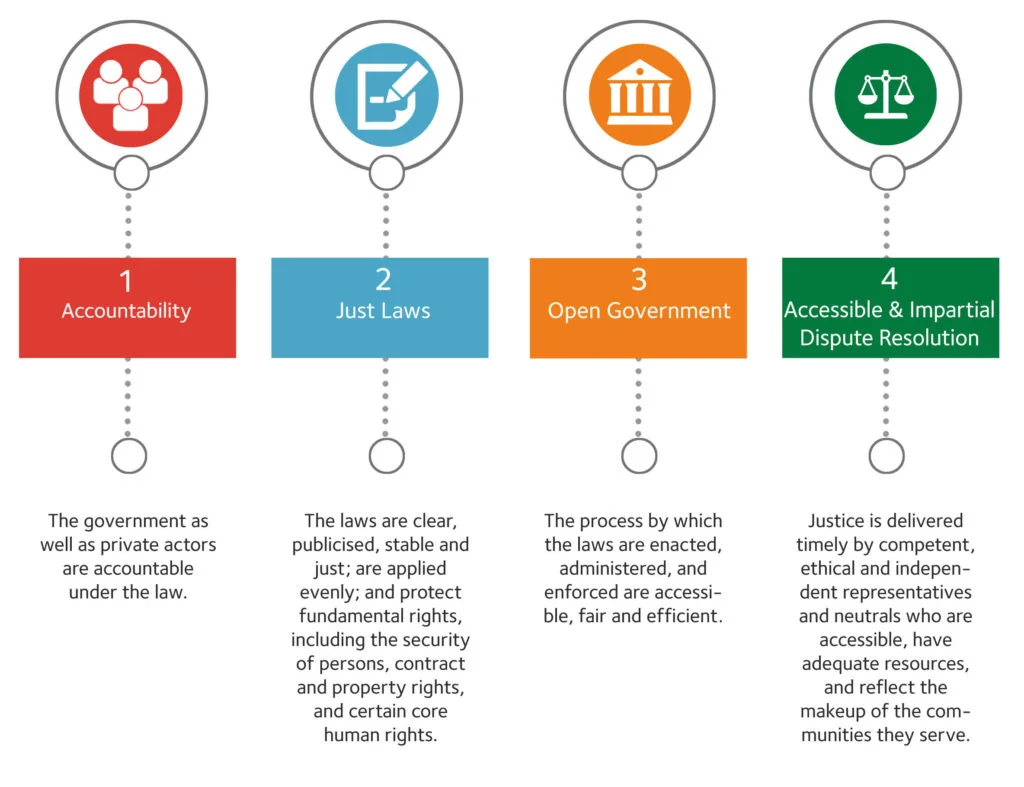
Source: World Justice Project Rule of Law Framework
The World Justice Project Rule of Law Index 2024 measures rule of law across 142 countries using eight factors: constraints on government powers, absence of corruption, open government, fundamental rights, order and security, regulatory enforcement, civil justice, and criminal justice. The index reveals significant global variation, with Nordic countries consistently ranking highest while authoritarian regimes show systematic rule of law deficits.
Modern rule of law encompasses several essential elements according to United Nations standards. Laws must be publicly promulgated, equally enforced, and independently adjudicated. Legal systems should be consistent with international human rights standards and norms. Rule of law requires supremacy of law over arbitrary power, equality before the law without discrimination, accountability to law for all persons and institutions, fairness in application and enforcement, separation of powers, participation in decision-making, legal certainty avoiding arbitrary decisions, and procedural and legal transparency.
The International Bar Association emphasizes that the rule of law differs fundamentally from “rule by law,” where law serves merely as an instrument of governmental power. The rule of law constrains the government itself, requiring authorities to justify actions by reference to legal authorization and subject decisions to independent review. This distinction separates democratic governance from authoritarian systems that maintain extensive legal codes but lack genuine legal constraints on power.
According to Lord Bingham:
“The rule of law is more than the blind application of rigid rules; it demands fairness, equity, and justice.”
Due Process: Constitutional Guarantees of Fair Treatment
Due process refers to the legal requirement that governments must respect all legal rights owed to individuals. It ensures that legal proceedings are conducted fairly and that individuals are given notice and an opportunity to be heard before adverse actions are taken. Due process ensures the government cannot deprive persons of life, liberty, or property without fair procedures and adequate legal justification.
The Fifth Amendment to the U.S. Constitution prohibits the federal government from depriving persons of life, liberty, or property without due process of law, while the Fourteenth Amendment extends this protection against state governments. Due process contains two distinct components with different requirements. Procedural due process requires fair procedures before governmental deprivation of protected interests. Substantive due process protects certain fundamental rights from governmental interference regardless of procedures used.
The Supreme Court of the United States has developed extensive jurisprudence defining both aspects through landmark cases spanning two centuries. Procedural due process mandates notice and opportunity to be heard before governmental action affecting protected interests. The Supreme Court in Mathews v. Eldridge established a three-factor test balancing the private interest affected, risk of erroneous deprivation through procedures used, probable value of additional safeguards, and the government’s interest, including administrative and fiscal burdens.
This flexible framework requires more extensive procedures for severe deprivations like criminal punishment or parental rights termination than for minor administrative matters. Essential procedural protections include adequate notice specifying charges or grounds for action, a neutral decision-maker free from bias, opportunity to present evidence and arguments, the right to counsel in certain proceedings, a reasoned decision based on evidence, and appellate review of adverse decisions.
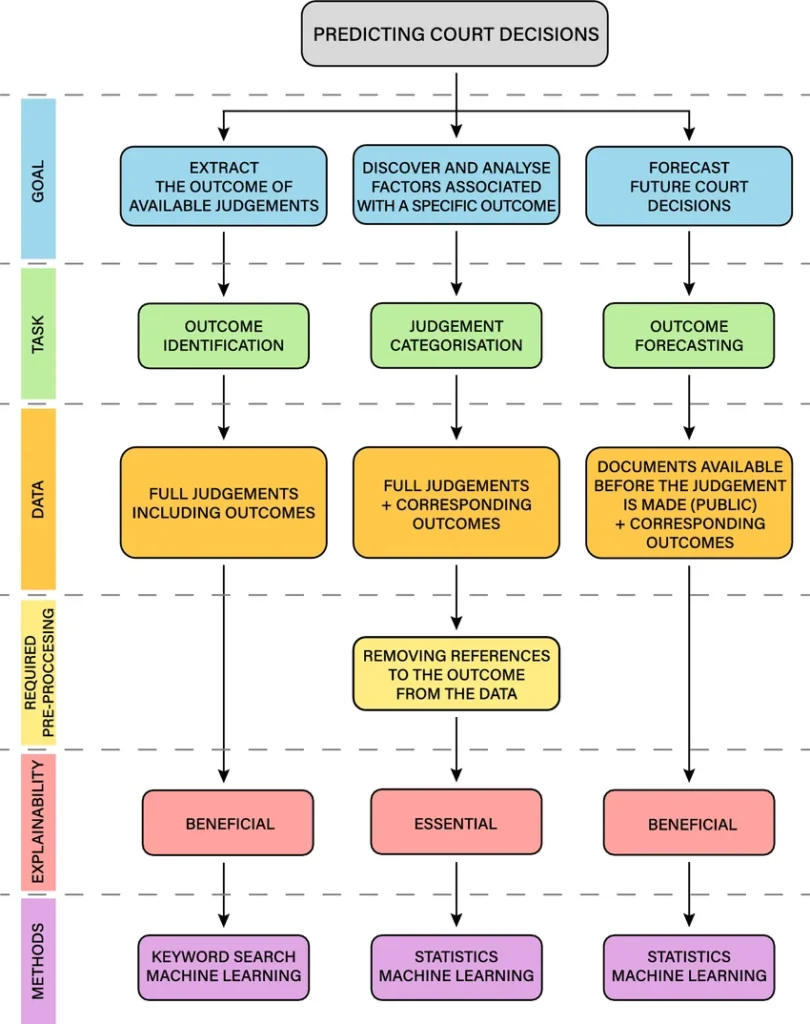
Source: U.S. Courts Educational Resources
The American Bar Association emphasizes that:
“specific procedures required depend on context, with criminal proceedings demanding the most rigorous protections.”
Substantive due process protects fundamental rights from unjustified governmental interference ,even with perfect procedures. The Supreme Court has recognized various unenumerated fundamental rights ,including privacy, marriage, family relationships, and personal autonomy. Governmental restrictions on fundamental rights receive strict scrutiny, requiring compelling governmental interests and narrowly tailored means. Non-fundamental rights face only rational basis review, requiring reasonable relationship to legitimate governmental purposes.
Criminal Justice and Fair Trial Rights
Criminal due process represents the most developed area of procedural protections given the severe consequences of criminal punishment. The U.S. Constitution establishes comprehensive criminal procedure guarantees through the Fourth, Fifth, Sixth, and Eighth Amendments protecting against unreasonable searches, compelled self-incrimination, and cruel punishment while ensuring speedy public trials, impartial juries, confrontation of witnesses, and legal representation.
The presumption of innocence requires prosecution to prove guilt beyond a reasonable doubt, placing the burden entirely on the state rather than requiring defendants to prove innocence. The United Nations Human Rights Committee (UNHRC) emphasizes that the presumption of innocence forms the foundation of fair criminal process, requiring that doubt benefits defendants and that pre-trial detention and treatment respect this fundamental principle.
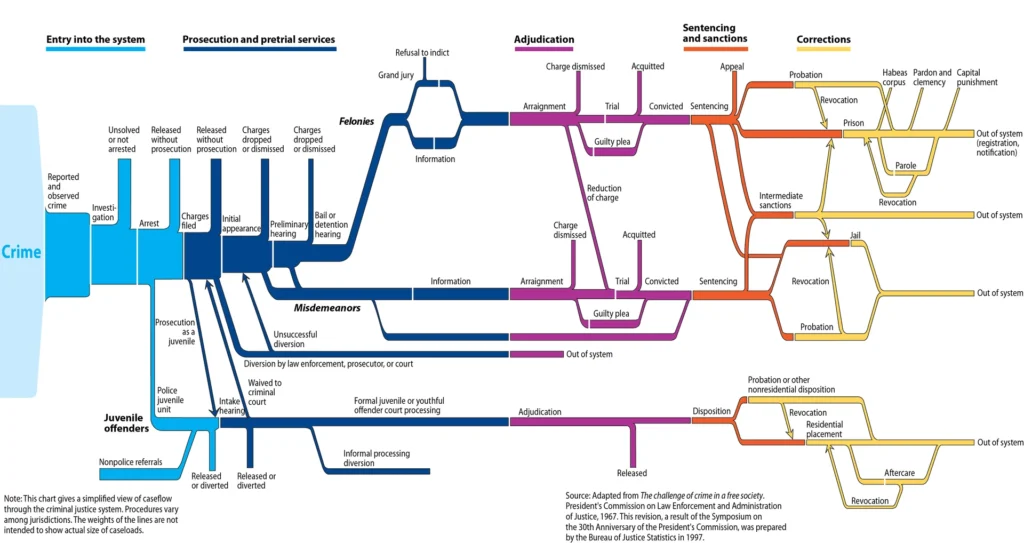
Source: Sequence of Events in the Criminal Justice System
Civil Justice and Access to Courts
Civil due process protects property and liberty interests outside the criminal context through fair procedures in civil litigation, administrative proceedings, and governmental decision-making. The Supreme Court requires procedural protections when government deprives individuals of protected interests, though specific procedures vary based on the Mathews v. Eldridge balancing test.
Access to justice ensures individuals can vindicate their rights through legal proceedings. The Legal Services Corporation provides civil legal assistance to low-income Americans, though funding limitations leave most civil legal needs unmet. The American Bar Association documents the “justice gap” where millions lack representation in civil matters affecting housing, family, income, and health.
Alternative dispute resolution mechanisms, including mediation and arbitration, provide less formal processes for resolving disputes. The American Arbitration Association facilitates arbitration across commercial, employment, and consumer contexts. However, mandatory arbitration agreements increasingly prevent individuals from accessing courts, raising due process concerns about forced waiver of judicial remedies. The National Consumer Law Center advocates against forced arbitration that denies consumers and employees their day in court.
Administrative due process governs proceedings before governmental agencies affecting regulated industries, benefit recipients, licensees, and others subject to administrative authority. The Administrative Procedure Act establishes minimum procedural requirements for federal agencies including notice-and-comment rulemaking, formal adjudication procedures when required by statute, and judicial review of final agency actions. State administrative procedure acts provide similar protections at state levels.
Class action litigation enables individuals with small claims to aggregate into collective proceedings, making litigation economically viable and ensuring accountability for widespread harms. The Federal Rules of Civil Procedure Rule 23 governs federal class actions, requiring numerosity, commonality, typicality, and adequate representation. However, the Supreme Court has increasingly restricted class certification, making it harder to bring collective claims against corporations and governments.
International Legal Frameworks Governing Due Process
The Universal Declaration of Human Rights (UDHR) Article 10 establishes that
“everyone is entitled in full equality to a fair and public hearing by an independent and impartial tribunal, in the determination of his rights and obligations and of any criminal charge against him.”
This foundational principle has been elaborated through binding treaties and regional human rights systems.
The International Covenant on Civil and Political Rights (ICCPR) Articles 9-14 establish comprehensive due process and fair trial rights binding 173 states parties. Protections include prohibition of arbitrary arrest and detention, humane treatment of detainees, prompt appearance before judicial authority, trial within a reasonable time or release, presumption of innocence, minimum guarantees for criminal defendants, and prohibition of retroactive criminal laws.
Regional human rights systems provide additional protections enforced through supranational courts. The European Court of Human Rights (ECHR) has issued thousands of judgments interpreting Article 6 fair trial guarantees, developing sophisticated jurisprudence on trial length, legal aid, witness examination, and judicial independence. The Inter-American Court of Human Rights enforces the American Convention guarantees across Latin America, while the African Court on Human and Peoples’ Rights interprets the African Charter protections.
The UN Basic Principles on the Independence of the Judiciary establish standards for judicial independence essential for fair trials. Principles include judicial selection based on integrity and ability, security of tenure, adequate remuneration, and freedom from improper influences. The Venice Commission monitors judicial independence in Council of Europe member states and provides expertise on institutional reforms.
Torture prohibitions receive absolute protection under international law, with no exceptions permitted even during emergencies. The Convention Against Torture prohibits torture and cruel, inhuman, or degrading treatment, requires prosecution or extradition of alleged torturers, and excludes evidence obtained through torture. The Committee Against Torture monitors compliance through state reports and individual complaints.
Judicial Independence and Impartiality
Judicial independence ensures courts can decide cases based on law and facts without improper external influence from other governmental branches, private parties, or public pressure. The American Bar Association identifies judicial independence as essential for the rule of law, requiring structural protections including security of tenure, adequate compensation, transparent appointment processes, and protection against retaliation.
Selection methods significantly affect judicial independence and accountability. Federal judges in the United States receive lifetime appointments after presidential nomination and Senate confirmation, insulating them from political pressure but raising accountability concerns. Many states elect judges, creating democratic accountability but risking politicization and campaign financing influence. Merit selection systems attempt to balance independence and accountability through nonpartisan nominating commissions, though implementation varies.
Judicial ethics rules prohibit conflicts of interest and require recusal when impartiality might reasonably be questioned. The Code of Conduct for United States Judges establishes standards for federal judges, while the American Bar Association Model Code of Judicial Conduct influences state judicial ethics codes. However, Supreme Court justices are not bound by the federal code, creating accountability gaps addressed through proposed reforms.
Court funding affects independence when legislatures or executives can retaliate against unfavorable decisions by reducing budgets or resources. The National Center for State Courts emphasizes that adequate, secure funding independent of case outcomes is essential for judicial independence. Many jurisdictions struggle with underfunded courts, creating access barriers and undermining the quality of justice.
Threats to judicial independence include physical attacks on judges, improper criticism, court-packing schemes, and the removal of judges for politically unpopular decisions. The Brennan Center for Justice documents increasing attacks on judicial legitimacy in the United States and globally, with authoritarian leaders undermining courts that constrain executive power. The The International Association of Judges advocates for judicial independence protections worldwide.
Contemporary Challenges to Rule of Law in 2026
Despite strong legal frameworks, rule of law faces significant challenges worldwide.
Political Interference in Judiciary – In several countries, concerns have emerged over executive influence on judicial appointments and decisions, undermining judicial independence.
National Security and Emergency Powers – Governments increasingly invoke national security to justify surveillance, detention, and restrictions on civil liberties. Balancing security with due process remains a central legal challenge.
Digital Governance and AI – Artificial intelligence in policing, sentencing, and surveillance raises new due process questions. Automated decision-making systems may lack transparency, making it difficult for individuals to challenge outcomes.
Disinformation and Social Media Regulation – Efforts to regulate online content have sparked debates about freedom of expression and procedural fairness, particularly where platforms or states remove content without clear legal processes.
Selective Enforcement of Law – Allegations of politically motivated prosecutions and unequal enforcement of laws undermine public trust in legal systems and challenge rule-of-law legitimacy.
Conclusion
In 2026, the rule of law and due process remain indispensable to democratic governance and human dignity. They provide the legal architecture that restrains power, protects rights, and ensures accountability. While global legal systems face evolving challenges from technological disruption to geopolitical tensions, the fundamental principles of fairness, transparency, and equality before the law continue to guide the pursuit of justice.
Rule of law and due process represent humanity’s greatest achievements in constraining arbitrary power through legal principles, institutional structures, and procedural safeguards. These foundational concepts transform raw power into legitimate authority, subject governmental decisions to reasoned justification, and protect individuals from oppression. Though implementation remains imperfect and constant vigilance is required against erosion, the principles endure because they address timeless human needs for order, justice, and dignity.
Strengthening rule of law and due process for contemporary challenges requires constitutional commitments, adequately resourced institutions, independent judiciaries, accessible legal systems, engaged civil society, and democratic culture valuing legal constraints on power. The future of democratic governance and human rights protection depends substantially on whether societies maintain and improve these legal foundations amid technological, political, and social transformations threatening established protections.
Frequently Asked Questions
What is the rule of law?
The rule of law is a legal principle requiring that all individuals and institutions, including governments, are subject to and accountable under the law, ensuring fairness, equality, and transparency.
What does due process mean?
Due process refers to fair legal procedures and safeguards that protect individuals from arbitrary state action, including the right to a fair trial, legal representation, and impartial adjudication.
Why is judicial independence important?
Judicial independence ensures that courts can make decisions based on law and evidence without political pressure, maintaining fairness and public confidence in the legal system.
How does international law protect due process?
International treaties such as the ICCPR and regional human rights conventions guarantee fair trial rights and allow individuals to seek remedies for violations through international bodies.
What is the difference between rule of law and rule by law?
The rule of law means law constrains government itself, requiring authorities to justify actions by reference to legal authorization and subjecting decisions to independent review. Rule by law means the government uses law as an instrument of power without being genuinely constrained by it. Democratic systems operate under the rule of law, where government is accountable to law, while authoritarian systems may have extensive legal codes but lack genuine legal limits on power.
Do non-citizens receive due process protections?
Yes. The Fifth and Fourteenth Amendments use the term “person” rather than “citizen,” extending due process protections to all individuals within U.S. jurisdiction regardless of citizenship status. However, immigration proceedings provide fewer procedural protections than criminal cases, and non-citizens lack certain rights limited to citizens such as voting.
Can due process rights be suspended during emergencies?
Some rights may be limited during genuine emergencies when measures are necessary, proportionate, and temporary. However, certain rights are non-derogable even during crises, including prohibitions against torture, arbitrary killing, and slavery. International human rights law requires that emergency derogations be officially proclaimed, strictly necessary, non-discriminatory, and consistent with other international obligations.
What happens when courts violate due process?
Remedies for due process violations include reversal of convictions or judgments, exclusion of unconstitutionally obtained evidence, damages against officials (subject to immunity limits), injunctions preventing future violations, and disciplinary action against judges or lawyers. Habeas corpus petitions provide post-conviction relief for constitutional violations in criminal cases.
How is rule of law measured?
Organizations like the World Justice Project measure rule of law through surveys of legal practitioners and general population combined with quantitative data. Factors assessed include constraints on government powers, absence of corruption, open government, fundamental rights protection, order and security, regulatory enforcement, civil justice effectiveness, and criminal justice fairness. Measurement enables comparative assessment and tracking changes over time.
What are the biggest rule-of-law challenges today?
Major challenges include political interference in courts, misuse of emergency powers, digital surveillance, AI-driven decision-making, and selective enforcement of laws.