
Pollution control laws form the backbone of environmental protection in the United States, setting enforceable limits on how industries, governments, and individuals may impact air, water, and land resources. In 2026, environmental regulation has entered a period of significant transition. The Environmental Protection Agency (EPA) is implementing revised compliance frameworks while reassessing several standards adopted during the previous administration.
Legal analysis from Harvard Law School’s Environmental and Energy Law Program confirms that
“EPA has amended key elements of the New Source Review (NSR) program, easing permitting requirements for certain new and modified sources while maintaining statutory enforcement authority.”
This comprehensive legal guide explains how pollution control laws operate in 2026, covering the Clean Air Act, emission standards, waste management regulations, enforcement mechanisms, and the evolving compliance risks businesses must navigate to operate lawfully in a shifting regulatory environment. This analysis reflects how environmental compliance is interpreted and applied across federal agencies, state regulators, and legal advisory practice.
Understanding the Legal Framework of Pollution Control
Pollution control laws in the United States operate through a layered legal structure combining federal statutes, agency regulations, and state implementation authority. At the center of this framework is the Clean Air Act, which remains the primary federal law governing air pollution from both stationary and mobile sources.
Courts and regulators consistently recognize the Clean Air Act as:
“the comprehensive statute authorizing federal oversight of ambient air quality, industrial emissions, and vehicle pollution.”
Federal environmental statutes establish baseline requirements, but enforcement is shared with states through cooperative federalism, allowing regional flexibility while preserving national standards.
The Role of the Environmental Protection Agency
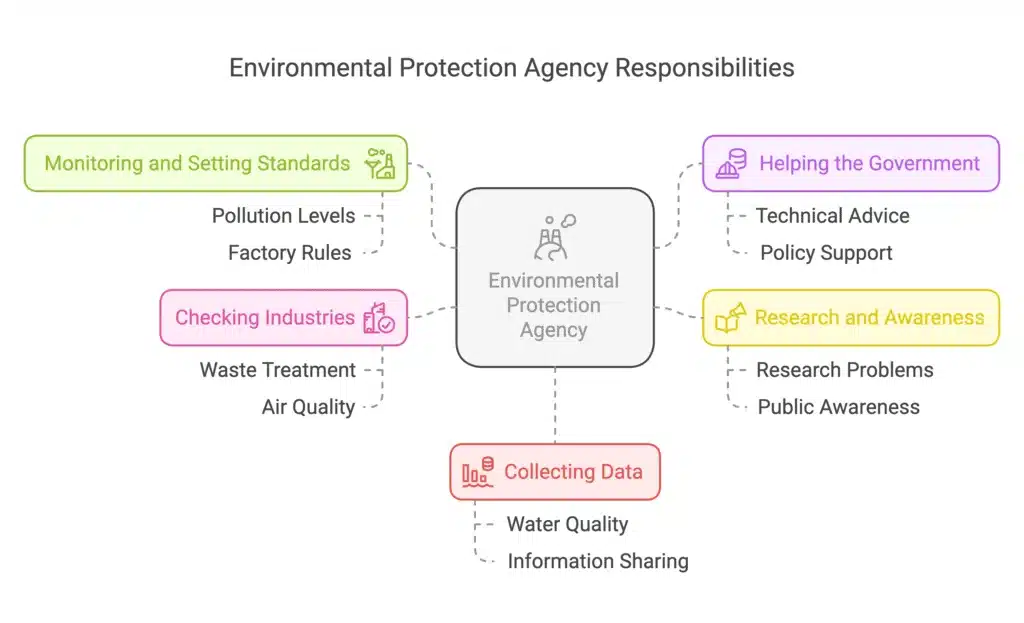
The EPA functions as the primary federal authority responsible for implementing, interpreting, and enforcing environmental laws. In 2026, the agency continues its shift toward what it describes as “Next Generation Compliance,” a strategy emphasizing technology, electronic reporting, and transparency over purely reactive enforcement.
According toPerformance.gov, current EPA compliance systems rely on:
- Regulations and permits with built-in compliance drivers
- Advanced emissions/pollutant detection technology
- Electronic reporting systems
- Expanded transparency measures
- Innovative enforcement approaches
In practice, regulated entities most frequently encounter enforcement risk through reporting discrepancies rather than visible emission exceedances.
State Implementation Plans and Federal-State Coordination
While the EPA sets national air quality standards, states remain responsible for achieving compliance through State Implementation Plans, commonly known as SIPs. The Congressional Research Service explains that:
“Under Section 110 of the act, the states adopt plans, known as State Implementation Plans (SIPs), and submit them to EPA to ensure that they are adequate to meet statutory requirements.”
SIPs rely on emissions inventories, modeling, and enforcement programs tailored to local conditions. If a state fails to submit an adequate plan, the EPA retains authority to impose a federal implementation plan to ensure statutory compliance.
The Regulatory Climate in 2026
Environmental regulation in 2026 reflects a broader federal deregulatory agenda aimed at reducing compliance burdens on energy, manufacturing, and infrastructure sectors. Several high-profile rules remain under review or legal challenge, including particulate matter standards, risk management requirements for hazardous chemicals, oil and gas effluent guidelines, and the definition of Waters of the United States under the Clean Water Act.
Williams Mullen reports that:
“in the Spring of 2025, the Trump Administration announced its deregulatory agenda with the announced aim to promote American energy and manufacturing.”
This leads to reconsideration of numerous environmental regulations, including:
- National Ambient Air Quality Standards for Particulate Matter
- Risk Management Program under the CAA
- Oil and Gas Effluent Limitations Guidelines
- Waters of the United States Definition under the Clean Water Act
Despite these policy shifts, core statutory obligations remain intact. Courts continue to enforce Clean Air Act mandates even as agencies revise implementing regulations, creating an environment where legal compliance requires careful attention to both regulatory changes and litigation outcomes.
The Clean Air Act as the Foundation of Air Quality Regulation
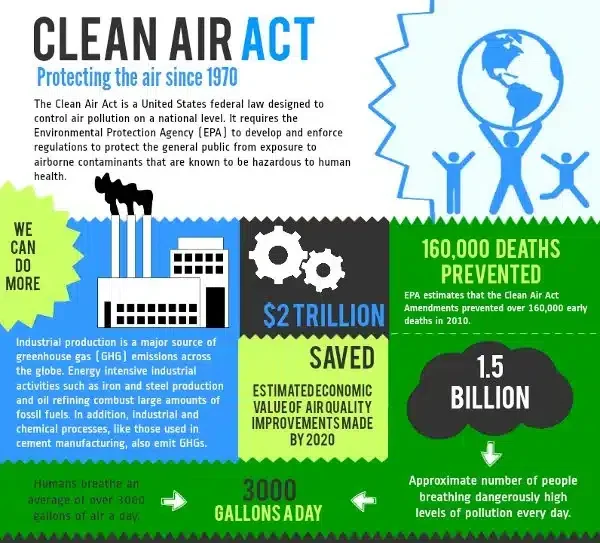
The Clean Air Act remains the most comprehensive air pollution control statute in U.S. history. It authorizes the EPA to establish national standards, regulate emissions from diverse sources, and enforce compliance through civil and criminal penalties.
National Ambient Air Quality Standards (NAAQS)
In 2026, the EPA continues to enforce National Ambient Air Quality Standards for six criteria pollutants:
- Carbon Monoxide (CO): Produced primarily by vehicle emissions
- Lead (Pb): From industrial processes and leaded aviation fuel
- Particulate Matter (PM2.5 and PM10): Fine and coarse particles from combustion
- Ground-level Ozone (O3): Formed when pollutants react in sunlight
- Nitrogen Dioxide (NO2): From burning fuel in vehicles and power plants
- Sulfur Dioxide (SO2): Primarily from fossil fuel combustion at power plants
According to the Congressional Research Service:
“Areas that fail to meet these standards are designated non-attainment areas and must implement additional pollution control measures.”
Non-attainment status carries significant legal consequences, including stricter permitting requirements and mandatory emission reduction plans.
New Source Performance Standards (NSPS)
The Clean Air Act requires EPA to:
“create a list of the important categories of stationary sources of air pollution, and to establish Federal standards of performance for new sources within these categories.”
New Source Performance Standards apply to:
- Newly constructed sources
- Sources undergoing major upgrades or modifications
- Both equipment specifications and operational requirements
- Specific measurement and monitoring obligations
These standards establish technology-based emission limits tailored to specific industrial categories. Compliance obligations include equipment specifications, operational controls, monitoring requirements, and record-keeping duties.
National Emission Standards for Hazardous Air Pollutants (NESHAP)
Section 112 of the Clean Air Act governs emissions of hazardous air pollutants through Maximum Achievable Control Technology standards.
The EPA explains that:
“for major sources, Section 112 requires that EPA establish emission standards that require the maximum degree of reduction in emissions of hazardous air pollutants.”
Facilities emitting significant quantities of hazardous pollutants must adopt the strictest controls demonstrated by top-performing sources within their industry. These standards apply to chemicals such as mercury, benzene, and ethylene oxide and remain a major enforcement focus in 2026.
Major sources are defined as facilities emitting:
- 10 tons per year or more of any single hazardous air pollutant, OR
- 25 tons per year or more of combined hazardous air pollutants
These emission standards are commonly referred to as “maximum achievable control technology” (MACT) standards, requiring the strictest controls that have been demonstrated as achievable by the best-performing facilities in each category.
Emission Standards and Compliance Obligations
Emission standards establish enforceable limits on pollutant releases and form the basis of environmental permits issued to regulated entities.
Mobile Source Emission Regulation
Vehicle emissions remain regulated under Title II of the Clean Air Act. Tier 3 standards, fully implemented by 2025, require substantial reductions in sulfur content and tailpipe emissions. In 2026, regulatory uncertainty persists as the EPA reevaluates the legal foundation for greenhouse gas regulation, including the 2009 Endangerment Finding that underpins federal climate rules.
Any change to this finding would have sweeping implications for transportation, power generation, and industrial emissions, though such action remains subject to extensive litigation. EPA regulates vehicle emissions through comprehensive standards covering:
On-Road Vehicles:
- Light-duty passenger cars and trucks
- Medium-duty vehicles
- Heavy-duty trucks and buses
Nonroad Sources:
- Construction equipment
- Agricultural machinery
- Locomotives
- Marine vessels
- Small engines (lawn equipment, chainsaws, etc.)
Stationary Source Emission Controls
Major stationary sources must install pollution control technology, conduct continuous emissions monitoring, obtain Title V operating permits, and submit regular compliance certifications. Failure to comply with permit conditions remains one of the most common enforcement triggers.
Industrial facilities face stringent emission limits based on source category and pollutant type. EPA’s regulations require major stationary sources to:
- Install pollution control equipment meeting MACT standards
- Meet specific emissions limitations for criteria and hazardous air pollutants
- Obtain operating permits under Title V of the Clean Air Act
- Conduct continuous emissions monitoring for certain pollutants
- Submit periodic compliance reports demonstrating adherence to permit limits
New Source Review (NSR) Permitting
The New Source Review program governs construction and modification of emission sources. Facilities in attainment areas are subject to Prevention of Significant Deterioration requirements, while those in nonattainment areas face stricter controls. EPA revisions in 2026 have adjusted permitting thresholds, but statutory NSR obligations continue to apply.
The NSR program applies when facilities construct new emission sources or modify existing ones. Harvard Law’s tracker notes that:
“EPA establishes the baseline requirements for new source review (NSR) permits, which are then issued by state and local air pollution agencies.”
NSR includes two sub-programs:
- Prevention of Significant Deterioration (PSD): For areas meeting NAAQS
- Nonattainment NSR: For areas not meeting NAAQS
Waste Management and Hazardous Materials Regulation
Pollution control law extends beyond air emissions to comprehensive waste management requirements under the Resource Conservation and Recovery Act.
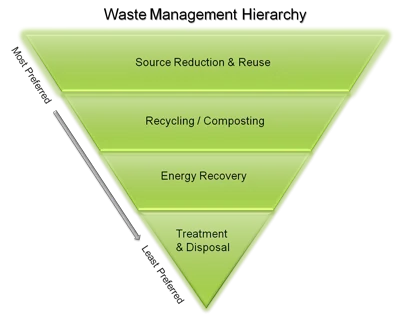
Source: EPA – Waste Management
Solid Waste Regulation
Updated standards for small waste incinerators took effect in late 2025, imposing stricter limits on particulate matter, carbon monoxide, dioxins, and heavy metals. These requirements apply to facilities processing limited daily waste volumes but still present significant compliance obligations.
The Resource Conservation and Recovery Act (RCRA) governs solid and hazardous waste management. With new rules effective December 29, 2025, EPA’s Sidley Brief reports that:
“EPA updated Clean Air Act standards applicable to small waste incinerators.”
For small waste incinerators burning 10 or fewer tons per day, the updated standards introduce:
- Stricter controls on fine particulate matter (PM)
- Revised standards for carbon monoxide (CO)
- Limits on dioxins/furans
- Controls for hydrogen chloride, sulfur dioxide, and nitrogen oxides
- Metal emission limits including lead, mercury, and cadmium
Hazardous Waste Compliance
Facilities handling hazardous waste must meet detailed generator, transporter, and treatment standards. Obligations include:
Generator Requirements:
- Proper waste characterization and classification
- Use of appropriate containers and labels
- Compliance with accumulation time limits
- Maintenance of detailed records
- Training for personnel handling hazardous waste
Treatment, Storage, and Disposal Facilities (TSDFs):
- Obtaining permits before beginning operations
- Meeting design and operating standards
- Conducting groundwater monitoring
- Maintaining financial assurance for closure and post-closure care
- Implementing corrective action for releases
Electronic Reporting and Transparency
Performance.gov explains that:
“electronic reporting allows for more accurate and timely information on pollution sources, as well as public access to pollution and compliance information.”
These systems improve regulatory oversight while increasing exposure to penalties for inaccurate reporting. The shift toward e-reporting includes:
- Real-time data submission capabilities
- Improved data accuracy and completeness
- Enhanced public transparency
- Reduced reporting burdens for regulated entities
- Better enforcement through timely violation identification
Monitoring, Audits, and Compliance Systems
Achieving and maintaining compliance with pollution control laws requires systematic monitoring, record-keeping, and reporting by regulated entities.
Continuous Emissions Monitoring Systems (CEMS)
Major emission sources must install CEMS to track pollutant releases in real-time. These systems:
- Measure pollutant concentrations continuously
- Calculate emission rates and totals
- Generate data for compliance demonstrations
- Trigger alerts when emission limits are approached or exceeded
- Provide verifiable records for regulatory submissions
Performance Testing Requirements
Facilities must conduct periodic stack testing to verify that emission control equipment operates effectively. Testing protocols require:
- Use of EPA-approved test methods
- Qualified third-party testing firms
- Advance notice to regulatory agencies
- Comprehensive test reports documenting results
- Corrective action plans if tests show non-compliance
Record-Keeping and Reporting
Detailed documentation requirements ensure regulatory oversight and enforcement capability. Federal Register documents indicate that facilities must maintain records including:
- Operating parameters for pollution control equipment
- Fuel consumption and composition data
- Maintenance and repair activities
- Deviations from permit requirements
- Emissions calculations and measurements
- Compliance certifications
Title V Operating Permits
The 1990 Clean Air Act Amendments established a comprehensive operating permit program. Major sources must:
- Apply for Title V permits consolidating all applicable requirements
- Pay annual fees based on emissions
- Submit semi-annual monitoring reports
- Certify compliance annually
- Notify EPA of any deviations from permit terms
Environmental Audits
Many facilities conduct voluntary environmental audits to identify and correct compliance issues before they trigger enforcement. The EPA encourages such audits through:
- Recognition of systematic compliance management systems
- Reduced penalties for self-disclosed violations
- Immunity from criminal prosecution for promptly corrected issues
Enforcement Authority and Penalties
EPA and state agencies possess substantial enforcement authority to ensure compliance with environmental regulations, utilizing both administrative and judicial mechanisms.
Administrative Enforcement Actions
Regulatory agencies can issue:
- Administrative Orders: Requiring facilities to take specific actions to achieve compliance or cease violations
- Administrative Penalties: Civil fines up to $25,000 per day per violation (adjusted periodically for inflation)
- Compliance Orders: Establishing schedules for achieving compliance with specific milestones
Civil Judicial Enforcement
For serious or ongoing violations, EPA may file civil lawsuits in federal court seeking:
- Injunctive relief requiring compliance
- Civil penalties up to $37,500 per day per violation
- Supplemental environmental projects benefiting affected communities
- Stipulated penalties for future violations
Criminal Enforcement
Knowing violations of environmental laws can result in criminal prosecution. Criminal penalties may include:
- Imprisonment up to 5 years for negligent violations
- Imprisonment up to 15 years for knowing endangerment
- Corporate fines reaching millions of dollars
- Individual fines up to $250,000 per day of violation
Citizen Suit Provisions
The Clean Air Act authorizes citizens to sue:
- EPA for failure to perform non-discretionary duties. Courts may award attorney fees and costs to prevailing parties, enabling environmental groups to enforce regulations when agencies do not.
- Alleged violators after providing 60 days notice.
Industry-Specific Regulatory Challenges
Different industrial sectors face tailored regulatory requirements reflecting their unique pollution profiles and environmental impacts.
Oil and Gas Industry
EPA’s July 2025 interim final rule extended compliance deadlines for oil and natural gas operations, with requirements including:
- Control devices for emissions from equipment leaks
- Standards for storage vessels
- Requirements for process controllers
- Covers and closed vent systems
- Continuous pilot flame requirements for flares
- Alarm systems for combustion device failures
Power Generation Sector
Harvard Law’s analysis indicates that:
“on June 11, 2025, EPA proposed a rule to repeal the 2024 carbon pollution standards for fossil fuel-fired power plants, with greenhouse gas emissions from these facilities representing roughly 25% of total U.S. GHG emissions.”
Chemical Manufacturing
The sector faces stringent hazardous air pollutant controls. EPA’s proposed rules address:
“chemical manufacturing area sources, with particular focus on ethylene oxide (EtO) emissions.”
In July 2025, the Trump administration exempted 41 sterilization facilities from stringent EtO rules, prompting challenges from public health organizations.
Data Centers and AI Infrastructure
Recognizing the growth of artificial intelligence infrastructure, EPA launched the Clean Air Act Resources for Data Centers webpage in December 2025, providing guidance on:
- Managing emissions from backup power sources
- Determining applicable permitting requirements
- Navigating Clean Air Act regulations
- Avoiding major source requirements
- Starting construction on non-emitting facility components
Pollution Prevention and Future Regulatory Trends
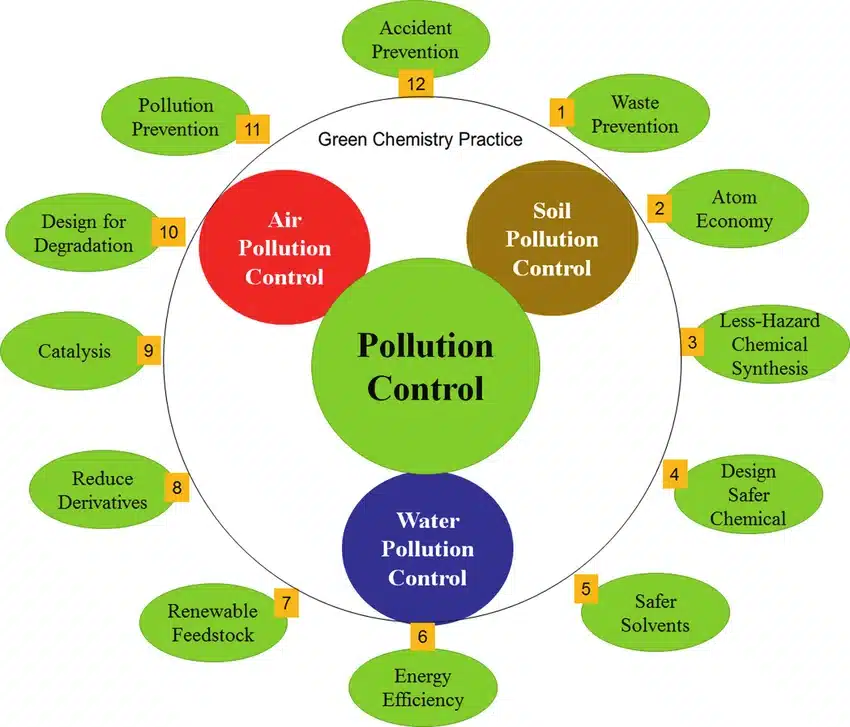
Beyond end-of-pipe controls, the Pollution Prevention Act encourages reducing pollution at its source rather than managing waste after generation.
Source Reduction Strategies
The law defines pollution prevention as practices that:
- Reduce hazardous substances released into the environment
- Occur prior to recycling, treatment, or disposal
- Include equipment or technology modifications
- Involve process or procedure improvements
- Implement product reformulation or redesign
- Substitute less hazardous raw materials
- Improve housekeeping, maintenance, and training
Benefits of Prevention Approaches
According to EPA’s summary:
“pollution prevention includes practices that increase efficiency in the use of energy, water, or other natural resources, and protect our resource base through conservation.”
Prevention proves more cost-effective than managing pollution after generation because it:
- Reduces raw material costs
- Decreases waste management expenses
- Lowers regulatory compliance burdens
- Improves operational efficiency
- Enhances corporate environmental reputation
Future Outlook and Regulatory Trends
The pollution control regulatory landscape continues evolving, with several key trends shaping future requirements.
Regulatory Uncertainty
The current administration’s deregulatory focus creates uncertainty for businesses planning long-term compliance investments. Williams Mullen notes that numerous rules face reconsideration, including:
- PFAS drinking water standards
- Greenhouse gas reporting requirements
- The 2009 Endangerment Finding for GHGs
- Various sector-specific emission standards
Litigation and Legal Challenges
Regulatory changes will face extensive litigation. NPR reports that:
“The deregulatory push is also being challenged in court and will almost certainly face more lawsuits, with environmental groups like the Environmental Defense Fund repeatedly suing over weakened protections.”
State-Level Action
As federal standards potentially weaken, states may fill regulatory gaps. California’s authority under Clean Air Act waivers allows the state:
“to maintain stricter standards, with other states able to adopt California’s requirements.”
Technological Innovation
Advanced monitoring technologies continue improving compliance verification and enforcement efficiency. Innovations include:
- Blockchain for supply chain tracking
- Satellite-based emission detection
- Continuous fenceline monitoring
- Real-time data analytics
- Artificial intelligence for pattern recognition
Conclusion
Pollution control laws in 2026 reflect a complex balance between statutory mandates, regulatory reform, and judicial oversight. While policy priorities may shift, core environmental protections remain legally enforceable. Businesses and regulated entities must remain vigilant by monitoring regulatory developments, maintaining robust compliance systems, and preparing for enforcement and litigation risks.
The Clean Air Act’s fundamental objective of protecting public health and environmental quality continues to guide enforcement, regardless of political change. Organizations that treat environmental compliance as a core operational responsibility rather than a regulatory burden will be best positioned to adapt to ongoing legal and regulatory evolution.
“For practical insights on wastewater treatment, effluent limits, and emerging regulatory challenges, see our 2026 Water Pollution Control Guide for Legal Standards and Compliance.”Frequently Asked Questions
What are the most important pollution control law changes in 2026?
Key changes include revised EPA permitting rules, increased reliance on electronic reporting, continued enforcement of Clean Air Act standards, and legal challenges affecting greenhouse gas regulation.
Is environmental regulation weaker in 2026?
While some regulations are under review, statutory obligations remain enforceable. Courts continue to uphold core pollution control requirements.
What industries face the highest compliance risk?
Oil and gas, power generation, chemical manufacturing, and facilities with complex permitting obligations face heightened enforcement scrutiny.
Are citizen lawsuits still allowed?
Yes. Federal environmental statutes continue to authorize citizen suits against violators and agencies that fail to perform mandatory duties.
Does deregulation eliminate environmental compliance obligations?
No. Regulatory revisions do not override statutory requirements. Compliance failures remain subject to civil and criminal penalties.