
The reported sinking of an Iranian warship IRIS DENA by a U.S. submarine in international waters has intensified global debate over the legality of naval warfare during the ongoing U.S.–Israel–Iran conflict. While armed conflict at sea is not uncommon during interstate hostilities, international law imposes strict limits on when naval forces may use lethal force against enemy vessels, particularly in international waters where freedom of navigation is a core principle of maritime law. The legality of such an action depends on several overlapping legal frameworks, including the United Nations Charter, the law of armed conflict at sea, and customary international humanitarian law governing military conduct during hostilities.
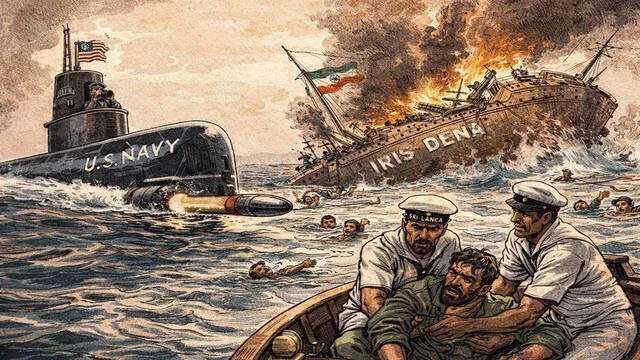
At the center of the debate is whether the sinking of an Iranian warship can be justified as a lawful act of self-defense or a legitimate military engagement during an armed conflict. Under international law, warships are generally considered legitimate military targets once hostilities exist between states. However, the use of force must still comply with fundamental legal principles such as necessity, proportionality, and distinction, and it must occur within the broader legal context governing the use of force between states.
Determining whether the attack was lawful, therefore, requires examining not only the circumstances of the naval engagement but also whether the broader U.S. military operations against Iran meet the legal thresholds established by international law.
Naval warfare is regulated by a combination of treaty law, customary international law, and humanitarian principles developed over centuries of maritime conflict. Although there is no single comprehensive treaty governing modern naval warfare, key legal frameworks include:
- The United Nations Charter, which regulates when states may use force
- The San Remo Manual on International Law Applicable to Armed Conflicts at Sea (1994)
- The Geneva Conventions and customary international humanitarian law
- The United Nations Convention on the Law of the Sea (UNCLOS)
The United Nations Charter provides the foundational rule governing the use of force between states. Article 2(4) prohibits states from using force against the territorial integrity or political independence of another state unless the action is justified as self-defense under Article 51 or authorized by the UN Security Council. This rule applies equally to military actions conducted at sea, meaning that naval engagements must be legally justified within the same framework that governs land and air warfare.
Once an armed conflict exists between states, the conduct of naval operations is regulated by international humanitarian law, particularly the law of armed conflict at sea. These rules derive from several sources, including the Geneva Conventions, customary international law, and specialized maritime warfare guidance such as the San Remo Manual on International Law Applicable to Armed Conflicts at Sea (1994). Although the San Remo Manual is not a treaty, it is widely regarded by legal scholars and military practitioners as an authoritative summary of customary rules governing naval warfare.
Under these rules, enemy warships are generally considered legitimate military targets during armed conflict. Naval forces may attack or disable enemy military vessels, including submarines, destroyers, and aircraft carriers, provided that the attack complies with core humanitarian principles. However, the legality of such engagements depends on whether an armed conflict legally exists between the states involved and whether the use of force meets the requirements of necessity and proportionality.
International humanitarian law also requires that naval operations distinguish between military vessels and civilian shipping. Merchant ships, fishing vessels, and other civilian maritime traffic are protected unless they are directly participating in hostilities or transporting military supplies. Naval commanders must take precautions to avoid unnecessary harm to civilian vessels and maritime infrastructure.
The United Nations Convention on the Law of the Sea (UNCLOS) also plays an important role in regulating activities in international waters. UNCLOS establishes the principle of freedom of navigation on the high seas, allowing warships and merchant vessels from all nations to operate freely outside territorial waters. However, during armed conflict, military engagements between belligerent states may still occur in international waters, provided they comply with the rules governing naval warfare.
Taken together, these legal frameworks demonstrate that while naval combat is not prohibited under international law, it is heavily regulated. Any attack on an Iranian warship by U.S. forces would therefore need to be assessed within the broader context of whether a lawful armed conflict exists, whether the target qualifies as a legitimate military objective, and whether the attack complies with the principles of necessity, proportionality, and distinction established under the law of armed conflict.
The UN Charter and the Legality of the Use of Force
The legality of any military engagement between states, including naval warfare, is fundamentally governed by the United Nations Charter, which establishes the modern international legal framework regulating the use of force. Adopted in 1945 following the devastation of World War II, the UN Charter was designed to prevent unilateral aggression by placing strict limits on when states may resort to military force against another sovereign nation. As a result, the Charter forms the cornerstone of the global rules-based order governing interstate conflict.
Article 2(4) of the UN Charter sets out the central prohibition, requiring all member states to refrain from the threat or use of force against the territorial integrity or political independence of any state. This rule applies broadly to all forms of military action, including air strikes, land invasions, cyber operations that produce physical destruction, and naval engagements at sea. In principle, therefore, the sinking of an Iranian warship by U.S. forces would fall within this prohibition unless it can be justified under one of the recognized legal exceptions.
The Charter provides two primary exceptions to this rule. The first is the right of self-defense, recognized under Article 51, which allows states to use force if they are responding to an armed attack or preventing an imminent threat of such an attack. In invoking self-defense, a state must demonstrate that the use of force was both necessary and proportionate to the threat it faced. If a naval engagement occurs as part of an ongoing armed attack or to prevent an imminent hostile action by an enemy warship, the state may argue that the strike is legally justified under this provision.
The second exception arises when the UN Security Council authorizes the use of force under Chapter VII of the Charter. In such cases, military action is undertaken collectively to restore international peace and security. However, Security Council authorization is often difficult to obtain due to the veto power of its permanent members, leading many modern conflicts to involve states relying primarily on claims of self-defense rather than on collective authorization.
In the context of naval engagements between the United States and Iran, the legal question therefore centers on whether the circumstances meet the threshold for lawful self-defense under Article 51. If the Iranian warship posed an imminent threat or was actively engaged in hostilities against U.S. forces or allied vessels, the attack could potentially be justified as a defensive action. Conversely, if the engagement occurred without an immediate threat or outside the context of an ongoing armed conflict, critics may argue that the strike constitutes an unlawful use of force under the UN Charter.
Status of Warships in Armed Conflict
Under international law, warships occupy a distinct legal status during armed conflict, as they are considered sovereign military assets of the state that operates them. Unlike civilian vessels, warships are not protected from attack during hostilities because they represent part of a nation’s armed forces and therefore constitute legitimate military objectives. The legal treatment of warships in armed conflict is primarily governed by international humanitarian law, customary maritime law, and the law of armed conflict at sea.
A warship is generally defined under the United Nations Convention on the Law of the Sea (UNCLOS) as a vessel belonging to the armed forces of a state, bearing external markings identifying it as a military ship, commanded by a commissioned officer, and manned by a crew subject to military discipline. Because warships represent the sovereign authority of their state, they also enjoy sovereign immunity, meaning that they cannot be boarded, seized, or subjected to jurisdiction by another state in peacetime.
However, once an armed conflict exists between two states, the legal protection afforded by sovereign immunity changes significantly. In wartime, enemy warships become lawful military targets, meaning they may be attacked, disabled, or destroyed by opposing naval forces. This principle reflects the reality that warships are designed to carry out combat operations and therefore form part of a state’s military capabilities.
The legality of attacking a warship during conflict is further clarified in the San Remo Manual on International Law Applicable to Armed Conflicts at Sea, which provides widely accepted guidance on maritime warfare. According to these principles, warships engaged in hostilities may attack enemy naval vessels without prior warning, provided the engagement complies with the broader humanitarian rules governing warfare.
Nevertheless, even attacks on enemy warships must respect certain legal constraints. Military operations at sea must still comply with the core principles of necessity, proportionality, and distinction. For example, commanders must ensure that the attack is directed at a legitimate military objective and that the method of attack does not cause excessive harm to civilians or neutral vessels operating nearby.
Another important aspect of the legal status of warships involves their treatment after they are disabled or surrendered. If a warship becomes incapable of fighting or its crew abandons ship, the vessel and its personnel may be considered hors de combat, meaning they are no longer legitimate targets. In such circumstances, international humanitarian law requires opposing forces to respect the safety of surviving sailors and provide assistance where feasible.
In the context of potential U.S.–Iran naval engagements, the legal status of Iranian warships is therefore relatively clear under international law. If hostilities between the two states legally exist, Iranian warships operating in international waters may be considered legitimate military targets. However, the legality of attacking them still depends on whether the broader use of force between the states itself is lawful under the UN Charter, as well as whether the specific naval engagement complies with the rules governing the conduct of warfare at sea.
Location of the Attack and Maritime Jurisdiction
The location of a naval attack is a key factor in determining its legality under international law. Maritime law divides the oceans into different jurisdictional zones, each governed by specific legal rules regarding sovereignty, navigation rights, and military activity. These zones are primarily defined by the United Nations Convention on the Law of the Sea (UNCLOS), which establishes the framework for maritime jurisdiction and the rights of states operating at sea.
Territorial Waters
A coastal state exercises sovereignty over its territorial sea, which extends up to 12 nautical miles from its coastline. Within this zone, the coastal state has full authority similar to its control over land territory. Foreign vessels, including warships, may pass through these waters under the principle of innocent passage, provided their activities do not threaten the peace, security, or order of the coastal state.
If a naval attack occurs within the territorial waters of a state, it may be viewed as a violation of sovereignty unless it can be justified under international law, such as in cases of self-defense or when authorized by the state’s. Military action in another state’s territorial waters therefore carries significant legal consequences and may be interpreted as an act of aggression if not legally justified.
Exclusive Economic Zone (EEZ)
Beyond the territorial sea lies the Exclusive Economic Zone (EEZ), which extends up to 200 nautical miles from the coast. In this area, the coastal state has sovereign rights primarily related to natural resources, such as fishing, oil exploration, and seabed minerals. However, the EEZ is not fully sovereign territory, and other states retain freedoms of navigation, overflight, and military operations.
As a result, naval forces from different states may legally operate in the EEZ of another state, including conducting exercises and transiting through the zone. Nevertheless, the use of force within an EEZ during peacetime could still raise legal questions if it threatens regional stability or violates the broader prohibition on the use of force under the UN Charter.
High Seas (International Waters)
Areas beyond national jurisdiction are known as the high seas, commonly referred to as international waters. In these regions, all states enjoy the principle of freedom of navigation, meaning that ships from any country may sail, conduct lawful activities, and operate naval forces without interference from other states.
Even in international waters, however, the use of military force is not unrestricted. Naval engagements must still comply with the UN Charter’s rules governing the use of force as well as the laws of armed conflict at sea. If a lawful armed conflict exists between two states, their naval forces may engage enemy warships on the high seas. Conversely, if no lawful basis for the use of force exists, attacking another state’s vessel, even in international waters, may constitute an unlawful act under international law.
International Humanitarian Law at Sea
Once armed conflict exists between states, military operations conducted at sea are regulated by International Humanitarian Law (IHL), often IHLreferred to as the law of armed conflict at sea. These rules are designed to limit the humanitarian consequences of naval warfare by protecting civilians, neutral vessels, and individuals who are no longer participating in hostilities. Although naval combat has historically played a major role in interstate conflicts, modern international law imposes strict legal constraints on how naval forces may conduct military operations.
The legal foundations of maritime humanitarian law derive from several sources, including the Geneva Conventions of 1949, customary international law, and guidance such as the San Remo Manual on International Law Applicable to Armed Conflicts at Sea (1994). While the San Remo Manual is not a treaty, it is widely recognized as an authoritative restatement of customary legal principles governing naval warfare and is frequently referenced by military planners and legal scholars.
Principle of Distinction
A central rule of international humanitarian law is the principle of distinction, which requires belligerent forces to distinguish between military targets and civilian objects at all times. In the maritime context, this means that naval forces may attack enemy warships, submarines, and other military vessels, as these constitute legitimate military objectives.
However, civilian vessels, including merchant ships, fishing boats, and passenger vessels, are generally protected from attack unless they are directly participating in hostilities or being used to support military operations. Naval commanders must therefore carefully identify their targets to ensure that attacks are directed only at lawful military objectives.
Principle of Proportionality
Naval operations must also comply with the principle of proportionality, which prohibits attacks expected to cause excessive civilian harm relative to the anticipated military advantage. Even when a legitimate military target is identified, commanders must evaluate whether the potential damage to civilian vessels, ports, or coastal infrastructure would be disproportionate.
For example, if an enemy warship is operating in close proximity to civilian shipping lanes, commanders must consider the risk to nearby civilian vessels before launching an attack.
International humanitarian law also requires naval forces to take feasible precautions to minimize civilian harm during maritime operations. These precautions may include verifying targets through intelligence and surveillance, selecting weapons that limit collateral damage, and delaying or canceling attacks if new information indicates that civilian vessels may be at risk.
In modern naval warfare, these precautionary measures often involve the use of advanced surveillance systems, radar tracking, and intelligence analysis to ensure that military operations comply with legal requirements.
Protection of Shipwrecked Sailors and Survivors
International humanitarian law also addresses the treatment of sailors and individuals who become shipwrecked during naval combat. Under the Second Geneva Convention, sailors who are wounded, captured, or shipwrecked must be treated humanely and provided with medical assistance whenever feasible.
Once individuals are no longer participating in hostilities, often referred to as being hors de combat, they cannot be deliberately targeted. This rule reflects a broader humanitarian principle that individuals who are no longer capable of fighting should be protected from further harm.
Neutral Shipping and Maritime Safety
Another important aspect of maritime humanitarian law concerns the protection of neutral states and their commercial shipping. Neutral vessels operating in international waters must not be attacked unless they are clearly assisting one side in the conflict by transporting military supplies or engaging in hostile acts. Even in such cases, international law traditionally requires warning and verification before force is used against civilian shipping.
Even if the sinking of an Iranian warship were legally justified under the UN Charter’s rules on the use of force, the operation would still need to satisfy the humanitarian standards of distinction, proportionality, and precaution established by international humanitarian law. These rules ensure that naval warfare, while permitted under certain circumstances, remains subject to legal constraints designed to protect civilians and maintain humanitarian standards during armed conflict.
Rescue Obligations and Treatment of Survivors
International humanitarian law places significant obligations on naval forces regarding the rescue and treatment of survivors after a naval engagement. Even when the sinking of an enemy warship is considered a lawful military act, the rules governing armed conflict at sea require that those who are wounded, shipwrecked, or otherwise no longer participating in hostilities must be protected and treated humanely. These obligations are primarily derived from the Second Geneva Convention of 1949, which specifically addresses the protection of wounded, sick, and shipwrecked members of armed forces at sea.
Under these rules, once sailors abandon a sinking vessel or are thrown into the water as a result of combat, they are considered hors de combat, meaning they are no longer lawful targets. Attacking or deliberately harming individuals in this condition is strictly prohibited. Instead, naval forces are required, whenever circumstances permit, to take all feasible measures to search for and rescue survivors, regardless of whether they belong to friendly or enemy forces.
The obligation to provide assistance extends beyond simple rescue. Survivors who are captured become prisoners of war (POWs) and must be treated in accordance with international humanitarian law. This includes providing adequate medical care, humane treatment, protection from violence or intimidation, and respect for their dignity. The detention and interrogation of captured sailors must also comply with the legal protections outlined in the Third Geneva Convention, which governs the treatment of prisoners of war.
However, the obligation to rescue survivors is not absolute. Naval commanders may delay or limit rescue operations if immediate assistance would place their own forces at serious risk, such as when enemy combat operations are still ongoing or when rescue vessels could be exposed to further attack. In such cases, commanders must balance humanitarian obligations with operational security and the safety of their crews.
International law also requires belligerent states to respect the safety of neutral rescue vessels and humanitarian ships, such as hospital ships and maritime search-and-rescue units. These vessels are granted special protection during armed conflict and must not be targeted or interfered with while carrying out humanitarian missions.
In the context of a naval confrontation between the United States and Iran, the sinking of a warship would therefore trigger immediate humanitarian responsibilities under international law. Even if the initial attack were legally justified as part of an armed conflict, the attacking forces would still be expected to assist shipwrecked sailors when feasible and ensure that captured personnel are treated in accordance with the Geneva Conventions. These obligations reflect the broader humanitarian principle that, while warfare may permit the use of force against military targets, it must still respect
Domestic Legal Issues in the United States
In addition to international law governing naval warfare, any U.S. military action against an Iranian warship must also comply with domestic legal constraints within the United States. These constraints arise primarily from the U.S. Constitution, congressional war-making powers, and statutory frameworks such as the War Powers Resolution of 1973. Together, these legal rules define the balance of authority between the executive branch and Congress when the United States engages in military hostilities abroad.
Constitutional Allocation of War Powers
The U.S. Constitution divides authority over war between Congress and the president. Article I grants Congress the power to declare war, raise and support armed forces, regulate the military, and control funding for military operations. At the same time, Article II designates the president as Commander-in-Chief of the armed forces, giving the executive branch authority to direct military operations and respond to immediate threats.
This dual allocation of authority has historically produced tension over who has the ultimate authority to initiate military action. While Congress possesses the formal power to declare war, presidents have often relied on their commander-in-chief authority to conduct limited military operations without a formal declaration of war, particularly when responding to urgent security threats.
The War Powers Resolution
The War Powers Resolution of 1973 was enacted after the Vietnam War to limit unilateral presidential military action and restore congressional oversight. The law requires the president to notify Congress within 48 hours whenever U.S. forces are introduced into hostilities or situations where hostilities are likely.
Under the statute, the president may continue military operations for up to 60 days without congressional authorization, after which U.S. forces must be withdrawn unless Congress approves the action. A 30-day withdrawal period is provided to allow for the safe removal of troops if authorization is not granted.
In the context of a naval engagement with Iran, if the sinking of an Iranian warship were part of a broader military campaign, Congress could argue that the administration must seek explicit authorization for continued hostilities.
Authorization for Use of Military Force (AUMF)
In some cases, Congress provides authorization for military operations through an Authorization for Use of Military Force (AUMF) rather than a formal declaration of war. These authorizations give the president legal authority to conduct military operations against specific enemies or threats.
For example, the 2001 AUMF authorized military action against those responsible for the September 11 attacks, while the 2002 AUMF authorized the use of force against Iraq. Whether these existing authorizations could be used to justify military action against Iran is highly contested, and many lawmakers argue that a new AUMF would be required for any sustained conflict with Iran.
Congressional Oversight and Funding Authority
Congress also retains significant power over military operations through its control of federal spending. Even if the president initiates military action, Congress may pass legislation restricting or prohibiting the use of funds for certain military activities. This authority can effectively limit the scope or duration of military operations.
In addition, congressional committees may conduct oversight hearings and investigations into the legality and strategic justification of military actions. Such scrutiny can influence public debate and shape future legislative responses.
Conclusion
The sinking of an Iranian warship by a U.S. submarine represents a significant escalation in the ongoing conflict and raises complex legal questions under both international and domestic law. In such circumstances, naval engagements must comply with international humanitarian law, including the principles of distinction, proportionality, and precaution. Commanders must ensure that attacks are directed at lawful military objectives and that civilian vessels and neutral shipping are not placed at unnecessary risk.
Additionally, humanitarian obligations remain in force after the attack, requiring naval forces to assist shipwrecked sailors and treat captured survivors in accordance with the Geneva Conventions. From an international law perspective, the attack could be lawful if:
- An armed conflict exists between the United States and Iran
- The Iranian vessel was a legitimate military target
- The strike complied with necessity and proportionality requirements
However, if the conflict lacks a valid self-defense justification or if the vessel was not actively participating in hostilities, the legality of the operation could be contested. As the crisis continues to unfold, international legal scrutiny from governments, scholars, and multilateral institutions will play a crucial role in shaping how the event is interpreted and what precedents it may establish for future naval conflicts.
Frequently Asked Questions
Can the United States legally sink an Iranian warship in international waters?
Yes, but only under certain legal conditions. Under international law, particularly the UN Charter, the use of force is generally prohibited unless it is justified as self-defense against an armed or imminent attack or authorized by the UN Security Council. If an armed conflict legally exists between the United States and Iran, Iranian warships could be considered legitimate military targets under the law of armed conflict at sea.
Are warships protected under international maritime law?
Does the location of the attack matter under international law?
Yes. Maritime jurisdiction plays an important role in determining the legal implications of a naval engagement. Attacks occurring in territorial waters may violate a state’s sovereignty unless justified under international law. However, engagements on the high seas (international waters) may be lawful if they occur during a legitimate armed conflict and comply with the rules governing naval warfare.
What legal rules regulate naval warfare?
Naval warfare is governed by international humanitarian law, including the Geneva Conventions, customary international law, and guidance such as the San Remo Manual on International Law Applicable to Armed Conflicts at Sea. These rules require military operations to follow the principles of distinction, proportionality, and precaution.
Can civilian vessels be targeted during naval conflict?
Generally, civilian vessels are protected from attack under international humanitarian law. Merchant ships, fishing vessels, and passenger ships may only be targeted if they are directly participating in hostilities or transporting military supplies that support the enemy’s war effort.
What happens to sailors who survive a sinking warship?
Sailors who are wounded, captured, or shipwrecked after a naval engagement are protected under the Second Geneva Convention. They must be rescued when feasible and treated humanely. If captured, they are considered prisoners of war and must be treated according to the protections outlined in the Third Geneva Convention.
Does U.S. domestic law affect naval military operations?
Yes. Under the U.S. Constitution, Congress has the power to declare war, while the president serves as commander-in-chief. The War Powers Resolution of 1973 requires the president to notify Congress within 48 hours of introducing U.S. forces into hostilities and limits the duration of military operations without congressional authorization.
Could sinking an Iranian warship lead to legal challenges in the United States?
Potentially. If the action is part of a broader military campaign, members of Congress may argue that the president must obtain congressional authorization for continued hostilities. Legal and political debates may arise regarding the scope of the president’s authority under the Constitution.
Are neutral countries affected by naval warfare in international waters?
Yes. International law requires belligerent states to respect the rights of neutral states and their shipping. Neutral vessels must not be attacked unless they are directly assisting one side in the conflict. Even then, specific procedures and precautions must be followed.
Why is the legality of naval warfare important in modern conflicts?
The legal framework governing naval warfare helps ensure that military operations remain consistent with international humanitarian standards and the broader prohibition on unlawful use of force. These rules aim to protect civilians, maintain stability in global maritime trade, and uphold the international legal order even during armed conflict.