
The United States Secretary of Defense Pete Hegseth is facing growing criticism after issuing conflicting statements about the scale, duration, and objectives of the ongoing U.S.–Israel military campaign against Iran, creating confusion among lawmakers, allies, and international observers. The controversy comes as the conflict enters a dangerous phase marked by expanded airstrikes, naval clashes, and mounting civilian casualties across the Middle East.
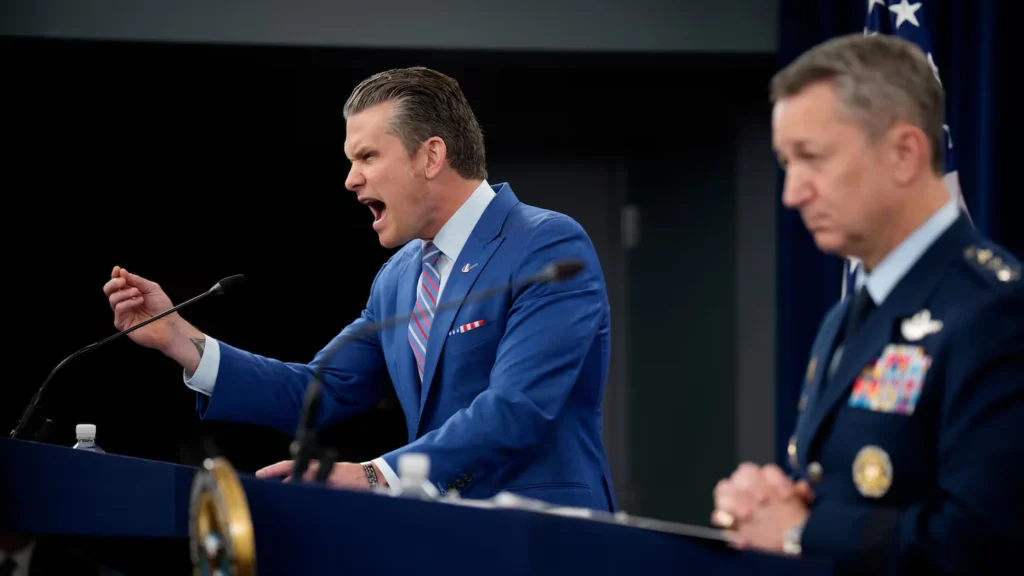
U.S. Defense Secretary Pete Hegseth also confirmed that an American submarine torpedoed and sank an Iranian warship in the Indian Ocean, marking one of the most dramatic naval incidents of the ongoing war. The strike occurred off the southern coast of Sri Lanka, where the Iranian frigate IRIS Dena was reportedly operating in international waters before being struck by a U.S. submarine-launched torpedo.
First Torpedo Sinking Since World War II
During a Pentagon briefing, Hegseth confirmed that the attack represented the first time a U.S. submarine had sunk an enemy vessel using a torpedo since World War II, highlighting the seriousness of the naval confrontation. He said:
“The Iranian ship thought it was safe in international waters, but was destroyed in the strike as part of expanded U.S. operations against Iranian military capabilities.”
U.S. officials also claimed that Iranian naval power has been significantly weakened during the conflict, with multiple vessels reportedly destroyed in ongoing operations. The Iranian vessel carried roughly 180 crew members, according to regional authorities. Following the attack, dozens remain missing at sea with at least 80 sailors reported killed, and 32 crew members were rescued and hospitalized in Sri Lanka.

The Iranian warship had reportedly been returning from a multinational naval exercise in India when it was targeted in the Indian Ocean. The sinking of the Iranian warship signals a potentially dangerous shift toward full-scale naval confrontation between Iran and U.S. forces.
Conflicting Messages on the Duration of the War
One of the central contradictions emerged when Hegseth initially insisted the war would be limited and short, saying:
“The campaign against Iran was focused on eliminating specific threats and not an endless war.”
However, during subsequent Pentagon briefings, the defense chief stated that:
“The United States would take all the time we need to win the war”
This suggests that operations could last weeks or longer, contradicting earlier assurances of a limited mission. These shifting statements have raised concerns in Washington that the conflict could evolve into a broader regional war.
Pentagon Claims Victory While Expanding Military Operations
Despite escalating hostilities, Hegseth told reporters that:
“America is winning the conflict decisively, describing U.S. operations as devastating and relentless.”
At the same time, the Pentagon confirmed new military actions including:
- Expanded airstrikes deeper into Iranian territory
- The sinking of an Iranian warship by a U.S. submarine near Sri Lanka
- Continued coordination with Israeli forces targeting Iranian military infrastructure
Unclear War Objectives Fuel Political Criticism
Critics argue the administration has failed to articulate a consistent legal and strategic rationale for the war. Reports indicate that officials have offered different explanations for the military campaign, including:
- Preventing Iran from acquiring nuclear weapons
- Destroying Iran’s missile and naval capabilities
- Supporting regime change in Tehran
These shifting narratives have been widely noted by analysts as evidence that the administration’s strategy remains unsettled. Members of the U.S. Congress have warned that the lack of clarity could violate the War Powers Resolution, which requires congressional authorization for extended military operations.
Controversial Remarks and Investigations
The controversy intensified when Hegseth faced questions over a deadly strike on a girls’ school in Iran, saying the Pentagon was still investigating the incident. His aggressive tone during press conferences and remarks about Iran’s leadership have also sparked criticism from media figures and political commentators who say the rhetoric risks inflaming the conflict further.
The contradictory messaging has also sparked debate among legal scholars about the lawfulness of the military campaign under international law. Key issues include:
- Whether the strikes meet the UN Charter’s self-defense requirements
- Whether pre-emptive attacks on Iranian targets can be legally justified
- Whether civilian casualties could trigger international humanitarian law investigations
Some experts argue that inconsistent official statements could weaken the United States’ legal justification for the use of force.
Growing Pressure in Washington
As the war expands, lawmakers in Washington are considering a War Powers resolution to limit the administration’s authority to continue the conflict without congressional approval. If adopted, such legislation could force the White House to either seek formal authorization for the war or withdraw U.S. forces from active combat operations.
Hegseth’s contradictory remarks, ranging from claims that the war will be short to warnings that it may take as long as necessary, have deepened political and legal scrutiny over the United States’ role in the escalating Iran conflict. As military operations intensify, the lack of clear objectives and legal justification is becoming a major issue in Washington and internationally.