
WASHINGTON / COPENHAGEN — U.S. President Donald Trump has reignited international controversy by reviving his vision of expanded U.S. control over Greenland, an autonomous territory of the Kingdom of Denmark, under U.S. control, pairing renewed rhetoric with threats of new tariffs against European partners. U.K. Prime Minister Keir Starmer has already labeled this move as:
“completely wrong.”
In a statement shared from Davos at the World Economic Forum, Trump reiterated that the U.S. will “not go back” on seeking to exert control over Greenland and refused to rule out military options to achieve that goal. The renewed campaign has raised serious questions about adherence to international law and respect for territorial sovereignty, central pillars of the post-World War II legal order. Trump said:
“As I expressed to everyone, very plainly, Greenland is imperative for National and World Security. There can be no going back — On that, everyone agrees!”
Trump suggested that additional trade penalties could be imposed on U.S. allies if negotiations over Greenland’s strategic future do not align with American interests. The remarks follow earlier tariff threats targeting European exports and have been widely interpreted as an effort to apply economic pressure in a dispute traditionally governed by diplomacy and treaty law.
The escalation has prompted legal and diplomatic warnings that Washington may be testing fundamental principles of international law governing sovereignty, self-determination, and non-coercion. Trump’s Greenland rhetoric also follows his recent criticism of the United Kingdom’s decision to transfer sovereignty of the Chagos Islands, signaling a broader challenge to post-war norms governing territorial arrangements among allies.
Tariffs, Coercion & NATO Strains
In a controversial move, Trump threatened a sweeping tariff regime of up to 25 % on imports from key European allies, including Denmark, Germany, France, and the UK, unless they acquiesce to U.S. demands regarding Greenland’s status. European diplomats and public officials have denounced the threats as coercive and legally dubious, arguing they imperil long-standing alliances and violate norms against economic blackmail.
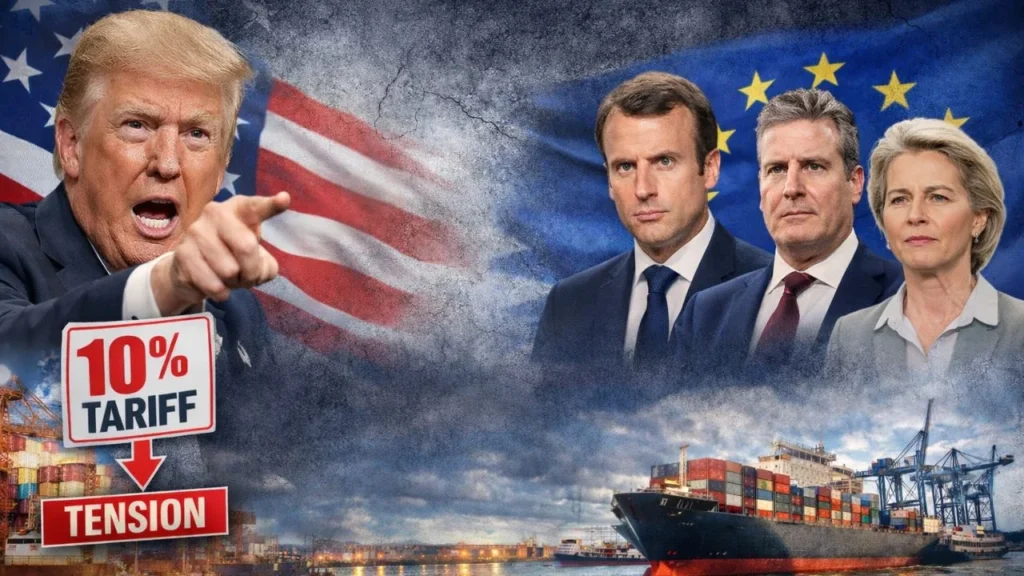
Trump over the weekend threatened to impose a 10% tariff on European allies beginning Feb. 1 “on any and all goods sent to the United States of America” until Denmark agrees to sell Greenland to the U.S. Trump said the tariff would be increased to 25% on June 1. Trump said:
“This Tariff will be due and payable until such time as a Deal is reached for the Complete and Total purchase of Greenland.”
Senior European leaders have mobilized emergency diplomatic responses to head off a broader crisis, and NATO partners have stressed that territorial integrity and collective defense obligations under Article 5 must be upheld.
Global Backlash & Legal Critics
The Trump administration’s actions have drawn rare bipartisan criticism at home and united opposition overseas. Prominent lawmakers in the U.S., including members of Trump’s own Republican Party, have condemned the tariff threats as “bad for America” and damaging to U.S. constitutional authority and diplomatic standing.
At the U.N., Secretary-General António Guterres has publicly lamented the erosion of international legal norms by powerful states, implicitly criticizing U.S. actions that prioritize power politics over treaty obligations and established multilateral processes. Guterres believes that U.S. foreign policy reflects what he described as a belief that
“The power of law should be replaced by the law of power, arguing that Washington increasingly relies on its influence rather than international norms.”
Greenland & NATO Partners Resist Pressure
Greenland’s prime minister, Jens-Frederik Nielsen, has specifically said at a joint news conference in Copenhagen with Denmark’s prime minister, Mette Frederiksen:
“We choose NATO. We choose the Kingdom of Denmark. We choose the EU.”
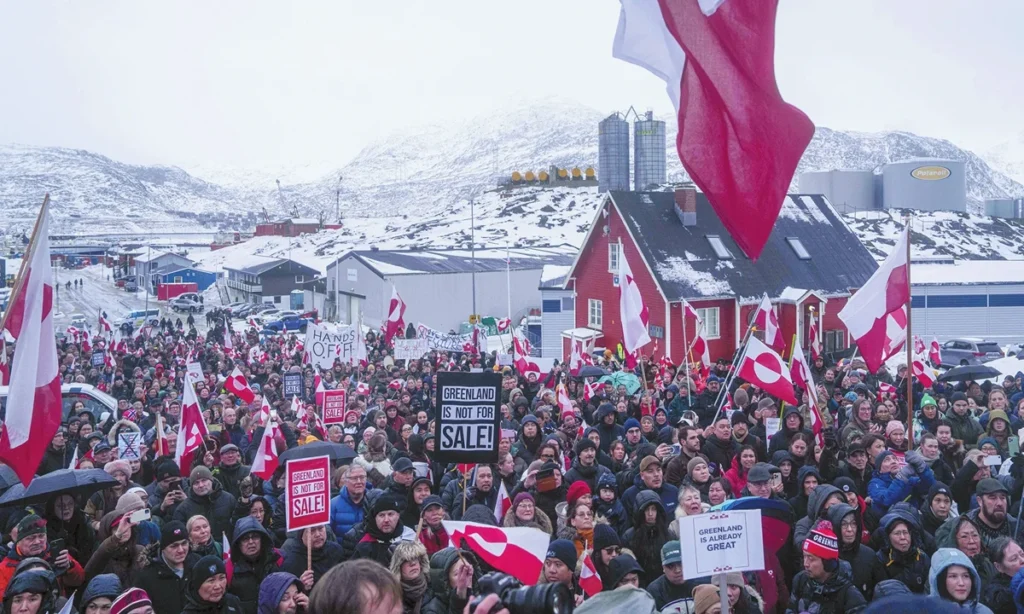
Greenlandic and Danish officials have repeatedly emphasized that the territory is “not for sale” and reaffirmed their commitment to international law and self-determination. Massive protests in Copenhagen and Nuuk under the banner “Hands off Greenland” have bolstered diplomatic efforts to reject U.S. pressure and dispel tropes of external domination.
At the same time, Denmark has bolstered its military presence in Greenland within the NATO framework, deploying additional troops and participating in exercises aimed at deterring any destabilizing actions. The military exercise was requested by Denmark in response to Trump’s threats to take control of Greenland.
The soldiers, positioned in the capital city of Nuuk and in the town of Kangerlussuaq in western Greenland, will take part in NATO military training exercises, dubbed “Arctic Endurance.” In an eyebrow-raising move, German troops quietly packed up and left the island on Sunday, just two days after arriving for the training.
Legal Norms at Stake
International law traditionally protects:
- Territorial sovereignty and the principle that no state may acquire territory by force or coercion.
- Self-determination of peoples under the U.N. Charter.
- Non-interference in the internal affairs of other states.
Experts say Trump’s public rhetoric, suggesting tariffs, questioning Denmark’s claim, and hinting at military options, challenges these norms and could set a dangerous precedent for great-power conduct in the 21st century. Potentially justifying coordinated legal and economic countermeasures by the EU, the officials have characterized the tariff threats as a:
“textbook case of coercion.”
Greenland Standoff Tests Rules-Based Global Order
Analysts warn that the Greenland row could have lasting effects on:
- Transatlantic alliances (especially NATO cohesion).
- Global trade law (disputes over tariff legality under the WTO).
- Arctic governance (multilateral cooperation over militarization and resources).
The situation in Greenland is increasingly being viewed both as a test of U.S. foreign policy restraint and of the durability of the rules-based international order in the face of coercive diplomacy.
Greenlandic leaders emphasize that the dispute is not merely strategic but existential, warning that external pressure disregards the right of peoples to determine their political future. That right remains a cornerstone of modern international law developed in the post-World War II era.
As rhetoric intensifies, analysts say the Greenland dispute may become a test case for the durability of the rules-based international order. Whether Washington follows through on tariff threats or recalibrates its approach, critics warn that using economic power to pressure territorial outcomes could set a precedent extending far beyond the Arctic.
Timeline: Key Developments in the Greenland Dispute
August 2019
U.S. President Donald Trump publicly expresses interest in purchasing Greenland, calling it a “large real estate deal.” Danish officials reject the idea outright, stating that Greenland is not for sale. Greenland’s government emphasizes the island’s right to self-determination.
September 2019
Following Denmark’s rejection, Trump abruptly cancels a scheduled state visit to Copenhagen, triggering diplomatic tension between the United States and Denmark. Legal experts note early concerns about respect for sovereignty and international norms.
2020–2023
The issue remains dormant publicly but continues to surface in U.S. strategic discussions focused on Arctic security, military positioning, and access to natural resources. Greenland expands diplomatic outreach, including opening a representative office in Washington.
2024
As Arctic competition intensifies due to climate change and shipping routes, U.S. political figures revive discussions about Greenland’s strategic value. Danish and Greenlandic leaders reiterate that any change in status can occur only through democratic processes.
Late 2025
Donald Trump, campaigning on an “America First” platform, signals renewed interest in Greenland’s strategic alignment with the United States. Reports emerge of internal discussions linking trade leverage with broader geopolitical objectives.
January 2026
Trump publicly threatens new tariffs on European allies while reviving rhetoric about Greenland’s future, prompting immediate diplomatic pushback from Denmark and Greenland. European officials warn that economic pressure tied to territorial issues may violate international legal norms.
Mid-January 2026
Legal scholars and international law experts raise concerns that using tariffs to influence sovereignty questions could amount to coercive interference under international law. NATO allies express unease over growing transatlantic strain. The Greenland dispute escalates into a broader test of international legal norms governing sovereignty, self-determination, and non-coercion.
Latest
The decision to pause tariff escalation, announced days later in Davos, highlights how quickly coercive economic strategies can collide with alliance politics and legal norms, without resolving the underlying sovereignty dispute.