
A complete beginner’s guide to Environmental Impact Assessment. Learn what an EIA is, how the process works, key steps, legal requirements, and why it matters.
Environmental Impact Assessment (EIA) has become one of the most vital tools in modern environmental management and sustainable development planning. As the world grapples with climate change, biodiversity loss, and resource depletion, understanding the potential environmental consequences of development projects before they begin has never been more critical. This comprehensive guide explores what EIA is, why it matters, and how it shapes responsible development worldwide.
Defining Environmental Impact Assessment
Environmental Impact Assessment is a systematic, formal process used to evaluate the potential environmental consequences of a proposed project, policy, program, or plan before a decision is made to proceed with implementation. According to Wikipedia’s comprehensive definition:
“EIA assesses environmental consequences before moving forward with proposed actions.”
The process examines how a project might affect various aspects of the environment, including air and water quality, soil conditions, biodiversity and ecosystems, local communities and human health, cultural and heritage sites, and natural resources. By identifying potential problems early, EIA enables decision-makers to modify projects, implement mitigation measures, or in some cases, reject proposals that would cause unacceptable environmental harm.
EIA differs from Strategic Environmental Assessment (SEA), which applies to higher-level policies, plans, and programmes. While EIA focuses on individual projects proposed by companies or individuals, SEA addresses broader governmental initiatives and planning frameworks.
The fundamental purpose of EIA, as explained by EcoOnline’s environmental glossary is:
“to ensure that decision-makers consider environmental impacts when deciding whether to proceed with a project.”
This tool of environmental management forms a crucial part of project approval and decision-making processes worldwide.
Source: EIA Process Overview Diagram
The Historical Development of EIA
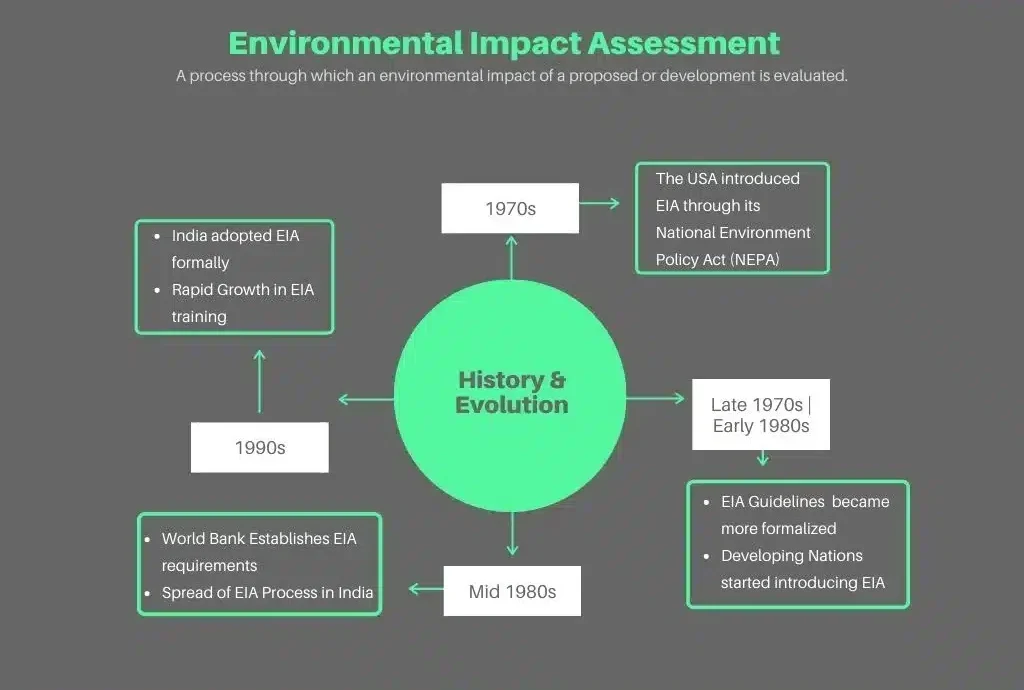
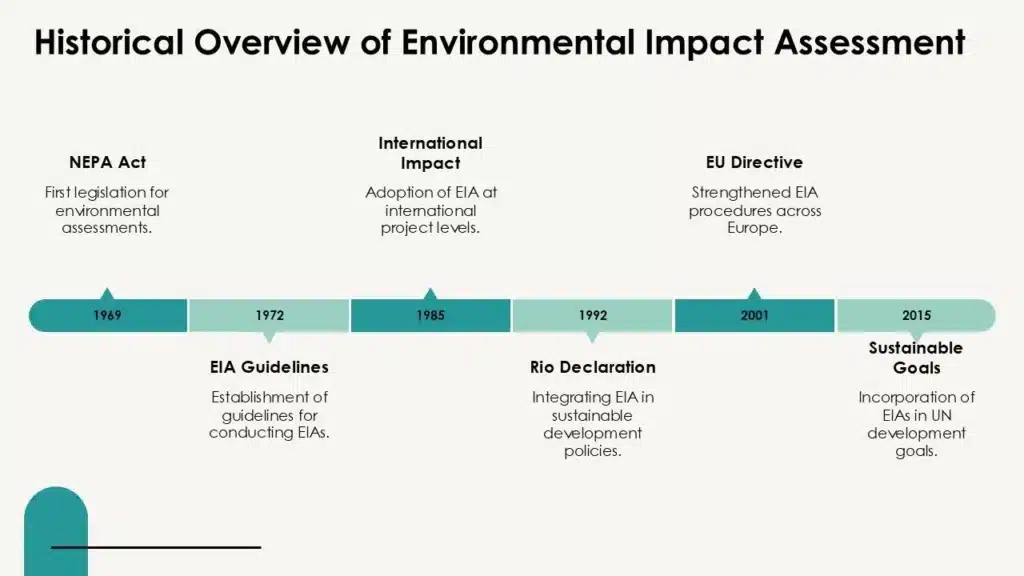
The modern EIA process originated in the United States with the passage of the National Environmental Policy Act (NEPA) in 1970. This landmark legislation established EIA as a formal requirement for federal actions significantly affecting the environment. NEPA’s introduction marked a revolutionary shift in how governments and organizations approach development planning.
Following the United States’ lead, countries worldwide began adopting EIA frameworks. Canada, Australia, and European nations implemented their own EIA systems throughout the 1970s and 1980s. The process gained international recognition as an essential tool for environmental protection and sustainable development.
In developing nations, EIA adoption accelerated during the 1980s and 1990s, often driven by international development banks and lending institutions requiring environmental assessments for funded projects.
According to Mission Sustainability’s historical overview:
“India introduced its first official EIA Notification in 1994, following growing environmental concerns and the wake-up call provided by the 1984 Bhopal gas tragedy.”
The 1994 Indian notification required certain projects to undergo EIA before approval. In 2006, India revised the notification, introducing project categories and improving the assessment process. This evolution demonstrates how EIA frameworks continue adapting to address emerging environmental challenges and incorporate lessons learned from implementation experience.
International agreements and conventions have further strengthened EIA requirements. The 1991 Espoo Convention on Environmental Impact Assessment in a Transboundary Context established frameworks for assessing environmental impacts that cross national boundaries, recognizing that environmental harm often does not respect political borders.
Source: EIA Historical overview
Core Objectives and Benefits of EIA
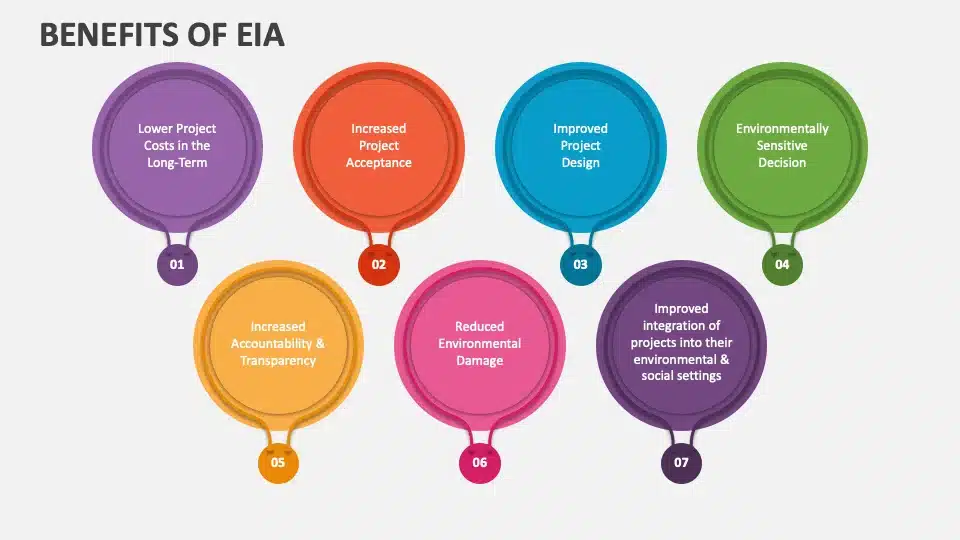
Environmental Impact Assessment serves multiple critical objectives that extend beyond simple regulatory compliance. Understanding these objectives helps explain why EIA has become such a fundamental component of responsible development.
Protecting Environmental Quality
The primary objective is identifying and preventing environmental degradation before it occurs. By assessing potential impacts during the planning phase, projects can be designed to avoid or minimize harm to air, water, soil, and ecosystems. This proactive approach proves far more effective and economical than attempting to remediate environmental damage after the fact.
Informing Decision-Making
According to the HUD Exchange environmental assessment guide:
“EIA facilitates informed decision-making by providing clear, well-structured, factual analysis of the effects and consequences of proposed actions.”
Decision-makers receive comprehensive information about environmental trade-offs, enabling them to weigh development benefits against potential environmental costs.
Promoting Sustainable Development
EIA helps promote development that is sustainable and optimizes resource use and management opportunities. By incorporating environmental considerations into development planning from the outset, EIA ensures that economic progress does not come at the expense of environmental quality or future generations’ needs.
Ensuring Public Participation
Modern EIA processes emphasize stakeholder engagement and public participation. Communities affected by proposed projects have opportunities to voice concerns, share local knowledge, and influence project design. This democratic aspect of EIA builds trust, improves project outcomes, and ensures that development benefits align with community values and priorities.
Legal and Regulatory Compliance
Many jurisdictions mandate EIA for certain types or scales of projects. Conducting proper environmental assessments ensures compliance with environmental laws and regulations, reducing legal risks and avoiding costly project delays or cancellations due to regulatory violations.
Enhancing Corporate Responsibility
For businesses, conducting thorough EIAs demonstrates commitment to environmental stewardship and corporate social responsibility. This transparency can enhance corporate reputation, build stakeholder confidence, and create competitive advantages in markets where environmental performance matters to customers and investors.
According to EcoOnline’s analysis:
“Environmental impact assessments offer transparent processes for identifying impacts, encouraging stakeholder participation.”
This transparency and collaboration in decision-making builds trust and confidence among all parties involved.
Source: EIA Benefits Infographic
When Is EIA Required?
The requirement for conducting EIA varies by country, jurisdiction, and project characteristics. Understanding when EIA is necessary helps project proponents plan appropriately and avoid regulatory complications.
Project Size and Scale
Many jurisdictions establish size thresholds that trigger EIA requirements. Large-scale projects typically require full EIA regardless of other factors. For example, major infrastructure developments like highways, airports, and dams almost always undergo comprehensive environmental assessment.
According to EcoOnline’s requirements overview:
“The requirement for EIA is often triggered by the size, scale, and complexity of the proposed activity or project.”
Smaller projects may be exempt or subject to simplified screening processes.
Project Type and Sector
Certain project categories automatically require EIA due to their inherent environmental sensitivity. These commonly include mining and extractive industries, power generation facilities (especially fossil fuel plants), industrial manufacturing plants, waste management facilities, and large agricultural or forestry operations.
In the United States, the EPA’s NEPA:
“The review process requires EIA for major federal actions significantly affecting the quality of the human environment.”
This includes projects receiving federal funding, requiring federal permits, or occurring on federal lands.
Environmental Sensitivity
Project location significantly influences EIA requirements. Developments proposed in or near environmentally sensitive areas typically require assessment regardless of size. Sensitive areas include protected areas and nature reserves, wetlands and coastal zones, critical wildlife habitats, areas with endangered species, and cultural or heritage sites.
Potential Impact Severity
Projects likely to cause significant environmental impacts require EIA even if they do not meet size thresholds or fall into automatically assessed categories. Significance is determined by considering factors like magnitude of change to environmental conditions, duration and reversibility of impacts, and number of people or area affected.
Transboundary Impacts
Projects with potential impacts extending beyond national borders may require international EIA processes, as established by conventions like the Espoo Convention. This ensures that affected nations have input into environmental decision-making.
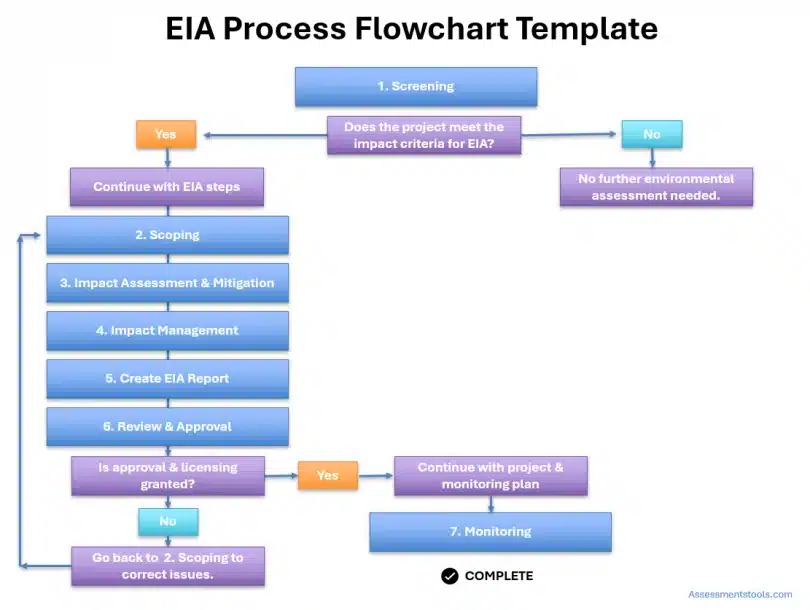
Source: EIA Triggering Criteria Chart
The Global Regulatory Framework
EIA operates within complex regulatory frameworks that vary considerably across jurisdictions while sharing common principles and objectives.
United States NEPA System
The National Environmental Policy Act establishes the federal EIA framework in the United States. Under NEPA, federal agencies must prepare Environmental Assessments (EA) or Environmental Impact Statements (EIS) for major actions. According to the EPA’s process description:
“Agencies first determine whether Categorical Exclusions apply, then prepare EAs to assess significance, and finally develop full EISs for actions with significant impacts.”
European Union Directive
The EU Environmental Impact Assessment Directive establishes requirements for member states. According to Capacity4dev’s EIA information:
“The Directive underwent revision in 2014 and continues evolving to address new environmental challenges.”
The system emphasizes public participation consistent with the Aarhus Convention.
Developing Country Systems
Many developing nations have established EIA systems, often with support from international development institutions. These systems face unique challenges including limited resources and expertise, weak enforcement capacity, and balancing development pressures with environmental protection. However, as demonstrated by India’s evolving framework, these systems continue strengthening over time.
International Standards
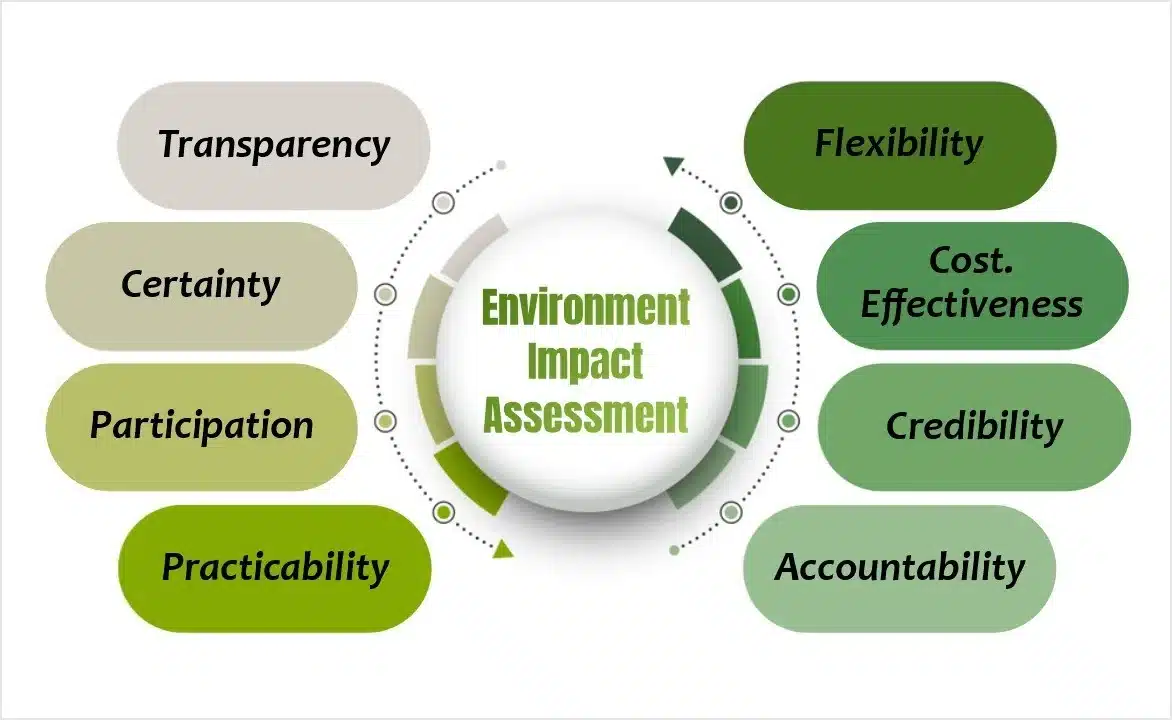
Beyond national regulations, international standards guide EIA practice. The International Association for Impact Assessment (IAIA) has developed principles of EIA best practice that provide widely agreed guidance for practitioners worldwide. These principles emphasize rigor, practicality, credibility, cost-effectiveness, efficiency, focus, adaptability, and participation.
Key Components of Effective EIA
While specific requirements vary, effective EIA processes share common elements that ensure comprehensive environmental assessment.
Baseline Environmental Studies
Understanding existing environmental conditions provides the foundation for impact assessment. Baseline studies document the state of the environment before project implementation, covering physical parameters (climate, air quality, water resources, soil conditions, topography), biological parameters (flora, fauna, ecosystems, biodiversity), and socioeconomic parameters (population, land use, cultural resources, economic activities).
This baseline information establishes the reference point against which predicted project impacts are measured.
Impact Identification and Prediction
The heart of EIA involves identifying which environmental components the project will affect and predicting the nature and magnitude of those impacts. This requires understanding causal relationships between project activities and environmental changes.
Predictions address questions about the type of impact (positive or negative), magnitude and intensity, spatial extent (local, regional, global), temporal dimensions (short-term or long-term, temporary or permanent), and probability of occurrence.
Alternatives Analysis
Effective EIA examines project alternatives, including different locations, technologies, designs, and operational approaches. Even the “no-action” alternative is considered to understand what would happen if the project does not proceed.
Comparing alternatives helps identify the most environmentally sound approach and may reveal options that achieve project objectives with fewer environmental costs.
Mitigation Measures
When impacts cannot be avoided entirely, EIA identifies measures to minimize, reduce, or offset environmental harm. The mitigation hierarchy prioritizes avoiding impacts first, then minimizing unavoidable impacts, and finally compensating for residual impacts through offsets or restoration.
Environmental Management Plans
The assessment culminates in an Environmental Management Plan (EMP) that details how mitigation measures will be implemented, who is responsible for implementation, what resources are required, and how compliance will be monitored. According to Capacity4dev:
“EMPs lay out implementation and monitoring procedures for recommended measures.”
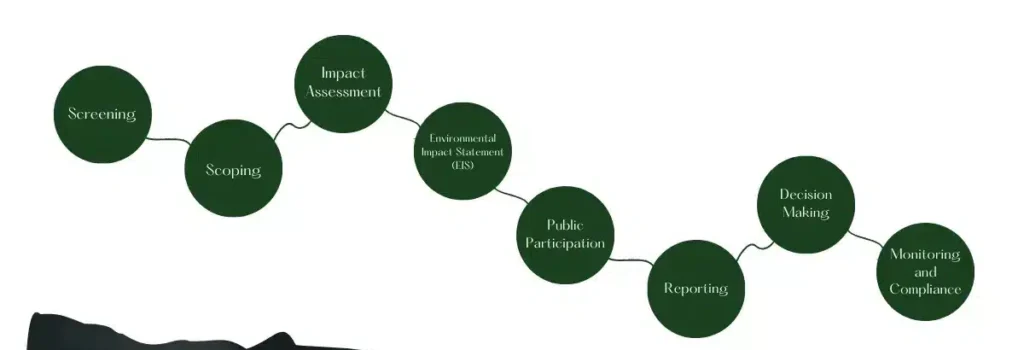
Source: EIA Process
The Role of Stakeholder Engagement
Public participation has evolved from a peripheral activity to a central element of effective EIA. Meaningful stakeholder engagement improves assessment quality, builds social acceptance, and ensures that local knowledge informs environmental decision-making.
Types of Stakeholders
EIA processes involve diverse stakeholders including affected communities and landowners, indigenous peoples with traditional territories or interests, local and national government agencies, environmental organizations and advocacy groups, technical experts and scientific institutions, and project proponents and their consultants.
Participation Methods
Stakeholder engagement employs various methods depending on project scale, context, and regulatory requirements. Common approaches include public meetings and hearings, written comment periods, focused stakeholder workshops, community advisory committees, and online consultation platforms.
Benefits of Participation
According to EcoOnline’s stakeholder analysis:
“Environmental impact assessments offer transparent processes for identifying impacts and encourage stakeholder participation. Stakeholders can voice opinions, concerns, and priorities, contributing to project credibility.”
Effective participation helps identify impacts that technical studies might miss, incorporates local and traditional ecological knowledge, builds trust and reduces conflict, and improves project design through diverse perspectives.
Emerging Trends in EIA Practice
As environmental challenges evolve and technology advances, EIA practice continues developing in several important directions.
Climate Change Integration
Modern EIAs increasingly address climate change from two angles: how projects contribute to greenhouse gas emissions (mitigation) and how projects and affected communities will cope with climate impacts (adaptation). This dual focus ensures that development projects align with climate action goals.
Cumulative Impact Assessment
Rather than examining projects in isolation, contemporary EIA considers cumulative impacts from multiple developments affecting the same environment. This systems-level perspective better captures real-world environmental pressures.
Strategic Environmental Assessment
Strategic Environmental Assessment (SEA) applies EIA principles to policies, plans, and programs, enabling environmental considerations to inform higher-level decision-making before individual projects are proposed. This proactive approach can prevent environmental problems more effectively than project-level assessment alone.
Technology Applications
Digital tools are transforming EIA practice. Geographic Information Systems (GIS) enable sophisticated spatial analysis, remote sensing provides comprehensive environmental monitoring data, and modeling software improves impact prediction accuracy. These technologies make EIA more rigorous and efficient.
Ecosystem Services Approach
Increasingly, EIA examines impacts on ecosystem services – the benefits that humans derive from ecosystems. This framework helps communicate environmental values in terms meaningful to decision-makers and the public.
Conclusion
Environmental Impact Assessment represents humanity’s commitment to understanding and managing the environmental consequences of development. From its origins in 1970s environmental legislation to its current global application, EIA has evolved into a sophisticated, multi-faceted process that shapes how societies balance progress with environmental stewardship.
At its core, EIA embodies a simple but profound principle: look before you leap. By requiring systematic examination of potential environmental impacts before projects proceed, EIA enables informed decision-making that considers environmental costs alongside economic and social benefits. This foresight helps avoid environmental damage that would be difficult or impossible to reverse, protecting natural resources and ecosystem services for current and future generations.
The effectiveness of EIA depends on multiple factors including regulatory frameworks that require rigorous assessment, adequate resources and expertise, meaningful public participation, decision-makers who take EIA findings seriously, and robust monitoring and enforcement mechanisms. When these elements align, EIA succeeds in steering development toward more sustainable pathways.
As we face escalating environmental challenges including climate change, biodiversity loss, and resource scarcity, the importance of EIA will only grow. Strengthening EIA systems, improving assessment methods, and ensuring that environmental considerations genuinely influence decisions about development represent crucial tasks for the global community.
Environmental Impact Assessment is not a perfect tool, but it remains our best systematic approach to understanding and managing the environmental consequences of human activities. By continuing to refine and strengthen EIA practice worldwide, we can work toward a future where economic development and environmental protection advance together rather than in conflict.
Frequently Asked Questions
What is the difference between Environmental Assessment (EA) and Environmental Impact Statement (EIS)?
Under systems like the United States NEPA, Environmental Assessment (EA) is a shorter document that determines whether a proposed action will have significant environmental impacts. If the EA concludes no significant impact, a Finding of No Significant Impact (FONSI) is issued. If significant impacts are identified, a full Environmental Impact Statement (EIS) must be prepared. The EIS is more comprehensive and detailed, with stricter procedural requirements including extended public comment periods.
How long does the EIA process typically take?
EIA duration varies considerably based on project complexity, regulatory requirements, and stakeholder processes. Simple projects might complete screening and scoping within weeks, while complex projects requiring full EIS can take 6 to 18 months or longer. Large infrastructure projects with significant environmental concerns and extensive public involvement may require several years from initial screening through final approval.
Who pays for Environmental Impact Assessment?
Typically, the project proponent (the company or organization proposing the development) bears the cost of conducting EIA. However, regulatory agencies, not proponents, make the final decisions on project approval. This separation helps maintain objectivity. EIA costs generally range from 0.1 to 3% of total project costs, depending on project size and complexity.