
A rare and forceful public statement by Melania Trump denying any connection to Jeffrey Epstein has ignited a fresh legal and political storm in Washington. The remarks have brought renewed attention to the legal boundaries of defamation, evidentiary standards in high-profile allegations, and the broader accountability surrounding the Epstein network.
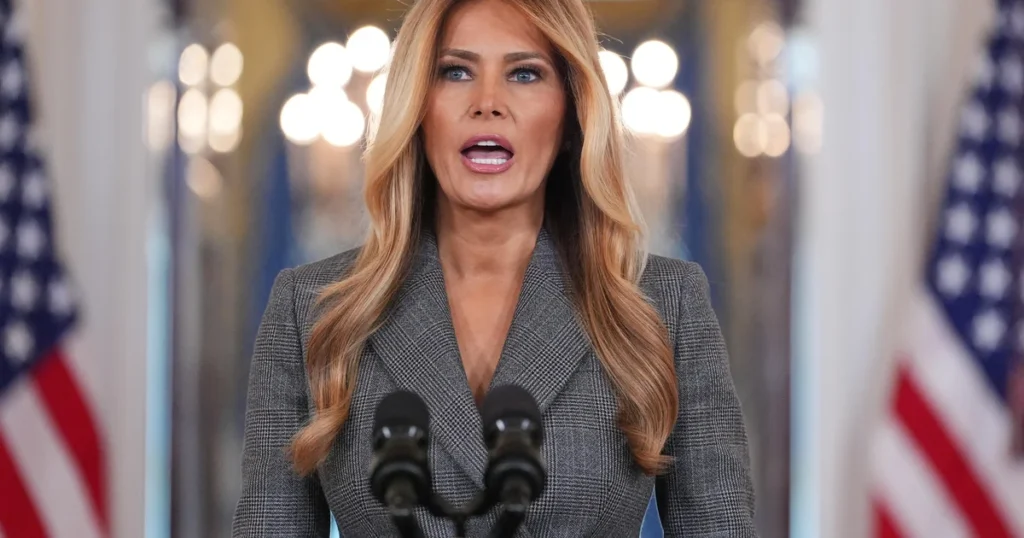
Framed as a direct response to what she described as:
“false and defamatory claims”
The “Revelation”: A Forceful Legal Denial
In a highly unusual White House address, Melania Trump firmly rejected allegations linking her to Epstein, stating she had:
“never been friends with him and had no relationship with either Epstein or his associate Ghislaine Maxwell.”
She further clarified that:
- Epstein did not introduce her to Donald Trump
- Any past communication with Maxwell was casual and insignificant
- She has never been named in any legal proceedings related to Epstein
The statement was structured in a manner consistent with legal positioning, rather than mere public clarification. By explicitly rejecting claims of connection and addressing specific points, such as how she met Donald Trump and the nature of any incidental social encounters, Melania Trump appeared to be laying the groundwork for potential defamation claims against individuals or media outlets circulating such allegations.
Her remarks also sought to distinguish between casual social proximity and legally meaningful association, a distinction that is central in defamation and reputational law. Importantly, the tone and content of the denial suggest an awareness of the evidentiary implications of public statements. In high-profile controversies, such statements can later be scrutinized in legal proceedings, making precision in language critical.
Legal Fallout: Defamation and Media Liability
Melania Trump’s response has strong legal undertones, particularly in the area of defamation law. Her legal team has reportedly:
- Pursued legal action or threats of litigation against individuals and media outlets
- Sought retractions and corrections for alleged false claims
- Warned of further lawsuits to protect her reputation
But to succeed in defamation claims, especially as a public figure, she must prove:
- Statements were false
- Made with actual malice (knowledge of falsity or reckless disregard for truth)
This sets a high legal threshold, making such cases complex and politically sensitive.
Evidence Controversy: Emails, Photos, and “Association”
At the center of the dispute are pieces of circumstantial material, photos, reported email exchanges, and social sightings that critics cite to suggest some level of connection between Melania Trump and Jeffrey Epstein. These include images from high-profile social events attended by overlapping figures, as well as references to a reported 2002 email exchange with Ghislaine Maxwell.
However, the legal significance of such material remains highly contested. Melania Trump’s position is that these instances represent incidental or superficial contact. This is typical of elite social circles, and they do not establish any meaningful personal or legal relationship. A line that is central in defamation and reputational law is her defense that draws a critical distinction between
“mere association and substantive involvement.”
From a legal standpoint, the question is not whether individuals appeared in the same spaces or had minimal interaction, but whether there is credible evidence of a sustained relationship or participation in unlawful conduct. Courts generally require more than proximity or occasional contact to infer liability or reputational harm. In this context, photographs or brief communications may be considered weak or non-probative evidence unless supported by additional corroborating facts.
Congressional and Investigative Implications
The statement comes amid renewed scrutiny of Epstein-related files and political pressure for greater transparency. Lawmakers in Washington have increasingly faced pressure to revisit unresolved questions related to Epstein’s associations, financial dealings, and the extent of institutional awareness or failure.
One key implication is the possibility of congressional hearings or inquiries aimed at expanding transparency. While Melania Trump has not been formally implicated in any legal proceedings, her public denial may intersect with broader investigative efforts seeking to map relationships, clarify timelines, and assess the credibility of claims circulating in the public domain.
From a legal standpoint, congressional investigations operate under a different framework than criminal proceedings. Their purpose is not necessarily to establish guilt, but to gather information, assess systemic failures, and inform potential legislative reforms. In this context, her denial can become relevant as reference points for questioning, verification, or contradiction, particularly if new evidence emerges.
Timing and Strategic Legal Positioning
Analysts note that the timing of the statement is significant:
- It follows renewed attention to Epstein documents and investigations
- It may be an attempt to preempt potential allegations or disclosures
- It coincides with political pressure on the administration over Epstein-related issues
From a legal perspective, early public denial can serve as:
- A reputation management strategy
- A foundation for future legal claims against accusers
Broader Legal Implications
The controversy surrounding Melania Trump’s denial of any connection to Jeffrey Epstein extends far beyond individual reputation, raising fundamental legal questions about defamation, evidence, accountability, and the evolving role of public discourse in high-profile cases. These broader legal issues are:
1. Defamation vs. Public Interest
As a public figure, Melania Trump faces a higher legal threshold in pursuing defamation claims, requiring proof of “actual malice”, that false statements were made knowingly or with reckless disregard for the truth. This standard protects investigative journalism and public debate, but also makes it difficult for individuals to counter reputational harm, particularly in cases driven by speculation or indirect associations.
2. Guilt by Association
In high-profile investigations like those involving Epstein, individuals who appear in social, financial, or photographic proximity to controversial figures may face public scrutiny. However, legally, such proximity does not establish liability or wrongdoing without clear, corroborated evidence of involvement. This distinction is crucial in preventing the erosion of due process and evidentiary standards.
3. Use of Public Statements as Legal Evidence
In the modern information environment, remarks made in press conferences or online platforms can function as quasi-legal declarations, potentially influencing investigations, shaping public perception, and even being cited in legal proceedings. This blurs the boundary between legal defense and public relations, making strategic communication an integral part of legal positioning.
Conclusion
The controversy surrounding Melania Trump’s denial of any association with Jeffrey Epstein illustrates the complex intersection of law, reputation, and public scrutiny in high-profile cases. What began as a personal rebuttal has evolved into a broader legal discourse involving defamation standards, evidentiary thresholds, and the role of media and public statements in shaping accountability.
This highlights a key reality of modern legal systems that reputation, evidence, and accountability are increasingly contested not only in courts but also in the public sphere, where legal principles must adapt to the speed and scale of information dissemination.