
The dramatic shootdown of a U.S. F-15E Strike Eagle over Iran and the massive operation launched to rescue its crew have triggered serious legal, strategic, and geopolitical scrutiny. What began as a tactical crisis evolved into a strategic and legal flashpoint, exposing both the risks of U.S. military escalation and the evolving nature of modern warfare accountability, with global implications.
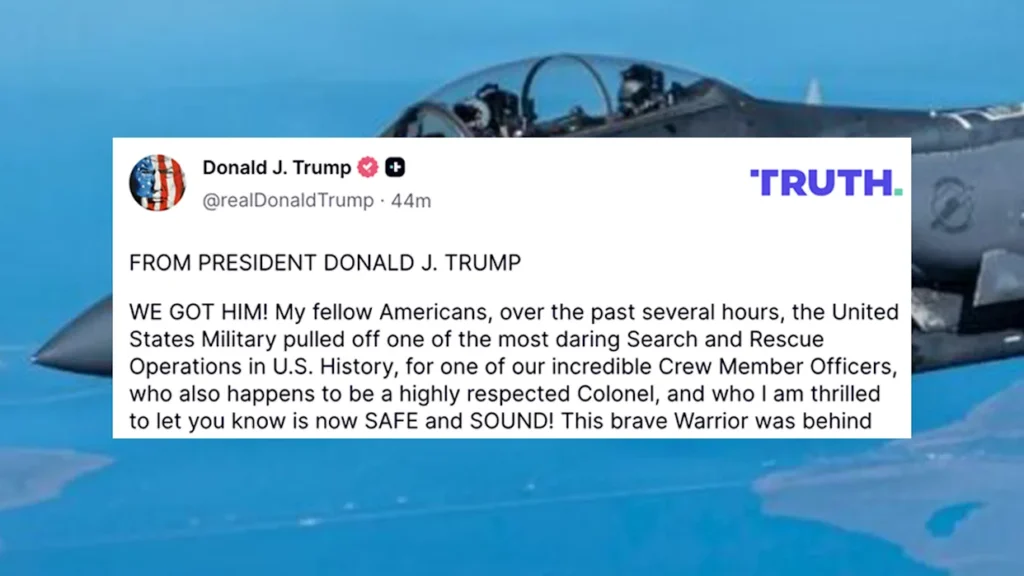
The controversy surrounding the F-15E colonel has brought renewed legal and geopolitical scrutiny to the United States’ large-scale air armada rescue mission in Iran. As details emerge, questions are being raised not only about operational decision-making but also about compliance with international law, including the rules governing the use of force and command responsibility.
The incident sits at the intersection of military necessity and legal accountability, with broader implications for U.S. state conduct, escalation risks, and the evolving framework of the law of armed conflict. This analysis examines the legal basis of the operation and the geopolitical consequences that may follow.
The Incident: From Shootdown to “Air Armada” Rescue
The incident began when a U.S. F-15E Strike Eagle was shot down while operating over Iranian territory during an active combat mission. Initial reports indicate that the aircraft was hit by a surface-to-air threat, possibly a shoulder-fired missile (MANPADS). This marked a significant development as it was the first confirmed loss of a U.S. crewed combat aircraft inside Iran during the conflict.
The two crew members, a pilot and a weapons systems officer, one of whom was a senior-ranking colonel, successfully ejected before the aircraft crashed. However, their descent into hostile territory immediately created a high-risk personnel recovery scenario, with the danger of capture by Iranian forces or affiliated militias.
Within hours of the shootdown, the United States initiated a Combat Search and Rescue (CSAR) operation, one of the most sensitive and complex types of military missions. The priority was to recover the downed aircrew before enemy forces could locate them, as rescue operations in hostile territory are governed by the principle that no personnel areleft behind, and also require rapid escalation of military assets.
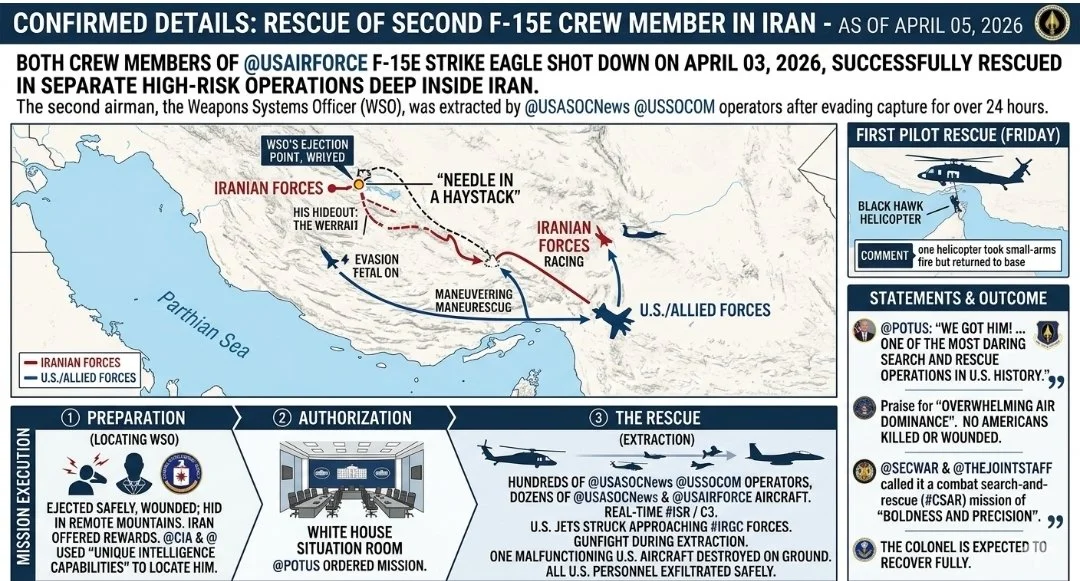
What followed was an unprecedented escalation. The U.S. deployed what has been described as an:
“air armada, a massive, coordinated aerial operation involving over 100–150 aircraft.”
The operation was not a simple rescue as it was a full-spectrum military operation, designed to dominate the airspace, confuse enemy defenses, and ensure safe extraction.
Why Was a Colonel Flying in an F-15E?
The presence of a senior-ranking officer, a colonel in the cockpit of an F-15E Strike Eagle during active combat operations over Iran has drawn unusual attention, but within military practice, it is neither unprecedented nor unlawful. However, in the context of a high-intensity conflict, it carries significant strategic, operational, and legal implications.
One of the most debated aspects of the incident is why a colonel (a senior-ranking officer) was flying in a frontline strike aircraft. Military experts clarify that:
- Senior officers often maintain combat flight certification
- Leadership presence in combat is seen as operationally valuable
- It allows commanders to directly oversee missions and maintain credibility
As retired Lt. Gen. Dave Deptula explained, even generals have historically flown combat missions to:
“lead from the front and maintain operational readiness.”
From a legal standpoint, there is no prohibition under international law or military law against senior officers participating in combat missions. In fact:
- All uniformed personnel engaged in combat are considered lawful combatants
- Rank does not alter their legal status under international humanitarian law (IHL)
However, the decision may still be scrutinized under command responsibility principles, particularly if:
- The resulting escalation led to disproportionate military action
- The mission exposed critical leadership unnecessarily
- Potential escalation if senior personnel are captured
- Political pressure to launch large-scale rescue operations
Legal Fallout: Sovereignty and Use of Force
The rescue mission itself raises complex issues under international law.
1. Violation of Sovereignty
The operation involved large-scale U.S. military activity inside Iranian territory, which may be interpreted as:
- A violation of state sovereignty
- An unlawful use of force under Article 2(4) of the UN Charter, unless justified as self-defense
2. Self-Defense Justification
The U.S. may argue the rescue falls under:
- Self-defense doctrine (Article 51)
- Protection of its personnel in hostile territory
However, critics argue that deep penetration rescue missions involving 150+ aircraft may exceed what is considered necessary and proportionate.
Strategic Blowback: Limits of U.S. Air Superiority
The shootdown of a U.S. F-15E Strike Eagle over Iran, and the scale of the subsequent rescue operation, have exposed a critical reality in modern warfare that U.S. air superiority, long considered uncontested, is increasingly vulnerable in contested and asymmetric environments.
The incident represents not just a tactical setback but a broader strategic blowback with long-term implications for military doctrine, deterrence, and global power perception. The incident has exposed significant strategic :
- The F-15E was reportedly downed by a low-cost, shoulder-fired missile (MANPADS)
- This challenges U.S. claims of air dominance over Iran
- It demonstrates the effectiveness of asymmetric warfare
Additionally, the rescue mission itself:
- Resulted in damaged aircraft and operational risk
- Required massive resources, raising questions about cost-benefit proportionality
Controversy: Rescue Mission or Strategic Cover?
The large-scale U.S. operation to recover the downed F-15E crew has sparked a significant debate among legal analysts and geopolitical observers: was the mission purely a humanitarian combat search and rescue (CSAR) operation, or did it also serve broader strategic or intelligence objectives?
The sheer scale, complexity, and depth of the incursion into Iranian territory have fueled suspicions that the rescue may have had dual-use purposes beyond personnel recovery. Iran has alleged that the rescue operation may have been used as a cover for intelligence or strategic objectives, including attempts to access sensitive sites.
The United States maintains that the mission was a legitimate combat search and rescue effort, grounded in long-standing military doctrine and international law principles. Under this view:
- States have a recognized right to recover their personnel in hostile territory
- The operation falls within self-defense under Article 51 of the UN Charter
- Protecting captured or stranded personnel is considered a military necessity and moral obligation
Despite the official justification, several factors have led to widespread skepticism:
Unprecedented Scale of the Operation: Deploying over 100–150 aircraft, including advanced surveillance and electronic warfare platforms, goes far beyond a typical rescue mission. Critics argue that such a large force suggests:
- Additional operational objectives
- A broader intent to control or map Iranian air defenses
Deep Penetration into Iranian Territory: The mission involved sustained activity deep inside Iran, raising questions about whether the U.S. used the opportunity to:
- Gather real-time intelligence on radar systems and missile sites
- Test Iranian defensive capabilities under combat conditions
Use of Advanced Electronic Warfare: The deployment of sophisticated electronic warfare systems may have allowed the U.S. to:
- Jam and analyze Iranian radar responses
- Identify weaknesses in integrated air defense networks
This reflects a shift toward multi-domain operations, where every mission is designed to maximize strategic value. However, this dual-use nature creates tension with legal norms, as it becomes harder to distinguish between legitimate objectives and opportunistic expansion.
Military Law and Command Responsibility
The F-15E shootdown and subsequent large-scale rescue mission bring into sharp focus the doctrine of command responsibility, a core principle of both military law and international humanitarian law (IHL). While frontline actions are executed by pilots and special forces, legal accountability ultimately extends upward to commanders and decision-makers who plan, authorize, and oversee operations.
Command responsibility is a legal principle that holds military and civilian leaders accountable for unlawful acts committed by forces under their control if they:
- Ordered the unlawful act, or
- Knew or should have known about violations, and
- Failed to prevent or punish such conduct
This doctrine has been recognized in international jurisprudence, including cases before war crimes tribunals, and forms part of customary international law.
Broader Legal Implications
Expansion of War Footprint
The rescue mission effectively expanded the conflict:
- From targeted strikes to deep territorial operations
- Increasing the risk of full-scale war
Precedent for Future Conflicts
The operation may set a precedent where states justify:
- Large-scale incursions
- Under the banner of personnel recovery
Escalation Liability
Such operations increase the risk of:
- Retaliation
- Civilian casualties
- Broader violations of international humanitarian law
Conclusion
The F-15E shootdown and subsequent rescue mission highlight a critical turning point in the Iran conflict. What began as a tactical recovery operation has evolved into a legal and strategic flashpoint, exposing:
- The limits of U.S. military dominance
- The legal ambiguity of cross-border rescue missions
- The escalating risks of leadership involvement in combat
Ultimately, the episode demonstrates a key modern reality that even defensive military actions like rescuing a pilot can trigger profound legal consequences, geopolitical backlash, and strategic instability in high-intensity conflicts.
Frequently Asked Questions
What is the F-15E Colonel controversy about?
The controversy stems from the shootdown of a U.S. F-15E fighter jet over Iran and the presence of a senior-ranking colonel (weapons systems officer) among the crew, followed by a massive U.S. rescue operation inside Iranian territory. It has raised questions about military decision-making, escalation risks, and the legality of cross-border operations.
Why was a colonel flying in a combat mission?
Senior officers like colonels often remain qualified combat pilots and may participate in missions to maintain operational readiness and leadership credibility. However, their presence increases:
Strategic risk if captured
Political pressure for large-scale rescue
Potential escalation of conflict
What made the rescue mission controversial?
Was the rescue mission legal under international law?
What is “command responsibility” in this context?
Command responsibility means senior military and political leaders can be held accountable for decisions that lead to unlawful acts.
In this case, scrutiny focuses on:
Who authorized the mission
Whether risks were properly assessed
Whether the scale of force was legally justified
Did the incident expose limits of U.S. air superiority?
Yes. The F-15E was reportedly downed by a low-cost air defense system, highlighting:
Vulnerability of advanced aircraft
Effectiveness of asymmetric warfare tactics
Limits of U.S. dominance in contested airspace
Why did Iran claim the mission was a “cover”?
Iran alleged that the rescue operation may have been used as a pretext for intelligence gathering or strategic objectives, such as probing defenses or accessing sensitive sites. While unproven, this claim fueled legal debate about good faith in military operations.
What are the geopolitical implications of the incident?
The incident has:
Escalated tensions between the U.S. and Iran
Strained international perceptions of U.S. compliance with international law
Highlighted risks of rapid escalation from tactical events
Could this set a precedent in international law?
Yes. If accepted, such operations could normalize:
Large-scale cross-border incursions for rescue missions
Broader interpretations of self-defense
This risks weakening legal limits on use of force and sovereignty.
What is the key legal takeaway from the controversy?
The main takeaway is that military necessity does not override legal constraints. Even a rescue mission must comply with:
Proportionality
Necessity
Respect for sovereignty
The incident shows how a single battlefield event can trigger global legal scrutiny and geopolitical consequences.