
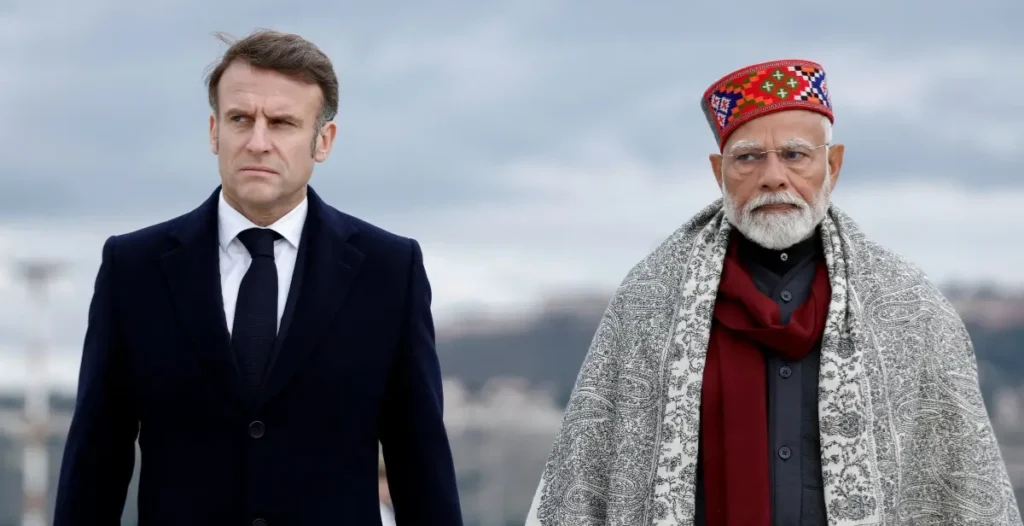
India has moved swiftly to recalibrate its foreign policy posture following renewed U.S. sanctions pressure under President Donald Trump, with Prime Minister Narendra Modi engaging in high-level diplomatic outreach across Europe and the Middle East. The diplomatic push comes as French President Emmanuel Macron met Modi to finalize key bilateral agreements, while New Delhi confirmed that the Indian leader will travel to Israel on Sunday for strategic talks focused on defence, technology, and regional security.
Strategic Diplomatic Shift After U.S. Sanctions Pressure
India’s intensified diplomacy follows recent U.S. trade and financial sanctions targeting entities linked to India’s continued energy and defence engagements with Russia and select Global South partners. Washington’s measures, framed as compliance with sanctions regimes and export controls, have triggered legal and geopolitical debate over the use of economic coercion against strategic partners.
Indian officials have signaled that New Delhi will pursue diversified partnerships to offset potential economic and technological restrictions. Legal experts note that unilateral sanctions imposed without multilateral backing often raise questions under World Trade Organization (WTO) principles and customary international law governing non-intervention and sovereign equality.
In a joint statement issued on 6 February, the Trump administration announced it had reached an agreement to lower tariffs on India. The agreement has reduced the reciprocal tariff on India from 25% to 18% and removed the additional 25% tariff imposed for India’s purchase of Russian crude. In exchange, India will commit to buying $500 billion worth of US products over five years and stop buying Russian oil.
This significantly reduces the US tariff level on India from 50%, which was among the highest in the world, to levels on par with other countries in South and Southeast Asia. The agreement paves the way for a partial reset in the relationship as the joint statement will be followed by an interim agreement in March, which will culminate in a bilateral trade agreement.
Macron–Modi Meeting Produces Defence and Technology Pacts
French President Emmanuel Macron’s visit to India is seen as India’s largest defence deal, reflecting efforts by New Delhi to reduce its dependence on Russian military hardware, despite the fact that Moscow remains a key strategic partner for New Delhi, as noted by President Vladimir Putin’s visit to New Delhi in December.
During talks in Europe, Macron and Modi finalized several agreements covering defence procurement, artificial intelligence cooperation, and clean energy transition. French and Indian officials confirmed that negotiations included expanded joint production of military hardware, cybersecurity coordination, and nuclear energy cooperation within the framework of peaceful civilian use.
A possible commitment to purchase an additional 114 Rafale jets, joint production of helicopters, and collaboration on AASM Hammer precision missiles signal a deepening of the strategic partnership between New Delhi and Paris. French engine maker SAFRAN, which makes M-88 engines for Dassault Aviation, has announced it is ready to buy parts from local suppliers in India and strengthen India’s aviation industry. Safran already has a unit operating in Telangana.
From a legal standpoint, the agreements reinforce India’s strategy of entering diversified bilateral treaties to mitigate exposure to unilateral sanctions regimes. France has emphasized that its cooperation with India complies with European Union strategic autonomy doctrine and does not breach existing sanctions frameworks.
Modi’s Israel Visit Signals Security and Technology Alignment
Following the Paris engagement, Modi is scheduled to visit Israel on Sunday for discussions expected to focus on defence technology transfers, drone systems, cyber defence, and joint research initiatives. The visit is widely viewed as part of India’s broader effort to strengthen strategic partnerships outside traditional Western alliance structures.
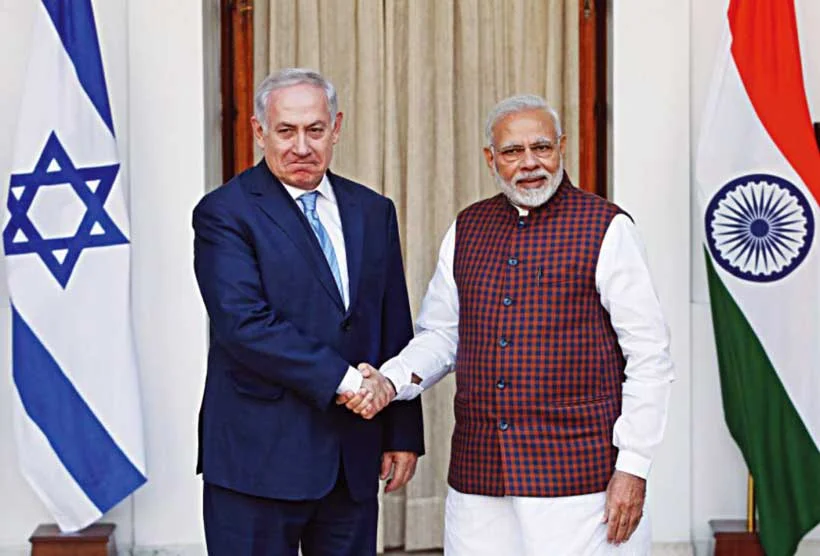
Speaking to the Conference of Presidents on Sunday, Netanyahu said:
“Modi will visit next week, and there is a tremendous alliance between Israel and India, and we are going to discuss all sorts of cooperation.”
Indian and Israeli officials are also expected to explore expanded cooperation in homeland security and counter-terrorism. Legal analysts suggest such agreements will likely be structured under bilateral defence cooperation treaties and technology-sharing frameworks designed to remain compliant with export-control regimes.
Legal and Geopolitical Implications
India’s accelerated diplomatic outreach highlights a shift toward strategic diversification in response to economic pressure. By deepening ties with European and Middle Eastern partners, New Delhi aims to demonstrate that unilateral sanctions will not isolate it from global supply chains or defence cooperation networks.
International law scholars note that while sanctions remain a lawful tool of statecraft when imposed under domestic law, their extraterritorial effects often generate disputes over sovereignty and trade obligations. India’s current diplomatic strategy appears designed to counterbalance such pressure through legally binding bilateral agreements and multilateral engagement.
What Comes Next
Further announcements are expected following Modi’s Israel visit, including potential defence procurement agreements and joint technology initiatives. Observers anticipate that India will continue expanding partnerships across Europe, the Middle East, and the Indo-Pacific to hedge against continued U.S. sanctions pressure.
The unfolding diplomatic sequence highlights a broader transformation in global alignment patterns, with India positioning itself as an independent strategic actor navigating between major power blocs while seeking to safeguard its economic and security interests under international law.