
India (January 2026) — The ICC Men’s T20 World Cup 2026, scheduled to begin 7 February in India and Sri Lanka, faces renewed uncertainty after a Nipah virus outbreak emerged in West Bengal, India, raising alarms among cricket boards, public-health officials, and international fans. The convergence of public-health risk, governance disputes, and participation uncertainty is raising serious questions under international sports law, host-event obligations, and duty-of-care standards.
Health authorities in India have confirmed multiple Nipah virus cases in recent weeks, prompting quarantines, enhanced surveillance, and emergency containment measures in affected regions. Nipah, a zoonotic virus with a high fatality rate and no approved vaccine, is listed by the World Health Organization as a priority pathogen.
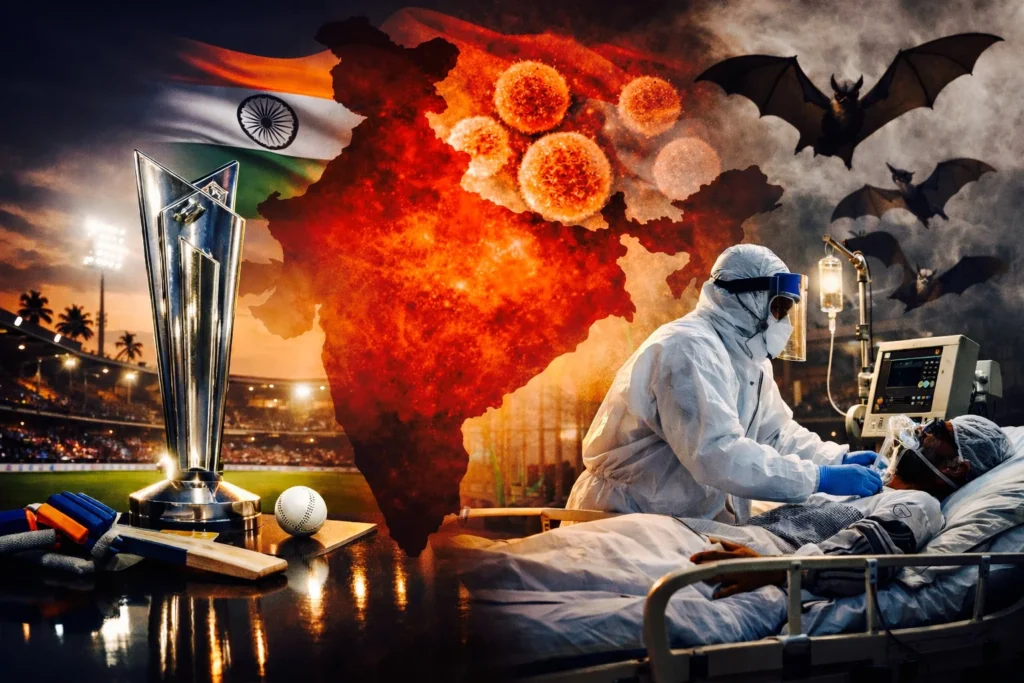
Its emergence weeks before a mega-sporting event involving thousands of international participants has triggered concern among cricket boards and public-health experts. The outbreak has sparked global concern because of its timing, coming just weeks before the start of one of cricket’s flagship events.
With teams, officials, support staff, and thousands of fans expected to travel to host cities, fears over transmission, biosecurity, and adequate safety protocols have intensified discussions about the tournament’s viability. The health crisis now threatens to escalate the matter into a broader legal liability and risk-management challenge.
Tournament Already in Turmoil After Bangladesh Withdrawal
The outbreak comes amid the ongoing controversy that erupted when the Bangladesh Cricket Board (BCB) withdrew from the tournament, citing security concerns over playing matches in India. After the ICC rejected Bangladesh’s request to relocate fixtures to Sri Lanka, it replaced Bangladesh with Scotland in Group C.
This decision drew criticism from cricket leaders and fans and highlighted governance tensions within the sport’s global body. That episode has already tested the ICC’s governance credibility and dispute-resolution mechanisms.
The situation has wider implications as Pakistan’s cricket board is reportedly considering a boycott of at least its match against India in protest, potentially threatening marquee fixtures and commercial interests tied to broadcast and sponsorship revenues.
ICC’s Exposure Under International Sports and Public-Health Law
Under international sports law, the ICC owes a heightened duty of care to players, officials, and accredited staff. With travel advisories tightening and some countries enhancing airport screening for arrivals from India, questions arise about mobility rights for teams and fans, duty of care obligations under ICC and host nation agreements, and potential legal claims should infections occur during the event.
Duty of Care and Player Safety Obligations
This obligation extends beyond security threats to foreseeable public-health risks, particularly where credible evidence of a contagious and lethal disease exists. Legal experts note that failure to conduct transparent, independent risk assessments, or to adapt hosting arrangements accordingly, could expose the ICC to claims of negligence or breach of contractual safety warranties.
Host Agreements and Force Majeure Considerations
Host agreements typically allocate health and safety responsibilities between the ICC and local organizers. A rapidly evolving outbreak such as Nipah raises complex questions about force majeure, material adverse change clauses, and the threshold at which health conditions justify relocation or postponement. Unlike generalized health risks, a WHO-recognized outbreak may strengthen arguments that continued play without adjustment constitutes unreasonable risk.
Participation Rights and Non-Discrimination
The Bangladesh dispute demonstrated that the ICC applies a strict compliance framework for participation. However, if other teams now raise health-based objections, the ICC must ensure consistency to avoid allegations of unequal treatment or arbitrary decision-making. Differential treatment between security-based and health-based concerns could be legally challenged if not supported by clear, evidence-based criteria.
Governance, Transparency, and Reputational Risk
The ICC’s credibility is under scrutiny following Bangladesh’s unsuccessful appeal to the ICC Dispute Resolution Committee (DRC). The Bangladesh episode already exposed governance tensions within the ICC. A perceived failure to respond proportionately to a public-health emergency could further erode trust among member boards, sponsors, and broadcasters, amplifying reputational and financial exposure.
International Health Regulations
While the ICC is not a state actor, its operations intersect with the International Health Regulations (IHR 2005) framework, which emphasizes risk communication, prevention of international disease spread, and coordination with national authorities. Legal analysts warn that ignoring escalating health advisories could undermine compliance expectations embedded in global event-hosting standards.
Global Response and Contingency Planning
Cricket boards around the world are said to be monitoring developments closely. Some analysts suggest that, if the Nipah outbreak escalates, the ICC could consider:
- Relocating or postponing certain fixtures to Sri Lanka or neutral venues
- Implementing enhanced biosecurity bubbles for teams
- Tightening health screening and isolation protocols at all venues
- Coordinating with the World Health Organization (WHO) and national health authorities on risk mitigation
No official tournament changes have been announced yet, but cricket administrators emphasize that player welfare and public health will be the primary considerations in any decision.
What Comes Next
With the tournament less than two weeks away, stakeholders, from national boards to global health experts, are awaiting further data on the outbreak’s trajectory and containment effectiveness. The ICC has historically adapted to crises, including during the COVID-19 pandemic, by rescheduling or relocating events; whether similar measures will be required in this case remains to be seen.
For now, the global cricket community faces a dual challenge: managing political and security disputes alongside a public-health emergency, all while striving to uphold the integrity and continuity of the sport’s pinnacle T20 event. Legal observers say the ICC now faces a narrow decision window. Options include enhanced biosecurity bubbles, partial relocation of fixtures, postponement, or reliance on assurances from host authorities. Each carries distinct legal and commercial risks.
What is clear is that the ICC’s response to the Nipah outbreak will be judged against the backdrop of the Bangladesh dispute. Together, these developments may define a new benchmark for how international sports bodies balance sovereign host interests, participant safety, and legal accountability in an era of overlapping security and public-health threats.
Timeline: Key Developments Impacting ICC T20 World Cup 2026
January 2026 (Early)
Bangladesh Cricket Board raises security objections to playing in India; requests venue relocation.
21 January 2026
ICC Board rejects Bangladesh’s relocation request after security assessments.
23 January 2026
BCB misses ICC compliance deadline following domestic political intervention.
24 January 2026
ICC confirms Bangladesh’s replacement by Scotland; BCB appeal to ICC Dispute Resolution Committee later fails.
Mid–Late January 2026
Indian health authorities confirm multiple Nipah virus cases in parts of India; quarantines and emergency measures imposed.
Late January 2026
Regional and international concern grows over tournament viability; calls emerge for contingency planning, including partial relocation or enhanced biosecurity protocols