
The International Cricket Council (ICC) has officially replaced Bangladesh with Scotland in the upcoming ICC Men’s T20 World Cup 2026 after the Bangladesh Cricket Board (BCB) refused to send its national team to India, citing security concerns. The decision followed a final deadline imposed by the ICC, after which Bangladesh failed to confirm participation.
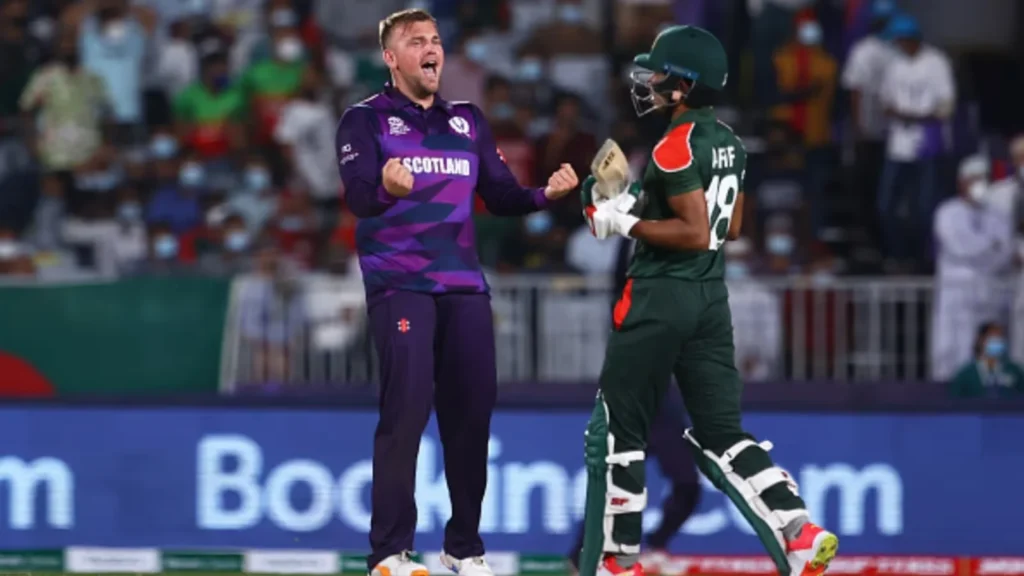
According to ICC officials, the Board voted 14–2 to retain Bangladesh’s scheduled fixtures in India, relying on independent security assessments that categorized the threat level as low to moderate and found no basis for relocation. The ICC subsequently determined that Bangladesh’s continued refusal amounted to a voluntary withdrawal under tournament regulations.
The dispute between the Bangladesh Cricket Board (BCB) and the International Cricket Council (ICC) over security concerns in India is governed primarily by the ICC Constitution, the ICC Event Hosting Agreements, and the ICC Anti-Political Interference framework.
Under ICC rules, member boards are required to ensure that decisions affecting participation in ICC events are taken independently and free from government direction. At the same time, the ICC retains exclusive authority over tournament scheduling, venues, and security clearances, relying on host-nation guarantees and independent security assessments.
This dual structure creates inherent tension when national security concerns overlap with state-level political considerations. The escalating standoff between the Bangladesh Cricket Board and the International Cricket Council over security concerns in India has exposed a familiar but increasingly complex fault line in international sport: where player safety, geopolitics, and institutional authority collide.
What began as a request to relocate Bangladesh’s T20 World Cup matches has evolved into a broader legal and governance dispute, raising questions about political interference, the limits of national discretion, and the ICC’s obligation to balance security assessments with the integrity of global competition.
ICC Governance Framework
Under the ICC’s governance framework, responsibility for player safety is centralized rather than left to individual member boards. For major international tournaments, the ICC relies on host-nation security guarantees, coordination with local authorities, and assessments conducted by independent security experts. These evaluations are designed to ensure uniform standards across venues and to prevent security concerns from being framed through political or diplomatic lenses.
Once the ICC determines that required security thresholds are met, participating teams are contractually bound to honor their fixtures. Member boards do not retain unilateral discretion to withdraw or demand relocation based solely on subjective risk perceptions or political developments. From a legal standpoint, this centralized model protects tournament integrity, commercial certainty, and equal treatment of all participants.
The ICC also exercises discretion in determining whether exceptional circumstances justify deviation from scheduled venues. However, that discretion is narrowly framed. It requires objective evidence of imminent and credible threats, not generalized diplomatic tension or speculative risk. Accepting unverified security claims could expose the ICC to contractual breaches, competitive imbalance, and precedent-setting pressure in future tournaments.
In the Bangladesh–India dispute, the ICC’s refusal to relocate matches reflects this legal calculus. By affirming independent security assessments and rejecting politically framed objections, the ICC has sought to preserve its authority as the final arbiter of safety and logistics. While this approach may carry reputational and relational costs, it aligns with established governance practice and the legal obligation to administer global events consistently and predictably.
Political Interference in International Sports Law
Political interference is one of the most sensitive compliance issues in international sports governance. Under the constitutions and regulations of major sporting bodies, including the International Cricket Council, national federations are required to operate independently of government control, particularly in matters involving international participation, scheduling, and competition integrity.
Legal Standard for Political Interference
In international sports law, political interference generally arises when a state authority directly or indirectly influences a sports federation’s decision-making. This includes government instructions on whether a team may tour, participate in an event, withdraw, or adopt a particular position in an international dispute. The legal concern is not limited to formal orders; sustained political pressure, public directives, or conditional approvals can also meet the threshold.
The rationale behind this standard is institutional neutrality. International sports bodies are designed to function outside geopolitical rivalries, ensuring that competition is governed by rules rather than diplomatic leverage. Where governments intervene, it undermines competitive equality and exposes tournaments to politicization.
Security Concerns Versus Interference
A critical legal distinction exists between legitimate security assessments and political interference. Governments retain a sovereign duty to protect their citizens and may raise safety concerns. However, under sports governance rules, those concerns must be conveyed through independent, technical channels rather than political declarations or public pressure.
When a government publicly endorses, directs, or frames a federation’s refusal to participate as a matter of diplomatic dispute, the risk of non-compliance increases. At that point, what might begin as a safety issue can be recharacterized legally as state interference in sport.
Risk Exposure for National Federations
If a federation is found to be acting under government direction, it may face consequences ranging from formal warnings to suspension of rights, loss of hosting privileges, or exclusion from events. While enforcement has historically been cautious, the legal exposure remains real, particularly where political involvement is overt and documented.
Institutional Risk for Governing Bodies
International federations also face legal and reputational risk. Failure to enforce non-interference rules consistently can weaken governance credibility and encourage future political leverage. Conversely, rigid enforcement without transparent justification may alienate member boards and invite accusations of bias.
Legal Balance Point
The core legal challenge lies in balancing sovereign security responsibilities with institutional autonomy. International sports law does not deny states the right to protect athletes, but it requires that decisions affecting competition remain insulated from political command. Where that line is crossed, the issue ceases to be about safety and becomes a governance violation.
In this sense, political interference rules serve a dual function: they protect sport from geopolitics, and they protect athletes and competitions from becoming instruments of state policy rather than participants in a neutral global framework.
Bangladesh Board’s Position On Political Interference
A central legal risk for Bangladesh lies in the political interference doctrine. ICC regulations prohibit national governments from directing or coercing cricket boards in matters such as team selection, participation, or international engagement.
Public endorsements by Bangladesh’s interim government of the decision not to travel, combined with statements framing the issue as a political or diplomatic dispute with India, raise compliance concerns under ICC rules. If the ICC determines that the BCB acted under government instruction rather than independent judgment, sanctions could theoretically include suspension or loss of voting rights, though such measures are rarely applied in practice.
At the same time, Bangladesh argues that state responsibility for player safety cannot be ignored and that governments are entitled to assess risks to their citizens abroad. This creates a gray zone where sports autonomy intersects with sovereign security obligations.ety, direct involvement in participation decisions risks breaching ICC non-interference obligations. Even if sanctions are unlikely, the legal exposure exists.
Dispute Resolution Mechanisms Available to Bangladesh
Under the governance framework of the International Cricket Council, Bangladesh has a limited but clearly defined set of legal and procedural avenues to challenge decisions relating to tournament participation, security assessments, and alleged procedural unfairness. These mechanisms are designed to resolve disputes within the institutional structure of international cricket, rather than through external political or diplomatic pressure.
ICC Dispute Resolution Committee
The primary formal mechanism available to the Bangladesh Cricket Board is referral to the ICC’s Dispute Resolution Committee. This body may review whether ICC procedures were followed correctly, including whether Bangladesh’s submissions were duly considered, whether security assessments met prescribed standards, and whether the decision-making process was impartial and consistent with past practice. Importantly, the Committee does not substitute its judgment for the ICC’s on operational matters such as venue selection unless a clear procedural defect is established.
Procedural Fairness and Due Process Claims
Bangladesh may argue that its concerns were dismissed without adequate engagement, or that relevant information was not transparently shared. Such claims focus on due process rather than outcome. However, even if procedural shortcomings are identified, remedies typically involve clarification or reconsideration, not automatic relocation or suspension of fixtures.
Force Majeure and Exceptional Circumstances
Another potential argument is invocation of force majeure or exceptional circumstances. This is a high legal threshold. Bangladesh would need to demonstrate objective, independently verifiable evidence of an imminent and specific security threat that materially prevents participation. Generalized political tension, diplomatic disputes, or speculative risk assessments are unlikely to satisfy this standard under ICC contracts and event regulations.
Negotiated Settlement and Mediation
Historically, most ICC disputes are resolved through confidential negotiation rather than adjudication. Bangladesh may seek assurances such as enhanced security protocols, additional liaison officers, or formal written guarantees. While these measures do not alter venues, they can provide face-saving solutions that avoid escalation or sanctions.
Limits of Legal Remedies
Crucially, none of these mechanisms suspends the ICC’s authority over tournament logistics. If Bangladesh ultimately refuses to participate without ICC approval, the legal characterization would likely be voluntary withdrawal rather than exclusion. This distinction carries significant reputational and competitive consequences but limits Bangladesh’s ability to claim institutional fault.
Strategic Reality
From a legal strategy perspective, Bangladesh’s strongest position lies not in overturning the ICC’s decision, but in demonstrating good-faith engagement with institutional processes. Doing so reduces exposure to allegations of political interference and preserves standing within the ICC framework, even if the substantive outcome remains unchanged.
While dispute resolution mechanisms exist, they are designed to preserve centralized governance and tournament integrity. They offer process-based review and negotiation, not unilateral veto power over venues or scheduling.
Comparative Precedents
The Bangladesh–India T20 World Cup standoff is not unprecedented. International sport, and cricket in particular, has repeatedly faced disputes where security, geopolitics, and governance intersect.
Pakistan–India Cricket Relations
For decades, cricketing ties between Pakistan and India have been disrupted by security concerns and political tension. Pakistan has repeatedly argued that it cannot safely host Indian teams, while India has declined tours citing security assessments endorsed by its government. In these cases, the ICC and bilateral agreements have generally deferred to host-nation guarantees and independent security reviews, rather than unilateral political claims. Crucially, when matches were relocated or canceled, decisions were typically negotiated multilaterally rather than imposed unilaterally by one board.
Sri Lanka Tours During Civil Conflict
Sri Lanka continued to host international matches during periods of internal conflict, including during its civil war. Following the 2009 Lahore attack on the Sri Lankan team in Pakistan, international cricket authorities significantly tightened security protocols. However, venue decisions remained grounded in independent risk assessments, not political statements. This precedent reinforced the principle that objective security evaluation, not diplomatic tension, governs participation.
Afghanistan Cricket and Political Instability
Afghanistan’s participation in ICC events despite internal instability further illustrates ICC practice. The ICC has consistently separated domestic political conditions from tournament participation, unless player safety risks are verified by independent experts. Even amid regime change, the ICC emphasized non-interference while maintaining centralized authority over event logistics.
Across these cases, the governing principle has been consistent: security concerns must be objectively substantiated and institutionally assessed. Political tension alone has not been accepted as a sufficient legal basis for relocation or withdrawal.
Bangladesh’s Prospects Before the Court of Arbitration for Sport
Bangladesh has unsuccessfully appealed the decision before the ICC’s Dispute Resolution Committee and is reportedly exploring options before the Court of Arbitration for Sport (CAS), although legal experts note that overturning an ICC venue decision would be difficult absent procedural irregularity. Under the ICC’s constitutional and regulatory framework, authority over scheduling, venues, and security determinations is centralized, leaving member boards with narrow grounds for contestation.
Outcome Before the ICC Dispute Resolution Committee
The ICC DRC primarily examines whether the decision-making process complied with applicable rules, contractual obligations, and principles of procedural fairness. It does not reassess the substantive merits of operational decisions such as security assessments or venue allocation unless there is evidence of bias, arbitrariness, or departure from established procedure. Bangladesh’s appeal reportedly failed because the ICC demonstrated reliance on independent security evaluations, board-level voting, and prior notice—satisfying procedural requirements under ICC regulations.
Limits of Substantive Review in Sports Governance
From a legal standpoint, sports governing bodies are afforded wide discretion in organizing global events. Courts and arbitral tribunals consistently defer to institutional expertise in areas involving safety, logistics, and competitive balance. As a result, disagreement with the outcome of a decision, such as refusal to relocate matches, does not, by itself, establish a legal violation.
Potential Recourse to the Court of Arbitration for Sport
Bangladesh may seek relief before the Court of Arbitration for Sport, which has jurisdiction over disputes arising under ICC rules where arbitration clauses apply. However, CAS jurisprudence indicates that overturning a governing body’s operational decision requires proof of a serious procedural defect, such as denial of the right to be heard, lack of impartiality, manifest arbitrariness, or bad faith.
In the absence of such defects, CAS typically upholds the autonomy of sports organizations, particularly where decisions are supported by expert assessments and taken in good faith to preserve competition integrity. CAS has also recognized that venue selection and security management fall squarely within the discretionary competence of international federations.
Standard of Review and Burden of Proof
Bangladesh would bear a high burden of proof to demonstrate that the ICC acted ultra vires, violated its own regulations, or breached fundamental principles of natural justice. Claims based solely on political tension, subjective security fears, or disagreement with expert conclusions are unlikely to succeed.
Practical Legal Assessment
Legal experts therefore view Bangladesh’s prospects before CAS as limited. Even if CAS were to identify minor procedural shortcomings, remedies would more likely involve declaratory relief or guidance for future process, rather than reinstatement in an ongoing tournament or reversal of venue decisions already implemented.
The failure of Bangladesh’s appeal before the ICC DRC shows a central feature of international sports law: institutional discretion is strongly protected, particularly in matters of security and tournament logistics. Without clear evidence of procedural irregularity or abuse of power, external arbitration is unlikely to disturb an ICC decision grounded in independent assessments and collective governance
Precedent and Broader Implications for International Sport
The Bangladesh–India dispute carries significance far beyond a single tournament, as it touches on how international sport responds when security concerns intersect with geopolitics. Historically, governing bodies such as the International Cricket Council, FIFA, and the IOC have sought to insulate competitions from political disputes by relying on centralized authority and independent assessments. The consistency of that approach is now being tested.
Precedent on Security-Based Withdrawals
Past cases involving Pakistan–India fixtures, Sri Lanka’s touring disruptions, and Afghanistan’s participation amid domestic instability show a clear pattern: international bodies prioritize objective, expert-led security evaluations over unilateral political claims. Where venues were changed or matches relocated, decisions typically followed negotiated, multilateral processes rather than one-sided refusals. Departing from this model risks encouraging future withdrawals framed as “security concerns” but rooted in diplomatic tension.
Risk of Politicization of Sport
If international federations accept politically contested security objections without independent verification, sport risks becoming a proxy arena for state rivalry. This would undermine competitive equality and expose tournaments to unpredictable disruption, weakening trust among players, sponsors, broadcasters, and fans.
Institutional Authority Versus Member Confidence
At the same time, rigid enforcement of centralized authority carries its own risks. Member boards may perceive governing bodies as dismissive of legitimate anxieties, particularly in regions where political volatility is real. The challenge lies in maintaining authority while demonstrating transparency, consultation, and credibility in decision-making.
Long-Term Governance Implications
The precedent set here will influence how future disputes are handled—not only in cricket but across international sport. A permissive approach could fragment governance and normalize political leverage, while an inflexible one could erode confidence in institutions meant to safeguard both integrity and safety.
Broader Lesson for Global Sport
Ultimately, the case illustrates a structural tension at the heart of international sport: neutrality depends on strong rules, but legitimacy depends on trust. How governing bodies navigate this balance will shape whether global competitions remain insulated from geopolitics or become increasingly vulnerable to it.
Legal Perspective
From a legal standpoint, the Bangladesh–ICC dispute sits at the intersection of contractual obligation, institutional autonomy, and public international law principles applied through sports governance. Under the ICC’s constitutional framework, participation in ICC events is not discretionary once venues and schedules are confirmed through established procedures. Member boards accept these constraints contractually, including reliance on centralized security determinations.
The ICC’s position is therefore legally defensible on three grounds:
- First, contractual authority: the ICC retains exclusive competence over venues, logistics, and security clearance for global tournaments.
- Second, governance integrity: permitting unilateral withdrawal based on politically framed security concerns would undermine equality of competition and expose the institution to claims of arbitrariness.
- Third, non-interference norms: international sports law consistently requires insulation of sporting decisions from state direction, even where governments invoke public safety narratives.
For Bangladesh, the legal challenge is less about disproving the ICC’s authority and more about process and proportionality. Unless Bangladesh can demonstrate that the ICC ignored material evidence or departed from its own security protocols, courts or arbitral bodies are unlikely to override institutional discretion. At most, remedies would focus on procedural fairness rather than substantive reversal.
More broadly, the case illustrates how sports law functions as a hybrid legal order: formally private and contractual, yet deeply influenced by public law values such as neutrality, due process, and non-coercion. In that hybrid space, the law tends to favor centralized governance over sovereign preference, particularly where accepting the latter would politicize global competition.
What This Means Going Forward
Going forward, Bangladesh’s failed appeal before the ICC’s Dispute Resolution Committee significantly narrows its legal and strategic options. With the tournament already proceeding and a replacement team confirmed, any further challenge, particularly before the Court of Arbitration for Sport, would be prospective rather than restorative. In practical terms, even a successful CAS ruling would be unlikely to reinstate Bangladesh in the current T20 World Cup, as sports tribunals are reluctant to disrupt competitions already underway.
Institutionally, the episode reinforces the high level of deference afforded to international governing bodies in matters of venue selection, security assessment, and tournament logistics. The ICC’s reliance on independent expert evaluations and collective board voting places its decision on firm legal footing, making future challenges by member boards difficult unless clear procedural defects can be shown.
For Bangladesh, the more immediate implications are reputational and financial. The case may prompt closer scrutiny of the BCB’s governance independence and its compliance with ICC non-interference rules. Even without formal sanctions, the perception of government direction could affect Bangladesh’s influence within ICC decision-making structures and future hosting or participation negotiations.
More broadly, the dispute is likely to shape how the ICC and other sports bodies manage security-related objections going forward. Greater emphasis may be placed on early engagement, documented consultation, and transparency in security assessments to pre-empt political escalation. At the same time, the ICC’s firm stance signals that subjective or politically framed security concerns will not override centralized governance.
Ultimately, the case sends a clear message to member boards that participation in global tournaments is governed by institutional process, not unilateral discretion. Where security concerns arise, they must be raised early, substantiated independently, and pursued within established legal channels, or risk exclusion with limited recourse once decisions are finalized.
Frequently Asked Questions
Why did Bangladesh request the relocation of matches from India?
Bangladesh cited security concerns arising from political tensions with India, arguing that these posed risks to players and officials.
Why did the ICC reject the request?
Can a team refuse to play if it feels unsafe?
Yes, but legally such refusal is treated as voluntary withdrawal unless supported by verified, independent security findings recognized by the governing body.
Is this considered political interference?
It may be, depending on whether the decision was driven by government direction rather than the independent judgment of the cricket board. Public governmental involvement raises compliance concerns under ICC rules.
Can the ICC sanction Bangladesh?
Why doesn’t the ICC simply move the matches?
Has this happened before?
Yes. Similar disputes involving Pakistan, India, Sri Lanka, and Afghanistan have arisen. Historically, decisions hinge on objective security assessments, not diplomatic disputes.
What does this mean for international sport?
The dispute highlights the growing challenge of insulating global sport from geopolitics while maintaining credibility, safety, and fairness.