
A complete 2025 overview of climate change causes, comparing human-driven emissions with natural climate factors to understand the planet’s warming trends.
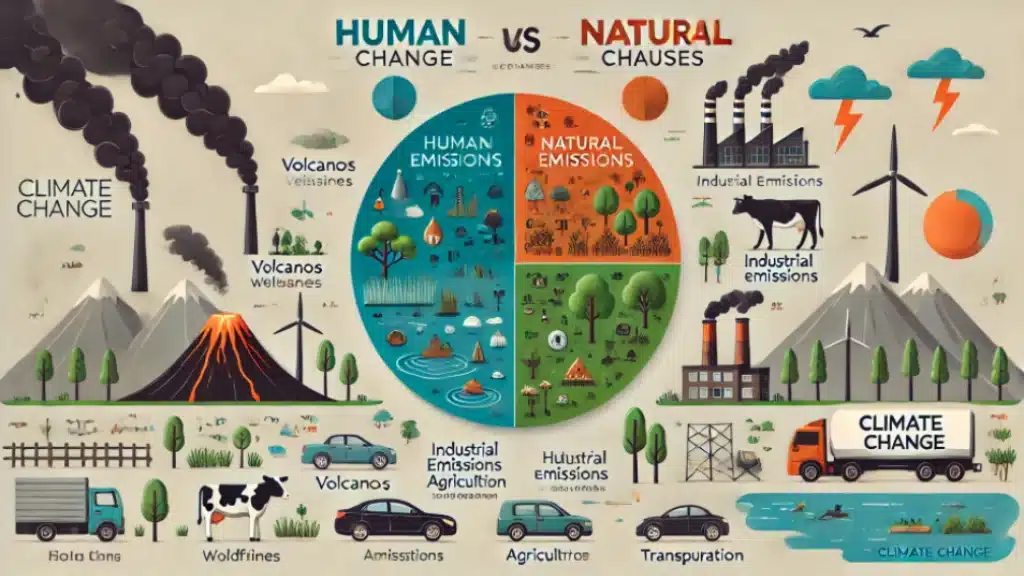
Climate change in 2025 is driven by a complex mix of human activities and natural forces, but their impacts are far from equal. While natural climate cycles have always influenced Earth’s temperature, today’s rapid warming is overwhelmingly linked to human-driven emissions, industrial growth, and land-use changes. Understanding how these factors interact is essential for grasping why the planet is heating faster than at any point in modern history and what it means for the future.
According to EPA:
“since the Industrial Revolution, human activities have released large amounts of carbon dioxide and other greenhouse gases into the atmosphere, which has changed the earth’s climate.”
While Earth’s climate has always changed due to natural factors, current warming is overwhelmingly driven by human activities. The Intergovernmental Panel on Climate Change (IPCC), composed of scientific experts from countries worldwide, concluded that:
“It is unequivocal that the increase of CO2, methane, and nitrous oxide in the atmosphere over the industrial era is the result of human activities and that human influence is the principal driver of many changes observed across the atmosphere, ocean, cryosphere and biosphere.”
This comprehensive guide explains both natural and human causes of climate change, the greenhouse gases responsible, and how scientists know humans are the primary cause of current warming.
Source: NASA – Causes of Climate Change
Understanding the Greenhouse Effect: The Foundation
Before examining specific causes, we must understand the greenhouse effect, the natural process that makes Earth habitable but becomes dangerous when intensified by human activities.
According to NASA:
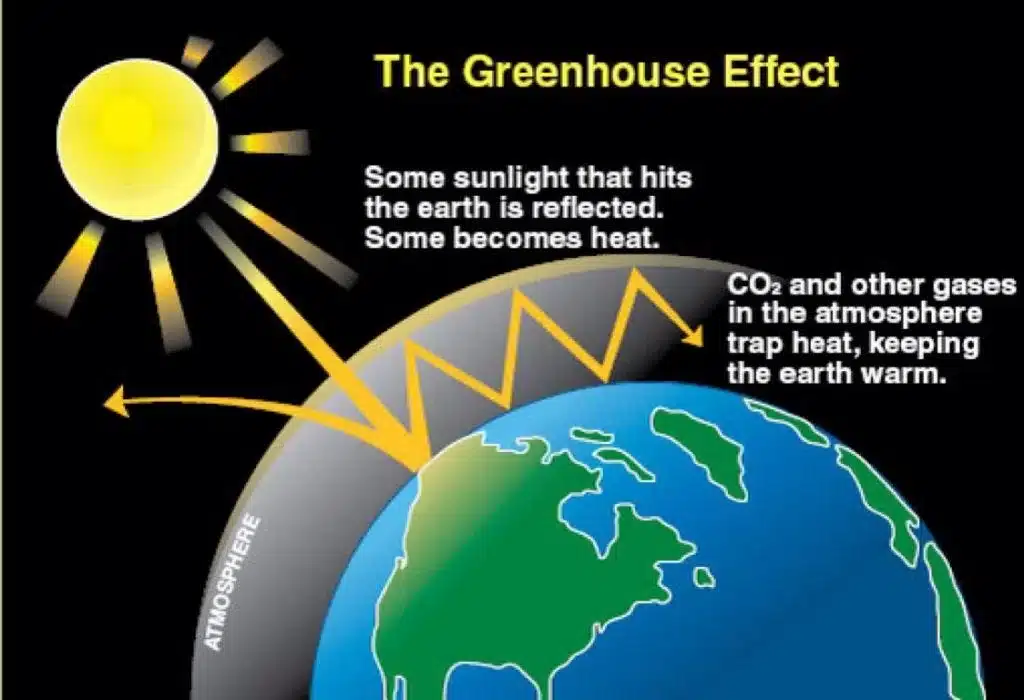
“Life on Earth depends on energy coming from the Sun. About half the light energy reaching Earth’s atmosphere passes through the air and clouds to the surface, where it is absorbed and radiated in the form of infrared heat. About 90% of this heat is then absorbed by greenhouse gases and re-radiated, slowing heat loss to space.”
The Natural Greenhouse Effect
Without the natural greenhouse effect, Earth would be uninhabitably cold about -18°C (0°F) instead of the current 15°C (59°F).
AdaptNSW explains that:
“Greenhouse gases in our atmosphere act like the glass in a greenhouse, letting light through but stopping heat from escaping.”
The process works like this:
- Solar energy reaches Earth’s atmosphere
- About half passes through to the surface
- Earth’s surface absorbs this energy and warms
- The surface radiates heat back as infrared energy
- Greenhouse gases trap this heat in the atmosphere
- The trapped heat keeps Earth warm enough for life
The Enhanced Greenhouse Effect
The problem occurs when human activities add excessive greenhouse gases to the atmosphere.
According to AdaptNSW:
“The enhanced greenhouse effect is where extra greenhouse gases in our atmosphere trap too much of the Sun’s energy. This causes a warming effect, which some people call global warming.”
European Commission reports that:
“This adds enormous amounts of greenhouse gases to those naturally occurring in the atmosphere, increasing the greenhouse effect and global warming.”
Key Greenhouse Gases Causing Climate Change
Carbon Dioxide (CO₂): The Primary Driver
Carbon dioxide is the most important greenhouse gas causing climate change.
NASA explains that:
“A vital component of the atmosphere, carbon dioxide (CO2) is released through natural processes (like volcanic eruptions) and through human activities, such as burning fossil fuels and deforestation.”
Current Levels: EPA data shows that:
“Atmospheric carbon dioxide concentrations have increased by more than 40 percent since pre-industrial times, from approximately 280 parts per million (ppm) in the 18th century to 419 ppm in 2023.”
Sources of CO₂:
- Burning fossil fuels (coal, oil, natural gas) for energy
- Deforestation and land-use changes
- Industrial processes like cement production
- Transportation (cars, trucks, ships, planes)
According to European Commission:
“CO2 produced by human activities is the largest contributor to global warming. By 2023, its concentration in the atmosphere had risen to 51% above its pre-industrial level (before 1750).”
Methane (CH₄): A Powerful Warming Agent
While less abundant than CO₂, methane is far more powerful at trapping heat.
European Commission reports that:
“Methane is a more powerful greenhouse gas than CO2 but has a shorter atmospheric lifetime.”
NASA explains it as:
“Like many atmospheric gases, methane comes from both natural and human-caused sources. Methane comes from plant-matter breakdown in wetlands and is also released from landfills and rice farming. Livestock animals emit methane from their digestion and manure.”
Human Sources of Methane:
- Livestock farming (cattle and sheep digestion)
- Rice cultivation in flooded paddies
- Landfills decomposing organic waste
- Natural gas production and leaks
- Coal mining operations
EPA reports that:
“Human activities increased methane concentrations during most of the 20th century to more than 2.5 times the pre-industrial level, from approximately 722 parts per billion (ppb) in the 18th century.”
Nitrous Oxide (N₂O): The Long-Lived Gas
NASA describes nitrous oxide as:
“A potent greenhouse gas produced by farming practices, released during commercial and organic fertilizer production and use.”
European Commission adds that:
“Nitrous oxide, like CO2, is a long-lived greenhouse gas that accumulates in the atmosphere over decades to centuries.”
Sources of Nitrous Oxide:
- Agricultural fertilizers (nitrogen-based)
- Manure management
- Fossil fuel combustion
- Industrial processes
- Wastewater treatment
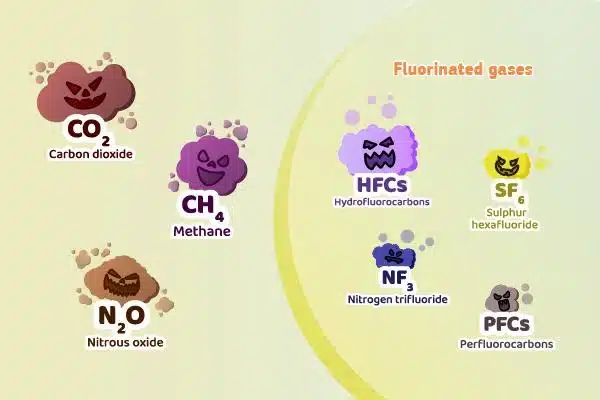
Other Greenhouse Gases
Fluorinated Gases: European Commission warns that:
“Fluorinated gases are emitted from equipment and products that use these gases. Such emissions have a very strong warming effect, up to 23,000 times greater than CO2.”
Water Vapor: NASA clarifies that:
“Water vapor is the most abundant greenhouse gas, but because the warming ocean increases the amount of it in our atmosphere, it is not a direct cause of climate change.”
Instead, it acts as a feedback mechanism, amplifying warming caused by other gases.
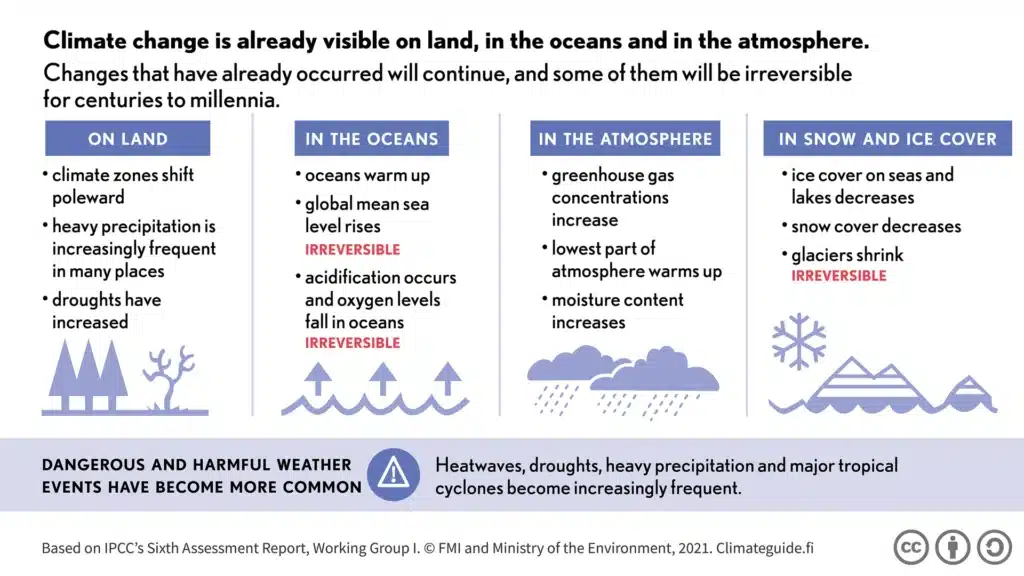
Source: Climate Change Visible
Natural Causes of Climate Change
While human activities drive current warming, Earth’s climate has always changed due to natural factors:
Solar Radiation Variations
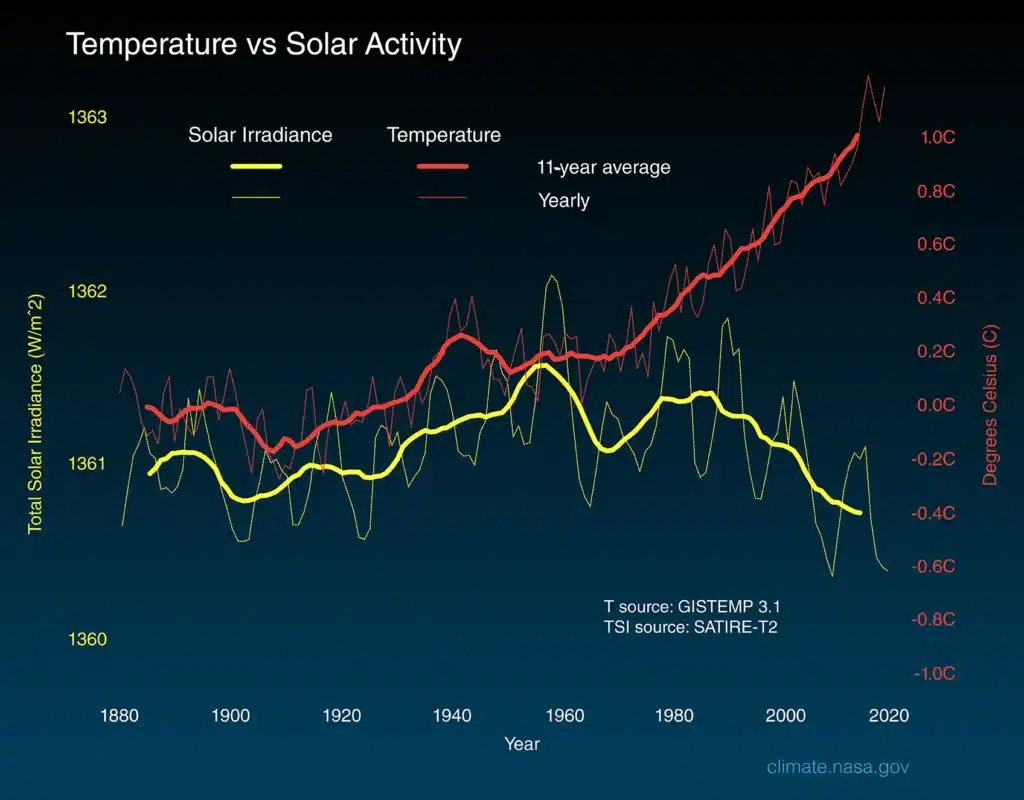
The Sun’s energy output varies slightly over time, affecting Earth’s climate. However, NASA’s research shows that:
“if a more active Sun caused the warming, scientists would expect warmer temperatures in all layers of the atmosphere. Instead, they have observed a cooling in the upper atmosphere and a warming at the surface and lower parts of the atmosphere. That’s because greenhouse gases are slowing heat loss from the lower atmosphere.”
European Commission confirms that:
“Natural causes, such as changes in solar radiation or volcanic activity, are estimated to have contributed less than plus or minus 0.1°C to total warming between 1850 and 2019.”
Volcanic Eruptions
Volcanic eruptions release gases and particles into the atmosphere. However, EPA reports that:
“Volcanic particles from a single eruption do not produce long-term climate change because they remain in the atmosphere for a much shorter time than greenhouse gases. In addition, human activities emit more than 100 times as much carbon dioxide as volcanoes each year.”
Large eruptions can temporarily cool the planet by reflecting sunlight, but this effect lasts only a few years.
Orbital Changes (Milankovitch Cycles)
Over tens of thousands of years, changes in Earth’s orbit and axial tilt affect how much solar energy reaches different parts of the planet. These cycles have caused ice ages and warm periods throughout Earth’s history.
EPA explains that:
“Over the last several hundred thousand years, carbon dioxide levels varied in tandem with the glacial cycles. During warm interglacial periods, carbon dioxide levels were higher. During cool glacial periods, carbon dioxide levels were lower.”
However, these orbital changes occur over thousands of years and cannot explain the rapid warming of the past century.
Natural Climate Variability
Ocean currents, atmospheric circulation patterns, and interactions between Earth’s systems cause natural climate variability on various timescales. El Niño and La Niña events, for example, temporarily affect global temperatures.
AdaptNSW notes that while
“Climate is always changing, scientists use computer models to distinguish natural variation from human-caused changes.”
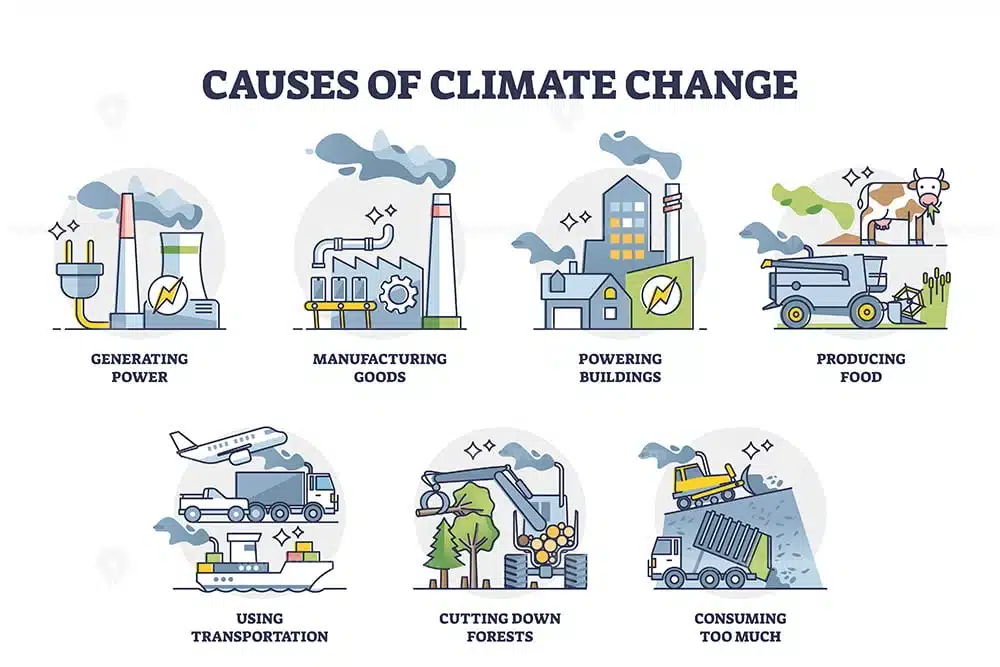
Human Causes of Climate Change
Human activities have become the dominant force changing Earth’s climate. Let’s examine the major contributors:
Burning Fossil Fuels: The Biggest Contributor
EPA states that:
“Burning fossil fuels changes the climate more than any other human activity. In recent years, human activities have released around 35 billion tons of carbon dioxide into the atmosphere every year.”
Why Fossil Fuel Combustion Produces CO₂: NASA explains that:
“Over the last century, burning of fossil fuels like coal and oil has increased the concentration of atmospheric carbon dioxide (CO2). This increase happens because the coal or oil burning process combines carbon with oxygen in the air to make CO2.”
Major Fossil Fuel Uses:
- Electricity Generation: Coal and natural gas power plants
- Transportation: Gasoline and diesel vehicles, aviation, shipping
- Industrial Processes: Manufacturing, chemical production
- Heating and Cooling: Buildings and homes
European Commission reports that:
“Burning coal, oil, and gas produces carbon dioxide and nitrous oxide.”
Deforestation and Land Use Changes
Forests are crucial carbon sinks that absorb CO₂ from the atmosphere. European Commission explains that:
“trees help to regulate the climate by absorbing CO2 from the atmosphere. When they are cut down, that beneficial effect is lost and the carbon stored in the trees is released into the atmosphere, adding to the greenhouse effect.”
Deforestation Impacts:
- Removes natural carbon absorption
- Releases stored carbon when trees decompose or burn
- Reduces biodiversity and ecosystem services
- Changes local weather patterns
- Increases soil erosion
NASA reports that:
“To a lesser extent, clearing of land for agriculture, industry, and other human activities has increased concentrations of greenhouse gases.”
Agriculture and Livestock Farming
Modern agriculture contributes significantly to climate change through multiple pathways:
Livestock Emissions: European Commission states that:
“Increasing livestock farming is a major concern because cows and sheep produce large amounts of methane when they digest their food.”
Rice Cultivation: Flooded rice paddies create anaerobic conditions that produce methane.
Fertilizer Use: The European Commission notes that
“fertilisers containing nitrogen produce nitrous oxide emissions.”
Land Conversion: Converting forests and grasslands to farmland releases stored carbon and reduces carbon absorption.
Industrial Processes and Manufacturing
Manufacturing and industrial activities contribute through:
- Direct emissions from chemical reactions (cement, steel production)
- Energy consumption from fossil fuels
- Release of fluorinated gases from refrigeration and air conditioning
- Production of plastics and other petroleum-based products
Transportation Sector
The global transportation system relies heavily on fossil fuels:
- Road vehicles (cars, trucks, buses)
- Aviation (jet fuel combustion)
- Shipping (heavy fuel oil)
- Rail transport
Transportation accounts for approximately one-quarter of global energy-related CO₂ emissions.
Building and Construction
- Energy Use: Heating, cooling, and powering buildings requires enormous energy, mostly from fossil fuels.
- Construction Materials: Producing cement and steel generates substantial CO₂ emissions.
- Urban Heat Islands: Cities with extensive concrete and asphalt absorb and retain more heat, affecting local climates.
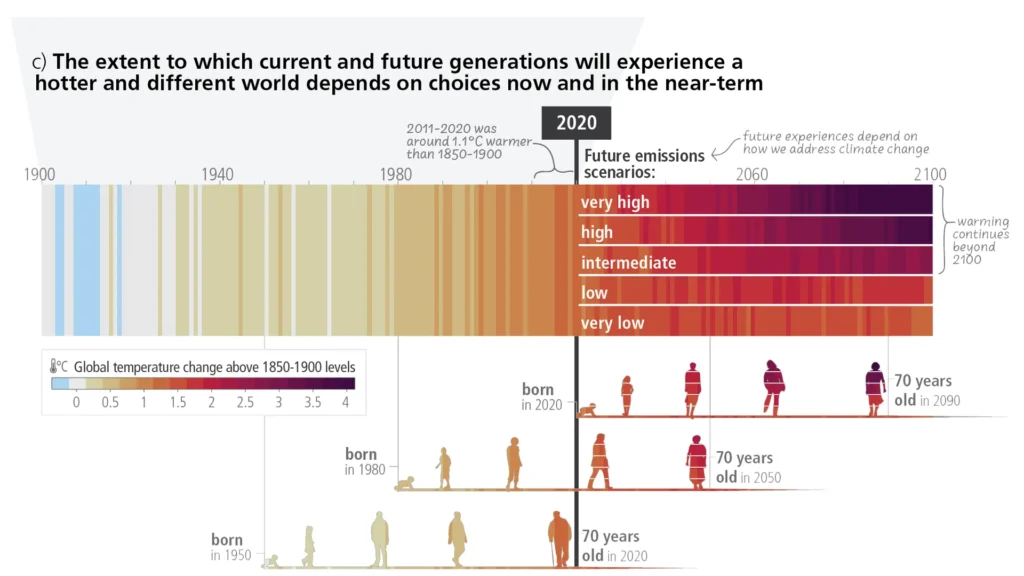
Source: Climate Action
How We Know Humans Cause Current Climate Change
Scientists have multiple lines of evidence proving human activities cause current warming:
Chemical Fingerprints
AdaptNSW explains that:
“Carbon dioxide released into the atmosphere from burning fossil fuels carries a different chemical fingerprint from that released by natural sources such as respiration and volcanoes.”
This isotopic analysis definitively shows the source of excess CO₂.
Correlation with Industrial Activity
NASA notes that:
“Industrial activities that our modern civilization depends upon have raised atmospheric carbon dioxide levels by nearly 50% since 1750.”
The timing of CO₂ increases matches perfectly with industrialization.
Climate Models
AdaptNSW describes how:
“Scientists have developed computer models that recreate the Earth’s natural rate of climate change. These models use real-world data and allow us to compare the modelled (natural) rate of climate change to the climate we are experiencing today. When we compare these climates, we see that today’s rate of climate change is higher than the natural rate.”
According to NASA:
“Climate models that include solar irradiance changes can’t reproduce the observed temperature trend over the past century or more without including a rise in greenhouse gases.”
Atmospheric Patterns
Scientists observe cooling in the upper atmosphere while the lower atmosphere and surface warm, exactly what we’d expect from greenhouse gas warming, not solar warming.
Rate of Change
Current warming is occurring 10 times faster than the average rate of ice-age-recovery warming, indicating it’s not a natural cycle.
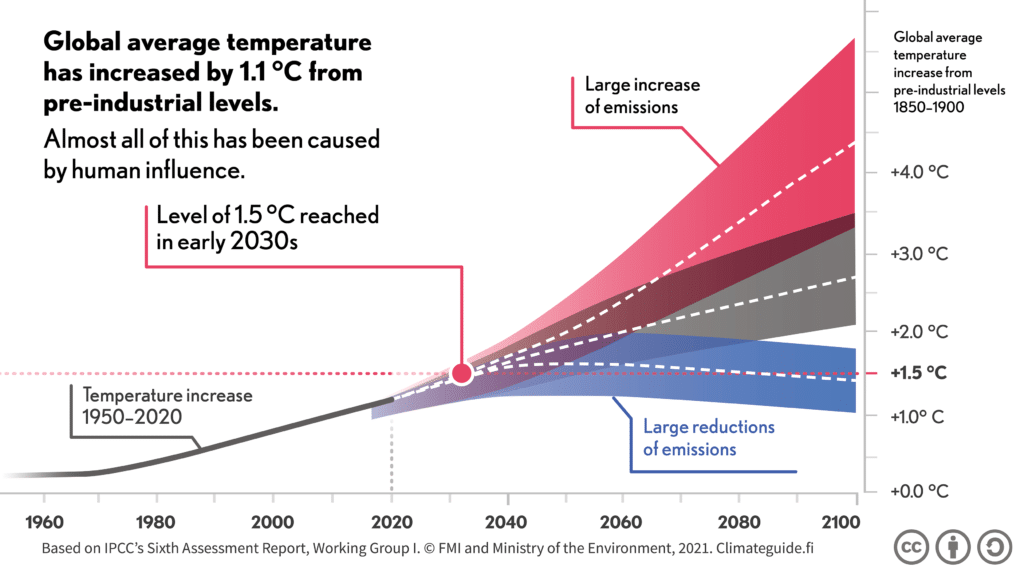
Source: Assessment Reports
The Scale of Human Impact
The numbers illustrate humanity’s climate impact:
- CO₂ Emissions: 35 billion tons annually from human activities
- Atmospheric Increase: CO₂ levels 51% above pre-industrial
- Methane Increase: 2.5 times pre-industrial levels
- Temperature Rise: 1.55°C above pre-industrial (2024)
- Rate of Warming: 0.25°C per decade currently
European Commission reports that:
“2015-2024 was the warmest decade recorded, with global average temperature reaching 1.55°C above pre-industrial levels in 2024. Human-induced global warming is presently increasing at a rate of 0.25°C per decade.”
Positive Feedback Loops Amplifying Warming
Climate change triggers feedback mechanisms that accelerate warming:
- Water Vapor Feedback: Warmer air holds more water vapor, itself a greenhouse gas, amplifying warming.
- Ice-Albedo Feedback: Melting ice exposes darker surfaces that absorb more heat, causing more melting.
- Permafrost Thaw: Frozen Arctic soils release methane and CO₂ as they thaw, adding more greenhouse gases.
- Forest Dieback: Climate stress causes forests to die, releasing stored carbon and reducing CO₂ absorption.
NASA explains that feedback is:
“A process where something is either amplified or reduced as time goes on, such as water vapor increasing as Earth warms, leading to even more warming.”
Conclusion
The causes of climate change are clear: while natural factors have always influenced Earth’s climate, current rapid warming is overwhelmingly caused by human activities, primarily burning fossil fuels and deforestation. The scientific evidence is unequivocal as atmospheric concentrations of CO₂, methane, and nitrous oxide have increased dramatically since the Industrial Revolution due to human activities.
Understanding these causes is essential for developing effective solutions. Since human activities cause the problem, human actions can solve it. Transitioning from fossil fuels to renewable energy, protecting and restoring forests, adopting sustainable agriculture, and improving energy efficiency can significantly reduce greenhouse gas emissions.
The urgency cannot be overstated. With global temperatures already 1.55°C above pre-industrial levels and warming at 0.25°C per decade, rapid action is needed to avoid the most catastrophic impacts. The good news is we have the knowledge and technology to address climate change what we need now is the collective will to implement solutions at scale.
Frequently Asked Questions
What is the main cause of climate change?
Burning fossil fuels for energy is the single largest cause, accounting for over 75% of global greenhouse gas emissions. This includes electricity generation, transportation, and industrial processes.
Are natural factors causing current climate change?
No. While natural factors like solar variations and volcanic eruptions affect climate, they contribute less than 0.1°C to warming since 1850. Human activities are responsible for the observed warming.
How do we know CO₂ from humans, not volcanoes?
Carbon isotope analysis shows a distinctive fingerprint proving the excess CO₂ comes from burning ancient organic matter (fossil fuels) rather than volcanic activity. Additionally, human emissions are 100 times greater than volcanic emissions.
Can reducing emissions stop climate change?
Which greenhouse gas is most important?
CO₂ is most important because of the massive quantities emitted and its long atmospheric lifetime. However, methane’s high warming potential makes reducing methane emissions crucial for near-term climate goals.