
A sweeping wave of anti-government demonstrations has erupted across the United States under the banner of the “No Kings” movement, with growing anger over the Iran war intensifying what has become the largest coordinated protest movement of 2026. Millions of Americans participated in over 3,000 rallies nationwide, spanning all 50 states, including New York, Washington D.C., Chicago, and Minneapolis, and even extending internationally.
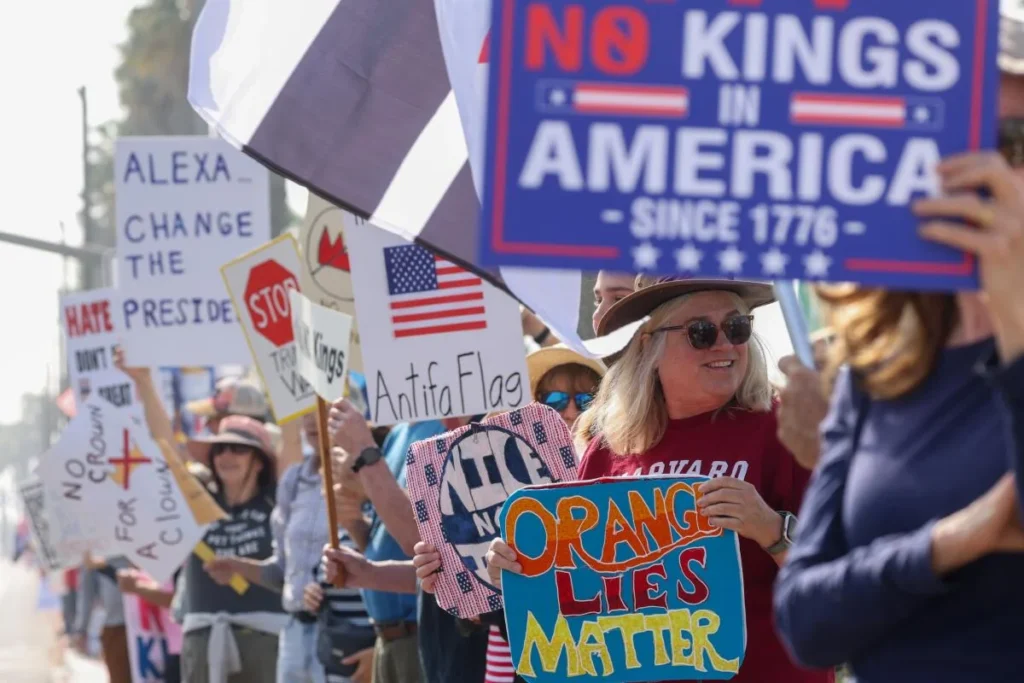
Originally focused on concerns over executive power and domestic policies, the protests have now evolved into a broad anti-war and constitutional accountability movement, with demonstrators accusing the Trump administration of bypassing legal limits on the use of force and undermining democratic norms. These demonstrations mark the third and largest mobilization of the movement since its emergence in 2025.
Iran War Becomes Central Flashpoint
While the “No Kings” movement originally focused on concerns about executive power and domestic policies, the ongoing U.S. war with Iran has significantly intensified public opposition. Protesters cited the conflict as evidence of unchecked presidential authority and questionable legal justification for military action. Many demonstrators criticized the war as a
“senseless escalation”
Demonstrators link it to:
- Rising economic pressure and fuel costs
- U.S. casualties and military expansion abroad
- Lack of clear congressional authorization
The Iran war has therefore transformed the protests from primarily domestic dissent into a broader anti-war and constitutional accountability movement.
Nationwide Mobilization and Growing Momentum
The scale of the protests reflects growing political mobilization across the country. Reports indicate that demonstrations were held not only in major urban centers but also in smaller towns and traditionally conservative regions, signaling widening dissatisfaction.
Minnesota emerged as a focal point, with massive rallies drawing tens of thousands of participants, alongside high-profile appearances by activists, public figures, and politicians. International solidarity protests were also reported in cities such as Paris, Tokyo, and Rome, highlighting the global attention surrounding U.S. domestic unrest.
Bernie Sanders Addresses Protesters
A major highlight of the protests was Bernie Sanders’s appearance at the flagship rally in Minnesota, where he joined activists, public figures, and thousands of demonstrators. Sanders’ address focused on what he described as
“dangerous times for American democracy.”
Sanders links the Iran war to broader concerns about economic inequality, civil liberties, and the concentration of executive power. While he criticized the direction of U.S. policy, his remarks framed the conflict as part of a wider pattern of governance that protesters argue threatens constitutional balance.
His participation added political weight to the movement, signaling that opposition to the war has moved beyond grassroots activism into mainstream political discourse.
Legal Context: Protest Rights vs. National Security Policy
From a legal perspective, the protests highlight a critical intersection between:
1. First Amendment Protections
The demonstrations are largely protected under the First Amendment, which guarantees the right to peaceful assembly and political expression.
2. War Powers and Executive Authority
The protests directly challenge the legality of the Iran war under:
- The War Powers Resolution of 1973
- Congressional authority over declarations of war
- International law governing the use of force
Legal experts note that sustained public pressure could influence congressional action or trigger investigations into the legal basis of the conflict.
3. Public Accountability and Democratic Oversight
The protests reflect broader concerns about whether the executive branch has exceeded its legal authority in initiating or expanding the conflict.
Political and Legal Fallout
The White House has dismissed the protests as politically motivated, but analysts note that the scale of mobilization may have significant legal and political consequences, including:
- Increased pressure on Congress to review or limit war powers
- Potential investigations into the legal basis of the Iran conflict
- Heightened scrutiny of executive decision-making
The protests are also expected to influence the 2026 midterm elections, with organizers framing the movement as part of a broader push to defend democratic institutions.
Broader Significance
The “No Kings” protests not only represent a political demonstration but also mark a defining moment at the intersection of law, politics, and public dissent in the United States.
As anger over the war in Iran continues to spread, the movement highlights a key legal reality: public protest remains one of the most powerful mechanisms for challenging government action and demanding accountability in a constitutional democracy.
With high-profile figures like Bernie Sanders joining the movement, the demonstrations signal a deepening national debate over war powers, executive authority, and the rule of law. As tensions over the Iran conflict continue, the protests highlight the enduring role of public mobilization as a constitutional check on government action.