
The Hague: Myanmar has formally begun presenting its defense before the International Court of Justice (ICJ) in proceedings alleging violations of the Convention on the Prevention and Punishment of the Crime of Genocide, categorically rejecting claims that it committed genocide against the Rohingya population. Similar questions about the threshold between grave human rights violations and the crime of genocide have arisen in other contemporary crises, including situations where UN rights groups warned Iran over the use of lethal force against protesters.
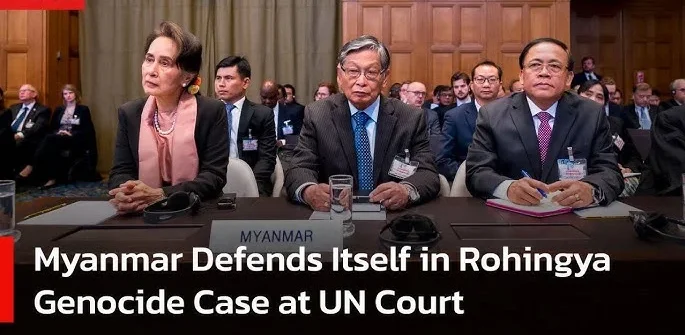
Myanmar’s legal representatives argued that the case rests on an incorrect application of international law and fails to satisfy the exceptionally high evidentiary threshold required to establish genocide. Ko Ko Hlaing, Myanmar’s legal counsel, stated:
“A finding of genocide would place an indelible stain on my country and its people. These proceedings are of fundamental importance for my country’s reputation and future.”
Counsel told the Court that the applicant improperly conflates alleged violations of international humanitarian and human rights law with genocide, which under the Convention requires proof of specific intent to destroy a protected group as such. He rejected the claim that Myanmar denies the existence or rights of the Muslim population in northern Rakhine state by stating:
“Myanmar considers that Bengalis in northern Rakhine State are culturally, ethnically and religiously part of the same group as the population living immediately across the border in Bangladesh.”
Background of the Case
The proceedings arise from Myanmar’s 2016–2017 military operations in Rakhine State following coordinated attacks on security posts by armed groups. Those operations triggered the mass displacement of Rohingya civilians into Bangladesh and led to allegations of killings, sexual violence, destruction of villages, and the creation of conditions of life allegedly calculated to bring about the group’s physical destruction, in whole or in part.
The case was filed by The Gambia, acting as a State Party to the Genocide Convention and invoking obligations erga omnes partes, which allow any state party to seek compliance with the Convention regardless of a direct territorial or national link to the alleged violations. In January 2020, the ICJ ordered provisional measures requiring Myanmar to take steps to prevent acts falling within Article II of the Convention and to preserve evidence.
Myanmar’s Legal Defense
Myanmar’s defense rejects all allegations of genocidal conduct and centers on the Convention’s demanding legal architecture. The submissions emphasize that genocide is a narrowly defined crime requiring proof of dolus specialis, the intent to destroy a protected group as such, and that no evidence establishes a state policy or coordinated plan aimed at destruction. Myanmar argues that allegations conflate potential violations of international humanitarian or human rights law with genocide, a category the ICJ has repeatedly treated as exceptional.
The defense further maintains that operations cited by the applicant were undertaken in response to security threats and were not directed at civilians as such, and that any unlawful acts by individuals fall within domestic accountability processes rather than constituting state responsibility for genocide. Jurisdictional and admissibility objections caution against an expansive reading of the Convention that would dilute the crime’s gravity and destabilize international criminal law.
ICJ Precedent on Genocide Claims
The Myanmar proceedings sit squarely within a line of ICJ judgments that have preserved a high evidentiary bar. In Bosnia and Herzegovina v. Serbia and Montenegro (2007), the Court recognized genocide at Srebrenica but declined to attribute commission to Serbia, instead finding a breach of the obligation to prevent genocide. In Croatia v. Serbia (2015), the Court rejected genocide claims by both parties, reiterating that widespread or systematic atrocities, even if constituting war crimes or crimes against humanity, do not suffice without proof of specific intent.
This strict approach mirrors debates in other protest-related contexts, where widespread lethal force may constitute serious human rights violations or crimes against humanity without necessarily satisfying the intent requirement for genocide, as explored in a detailed legal and geopolitical analysis of Iran’s protest crackdown.
More recently, in Ukraine v. Russian Federation (Provisional Measures, 2022), the ICJ addressed the misuse of the Genocide Convention as a justification for force, reaffirming the Convention’s precise scope. Collectively, these authorities reinforce the centrality of intent and the Court’s reluctance to broaden genocide beyond its settled definition.
Asia-Pacific and ASEAN Legal Significance
For Asia-Pacific states, the case raises foundational questions about the balance between sovereignty and peremptory norms, the interaction between domestic processes and international adjudication, and the practical consequences of erga omnes partes standing. The acceptance of third-state standing expands access to the Court and may recalibrate regional expectations about treaty compliance and dispute settlement.
From an ASEAN standpoint, the proceedings spotlight the tension between non-interference and collective treaty obligations. While ASEAN frameworks emphasize consensus and regional solutions, the ICJ’s approach underscores that multilateral human rights treaties can generate enforceable obligations beyond regional mechanisms, potentially influencing how future disputes are framed and litigated.
The Legal Test for Genocide and What the ICJ Can Decide
Under Article II of the Genocide Convention, genocide requires the commission of enumerated acts accompanied by the intent to destroy, in whole or in part, a national, ethnic, racial, or religious group. Article I imposes obligations to prevent and punish genocide, while Article IX confers ICJ jurisdiction over disputes concerning the interpretation, application, or fulfillment of the Convention.
The Court’s case law shows that proof of intent must be “fully conclusive,” and cannot be inferred solely from a pattern of conduct absent compelling evidence of a genocidal objective (see Bosnia and Herzegovina v. Serbia and Montenegro, Judgment, 2007).
The ICJ adjudicates disputes between states and determines state responsibility under international law. It does not assess individual criminal liability, which falls within the jurisdiction of international or domestic criminal courts. While ICJ judgments are legally binding under Article 94 of the UN Charter, enforcement depends primarily on voluntary compliance and political mechanisms.
What Comes Next and Why It Matters in 2026
The Court will continue to hear submissions on the merits before entering deliberations. A final judgment is expected to take considerable time, consistent with the ICJ’s practice in complex genocide cases.
The Myanmar genocide case represents one of the most consequential international law proceedings of the decade. Beyond its immediate factual context, the case tests the boundaries of genocide adjudication, the evidentiary threshold for dolus specialis, and the role of third states in enforcing multilateral human rights treaties. For Asia-Pacific states, the proceedings raise fundamental questions concerning sovereignty, non-intervention, and the judicialization of international relations.
Procedural Timeline
2016–2017 – Military operations in Rakhine State
2019 – Application filed by The Gambia at the ICJ
January 2020 – ICJ orders provisional measures
2024–2025 – Written pleadings exchanged
2026 – Myanmar opens oral defense
TBD – ICJ final judgment