
MINNEAPOLIS / WASHINGTON, D.C. (Jan. 19, 2026) — Nationwide protests against U.S. Immigration and Customs Enforcement (ICE) have entered a new phase of legal and political contention following a series of fatal and controversial shootings by federal agents, court rulings limiting enforcement tactics, expanding demonstrations beyond Minnesota, and mounting federal responses that include potential troop deployments. The unfolding confrontation has drawn comparisons to other recent protest crackdowns worldwide, including cases in which UN rights groups warned Iran over the use of lethal force against demonstrators, highlighting the global legal scrutiny that accompanies state responses to mass protests.
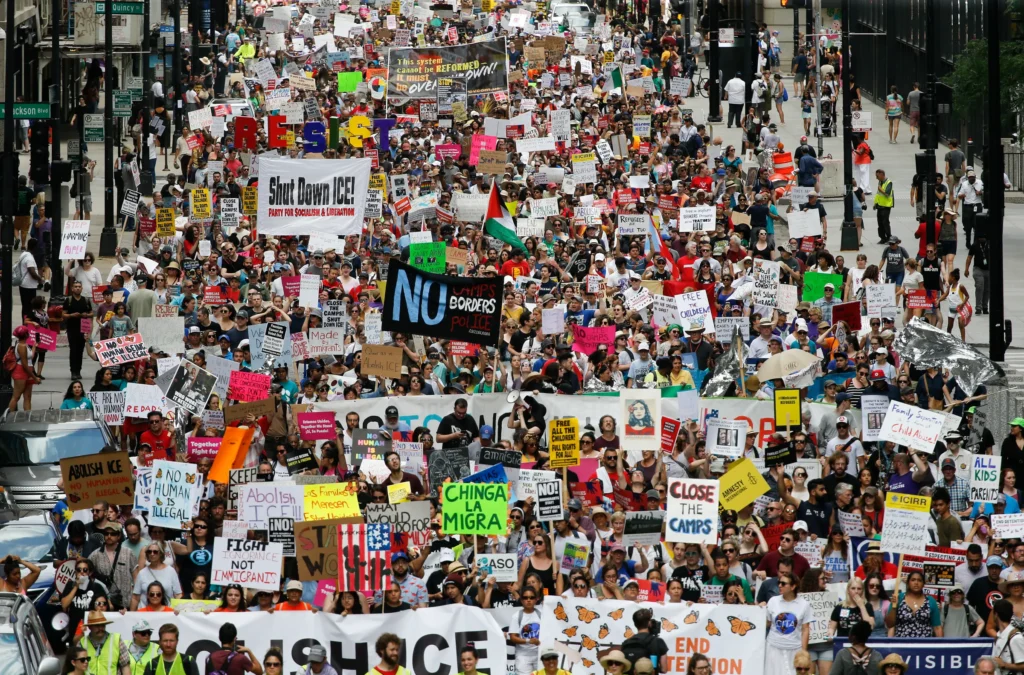
The unrest was sparked after the fatal shooting of 37-year-old Renée Nicole Good by an ICE agent during an immigration enforcement operation in Minneapolis. Tens of thousands of demonstrators later marched through the city and across the country, demanding accountability and an end to aggressive immigration enforcement policies.
Federal Judge Restricts ICE Tactics Amid Protest Surge
A federal judge in Minnesota issued an injunction limiting the tactics U.S. immigration agents may use against peaceful protesters in Minneapolis and St. Paul, barring arrests and forceful measures such as pepper spray or tear gas against non-violent demonstrators and observers unless there is reasonable suspicion of criminal activity.
Homeland Security Secretary Kristi Noem, one of the federal officials named in the lawsuit, said after the shooting that:
“Good had been stalking and impeding ICE agents all day and had committed an act of ‘domestic terrorism’ by trying to run over federal officers.”
Local authorities and civil liberties advocates hailed the ruling as a victory for free speech and public safety, while federal officials have not yet indicated whether the Department of Homeland Security (DHS) will appeal the decision. The injunction follows allegations that federal agents used excessive force, prompting legal challenges from Minnesota and its cities, accusing ICE of violating constitutional rights.
Protests Spread Nationwide Over Immigration Enforcement
Demonstrations have spread far beyond Minnesota, with coordinated “ICE Out for Good” protests held in cities from Portland, Oregon to Philadelphia and Indianapolis, where hundreds rallied against ICE and U.S. immigration policies. One of the protesters, Meghan Moore, a mother of two from Minneapolis, said:
“We’re all living in fear right now. ICE is creating an environment where nobody feels safe, and that’s unacceptable.”
In Durham, North Carolina, clashes with federal agents led to the use of fireworks and traffic disruptions during marches against immigration enforcement. Adali Abeldanez, the owner of Moroleon Supermarket in Durham, said:
“Fear is impacting daily life and local businesses, including his own. People are still stressed and worried.”
Organizers across states have cited videos of federal officers’ actions in Minneapolis and Portland, including shootings and the wounding of two individuals, as catalysts for a broader resistance movement. In Minneapolis, far-right activist Jake Lang, a pardoned January 6 rioter, drew only a few supporters to an anti-Muslim, pro-ICE rally where he had vowed to burn a Quran, but was instead soaked, pelted, and chased away by a much larger crowd of counter protesters, who later shared images of him leaving bloodied as alleged proof of chaos in the city.
Federal Government Threatens Broader Deployment
Amid rising tensions and persistent protests, President Donald Trump has threatened to invoke the Insurrection Act to deploy U.S. troops in Minneapolis if state and local authorities are unable to control unrest tied to ICE protests. Sources report that about 1,500 active-duty troops have been placed on standby in Alaska for potential deployment.
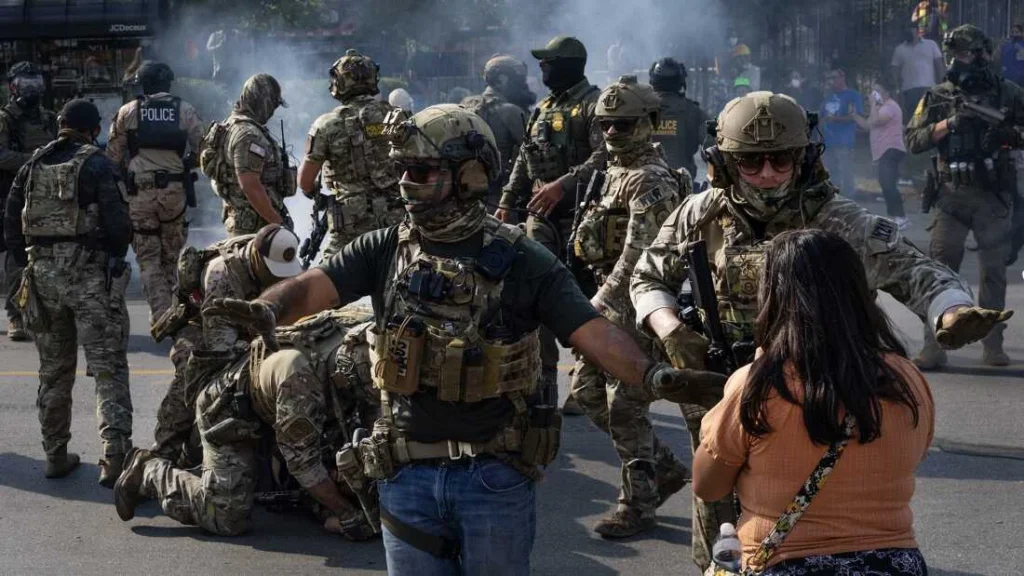
The administration maintains the expanded federal presence is necessary to protect federal personnel and property as immigration enforcement ramps up, while critics condemn the approach as overreach that could escalate conflict and suppress dissent.
Civil Rights and Legal Scrutiny Deepen
U.S. civil rights organizations and international observers have raised concerns about the use of force against demonstrators. Legal experts note that under U.S. constitutional law and international human rights standards, law enforcement must use force only when necessary and proportionate. Similar legal questions about necessity, proportionality, and accountability in protest policing have arisen in other jurisdictions, as explored in a broader legal and geopolitical analysis of protest crackdowns involving lethal force.
Federal authorities, on the other hand, are shifting focus toward protesters’ conduct. The U.S. Department of Justice announced investigations into a group of demonstrators who disrupted a church service in St. Paul, Minnesota, accusing them of civil rights violations for interrupting worship tied to a local pastor alleged to have connections with ICE. The DOJ has vowed to press charges under federal law.
U.S. Department of Justice Assistant Attorney General Harmeet Dhillon said on social media:
“A house of worship is not a public forum for your protest! It is a space protected from exactly such acts by federal criminal and civil laws!”
At the same time, litigation in federal court and lawsuits by state and local governments contend that federal immigration operations have trampled constitutional protections, including First Amendment rights. State Attorney General Keith Ellison said at a news conference:
“These poorly trained, aggressive and armed agents of the federal state have terrorized Minnesota with widespread unlawful conduct.”
Local Officials’ Criticism and Washington’s Response
Minneapolis Mayor Jacob Frey publicly criticized the federal immigration crackdown, characterizing the surge of ICE and Border Patrol agents as an “invasion” by the federal government. Frey and Minnesota Governor Tim Walz have also faced scrutiny from the Justice Department amid reports of an investigation into whether they conspired to obstruct federal immigration enforcement.
United States President Donald Trump in reply criticized protests against the US Immigration and Customs Enforcement (ICE) in Minnesota, claiming that the state’s Governor Tim Walz and Congresswoman Ilhan Omar are supporting the demonstrations because they take the focus away from the “FRAUD” in the state. Trump asked in a post on Truth Social:
“The thugs that are protesting include many highly paid professional agitators and anarchists. Is this really what Minnesota wants?”
He further added:
“The crooked Governor and ‘Congresswoman’ Omar, who married her brother, don’t mind because it keeps the focus of attention off the 18 Billion Dollar, Plus, FRAUD, that has taken place in the State! Don’t worry, we’re on it.”
Public Safety Incidents Fuel Anger
Demonstrations have been punctuated by incidents that intensify public debate over federal enforcement tactics. In Minneapolis, a family with young children was caught in a protest clash where tear gas deployment caused breathing difficulties for an infant, raising additional concerns about crowd control methods. Destiny Jackson, whose family was tear-gassed by ICE agents, said:
“An ICE agent, one of them, yells in my window, like, ‘Get the F out of here.’ And my husband’s like ‘We’re trying.”
A 21-year-old protester in Santa Ana, California, was reported to have suffered permanent blindness after being struck by non-lethal ammunition during an anti-ICE demonstration. According to his family, he could have died in the incident, for which he underwent six hours of surgery.
Ongoing National and Local Action
Civil rights leaders and community activists continue to mobilize, organizing protests, marches, and vigils in cities nationwide that call for independent investigations of federal agents’ conduct and systemic changes to immigration enforcement strategies.
In Philadelphia, protesters connected ICE demonstrations with broader issues of immigrant rights and opposition to other U.S. foreign and domestic policies, drawing sizable crowds in sustained rallies.
Legal analysts note that even as some protests remain largely peaceful, the broad geographic spread and variety of incidents, from church disruptions to federal injunctions, signal that immigration enforcement policy and protester response will remain key battlegrounds in U.S. politics and law for months to come. This use of force, whether in the United States or abroad, can generate long-term legal, political, and reputational consequences, a dynamic already visible in recent international assessments of protest responses and lethal force.
Timeline: Key Developments in the Anti-ICE Protests
January 7, 2026 – Renée Nicole Good is fatally shot by an ICE agent in Minneapolis during an enforcement operation, triggering immediate local protests.
January 8, 2026 – Protests spread after a separate federal shooting incident in Portland, Oregon, where two people were wounded during an immigration enforcement action.
January 10, 2026 – Tens of thousands of demonstrators march in Minneapolis as coordinated anti-ICE protests take place in cities across the United States, including Phoenix, Durham, and Washington, D.C.
January 11-12, 2026 – Clashes occur between protesters and federal agents in Minneapolis. Chemical irritants and non-lethal munitions are reported to have been used against crowds.
January 13, 2026 – Several federal prosecutors resign, citing concerns over the Department of Justice’s refusal to open a civil rights investigation into the Minneapolis shooting.
January 14, 2026 – A second shooting involving an ICE agent is reported in Minneapolis, where a Venezuelan national is wounded during an enforcement operation, intensifying protests and criticism.
January 16, 2026 – A federal judge in Minnesota issues an injunction restricting ICE and other federal agents from detaining or using force against peaceful protesters without reasonable suspicion of criminal activity.
January 17–18, 2026 – Federal officials signal readiness to escalate enforcement. About 1,500 active-duty U.S. troops are placed on standby amid warnings that the Insurrection Act could be invoked if unrest continues.
January 19, 2026 – The Department of Justice confirms it will not pursue a federal investigation into the ICE agent involved in the fatal shooting but announces inquiries into Minnesota state and city officials over alleged obstruction of federal enforcement.
January 20–23, 2026 — Economic Blackout Protest: Labor unions and community groups organize an economic blackout and demonstrations in Minneapolis against federal immigration enforcement and ICE tactics, drawing broad local support.
January 24, 2026 — Alex Pretti Killing: Federal immigration agents fatally shoot 37-year-old ICU nurse Alex Pretti during an immigration enforcement operation in Minneapolis, marking the second fatal shooting by federal agents in the city in weeks and sharply escalating tensions.
January 24–25, 2026 — Mass Protests and Clashes: Thousands of protesters gather in Minneapolis and spread to cities including New York, Los Angeles, San Francisco, and Boston, demanding accountability and the removal of ICE agents; clashes with law enforcement occur as federal agents use crowd-control measures.
January 25, 2026 — Judge Orders Preservation of Evidence: A federal judge issues a temporary restraining order requiring the Department of Homeland Security to preserve evidence related to the Pretti shooting after a legal challenge by Minnesota authorities focused on DHS’s handling of the scene.
January 25–26, 2026 — National Ripples: The protests and political response continue to grow, prompting broader debate over federal immigration enforcement and civil rights. Mass protests erupt across Minneapolis. City officials, civil rights groups, and members of Congress demand the withdrawal of federal agents and independent investigations.
January 26, 2026 — Minnesota state leadership formally objects to the federal deployment, citing public safety concerns and lack of coordination.
January 27, 2026 — President Trump signals a pullback, and Border Patrol Commander Gregory Bovino is reported to be leaving Minneapolis. Federal authorities announce leadership restructuring and operational reassessment.